The Rev Dodgson said:
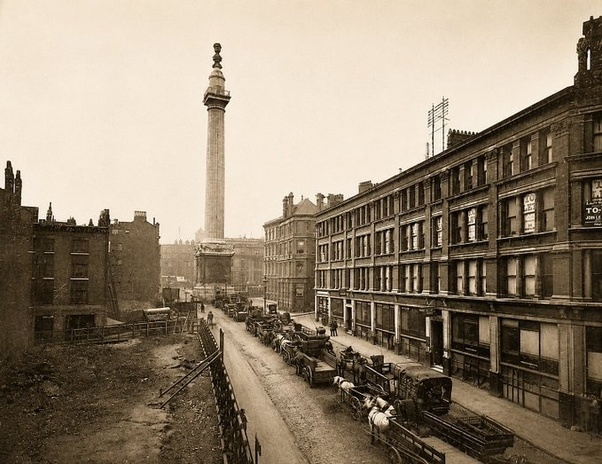
of the original purpose of the London Monument:“The Monument in London is best known for commemorating the Great Fire of London.
But few realise it was designed as one of the most ambitious scientific instruments of the seventeenth century.
Completed in 1677, it was designed by Christopher Wren and the brilliant scientist Robert Hooke.
- It is 202 feet (61.5 metres) high, and built exactly 202 feet from the bakery on Pudding Lane where the Great Fire began.
- Its hollow central shaft was designed to house a giant zenith telescope for observing stars passing directly overhead.
- The staircase was intended to function as a vertical laboratory for scientific experiments.
- A 202-foot pendulum could be suspended through the centre of the column to study gravity with remarkable precision.
- It was also designed for experiments into atmospheric pressure and magnetic variation.
Unfortunately, vibrations from the busy streets of London made the precise experiments impossible, and it was never used for its intended purpose.
The Monument still stands as a remarkable testament to scientific ambition.”
Confirmed by TATE:
“As a scientific instrument
The Monument at night
Wren and Hooke built the monument to double-up as a scientific instrument. It has a central shaft meant for use as a zenith telescope and for use in gravity and pendulum experiments that connects to an underground laboratory for observers to work (accessible through a hatch in the floor of the present-day ticket booth). Vibrations from heavy traffic on Fish Street Hill rendered the experimental conditions unsuitable.
At the top of the monument, a hinged lid in the urn covers the opening to the shaft. The steps in the shaft of the tower are all 6 inches (150 mm) high, allowing them to be used for barometric pressure studies.
In a study published in 2020, researchers from Queen Mary University of London used the shaft of the monument stairwell to measure deformation in a hanging wire. By twisting and untwisting a wire hanging down the shaft of the stairwell, they were able to detect deformation at less than 9 parts per billion – equivalent to a one-degree twist over the length of the 160-foot (50 m) wire.”
Queen Mary College (as it was known before the silly name change) is where I did my uni studies.