The Institute for the Scientific Study of Human and Non-Human Phenomena.
THE IRRITATION BUREAU.
The Irritation Bureau was the brainchild of Harvard sociologist and CIA agent Ludwik Debek Twardichleb. Professor Twardichleb theorized that if the public was distracted by a constant barrage of minor irritations, they would not have the energy to protest or form anti-government groups.
The organization, active during the Johnson and Nixon presidencies, was designed to counter unrest in America caused by the civil rights, anti-war, and unionized labor movements.
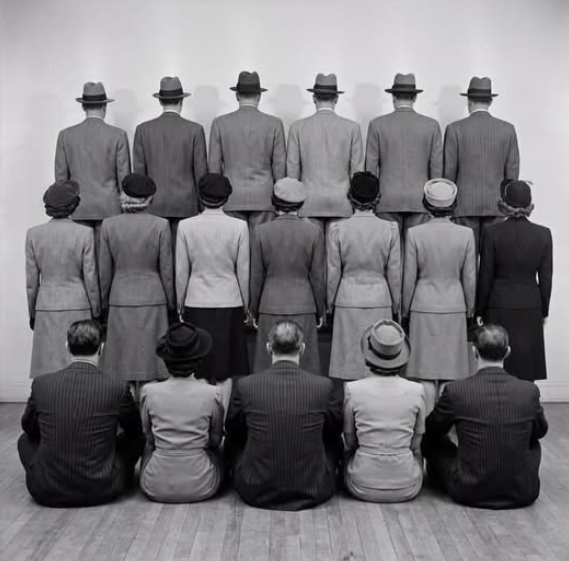
Provided with almost limitless tax-payer funds, Professor Twardichleb assembled a team of anthropologists, designers, engineers, and linguists whose mandate was to make daily life in the United States as frustrating as possible. This photo, taken in 1968, shows the first graduating class of bureau operatives, backs turned to maintain their privacy.
Employees of the Post Office, Dept of Motor Vehicles, Transit Authority Agency, and the IRS were given specialized training to further the Irritation Bureau’s agenda. Lectures such as “The Virtue of Listlessness,” “The Art of Creating Confusing Forms,” and “How to Make Driver’s License Renewal an All-Day project,” were just three of the many educational programs given to government clerks and agents.
The Bureau employed thousands of American citizens from diverse backgrounds. Individuals jailed for driving while intoxicated were offered pardons if they became Irritation Bureau operatives. Members of this group were sent to all major cities with the directive to drive erratically, cause minor but time-consuming accidents, and generally impede the flow of traffic. The drivers were given “get out of jail cards” to present to local police at accidents scenes, allowing them to immediately continue their duties.
No aspect of American life was overlooked as a possible source of vexation. One team of engineers designed buttons that immediately fell off shirts, zippers that jammed, packages and “safety” prescription bottles that were resistant to opening.
Professor Twardichleb’s program was a tremendous success and the public was kept in a state of simmering, unfocused rage. Unfortunately, it proved difficult to maintain a balance between mild irritatation and murderous frenzy. Crime rates skyrocketed and spontaneous episodes of rioting became the norm during the years the bureau was active.
President Nixon, initially a supporter of Professor Twardichleb’s ideas, closed the bureau down during his re-election campaign in 1972. The resulting drop in violent crime was enough to ensure Nixon’s victory, carrying 49 states and taking 60.7% of the popular vote. Nixon consoled a dejected Twardichleb, telling him he was ahead of his time, and that his ideas would almost certainly be implemented by future administrations.