Air Force Association – SA Division
17 August 1962: RAF Air to Surface Missile released on to Port Wakefield Weapons Range following a mid-air emergency
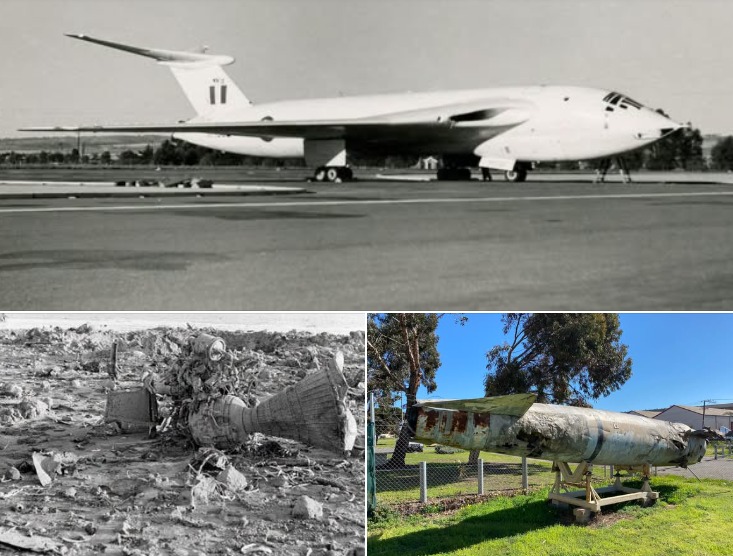
Did you know that on this day in 1962, a RAF Victor aircraft conducting a weapons trial flight dropped a Blue Steel air to surface missile on to the Port Wakefield Weapons Range in South Australia during an aircraft emergency?
The Blue Steel missile was a British designed nuclear armed standoff air to surface missile in service with the British Royal Air Force during the 1960’s. Being more than 10m long, it was a large missile designed to be employed on the RAF V Bombers such as the Victor as Britain’s principle means of delivering nuclear weapons when air defences during the Cold War were rapidly precluding traditional bomb delivery techniques.
The missiles were trialed in Australia. Flown out from England, they were prepared at the Joint UK-Australian Weapons Research Establishment at Salisbury, South Australia, located adjacent to RAAF Edinburgh. The new base had been established in the 1950’s initially to support the weapons research and trials programs conducted at Salisbury and Woomera. The Blue Steel missiles were loaded on to RAF aircraft based at RAAF Edinburgh and flown up to and test fired on Woomera Test Range. The preparation of the missiles was a complex task. During their fuelling and loading onto the aircraft, the preparations areas were flooded with water as a safety precaution. A British unit, No 4 Joint Services Trial Unit, conducted the trials.
On this day in 1962, a RAF Handley Page Victor (XL161) took off from RAAF Edinburgh with an unarmed but fully fuelled Blue Steel missile to be live fired over Woomera Test Range. Heading south, the aircraft reached its first navigation point over Kangaroo Island where the test pilot, John Baker, turned the aircraft northward for the transit up the St Vincent’s Gulf towards Woomera. A short while later flying at 45,000 feet over the St Vincent’s Gulf west of the Adelaide Plains, the crew observed several instrument failures.
The aircraft suddenly went into a stall and then enter a violent uncontrolled spin dropping 30,000 feet in under 30 seconds.
Being an experienced test pilot, John Baker elected to deploy the Victor’s drogue parachute as a final attempt to slow the speed of the aircraft and arrest control of the aircraft before disaster. Remarkably, the parachute remained in place for a short time before tearing off but succeeded in slowing the aircraft enough to allow him to regain controlled flight again. Realising they had averted disaster, the crew focused on confirming the status of the aircraft and returning to RAAF Edinburgh. Accordingly, they jettisoned the Blue Steel missile over Port Wakefield Range where it crashed into mud flats exploding and causing small fires.
Meanwhile, a RAAF Edinburgh based Meteor aircraft was tasked to join the Victor and visually check the aircraft for any damage. The Victor had to remain in flight for 90 minutes to burn off fuel to allow it to return to RAAF Edinburgh and land. A RAF Canberra replaced the escorting Meteor (which itself was running out of fuel) and escorted the Victor back to Edinburgh.
The Victor subsequently landed safely with a somewhat fortunate but professional crew who had just witnessed some incredible airmanship by the test pilot. The Victor survived the incident requiring minor repairs and went on to conduct several Blue Steel trials over the next 12 months before returning to Britain where it later served with an RAF reconnaissance squadron.
Not surprisingly, the incident drew considerable media attention and the Australian Minister for Supply, the Honourable Allen Fairhall, released a statement on 23 August 1962 confirming the incident had occurred.
Images of unrestored Blue Steel missile at South Australia Aviation Museum from Air Force Association (South Australia Collection). Image of RAF Victor at RAAF Edinburgh courtesy of Nigel Daw Collection. Image of Blue Steel impact site at Port Wakefield Range courtesy of National Australian Archives