Tau.Neutrino said:
Tau.Neutrino said:
Tau.Neutrino said:Creswick Road between Ballarat and Creswick is in terrible condition and needs to be rebuilt so this could a test bed for the new road with fibre optic cable looking for underground faults such as pot holes under the road while delivering data.
Two particular spots could do with some deeper analysis and deeper work to stay post pot hole free.
When there are no thunderquakes around, maybe artificial quakes could be generated using speakers or other audio technologies, these would generate subsonic sound and could easily map the whole layer of the roads surface and directly underneath it, perfect for pot hole detection.
I wonder if fibre optic cable could be temporarily laid on a roads surface by the side of a truck or directly underneath the truck, and right in the middle also underneath the truck could be the speakers, producing sound waves which could be picked up by the cable?
Related article
Using thunderquakes to X‑ray Earth – a new study shows urban seismology in action
When lightning strikes, it superheats the air around it and creates a shock wave that we hear as thunder. But thunder doesn’t just travel through the atmosphere to our ears.
When that energy reaches the ground, some of it is converted into seismic waves that ripple through the soil and rock beneath. The resulting vibrations are known as “thunderquakes.”
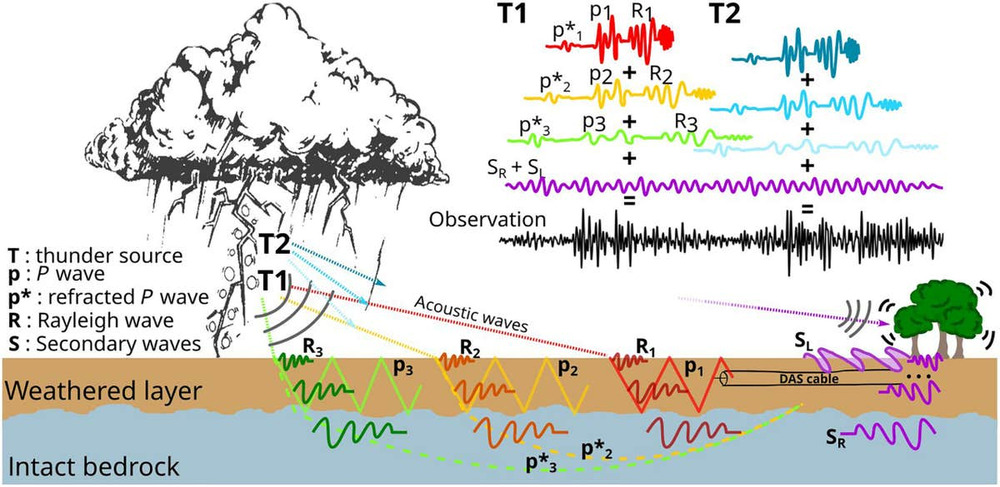
Thunderquake raypath diagram. Raypath schematic of thunderquake generation. Direct acoustic waves from along the thunderbolt (T1 and T2) couple into the ground and environment, creating propagating waves and surface waves. The summation of all these waves constitutes the thunderquake wavefield observed by DAS. (CREDIT: Tieyuan Zhu et al, Science Advances)
More…