Tau.Neutrino said:
Kingy said:
Bogsnorkler said:
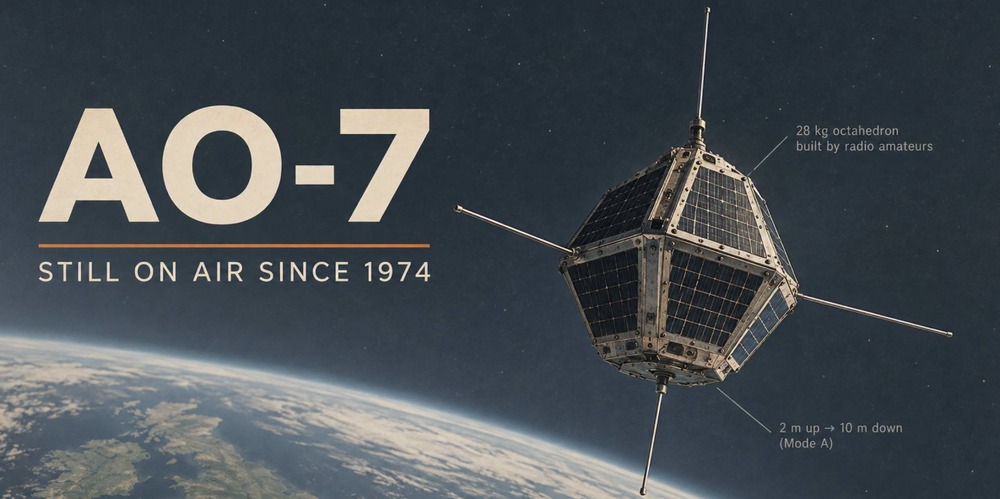
This satellite died in 1981. It’s still on the air. 🛰️AMSAT-OSCAR 7 was launched on 15 November 1974 — a 28 kg octahedron built by radio amateurs. It worked beautifully for six years, until a battery cell shorted in mid-1981 and the spacecraft went dark.
Everyone moved on. For twenty-one years.
Then on 21 June 2002, UK amateur Pat Gowen G3GOP heard a slow Morse beacon on 145.9738 MHz, checked the Doppler shift, and realised the impossible: AO-7 was transmitting again. The shorted battery cell had finally gone open-circuit — and whenever the satellite is in sunlight, its solar panels alone power the radios.
Fifty-two years after launch it’s still workable in sunlight — the oldest semi-operational satellite in orbit, any category. And because it was built in the 1970s, its Mode A transponder turns a 2-metre uplink into a 10-metre downlink. You can LISTEN on any HF+VHF setup — even many shortwave portables with SSB will hear it up on 29.5 MHz.
How to hear it:
• The 10m downlink is the easy listen: beacon near 29.502 MHz, CW.
• Wait until AO-7 is in sunlight — that’s the only time it lives. It wakes in an unpredictable mode each orbit, so treat each pass as a lottery ticket.
• Even if you never transmit, hearing a 1974-built machine keyed out on 10 metres is one of amateur radio’s genuine thrills.No batteries. No ground control. Just sunlight and a design that refused to quit.
Now if only NASA would chuck in a bit of extra money to boost the ISS into a higher more stable orbit, people could see it and use it for generations.
Maybe people could even use parts of it in future missions.
Chucking hundreds of billions of dollars worth of taxpayers money into Pacific is fkn criminal.
Why is NASA retiring the ISS
Google AI
The International Space Station is being retired around 2030 because its aging hardware and structure are reaching the end of their safe operational limits.
Aging and Wear
• Structural fatigue: Decades of extreme temperature swings, radiation exposure, and docking stresses have worn down the metal hull and modules.
• Maintenance costs: Fixing recurring cracks, air leaks, and outdated systems takes a massive amount of money and time.
Shifting Priorities
• Commercial space stations: NASA and its partners want to shift low-Earth orbit research to privately owned and operated commercial habitats.
• Deep space exploration: Retiring the station frees up government funds and resources to focus on crewed missions to the Moon and Mars.
I was thinking some kind of metallic spray specially designed for the ISS, if that worked there is still the problem of getting it there, and it would require large quantities.
As the NASA article points out there is the problem of getting fuel there in large quantities, there us nothing designed yet that can do it.