Spiny Norman said:
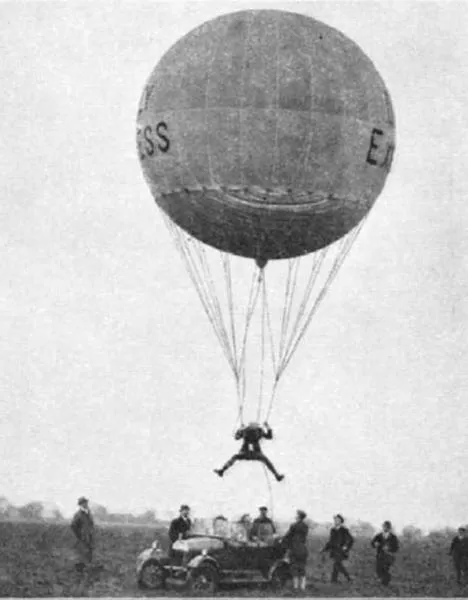
The Forgotten Sport of Balloon Jumping
For some reason this bizarre pastime never really took off.It is the 1920s, and you are standing in an open field. There are no sounds, other than the rustle of buffeted leaves and the faint notes of lark song. The summer sun warms your face. As the breeze brushes past, you break into a run and launch yourself into the sky. You’re flying through the air, impossibly, yet possible because the enormous helium-filled balloon to which you’re harnessed is dragging you with it as it soars hundreds of feet. Farms, forests, and meadows are stretched out below as you float over the landscape, legs dangling high above baffled farmers and terrified cows. Gradually you tail into a gentle descent, landing lightly on your feet. You scan your surroundings for where to go next as the balloon tugs on the ropes. You decide the sycamores to the west look like sport and bound towards them like a lunar explorer, leaping up to a branch before springing from bough to bough and sailing right over a tree. You feel like Peter Pan. Suddenly, the world is small and life is limitless . . .
It should have been revolutionary. “How would you like to own your own hand-power jitney balloon,” cried Popular Science in its April 1923 edition, “to spend your Saturday afternoons joyriding in the sky, up a thousand feet or so, swinging beneath the round belly of a small gas-filled bag and traveling anywhere you can induce the playful breezes to take you?”
The “jumping balloon” or “hopper balloon” was the invention of M. Q. Corbett, W. E. Hoffman, and C. F. Adams of the “lighter than air” division of the US Army based at McCook Field, Ohio. Consisting of a giant air bag attached by ropes to a wooden bench, the devices were initially used by maintenance workers as cheap tools for inspecting the outer surfaces of large airships and hot air balloons and carrying out repairs.*
As their use spread, people began to imagine how the personal balloons could be used for fun. The claim that only minimal training was required to operate them caused particular excitement, prompting visions of businessmen balloon-jumping their way to work and schoolboys raining from the sky.
“How helpful this sort of thing would be,” said the July 19, 1927, edition of Missouri’s Joplin News Herald, envisioning the sport as an aid for climbers and the elderly. “We could strip the spring cherry tree without endangering our legs. We could dispense with elevators and enter our offices on the third or fourth floors by merely leaping up to the window and crawling in. We could do a thousand and one things easily that we now do with difficulty.”
The perceived ease of use was down to the simplicity of the controls: altitude was gained simply by leaping into a mild to mid-strength wind; and, unlike hot air balloons, there was no need to shed ballast or vent gas, because it was carefully ensured that the weight of the balloonist slightly exceeded the pull of the balloon—thus the chances of disappearing into the stratosphere were minimized. The bag itself was roughly 18 feet in diameter and capable of holding 3,000 cubic feet of hydrogen or helium gas. The latter was preferred by most of the aeronauts because it allowed them to light up a cigarette midflight.
What could possibly go wrong!!
:)
However, despite its potential as the transportation of tomorrow and its supposedly low-risk operation, balloon jumping was in fact incredibly dangerous, even for the aeronautical experts pioneering the sport. One such trailblazer was Aircraftman “Brainy,” as his men called him, Dobbs, a British parachutist in the Royal Air Force. “A parachute,” Dobbs would advise his trainees, “must be so simple that even the highest officer in the Royal Air Force can understand it.” Dobbs was a huge fan of balloon jumping, and performed demonstrations to try to kindle public interest. In March 1927, Dobbs was practicing “balloon hopping” at Stag Lane Aerodrome in North London. A nearby officer, Captain Blacker, noticed that Dobbs’s leaps were taking him nearer and nearer to a high-tension cable. “For God’s sake, take care,” he shouted. “Those are live wires.” Dobbs replied, “I’ll risk it,” and proceeded to jump. He did nearly clear the electrified cables, but unfortunately his feet became entangled, and when he tried to extract himself by grabbing one of the wires he was blown to the ground in a hail of sparks, dying instantly.
Alas, balloon jumpers never quite managed to refine the sport to a level of safety below “frequently lethal,” and when stories such as Dobbs’s hit the headlines, its popularity was short-lived.
—
I dunno. I’d love to see Red Bull launching the new sport. I reckon it could really take off.