Date: 2/09/2018 05:46:03
From: mollwollfumble
ID: 1270505
Subject: Opals?

1. What’s the difference between “potch” and “flint”?

Both are silica, both are microstructured, both occur as nodules in chalk-like material, both can form when a gelatinous material fills cavities in the sediment, such as those left by molluscs.

If the difference is that between crystalline silica and hydrated silica, what are the conditions that lead to one or the other?

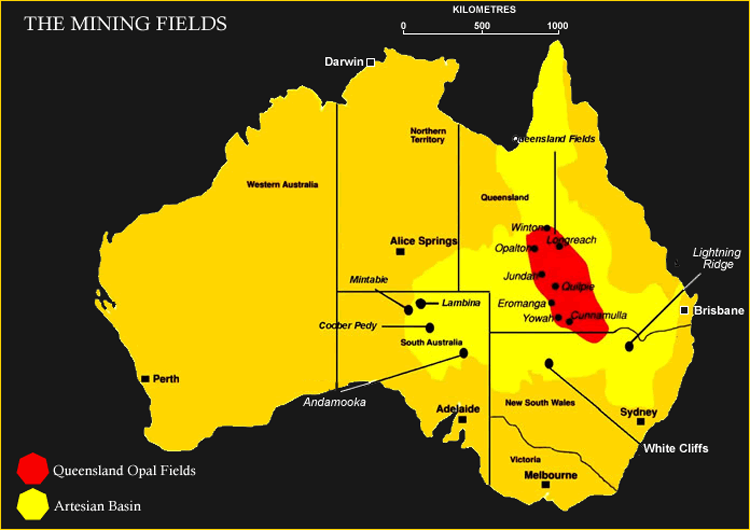
2. Could precious opal occur at depth throughout the great artesian basin?

Is the great artesian basin composed of highly porous material, such as a chalky material overlain by sandstone, similar to that around lightning ridge, white cliffs and coober pedy?

3. Precious opal is found only in Australia and Mexico. But common opal without fire is also found in many other places around the world such as Ethiopia, Slovakia and Peru, France and Iceland.

What are the conditions that cause that thin band of precious opal to exist within potch?

4. Synthetic opal is now being made. eg.
https://www.opalauctions.com/learn/technical-opal-information/what-is-synthetic-opal
Reply Quote

Date: 2/09/2018 06:47:22
From: roughbarked
ID: 1270506
Subject: re: Opals?

mollwollfumble said:


1. What’s the difference between “potch” and “flint”?

Both are silica, both are microstructured, both occur as nodules in chalk-like material, both can form when a gelatinous material fills cavities in the sediment, such as those left by molluscs.

If the difference is that between crystalline silica and hydrated silica, what are the conditions that lead to one or the other?

2. Could precious opal occur at depth throughout the great artesian basin?

Is the great artesian basin composed of highly porous material, such as a chalky material overlain by sandstone, similar to that around lightning ridge, white cliffs and coober pedy?

3. Precious opal is found only in Australia and Mexico. But common opal without fire is also found in many other places around the world such as Ethiopia, Slovakia and Peru, France and Iceland.

What are the conditions that cause that thin band of precious opal to exist within potch?

4. Synthetic opal is now being made. eg.
https://www.opalauctions.com/learn/technical-opal-information/what-is-synthetic-opal

Reply Quote

Date: 2/09/2018 06:52:27
From: roughbarked
ID: 1270507
Subject: re: Opals?

mollwollfumble said:


1. What’s the difference between “potch” and “flint”?

Both are silica, both are microstructured, both occur as nodules in chalk-like material, both can form when a gelatinous material fills cavities in the sediment, such as those left by molluscs.

If the difference is that between crystalline silica and hydrated silica, what are the conditions that lead to one or the other?

2. Could precious opal occur at depth throughout the great artesian basin?

Is the great artesian basin composed of highly porous material, such as a chalky material overlain by sandstone, similar to that around lightning ridge, white cliffs and coober pedy?

3. Precious opal is found only in Australia and Mexico. But common opal without fire is also found in many other places around the world such as Ethiopia, Slovakia and Peru, France and Iceland.

What are the conditions that cause that thin band of precious opal to exist within potch?

4. Synthetic opal is now being made. eg.
https://www.opalauctions.com/learn/technical-opal-information/what-is-synthetic-opal


First of all. Flint is not potch. You may as well imagine that jasper is potch and still be wrong.
Second you may think so but precious opal acts of its own accord and not to your wishes.
Thirdly, you need Cretaceous and not other.
Precious opal is fouind in many other places than you mention.
The conditions are, differences in the condition of the strata.

Reply Quote

Date: 2/09/2018 07:09:47
From: roughbarked
ID: 1270508
Subject: re: Opals?

roughbarked said:


mollwollfumble said:

1. What’s the difference between “potch” and “flint”?

Both are silica, both are microstructured, both occur as nodules in chalk-like material, both can form when a gelatinous material fills cavities in the sediment, such as those left by molluscs.

If the difference is that between crystalline silica and hydrated silica, what are the conditions that lead to one or the other?

2. Could precious opal occur at depth throughout the great artesian basin?

Is the great artesian basin composed of highly porous material, such as a chalky material overlain by sandstone, similar to that around lightning ridge, white cliffs and coober pedy?

3. Precious opal is found only in Australia and Mexico. But common opal without fire is also found in many other places around the world such as Ethiopia, Slovakia and Peru, France and Iceland.

What are the conditions that cause that thin band of precious opal to exist within potch?

4. Synthetic opal is now being made. eg.
https://www.opalauctions.com/learn/technical-opal-information/what-is-synthetic-opal

First of all. Flint is not potch. You may as well imagine that jasper is potch and still be wrong.
Second you may think so but precious opal acts of its own accord and not to your wishes.
Thirdly, you need Cretaceous and not other.
Precious opal is fouind in many other places than you mention.
The conditions are, differences in the condition of the strata.

So many times you seem to be very unscientific.
In SiO4 the molecules are either evenly laid or higgledy piggledy
The evenly laid have basically one colour.
The unevely laid allow for all types of magnificent refraction of light.
Common opal or potch occurs everywhjere in Australia and presmably not much different in other parts of the world.
This unevenness is caused by the specific nature of the filters nearby.

You can find potch opal by fiollowing the plumbing.
You find good opal by looking for blocked or broken plumbing pipes.

Reply Quote

Date: 2/09/2018 07:16:11
From: roughbarked
ID: 1270509
Subject: re: Opals?

A Gilson emerald is a different thing to an emerald but it is not so easy to see the difference.
A Gilson opal is a piece of shit and isn’t a lot better than crunching some alfoil amd pouring resin over it.

Reply Quote

Date: 2/09/2018 07:20:20
From: roughbarked
ID: 1270510
Subject: re: Opals?

Precious opal never has the same pattern. Never. Every stone is unique to the particular patch it came from.

Reply Quote

Date: 2/09/2018 09:28:08
From: mollwollfumble
ID: 1270565
Subject: re: Opals?

> Common opal or potch occurs everywhere in Australia and presmably not much different in other parts of the world.

Everywhere? I didn’t know that.

> You can find potch opal by fiollowing the plumbing. You find good opal by looking for blocked or broken plumbing pipes.

That’s interesting. Can you expand on that?

> A Gilson opal is a piece of shit and isn’t a lot better than crunching some alfoil and pouring resin over it.

I hadn’t heard of alfoil and resin, but apparently you’re right. Some people are trying to pass off alfoil in resin as Australian opal.

People have been trying to make or improve on opal since the year dot. When I was young, doublets, triplets and dying were the three main methods. A triplet is a sub-millimetre thin slice of colour placed between dark potch underneath and glass on the top.

Reply Quote

Date: 2/09/2018 09:36:52
From: mollwollfumble
ID: 1270568
Subject: re: Opals?

> 2. Could precious opal occur at depth throughout the great artesian basin? Is the great artesian basin composed of highly porous material, such as a chalky material overlain by sandstone, similar to that around lightning ridge, white cliffs and coober pedy?

According to this website, Australian opal fields are all associated with the Great Artesian Basin. So perhaps there could be a lot more underground.

http://www.nationalopal.com/opals/australian-opal-fields.html

Reply Quote

Date: 2/09/2018 09:47:24
From: roughbarked
ID: 1270570
Subject: re: Opals?

mollwollfumble said:


> Common opal or potch occurs everywhere in Australia and presmably not much different in other parts of the world.

Everywhere? I didn’t know that.

> You can find potch opal by fiollowing the plumbing. You find good opal by looking for blocked or broken plumbing pipes.

That’s interesting. Can you expand on that?

> A Gilson opal is a piece of shit and isn’t a lot better than crunching some alfoil and pouring resin over it.

I hadn’t heard of alfoil and resin, but apparently you’re right. Some people are trying to pass off alfoil in resin as Australian opal.

People have been trying to make or improve on opal since the year dot. When I was young, doublets, triplets and dying were the three main methods. A triplet is a sub-millimetre thin slice of colour placed between dark potch underneath and glass on the top.

A doublet is 50% gem opal and usually 50% potch. A triplet is 5% gem opal with either potch or othe material as backing and a clear quartz top.

I can expand on the plumbing if you are standing in an opal mine but it is easier to call it plumbing if you haven’t got the real picture to show.

Reply Quote

Date: 2/09/2018 09:50:17
From: roughbarked
ID: 1270571
Subject: re: Opals?

mollwollfumble said:


> 2. Could precious opal occur at depth throughout the great artesian basin? Is the great artesian basin composed of highly porous material, such as a chalky material overlain by sandstone, similar to that around lightning ridge, white cliffs and coober pedy?

According to this website, Australian opal fields are all associated with the Great Artesian Basin. So perhaps there could be a lot more underground.

http://www.nationalopal.com/opals/australian-opal-fields.html

Opal isn’t only associated with the Artesian basin. Though it is largely found in that part of Australia it is also found elsewhere in Australia far from the Artesian basin. The ansewer is; opal like gold, is where you find it. Get a map of Cretaceous outcrops and go prospecting.

Reply Quote

Date: 2/09/2018 10:01:29
From: mollwollfumble
ID: 1270582
Subject: re: Opals?

roughbarked said:

Opal isn’t only associated with the Artesian basin. Though it is largely found in that part of Australia it is also found elsewhere in Australia far from the Artesian basin. The ansewer is; opal like gold, is where you find it. Get a map of Cretaceous outcrops and go prospecting.

Will do, the map anyway.

“1. What’s the difference between “potch” and “flint”? Both are silica, both are microstructured, both occur as nodules in chalk-like material, both can form when a gelatinous material fills cavities in the sediment, such as those left by molluscs.”

According to this website, all flint originally began life as opal.
http://snpr.southdowns.gov.uk/files/additions/For%20how%20flint%20is%20formed.htm

“Silica precipitates by the molecule-by-molecule replacement of chalk. The silica is initially in the form of opal but gradually transforms to flint during later burial and with time. The chalk sea bed is deeply burrowed by many different organisms, such as shells, echinoids and worms etc. Some of these burrows are quite deep or branching, or have open living spaces. The burrows fill with sediment after the organism has died, this is slightly different material from the sediment around it. These filled burrows act as preferential pathways (conduits) for the chemical reactions to occur. Flint formed within these old burrows often has a nodular shape which reflects the whole, or part of, overgrown remnants of such burrow systems. There are two possible explanations for why flint forms in bands or layers.”

Reply Quote

Date: 2/09/2018 10:29:48
From: mollwollfumble
ID: 1270605
Subject: re: Opals?

roughbarked said:

You can find potch opal by fiollowing the plumbing. You find good opal by looking for blocked or broken plumbing pipes.

I can expand on the plumbing if you are standing in an opal mine but it is easier to call it plumbing if you haven’t got the real picture to show.

Is this what you mean?

“In the Lightning Ridge opal fields, most opal is recovered from near the top of the various Finch clay facies lenses (opal dirt), immediately below the overlying portion of the Wallangulla Sandstone Member. Geological mapping of the opal fields has shown that the sandstone is thickest in areas that have produced large amounts of opal. Opal is rarely produced from areas in which the sandstone is thin or absent. … blows and faults generally enhanced the permeability of rock strata and increased the potential for opal to form in association with sandstone and claystone. … Silcrete”.

“Silcrete is an indurated soil duricrust formed when surface sand and gravel are cemented by dissolved silica.”

Reply Quote

Date: 2/09/2018 10:32:34
From: captain_spalding
ID: 1270606
Subject: re: Opals?

mollwollfumble said:

“In the Lightning Ridge opal fields, most opal is recovered from near the top of the various Finch clay facies lenses (opal dirt), immediately below the overlying portion of the Wallangulla Sandstone Member. Geological mapping of the opal fields has shown that the sandstone is thickest in areas that have produced large amounts of opal. Opal is rarely produced from areas in which the sandstone is thin or absent. … blows and faults generally enhanced the permeability of rock strata and increased the potential for opal to form in association with sandstone and claystone. … Silcrete”.

“Silcrete is an indurated soil duricrust formed when surface sand and gravel are cemented by dissolved silica.”

https://www.opalwebdesign.com/wp-content/uploads/2017/04/opal-structure-1024×713.jpg

https://www.opalwebdesign.com/wp-content/uploads/2017/04/opal-structure-trees-1024×691.jpg

They’re the kind of diagrams you need.

On one, it says (with an arrow) ‘opal found here’. Real treasure map stuff.

On the other, it says ‘opal’ twice with an actual ‘X’ marking the spot between them.

See yas, i’m off to make my fortune.

Reply Quote

Date: 2/09/2018 10:35:02
From: roughbarked
ID: 1270608
Subject: re: Opals?

mollwollfumble said:


roughbarked said:

Opal isn’t only associated with the Artesian basin. Though it is largely found in that part of Australia it is also found elsewhere in Australia far from the Artesian basin. The ansewer is; opal like gold, is where you find it. Get a map of Cretaceous outcrops and go prospecting.

Will do, the map anyway.

“1. What’s the difference between “potch” and “flint”? Both are silica, both are microstructured, both occur as nodules in chalk-like material, both can form when a gelatinous material fills cavities in the sediment, such as those left by molluscs.”

According to this website, all flint originally began life as opal.
http://snpr.southdowns.gov.uk/files/additions/For%20how%20flint%20is%20formed.htm

“Silica precipitates by the molecule-by-molecule replacement of chalk. The silica is initially in the form of opal but gradually transforms to flint during later burial and with time. The chalk sea bed is deeply burrowed by many different organisms, such as shells, echinoids and worms etc. Some of these burrows are quite deep or branching, or have open living spaces. The burrows fill with sediment after the organism has died, this is slightly different material from the sediment around it. These filled burrows act as preferential pathways (conduits) for the chemical reactions to occur. Flint formed within these old burrows often has a nodular shape which reflects the whole, or part of, overgrown remnants of such burrow systems. There are two possible explanations for why flint forms in bands or layers.”

That’s interesting stuff that I hadn’t been aware of until now. thanks.

Reply Quote

Date: 2/09/2018 12:39:27
From: mollwollfumble
ID: 1270688
Subject: re: Opals?

captain_spalding said:


mollwollfumble said:

“In the Lightning Ridge opal fields, most opal is recovered from near the top of the various Finch clay facies lenses (opal dirt), immediately below the overlying portion of the Wallangulla Sandstone Member. Geological mapping of the opal fields has shown that the sandstone is thickest in areas that have produced large amounts of opal. Opal is rarely produced from areas in which the sandstone is thin or absent. … blows and faults generally enhanced the permeability of rock strata and increased the potential for opal to form in association with sandstone and claystone. … Silcrete”.

“Silcrete is an indurated soil duricrust formed when surface sand and gravel are cemented by dissolved silica.”

https://www.opalwebdesign.com/wp-content/uploads/2017/04/opal-structure-1024×713.jpg

https://www.opalwebdesign.com/wp-content/uploads/2017/04/opal-structure-trees-1024×691.jpg

They’re the kind of diagrams you need.

On one, it says (with an arrow) ‘opal found here’. Real treasure map stuff.

On the other, it says ‘opal’ twice with an actual ‘X’ marking the spot between them.

See yas, i’m off to make my fortune.

Oh yes. First hit on Google image search for geology Lightning Ridge.
https://www.opalwebdesign.com/about-opal/nsw-geology-lightning-ridge/

So they must be accurate ;-)

Reply Quote

Date: 2/09/2018 12:59:17
From: mollwollfumble
ID: 1270699
Subject: re: Opals?

roughbarked said:


mollwollfumble said:

> 2. Could precious opal occur at depth throughout the great artesian basin? Is the great artesian basin composed of highly porous material, such as a chalky material overlain by sandstone, similar to that around lightning ridge, white cliffs and coober pedy?

According to this website, Australian opal fields are all associated with the Great Artesian Basin. So perhaps there could be a lot more underground.

http://www.nationalopal.com/opals/australian-opal-fields.html

http://www.nationalopal.com/images/stories/australian-opal-fields.png

Opal isn’t only associated with the Artesian basin. Though it is largely found in that part of Australia it is also found elsewhere in Australia far from the Artesian basin. The ansewer is; opal like gold, is where you find it. Get a map of Cretaceous outcrops and go prospecting.

Here’s the map. https://d28rz98at9flks.cloudfront.net/69455/Geocat_69455.pdf
Scaled to print at A0 size.

Damn shame that I’m colourblind. No way I can identify which colour is Cretaceous sedimentary (Ks). Will keep trying.

Reply Quote

Date: 2/09/2018 13:46:51
From: mollwollfumble
ID: 1270709
Subject: re: Opals?

mollwollfumble said:


roughbarked said:

mollwollfumble said:

> 2. Could precious opal occur at depth throughout the great artesian basin? Is the great artesian basin composed of highly porous material, such as a chalky material overlain by sandstone, similar to that around lightning ridge, white cliffs and coober pedy?

According to this website, Australian opal fields are all associated with the Great Artesian Basin. So perhaps there could be a lot more underground.

http://www.nationalopal.com/opals/australian-opal-fields.html

http://www.nationalopal.com/images/stories/australian-opal-fields.png

Opal isn’t only associated with the Artesian basin. Though it is largely found in that part of Australia it is also found elsewhere in Australia far from the Artesian basin. The ansewer is; opal like gold, is where you find it. Get a map of Cretaceous outcrops and go prospecting.

Here’s the map. https://d28rz98at9flks.cloudfront.net/69455/Geocat_69455.pdf
Scaled to print at A0 size.

Damn shame that I’m colourblind. No way I can identify which colour is Cretaceous sedimentary (Ks). Will keep trying.

Missy isn’t colourblind, so I got her to interpret. Cretaceous outcroppings include:

Geat Artesian Basin
In WA, 250 km west of the SA/NT border
200 km SSE of Darwin
Cobourg Peninsula (Garig Gunak Barlu National Park)
Dinosaur Cove (Otways)
Gippsland
Cape York

Reply Quote

Date: 2/09/2018 13:54:15
From: roughbarked
ID: 1270713
Subject: re: Opals?

mollwollfumble said:


roughbarked said:

mollwollfumble said:

> 2. Could precious opal occur at depth throughout the great artesian basin? Is the great artesian basin composed of highly porous material, such as a chalky material overlain by sandstone, similar to that around lightning ridge, white cliffs and coober pedy?

According to this website, Australian opal fields are all associated with the Great Artesian Basin. So perhaps there could be a lot more underground.

http://www.nationalopal.com/opals/australian-opal-fields.html

http://www.nationalopal.com/images/stories/australian-opal-fields.png

Opal isn’t only associated with the Artesian basin. Though it is largely found in that part of Australia it is also found elsewhere in Australia far from the Artesian basin. The ansewer is; opal like gold, is where you find it. Get a map of Cretaceous outcrops and go prospecting.

Here’s the map. https://d28rz98at9flks.cloudfront.net/69455/Geocat_69455.pdf
Scaled to print at A0 size.

Damn shame that I’m colourblind. No way I can identify which colour is Cretaceous sedimentary (Ks). Will keep trying.

Thanks for the links.

Reply Quote

Date: 2/09/2018 14:04:17
From: Michael V
ID: 1270719
Subject: re: Opals?

You could also look for opals at Tintenbar, northern NSW (in Tertiary vesicular basalt).

Reply Quote

Date: 2/09/2018 14:05:45
From: Stumpy_seahorse
ID: 1270720
Subject: re: Opals?

Michael V said:


You could also look for opals at Tintenbar, northern NSW (in Tertiary vesicular basalt).

they’re al Opels now…
they just stick a holden badge on them…

Reply Quote

Date: 2/09/2018 14:07:01
From: roughbarked
ID: 1270724
Subject: re: Opals?

Michael V said:


You could also look for opals at Tintenbar, northern NSW (in Tertiary vesicular basalt).

Correct.

Reply Quote

Date: 2/09/2018 14:07:18
From: roughbarked
ID: 1270725
Subject: re: Opals?

Stumpy_seahorse said:


Michael V said:

You could also look for opals at Tintenbar, northern NSW (in Tertiary vesicular basalt).

they’re al Opels now…
they just stick a holden badge on them…

:)

Reply Quote

Date: 2/09/2018 14:14:11
From: PermeateFree
ID: 1270737
Subject: re: Opals?

mollwollfumble said:


mollwollfumble said:

roughbarked said:

Opal isn’t only associated with the Artesian basin. Though it is largely found in that part of Australia it is also found elsewhere in Australia far from the Artesian basin. The ansewer is; opal like gold, is where you find it. Get a map of Cretaceous outcrops and go prospecting.

Here’s the map. https://d28rz98at9flks.cloudfront.net/69455/Geocat_69455.pdf
Scaled to print at A0 size.

Damn shame that I’m colourblind. No way I can identify which colour is Cretaceous sedimentary (Ks). Will keep trying.

Missy isn’t colourblind, so I got her to interpret. Cretaceous outcroppings include:

Geat Artesian Basin
In WA, 250 km west of the SA/NT border
200 km SSE of Darwin
Cobourg Peninsula (Garig Gunak Barlu National Park)
Dinosaur Cove (Otways)
Gippsland
Cape York

Cretaceous sediments from inland sea (kaolinite)

Reply Quote

Date: 2/09/2018 17:15:30
From: mollwollfumble
ID: 1270784
Subject: re: Opals?

From http://www.ga.gov.au/education/classroom-resources/minerals-energy/australian-mineral-facts/opal

“Recently it was discovered that the ‘opal level‘ and opals themselves are slightly radioactive and gamma ray logging of drill holes can provide evidence for the presence of precious opal, even if the drill hole was a ‘near-miss’ and failed to bring opal fragments to the surface.”

I like it.

“At Lightning Ridge all the excavated material is trucked to large processing centres known as puddling dams, where modified concrete trucks rotate, wash and screen the ore for several hours, until only the harder fragments remain.”

Not so sure about that. Precious opal can be pretty fragile.

Reply Quote

Date: 2/09/2018 17:23:42
From: mollwollfumble
ID: 1270786
Subject: re: Opals?

Michael V said:


You could also look for opals at Tintenbar, northern NSW (in Tertiary vesicular basalt).

Opals in basalt ! Checks web.

“Volcanic opal also forms from hydrothermal fluids. However, although volcanic opal has attractive colour-play, it contains abundant inclusions of water and cracks easily. It is not often used as a gemstone. … Slovakia”.

“Other important gemstones which form from hydrothermal fluids in volcanic environments include the various varieties of silica such as amethyst, agates, petrified wood and chalcedony.”

Aren’t all of those: “amethyst, agates, petrified wood and chalcedony” found in north Wollongong?

Reply Quote

Date: 2/09/2018 17:38:11
From: PermeateFree
ID: 1270788
Subject: re: Opals?

mollwollfumble said:


From http://www.ga.gov.au/education/classroom-resources/minerals-energy/australian-mineral-facts/opal

“Recently it was discovered that the ‘opal level‘ and opals themselves are slightly radioactive and gamma ray logging of drill holes can provide evidence for the presence of precious opal, even if the drill hole was a ‘near-miss’ and failed to bring opal fragments to the surface.”

I like it.

“At Lightning Ridge all the excavated material is trucked to large processing centres known as puddling dams, where modified concrete trucks rotate, wash and screen the ore for several hours, until only the harder fragments remain.”

Not so sure about that. Precious opal can be pretty fragile.

They are noodling for rocky nodules that might contain opal, so not fragile at this stage.

Reply Quote

Date: 2/09/2018 17:42:32
From: PermeateFree
ID: 1270789
Subject: re: Opals?

mollwollfumble said:


Michael V said:

You could also look for opals at Tintenbar, northern NSW (in Tertiary vesicular basalt).

Opals in basalt ! Checks web.

“Volcanic opal also forms from hydrothermal fluids. However, although volcanic opal has attractive colour-play, it contains abundant inclusions of water and cracks easily. It is not often used as a gemstone. … Slovakia”.

“Other important gemstones which form from hydrothermal fluids in volcanic environments include the various varieties of silica such as amethyst, agates, petrified wood and chalcedony.”

Aren’t all of those: “amethyst, agates, petrified wood and chalcedony” found in north Wollongong?

Most opal from overseas is from volcanic environments and the quality is generally regarded as inferior to Australian opal. Australia is by far the largest gem opal producer.

Reply Quote

Date: 2/09/2018 18:08:50
From: roughbarked
ID: 1270795
Subject: re: Opals?

mollwollfumble said:


From http://www.ga.gov.au/education/classroom-resources/minerals-energy/australian-mineral-facts/opal

“Recently it was discovered that the ‘opal level‘ and opals themselves are slightly radioactive and gamma ray logging of drill holes can provide evidence for the presence of precious opal, even if the drill hole was a ‘near-miss’ and failed to bring opal fragments to the surface.”

I like it.

“At Lightning Ridge all the excavated material is trucked to large processing centres known as puddling dams, where modified concrete trucks rotate, wash and screen the ore for several hours, until only the harder fragments remain.”

Not so sure about that. Precious opal can be pretty fragile.

It is entirely different at Lightning Ridge. The oopal is in Nobby form rather than fragile seams.

Reply Quote

Date: 2/09/2018 18:10:52
From: roughbarked
ID: 1270796
Subject: re: Opals?

PermeateFree said:


mollwollfumble said:

Michael V said:

You could also look for opals at Tintenbar, northern NSW (in Tertiary vesicular basalt).

Opals in basalt ! Checks web.

“Volcanic opal also forms from hydrothermal fluids. However, although volcanic opal has attractive colour-play, it contains abundant inclusions of water and cracks easily. It is not often used as a gemstone. … Slovakia”.

“Other important gemstones which form from hydrothermal fluids in volcanic environments include the various varieties of silica such as amethyst, agates, petrified wood and chalcedony.”

Aren’t all of those: “amethyst, agates, petrified wood and chalcedony” found in north Wollongong?

Most opal from overseas is from volcanic environments and the quality is generally regarded as inferior to Australian opal. Australia is by far the largest gem opal producer.

Ethiopian opal has been making inroads into the market.

Reply Quote

Date: 2/09/2018 19:00:13
From: PermeateFree
ID: 1270817
Subject: re: Opals?

roughbarked said:


PermeateFree said:

mollwollfumble said:

Opals in basalt ! Checks web.

“Volcanic opal also forms from hydrothermal fluids. However, although volcanic opal has attractive colour-play, it contains abundant inclusions of water and cracks easily. It is not often used as a gemstone. … Slovakia”.

“Other important gemstones which form from hydrothermal fluids in volcanic environments include the various varieties of silica such as amethyst, agates, petrified wood and chalcedony.”

Aren’t all of those: “amethyst, agates, petrified wood and chalcedony” found in north Wollongong?

Most opal from overseas is from volcanic environments and the quality is generally regarded as inferior to Australian opal. Australia is by far the largest gem opal producer.

Ethiopian opal has been making inroads into the market.


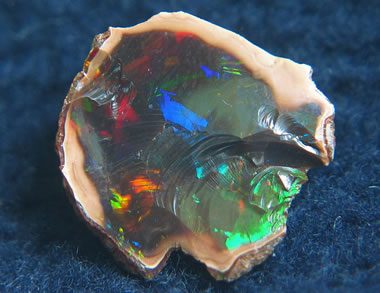
Ethiopian opal: A nodule of dark body color opal from the Shewa Province of Ethiopia.

I was aware of this opal, but the earlier specimens cracked once they had dried. However they might have discovered a better grade now, which seems to be the case. In Australia we need to find new ground as the old diggings are running out of good mineable opal.

https://geology.com/gemstones/opal/ethiopian-opal.shtml

Reply Quote

Date: 2/09/2018 19:24:27
From: mollwollfumble
ID: 1270824
Subject: re: Opals?

> 1. What’s the difference between “potch” and “flint”?

Looked up Australian flint and found some geologists with a sense of humour.

“Flint Report”

“Flint occurs in 4 geological settings in the South-East of SA – beds and dykes in the Gambier Limestone, bouldery conglomerate of the Bridgewater Formation, Holocene surface lag deposits and Holocene beach deposits. Pebbles from beach deposits between Cape Banks and Victoria are used mainly as grinding media, a source of high-grade silica for ceramics, and for ornamental purposes. The total resource is about 330 000 tonnes. Mottled grey and black flint from Cape Hart, Kangaroo Island (formed during the late Oligocene), is found only as boulders on current beaches. The flint is a fossiliferous chert with a granular, cherty matrix. High-grade samples from several SA localities are chemically similar to the flint produced from the Northfleet Plant, UK, for ceramic use.”

And the sense of humour? The authors are “Flint, D.J., Flint, R.B. and Flintoff, M.W.”

Reply Quote

Date: 3/09/2018 00:07:05
From: roughbarked
ID: 1270865
Subject: re: Opals?

Liked the Aussie flint tale and humour. :)

Welo opal is largely hydrophane but there is some quite high quality opal.. https://geology.com/gemstones/opal/ethiopian-opal.shtml

Reply Quote

Date: 3/09/2018 05:03:47
From: mollwollfumble
ID: 1270870
Subject: re: Opals?

What I’d like to do is visit Lightning Ridge to buy a big piece of potch (eg. 1 kg) and any invertebrate fossils of potch that happen to be available cheap.

I’d have the potch cut up into tiles as a replacement for coloured glass in mosaics.
And practice some gem cutting techniques on offcut material that it won’t hurt if I destroy it.

And learn a bit more about Cretaceous fossils.

Reply Quote

Date: 3/09/2018 14:13:38
From: PermeateFree
ID: 1271010
Subject: re: Opals?

mollwollfumble said:


What I’d like to do is visit Lightning Ridge to buy a big piece of potch (eg. 1 kg) and any invertebrate fossils of potch that happen to be available cheap.

I’d have the potch cut up into tiles as a replacement for coloured glass in mosaics.
And practice some gem cutting techniques on offcut material that it won’t hurt if I destroy it.

And learn a bit more about Cretaceous fossils.

You would be better off in Coober Pedy where sheets of potch can stretch for considerable distances, or go to the mullock heaps and help yourself.

Reply Quote

Date: 3/09/2018 18:04:49
From: mollwollfumble
ID: 1271064
Subject: re: Opals?

PermeateFree said:


mollwollfumble said:

What I’d like to do is visit Lightning Ridge to buy a big piece of potch (eg. 1 kg) and any invertebrate fossils of potch that happen to be available cheap.

I’d have the potch cut up into tiles as a replacement for coloured glass in mosaics.
And practice some gem cutting techniques on offcut material that it won’t hurt if I destroy it.

And learn a bit more about Cretaceous fossils.

You would be better off in Coober Pedy where sheets of potch can stretch for considerable distances, or go to the mullock heaps and help yourself.

Or both. Different colours. Thanks for the tip about Coober Pedy, I’d really like to see how translocent the potch there is, and whether it comes in colours other than white. Like light blue.

Reply Quote

Date: 3/09/2018 18:21:09
From: Michael V
ID: 1271077
Subject: re: Opals?

mollwollfumble said:


PermeateFree said:

mollwollfumble said:

What I’d like to do is visit Lightning Ridge to buy a big piece of potch (eg. 1 kg) and any invertebrate fossils of potch that happen to be available cheap.

I’d have the potch cut up into tiles as a replacement for coloured glass in mosaics.
And practice some gem cutting techniques on offcut material that it won’t hurt if I destroy it.

And learn a bit more about Cretaceous fossils.

You would be better off in Coober Pedy where sheets of potch can stretch for considerable distances, or go to the mullock heaps and help yourself.

Or both. Different colours. Thanks for the tip about Coober Pedy, I’d really like to see how translocent the potch there is, and whether it comes in colours other than white. Like light blue.

Light blue is an unusual colour for potch. On Hammonds Hill at The Grawin, the potch is sometimes very dark blue. White, and various greys are the most common colours, including at Coober Pedy. I agree that thick seams of potch are quite common there and can be picked up on mullock heaps.

Reply Quote

Date: 3/09/2018 18:23:28
From: roughbarked
ID: 1271079
Subject: re: Opals?

mollwollfumble said:


PermeateFree said:

mollwollfumble said:

What I’d like to do is visit Lightning Ridge to buy a big piece of potch (eg. 1 kg) and any invertebrate fossils of potch that happen to be available cheap.

I’d have the potch cut up into tiles as a replacement for coloured glass in mosaics.
And practice some gem cutting techniques on offcut material that it won’t hurt if I destroy it.

And learn a bit more about Cretaceous fossils.

You would be better off in Coober Pedy where sheets of potch can stretch for considerable distances, or go to the mullock heaps and help yourself.

Or both. Different colours. Thanks for the tip about Coober Pedy, I’d really like to see how translocent the potch there is, and whether it comes in colours other than white. Like light blue.

I dug up a sheet of absolutely clear opal that was up to 19mm thick. The sheet was about the size of the area my ute takes up. Only one stone was worth cutting.

Reply Quote

Date: 3/09/2018 18:26:28
From: PermeateFree
ID: 1271083
Subject: re: Opals?

mollwollfumble said:


PermeateFree said:

mollwollfumble said:

What I’d like to do is visit Lightning Ridge to buy a big piece of potch (eg. 1 kg) and any invertebrate fossils of potch that happen to be available cheap.

I’d have the potch cut up into tiles as a replacement for coloured glass in mosaics.
And practice some gem cutting techniques on offcut material that it won’t hurt if I destroy it.

And learn a bit more about Cretaceous fossils.

You would be better off in Coober Pedy where sheets of potch can stretch for considerable distances, or go to the mullock heaps and help yourself.

Or both. Different colours. Thanks for the tip about Coober Pedy, I’d really like to see how translocent the potch there is, and whether it comes in colours other than white. Like light blue.

Blue is common there.

Reply Quote

Date: 3/09/2018 18:29:17
From: roughbarked
ID: 1271085
Subject: re: Opals?

PermeateFree said:


mollwollfumble said:

PermeateFree said:

You would be better off in Coober Pedy where sheets of potch can stretch for considerable distances, or go to the mullock heaps and help yourself.

Or both. Different colours. Thanks for the tip about Coober Pedy, I’d really like to see how translocent the potch there is, and whether it comes in colours other than white. Like light blue.

Blue is common there.

Blue or mauve is common everywhere. Dark blue at the ridge and other places where black opal is found.

Reply Quote

Date: 3/09/2018 18:29:30
From: mollwollfumble
ID: 1271086
Subject: re: Opals?

roughbarked said:


mollwollfumble said:

PermeateFree said:

You would be better off in Coober Pedy where sheets of potch can stretch for considerable distances, or go to the mullock heaps and help yourself.

Or both. Different colours. Thanks for the tip about Coober Pedy, I’d really like to see how translocent the potch there is, and whether it comes in colours other than white. Like light blue.

> Light blue is an unusual colour for potch. On Hammonds Hill at The Grawin, the potch is sometimes very dark blue. White, and various greys are the most common colours, including at Coober Pedy. I agree that thick seams of potch are quite common there and can be picked up on mullock heaps.

I dug up a sheet of absolutely clear opal that was up to 19mm thick. The sheet was about the size of the area my ute takes up. Only one stone was worth cutting.

> Blue is common there.

Ta muchly. That’s a huge area for a sheet of common opal.

Reply Quote

Date: 3/09/2018 18:46:38
From: roughbarked
ID: 1271094
Subject: re: Opals?

mollwollfumble said:

Ta muchly. That’s a huge area for a sheet of common opal.

No. I’m still uncovering more of it.

Reply Quote

Date: 3/09/2018 18:59:56
From: PermeateFree
ID: 1271102
Subject: re: Opals?

roughbarked said:


mollwollfumble said:

Ta muchly. That’s a huge area for a sheet of common opal.

No. I’m still uncovering more of it.

Yes some are enormous and can get to house size, perhaps even larger.

Reply Quote

Date: 3/09/2018 19:23:39
From: roughbarked
ID: 1271115
Subject: re: Opals?

PermeateFree said:


roughbarked said:

mollwollfumble said:

Ta muchly. That’s a huge area for a sheet of common opal.

No. I’m still uncovering more of it.

Yes some are enormous and can get to house size, perhaps even larger.

I’d heard of them but mostly had previously only ever found small patches. White Cliffs was apperently worked out many decades ago but still people make good finds there. I’d rather that some of the potch turned into good stuff.

Reply Quote

Date: 4/09/2018 04:14:08
From: mollwollfumble
ID: 1271209
Subject: re: Opals?

roughbarked said:


PermeateFree said:

roughbarked said:

No. I’m still uncovering more of it.

Yes some are enormous and can get to house size, perhaps even larger.

I’d heard of them but mostly had previously only ever found small patches. White Cliffs was apperently worked out many decades ago but still people make good finds there. I’d rather that some of the potch turned into good stuff.

> No. I’m still uncovering more of it.

You mean you personally? Now? Where can I find you?

Reply Quote