Date: 18/10/2018 22:07:05
From: mollwollfumble
ID: 1290485
Subject: Trains?

Trains, what do you know about them – gauge and speed, throughout Australia?

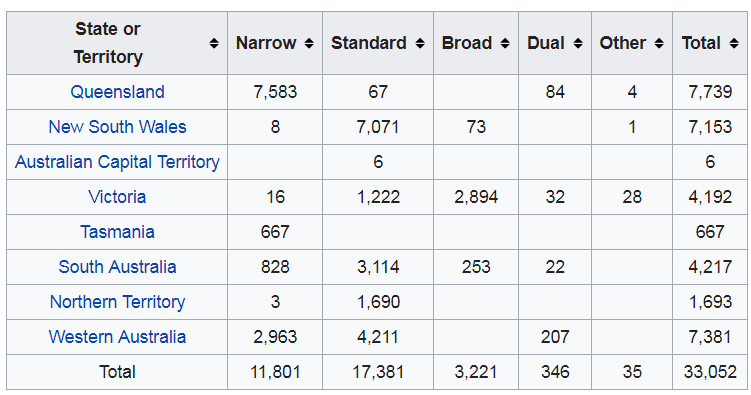
“As of 2014, there is 11,801 kilometres of narrow-gauge railways, 17,381 kilometres of standard gauge railways and 3,221 kilometres of broad gauge railways.”

It’s only just been drawn to my attention that Vic has trains capable of 210 km/hr (just sneaking into the bottom of the “high speed” category) but they are only run at up to 160 km/hr. The 160 km/hr network has currently proposed extensions – to Warrnambool, Albury and Bairnsdale – but what gauge is it?

Queensland experimented with tilt train – first tests were not promising as it made passengers travel sick.

Reply Quote

Date: 18/10/2018 22:09:37
From: roughbarked
ID: 1290486
Subject: re: Trains?

mollwollfumble said:


Trains, what do you know about them – gauge and speed, throughout Australia?

“As of 2014, there is 11,801 kilometres of narrow-gauge railways, 17,381 kilometres of standard gauge railways and 3,221 kilometres of broad gauge railways.”

It’s only just been drawn to my attention that Vic has trains capable of 210 km/hr (just sneaking into the bottom of the “high speed” category) but they are only run at up to 160 km/hr. The 160 km/hr network has currently proposed extensions – to Warrnambool, Albury and Bairnsdale – but what gauge is it?

Queensland experimented with tilt train – first tests were not promising as it made passengers travel sick.


The gauges are a problem but the biggest problem is are the rails up to it? It is very clear that we are still operating on antiquated infrastructure everywhere.

Reply Quote

Date: 18/10/2018 22:13:03
From: Peak Warming Man
ID: 1290487
Subject: re: Trains?

I didn’t know Queensland abandoned the tilt train.
It did have a couple of derailments from memory.

Reply Quote

Date: 18/10/2018 22:17:46
From: sibeen
ID: 1290488
Subject: re: Trains?

Peak Warming Man said:


I didn’t know Queensland abandoned the tilt train.
It did have a couple of derailments from memory.

That probably made passengers sick.

Reply Quote

Date: 18/10/2018 22:18:23
From: party_pants
ID: 1290489
Subject: re: Trains?

mollwollfumble said:


Trains, what do you know about them – gauge and speed, throughout Australia?

“As of 2014, there is 11,801 kilometres of narrow-gauge railways, 17,381 kilometres of standard gauge railways and 3,221 kilometres of broad gauge railways.”

It’s only just been drawn to my attention that Vic has trains capable of 210 km/hr (just sneaking into the bottom of the “high speed” category) but they are only run at up to 160 km/hr. The 160 km/hr network has currently proposed extensions – to Warrnambool, Albury and Bairnsdale – but what gauge is it?

Queensland experimented with tilt train – first tests were not promising as it made passengers travel sick.


Vic passenger services are broad gauge.

High speed rail above 200 km/h tends to need wide curves and smooth gradients for a smooth and safe ride. Not sure exactly what the numbers are for minimum radius and incline and all that, but most of the trackways in Australia were built before such speeds were envisaged and so can’t run at higher speeds without major re-work. High speed rail in other countries (France, Germany, Japan) usually involved new tracks to be laid out or realigned – often involving purchasing land and building expensive new tunnels and bridges. Very expensive upgrade. Also the new tracks tend to be run as dedicated passenger services while slower freight trains use the older existing tracks.

Reply Quote

Date: 18/10/2018 22:20:44
From: Tau.Neutrino
ID: 1290491
Subject: re: Trains?

It’s only just been drawn to my attention that Vic has trains capable of 210 km/hr (just sneaking into the bottom of the “high speed” category) but they are only run at up to 160 km/hr. The 160 km/hr network has currently proposed extensions – to Warrnambool, Albury and Bairnsdale – but what gauge is it?

https://en.wikipedia.org/wiki/V/Line_VLocity
Track gauge 1,600 mm (5 ft 3 in)

https://en.wikipedia.org/wiki/Rail_transport_in_Victoria

Rail transport in Victoria, Australia, is provided by a number of railway operators who operate over the government-owned railway lines. The network consists of Victorian broad gauge (1,600 mm (5 ft 3 in)) lines, and an increasing number of standard gauge (1,435 mm (4 ft 8 1⁄2 in)) freight and interstate lines; the latter brought into existence as a result of gauge conversion of the former. Historically, a few experimental 762 mm (2 ft 6 in) gauge lines were built, along with various private logging, mining and industrial railways.

Reply Quote

Date: 18/10/2018 22:22:08
From: Michael V
ID: 1290492
Subject: re: Trains?

I was surprised when we were in England about how broad the gauges were there.

Also there is this: a great one-day rail journey.

https://en.wikipedia.org/wiki/Snaefell_Mountain_Railway

Reply Quote

Date: 18/10/2018 22:32:27
From: captain_spalding
ID: 1290494
Subject: re: Trains?

Michael V said:


I was surprised when we were in England about how broad the gauges were there.

Also there is this: a great one-day rail journey.

https://en.wikipedia.org/wiki/Snaefell_Mountain_Railway

I understood that all of Britain is standard gauge (4 feet 8.5 in), and that the last broad gauge lines (5 ft 3 in) disappeared in the late 19th century. Although there’s still broad gauge in Ireland, i think.

Reply Quote

Date: 18/10/2018 22:36:40
From: Michael V
ID: 1290497
Subject: re: Trains?

And cane trains in QLD? Where do they fit in the scheme of things? Very narrow gauge, but they haul quite a bit of cane in harvest season.

And then there’s the Hillgrove very steeply inclined funicular ore-(and personnel)-haulage light rail system (now mostly dismantled). A marvel of engineering in its day. Build in England and installed in (then) remote northern NSW.

Reply Quote

Date: 18/10/2018 22:38:03
From: Bubblecar
ID: 1290499
Subject: re: Trains?

captain_spalding said:


Michael V said:

I was surprised when we were in England about how broad the gauges were there.

Also there is this: a great one-day rail journey.

https://en.wikipedia.org/wiki/Snaefell_Mountain_Railway

I understood that all of Britain is standard gauge (4 feet 8.5 in), and that the last broad gauge lines (5 ft 3 in) disappeared in the late 19th century. Although there’s still broad gauge in Ireland, i think.

Yes, Britain is ordinary standard gauge. Brunel’s Great Western Railway was broad gauge (7 feet) at first but eventually standardised in the late 19th century.

Reply Quote

Date: 18/10/2018 22:41:30
From: Peak Warming Man
ID: 1290501
Subject: re: Trains?

Michael V said:


And cane trains in QLD? Where do they fit in the scheme of things? Very narrow gauge, but they haul quite a bit of cane in harvest season.

And then there’s the Hillgrove very steeply inclined funicular ore-(and personnel)-haulage light rail system (now mostly dismantled). A marvel of engineering in its day. Build in England and installed in (then) remote northern NSW.

Hmm…………. I don’t know but it’s not in the ‘other’ category because theres certainly more than 4k of cane lines in Queensland.

Reply Quote

Date: 18/10/2018 22:42:27
From: party_pants
ID: 1290502
Subject: re: Trains?

Michael V said:


And cane trains in QLD? Where do they fit in the scheme of things? Very narrow gauge, but they haul quite a bit of cane in harvest season.

And then there’s the Hillgrove very steeply inclined funicular ore-(and personnel)-haulage light rail system (now mostly dismantled). A marvel of engineering in its day. Build in England and installed in (then) remote northern NSW.

Cane trains in QLD are very narrow gauge, usually around 2 ft. What we call narrow gauge is 3ft 6in and is the main gauge used in the old government built railways in QLD and WA. Standard gauge is 4ft 8 1/2in.

Reply Quote

Date: 18/10/2018 22:44:46
From: Tau.Neutrino
ID: 1290506
Subject: re: Trains?

It seems no one can agree what standard gauge should be.

Reply Quote

Date: 18/10/2018 22:47:51
From: party_pants
ID: 1290508
Subject: re: Trains?

Tau.Neutrino said:


It seems no one can agree what standard gauge should be.

Nah, they’ve got over that bit, it is agreed upon at 4ft 8 1/2 in or 1435 mm. Over half of the world’s railways are built to this gauge now. The others are outliers.

Reply Quote

Date: 18/10/2018 22:47:53
From: Michael V
ID: 1290509
Subject: re: Trains?

Peak Warming Man said:


Michael V said:

And cane trains in QLD? Where do they fit in the scheme of things? Very narrow gauge, but they haul quite a bit of cane in harvest season.

And then there’s the Hillgrove very steeply inclined funicular ore-(and personnel)-haulage light rail system (now mostly dismantled). A marvel of engineering in its day. Build in England and installed in (then) remote northern NSW.

Hmm…………. I don’t know but it’s not in the ‘other’ category because theres certainly more than 4k of cane lines in Queensland.


“Queensland also has extensive sugar cane tramways of 2 ft (610 mm) gauge. These cane tramways sometimes use second-hand standard-gauge shunting locomotives suitably regauged. The cane trams regularly haul over 500 tonnes of raw cane at a time, and because there are no continuous brakes, they may have a radio-controlled brake van coupled to the rear.”

https://en.wikipedia.org/wiki/Narrow-gauge_railways_in_Australia

Reply Quote

Date: 18/10/2018 22:47:59
From: JudgeMental
ID: 1290510
Subject: re: Trains?

Does the statement, “We’ve always done it that
way” ring any bells… ?

The US standard railroad gauge (distance between
the rails) is 4 feet, 8.5 inches. That’s an
exceedingly odd number.

Why was that gauge used?

Because that’s the way they built them in England,
and English expatriates built the US Railroads.

Why did the English build them like that?

Because the first rail lines were built by the
same people who built the pre-railroad tramways, and
that’s the gauge they used.

Why did “they” use that gauge then?

Because the people who built the tramways used
the same jigs and tools that they used for building
wagons, which used that wheel spacing.

Okay! Why did the wagons have that particular
odd wheel spacing?

Well, if they tried to use any other spacing,
the wagon wheels would break on some of the old,
long distance roads in England, because that’s
the spacing of the wheel ruts.

So who built those old rutted roads?

Imperial Rome built the first long distance
roads in Europe (and England) for their legions. The
roads have been used ever since.

And the ruts in the roads?

Roman war chariots formed the initial ruts,
which everyone else had to match for fear of
destroying their wagon wheels.
Since the chariots were made for Imperial Rome, they
were all alike in the matter of wheel spacing.

The United States standard railroad gauge of 4
feet, 8.5 inches is derived from the original
specifications for an Imperial Roman war chariot.
And bureaucracies live forever. So the next time you
are handed a specification and wonder what horse’s
ass came up with it, you may be exactly right,
because the Imperial Roman war chariots were made
just wide enough to accommodate the back ends of two
war horses. Now the twist to the story…

When you see a Space Shuttle sitting on its
launch pad, there are two big booster rockets
attached to the sides of the main fuel tank. These
are solid rocket boosters, or SRBs. The SRBs are
made by Thiokol at their factory at Utah. The
engineers who designed the SRBs would have preferred
to make them a bit fatter, but the SRBs had to
be shipped by train from the factory to the launch
site. The railroad line from the factory happens to
run through a tunnel in the mountains. The SRBs had
to fit through that tunnel. The tunnel is slightly
wider than the railroad track, and the railroad
track, as you now know, is about as wide as two
horses’ behinds.

So, a major Space Shuttle design feature of what
is arguably the world’s most advanced transportation
system was determined over two thousand years ago by
the width of a horse’s ass. … and you thought
being a HORSE’S ASS wasn’t important!
Reply Quote

Date: 18/10/2018 22:53:27
From: Michael V
ID: 1290514
Subject: re: Trains?

I haven’t seen that old furphy dusted off for a while. Perfect spot for it though.

Reply Quote

Date: 18/10/2018 23:00:35
From: Tau.Neutrino
ID: 1290520
Subject: re: Trains?

When the car you used to draw in kindergarten pulls up next to you

Reply Quote

Date: 19/10/2018 05:40:11
From: mollwollfumble
ID: 1290583
Subject: re: Trains?

Peak Warming Man said:


I didn’t know Queensland abandoned the tilt train.
It did have a couple of derailments from memory.

I think they didn’t. According to wikipedia it’s still running. They must have fixed the problems.

Reply Quote

Date: 19/10/2018 05:44:46
From: mollwollfumble
ID: 1290584
Subject: re: Trains?

Michael V said:


And cane trains in QLD? Where do they fit in the scheme of things? Very narrow gauge, but they haul quite a bit of cane in harvest season.

And then there’s the Hillgrove very steeply inclined funicular ore-(and personnel)-haulage light rail system (now mostly dismantled). A marvel of engineering in its day. Build in England and installed in (then) remote northern NSW.

My limited understanding is that cane trains are excluded from the above table and that yes, there are a lot of them.

Reply Quote

Date: 19/10/2018 06:01:17
From: mollwollfumble
ID: 1290585
Subject: re: Trains?

Let’s consider individual train tracks.

“The Ghan” – originally narrow gauge to Alice Springs. Now narrow gauge to Darwin – 115 km/hr. Yuk yuk yuk on the speed.
“Indian Pacific” – standard gauge – 115 km/hr.
XPT Sydney to Melbourne – standard gauge – 160 km/hr. When it’s not an hour late, which is as often as not.
Tilt train Brisbane to Cairns – narrow gauge – 160 km/hr.

Reply Quote

Date: 19/10/2018 07:03:36
From: Stumpy_seahorse
ID: 1290593
Subject: re: Trains?

Why would you want the Ghan and Indian Pacific to be high sped? they are very much tourist routes more than passenger routes and speeding them up would take a lot away from that.

Also you need to consider what these trains share their lines with.
High speed trains overseas don’t share their lines with bulk freight like ours do, and high speed is not high power that we require for a half kilometre long freight train.

imagine a high speed train sharing it’s line with a kilometre long grain train.. It’s just not practical.

Reply Quote

Date: 19/10/2018 09:24:34
From: mollwollfumble
ID: 1290629
Subject: re: Trains?

Stumpy_seahorse said:


Why would you want the Ghan and Indian Pacific to be high sped? they are very much tourist routes more than passenger routes and speeding them up would take a lot away from that.

Also you need to consider what these trains share their lines with.
High speed trains overseas don’t share their lines with bulk freight like ours do, and high speed is not high power that we require for a half kilometre long freight train.

imagine a high speed train sharing it’s line with a kilometre long grain train.. It’s just not practical.

Yeah, no. They are very much tourist routes, yes. But the faster the train the greater the enjoyment and the greater then number of passengers on both of these routes. Travelled on the Indian-Pacific and never would again – didn’t get any sleep all night and it must rank as the most boring train journey in the whole world. On the other hand, travelled on the Japanese bullet train and would again in a heartbeat.

Sharing with bulk freight is a big issue, yes. Particularly with the Ghan which was designed as a freight train – in the initial announcement of the construction through to Darwin it was emphasised that this train line would be for freight only – it was only after multiple complaints that they relented and allowed a tourist train on the line as well.

Reply Quote

Date: 19/10/2018 09:41:49
From: party_pants
ID: 1290632
Subject: re: Trains?

mollwollfumble said:


Stumpy_seahorse said:

Why would you want the Ghan and Indian Pacific to be high sped? they are very much tourist routes more than passenger routes and speeding them up would take a lot away from that.

Also you need to consider what these trains share their lines with.
High speed trains overseas don’t share their lines with bulk freight like ours do, and high speed is not high power that we require for a half kilometre long freight train.

imagine a high speed train sharing it’s line with a kilometre long grain train.. It’s just not practical.

Yeah, no. They are very much tourist routes, yes. But the faster the train the greater the enjoyment and the greater then number of passengers on both of these routes. Travelled on the Indian-Pacific and never would again – didn’t get any sleep all night and it must rank as the most boring train journey in the whole world. On the other hand, travelled on the Japanese bullet train and would again in a heartbeat.

Sharing with bulk freight is a big issue, yes. Particularly with the Ghan which was designed as a freight train – in the initial announcement of the construction through to Darwin it was emphasised that this train line would be for freight only – it was only after multiple complaints that they relented and allowed a tourist train on the line as well.

Freight is what pays the bills. Passenger and tourism stuff is secondary.

The problem with running high speed passenger rail is you need dedicated trackways built to a different standard than freight, they don’t mix well. Once you build them they must make a return on passenger revenue alone which means they have to capture the mass travel market and displace air travel or road travel. There is plenty written about the economics of it – basically the high speed rail niche is for journeys between 200-800 km. Faster than driving, time competitive with air travel on a city-to-city basis when you factor in check-in times and taxi ride from airport to city-centre. Hence its popularity in Europe and Japan where they have lots of city to city journeys that fall within that sweet-spot.

Reply Quote

Date: 19/10/2018 17:15:19
From: mollwollfumble
ID: 1290804
Subject: re: Trains?

party_pants said:


mollwollfumble said:

Stumpy_seahorse said:

Why would you want the Ghan and Indian Pacific to be high sped? they are very much tourist routes more than passenger routes and speeding them up would take a lot away from that.

Also you need to consider what these trains share their lines with.
High speed trains overseas don’t share their lines with bulk freight like ours do, and high speed is not high power that we require for a half kilometre long freight train.

imagine a high speed train sharing it’s line with a kilometre long grain train.. It’s just not practical.

Yeah, no. They are very much tourist routes, yes. But the faster the train the greater the enjoyment and the greater then number of passengers on both of these routes. Travelled on the Indian-Pacific and never would again – didn’t get any sleep all night and it must rank as the most boring train journey in the whole world. On the other hand, travelled on the Japanese bullet train and would again in a heartbeat.

Sharing with bulk freight is a big issue, yes. Particularly with the Ghan which was designed as a freight train – in the initial announcement of the construction through to Darwin it was emphasised that this train line would be for freight only – it was only after multiple complaints that they relented and allowed a tourist train on the line as well.

Freight is what pays the bills. Passenger and tourism stuff is secondary.

The problem with running high speed passenger rail is you need dedicated trackways built to a different standard than freight, they don’t mix well. Once you build them they must make a return on passenger revenue alone which means they have to capture the mass travel market and displace air travel or road travel. There is plenty written about the economics of it – basically the high speed rail niche is for journeys between 200-800 km. Faster than driving, time competitive with air travel on a city-to-city basis when you factor in check-in times and taxi ride from airport to city-centre. Hence its popularity in Europe and Japan where they have lots of city to city journeys that fall within that sweet-spot.

Australia has a lot more 200 to 800 km journeys than Japan. And fewer steep grades and tight turns than Japan.

As for dedicated rail lines, highly preferable but not essential. High speed trains in Europe are sometimes run along old track.

The Ghan could easily have been built to high speed specifications, with it’s open spaces and concrete sleepers. It may actually have been built to high speed specifications, the only limitations on speed being the limited number of places where a high speed train can pass a slow goods train.

There’s no reason why a goods train has to be slow, either.

Reply Quote

Date: 19/10/2018 17:22:06
From: sibeen
ID: 1290810
Subject: re: Trains?

mollwollfumble said:


party_pants said:

mollwollfumble said:

Yeah, no. They are very much tourist routes, yes. But the faster the train the greater the enjoyment and the greater then number of passengers on both of these routes. Travelled on the Indian-Pacific and never would again – didn’t get any sleep all night and it must rank as the most boring train journey in the whole world. On the other hand, travelled on the Japanese bullet train and would again in a heartbeat.

Sharing with bulk freight is a big issue, yes. Particularly with the Ghan which was designed as a freight train – in the initial announcement of the construction through to Darwin it was emphasised that this train line would be for freight only – it was only after multiple complaints that they relented and allowed a tourist train on the line as well.

Freight is what pays the bills. Passenger and tourism stuff is secondary.

The problem with running high speed passenger rail is you need dedicated trackways built to a different standard than freight, they don’t mix well. Once you build them they must make a return on passenger revenue alone which means they have to capture the mass travel market and displace air travel or road travel. There is plenty written about the economics of it – basically the high speed rail niche is for journeys between 200-800 km. Faster than driving, time competitive with air travel on a city-to-city basis when you factor in check-in times and taxi ride from airport to city-centre. Hence its popularity in Europe and Japan where they have lots of city to city journeys that fall within that sweet-spot.

Australia has a lot more 200 to 800 km journeys than Japan. And fewer steep grades and tight turns than Japan.

And Australia has about five times less people and a population density that is about two orders of magnitude less.

The only viable route for a very fast train in Australia would be a Melbourne to Sydney passenger run, and the politics probably wouldn’t let it go through as of course it would need to stop at Wodonga and then Canberra etc; making it no-viable. No-one really cares about fast freight.

Reply Quote

Date: 19/10/2018 17:28:10
From: Cymek
ID: 1290815
Subject: re: Trains?

sibeen said:


mollwollfumble said:

party_pants said:

Freight is what pays the bills. Passenger and tourism stuff is secondary.

The problem with running high speed passenger rail is you need dedicated trackways built to a different standard than freight, they don’t mix well. Once you build them they must make a return on passenger revenue alone which means they have to capture the mass travel market and displace air travel or road travel. There is plenty written about the economics of it – basically the high speed rail niche is for journeys between 200-800 km. Faster than driving, time competitive with air travel on a city-to-city basis when you factor in check-in times and taxi ride from airport to city-centre. Hence its popularity in Europe and Japan where they have lots of city to city journeys that fall within that sweet-spot.

Australia has a lot more 200 to 800 km journeys than Japan. And fewer steep grades and tight turns than Japan.

And Australia has about five times less people and a population density that is about two orders of magnitude less.

The only viable route for a very fast train in Australia would be a Melbourne to Sydney passenger run, and the politics probably wouldn’t let it go through as of course it would need to stop at Wodonga and then Canberra etc; making it no-viable. No-one really cares about fast freight.

Automated trains would make more sense especially freight

Reply Quote

Date: 19/10/2018 17:32:50
From: Witty Rejoinder
ID: 1290825
Subject: re: Trains?

sibeen said:


mollwollfumble said:

Australia has a lot more 200 to 800 km journeys than Japan. And fewer steep grades and tight turns than Japan.

And Australia has about five times less people and a population density that is about two orders of magnitude less.

The only viable route for a very fast train in Australia would be a Melbourne to Sydney passenger run, and the politics probably wouldn’t let it go through as of course it would need to stop at Wodonga and then Canberra etc; making it no-viable. No-one really cares about fast freight.

It only takes a few minutes to slow down from 300kmph. 5 minutes per stop at 3-4 population centres is not going to affect the economics of it that much.

Reply Quote

Date: 19/10/2018 17:39:11
From: party_pants
ID: 1290830
Subject: re: Trains?

mollwollfumble said:


party_pants said:

mollwollfumble said:

Yeah, no. They are very much tourist routes, yes. But the faster the train the greater the enjoyment and the greater then number of passengers on both of these routes. Travelled on the Indian-Pacific and never would again – didn’t get any sleep all night and it must rank as the most boring train journey in the whole world. On the other hand, travelled on the Japanese bullet train and would again in a heartbeat.

Sharing with bulk freight is a big issue, yes. Particularly with the Ghan which was designed as a freight train – in the initial announcement of the construction through to Darwin it was emphasised that this train line would be for freight only – it was only after multiple complaints that they relented and allowed a tourist train on the line as well.

Freight is what pays the bills. Passenger and tourism stuff is secondary.

The problem with running high speed passenger rail is you need dedicated trackways built to a different standard than freight, they don’t mix well. Once you build them they must make a return on passenger revenue alone which means they have to capture the mass travel market and displace air travel or road travel. There is plenty written about the economics of it – basically the high speed rail niche is for journeys between 200-800 km. Faster than driving, time competitive with air travel on a city-to-city basis when you factor in check-in times and taxi ride from airport to city-centre. Hence its popularity in Europe and Japan where they have lots of city to city journeys that fall within that sweet-spot.

Australia has a lot more 200 to 800 km journeys than Japan. And fewer steep grades and tight turns than Japan.

As for dedicated rail lines, highly preferable but not essential. High speed trains in Europe are sometimes run along old track.

The Ghan could easily have been built to high speed specifications, with it’s open spaces and concrete sleepers. It may actually have been built to high speed specifications, the only limitations on speed being the limited number of places where a high speed train can pass a slow goods train.

There’s no reason why a goods train has to be slow, either.

The size of cities determines the traffic volumes. Japan has about 200 cities with a population over 100,000, with a further 500 between 10,000 and 100,000. France has 40 and 900 respectively. Germany 100 and 1500. They have many more options to config a network.

The trains that run on conventional lines are speed restricted for those sections. They only open the throttle to maximum when they hit the dedicated passenger only sections. The approaches in and out of cities to traditional old rail stations are speed restricted.

Possibly the Ghan could have been built for higher speeds but still it is a service between Adelaide, Alice Springs and Darwin, nearly 3000 km and connecting only 1.5 million people. Evan at an average speed of 250 km/h it is still going to take 12 hours, which is uncompetitive with flying.

Reply Quote

Date: 19/10/2018 17:43:23
From: party_pants
ID: 1290831
Subject: re: Trains?

Also, there is no need for high speeds in freight. I can’t calculate what the drag would be for a kilometre long train full of shipping containers would be at 100 km/h versus 250 km/h, and how much extra horsepower would be needed to maintain that speed – you could probably do that better than me.

Also, having trains of mixed slow and high speeds sharing the same network reduces the capacity of the whole network overall.

Reply Quote

Date: 23/10/2018 08:45:14
From: mollwollfumble
ID: 1292429
Subject: re: Trains?

party_pants said:


Also, there is no need for high speeds in freight. I can’t calculate what the drag would be for a kilometre long train full of shipping containers would be at 100 km/h versus 250 km/h, and how much extra horsepower would be needed to maintain that speed – you could probably do that better than me.

Also, having trains of mixed slow and high speeds sharing the same network reduces the capacity of the whole network overall.

I can calculate that. The air drag on a properly designed high speed tain is very much less than of even a super-aerodynamic car travelling at the same speed. It is of the same order of magnitude as an airliner or rocket travelling at the same speed. The longer the train, the less significant the air drag is.

As for mixed slow and high speed, that’s bad unless there are sufficient locations for passing. But the present train networks are already runnhng at no more than 1% of capacity, many closer to 0.1% of capacity. So slowing down a network below 100% capachty is not a serious problem.

My personal thought is that the only reason goods trains run slowly is because they’ve been knocked up in somebody’s back yard for a couple of bucks.

Reply Quote
