Date: 6/03/2019 08:18:00
From: roughbarked
ID: 1355824
Subject: That Murray-Darling thing again.
The Government thinks we’ve returned more water to the Murray-Darling than in fact we have, Professor Williams said.
The Government thinks we’ve returned more water to the Murray-Darling than in fact we have, Professor Williams said.
roughbarked said:
The Government thinks we’ve returned more water to the Murray-Darling than in fact we have, Professor Williams said.
mollwollfumble thinks that agriculture on the Murray-Darling is slowly being strangled by being allowed a smaller share of the total water each year.
mollwollfumble is also surprised by the lack of progress in using groundwater.
roughbarked said:
The Government thinks we’ve returned more water to the Murray-Darling than in fact we have, Professor Williams said.
refer back to the Aussie Language discussion:
There’s a popular phrase for that:
“Don’t piss down my back and tell me it’s raining!”
Doano the reason behind Fudging the Numbers…
…but it bears watching.
mollwollfumble said:
roughbarked said:
The Government thinks we’ve returned more water to the Murray-Darling than in fact we have, Professor Williams said.
mollwollfumble thinks that agriculture on the Murray-Darling is slowly being strangled by being allowed a smaller share of the total water each year.
mollwollfumble is also surprised by the lack of progress in using groundwater.
mollwoll should probably realise that the groundwater is almost all gone already. The problem is much worse than mollwoll is aware.
roughbarked said:
mollwollfumble said:
roughbarked said:
The Government thinks we’ve returned more water to the Murray-Darling than in fact we have, Professor Williams said.
mollwollfumble thinks that agriculture on the Murray-Darling is slowly being strangled by being allowed a smaller share of the total water each year.
mollwollfumble is also surprised by the lack of progress in using groundwater.
mollwoll should probably realise that the groundwater is almost all gone already. The problem is much worse than mollwoll is aware.
mollwoll is aware that the problem is much worse than mollwoll is aware of.
Last time I checked, in 40% of the Murray-Darling the groundwater was already gone.
For starters, there is a huge uncertainty about illegal farm dams. The water lost to the Murray-Darling in this way subtracts an unknown amount from environmental flows.
mollwoll is of the opinion that Sydney should get most of its water from groundwater (it currently gets none), allowing water from Sydney’s reservoirs to be directed west into the Murray-Darling.
>>For starters, there is a huge uncertainty about illegal farm dams.
Bingo.
mollwollfumble said:
roughbarked said:
mollwollfumble said:mollwollfumble thinks that agriculture on the Murray-Darling is slowly being strangled by being allowed a smaller share of the total water each year.
mollwollfumble is also surprised by the lack of progress in using groundwater.
mollwoll should probably realise that the groundwater is almost all gone already. The problem is much worse than mollwoll is aware.
mollwoll is aware that the problem is much worse than mollwoll is aware of.
Last time I checked, in 40% of the Murray-Darling the groundwater was already gone.
For starters, there is a huge uncertainty about illegal farm dams. The water lost to the Murray-Darling in this way subtracts an unknown amount from environmental flows.
mollwoll is of the opinion that Sydney should get most of its water from groundwater (it currently gets none), allowing water from Sydney’s reservoirs to be directed west into the Murray-Darling.
So then, how would you get water from Warragamba into Burrunjuck?
Peak Warming Man said:
>>For starters, there is a huge uncertainty about illegal farm dams.Bingo.
That’s something that could be sorted by satellites and drone flyovers. I note that in Great Britain, Shire councils rely on aerial data to inform them of illegal or misreported deviations from development or taxation avoidance.
roughbarked said:
mollwollfumble said:
roughbarked said:mollwoll should probably realise that the groundwater is almost all gone already. The problem is much worse than mollwoll is aware.
mollwoll is aware that the problem is much worse than mollwoll is aware of.
Last time I checked, in 40% of the Murray-Darling the groundwater was already gone.
For starters, there is a huge uncertainty about illegal farm dams. The water lost to the Murray-Darling in this way subtracts an unknown amount from environmental flows.
mollwoll is of the opinion that Sydney should get most of its water from groundwater (it currently gets none), allowing water from Sydney’s reservoirs to be directed west into the Murray-Darling.
So then, how would you get water from Warragamba into Burrunjuck?
Ah, yeah, I had a look at that less than a week ago expecting it to be easy. It isn’t easy.
I’d have to have a close look at a topographic map to give you an answer on that one. It’s a bit like going to the Moon, there are four main strategies. Tunnel direct, pump to pondage then tunnel, pump to tunnel then pondage, and over the top. I’m tending towards pump to pondage then tunnel at the moment.
mollwollfumble said:
roughbarked said:
mollwollfumble said:mollwoll is aware that the problem is much worse than mollwoll is aware of.
Last time I checked, in 40% of the Murray-Darling the groundwater was already gone.
For starters, there is a huge uncertainty about illegal farm dams. The water lost to the Murray-Darling in this way subtracts an unknown amount from environmental flows.
mollwoll is of the opinion that Sydney should get most of its water from groundwater (it currently gets none), allowing water from Sydney’s reservoirs to be directed west into the Murray-Darling.
So then, how would you get water from Warragamba into Burrunjuck?
Ah, yeah, I had a look at that less than a week ago expecting it to be easy. It isn’t easy.
I’d have to have a close look at a topographic map to give you an answer on that one. It’s a bit like going to the Moon, there are four main strategies. Tunnel direct, pump to pondage then tunnel, pump to tunnel then pondage, and over the top. I’m tending towards pump to pondage then tunnel at the moment.
roughbarked said:
mollwollfumble said:
roughbarked said:So then, how would you get water from Warragamba into Burrunjuck?
Ah, yeah, I had a look at that less than a week ago expecting it to be easy. It isn’t easy.
I’d have to have a close look at a topographic map to give you an answer on that one. It’s a bit like going to the Moon, there are four main strategies. Tunnel direct, pump to pondage then tunnel, pump to tunnel then pondage, and over the top. I’m tending towards pump to pondage then tunnel at the moment.
Haven’t got the elevation of Warragamba but the current dam wall of Burrunjuck is 93m high and 361m above sea level. It could be raised to 400m.
From: https://www.parliament.nsw.gov.au/lcdocs/other/10687/Answer%20to%20questions%20on%20notice%20-%20Griffith%20Business%20Chamber.PDF
“Burrinjuck dam wall is currently 93 metres high and 361 metres above sea level
Burrinjuck wall is 233 metres long and Burrinjuck dam has a surface area of 5500 hectares and dam capacity is 1028 gig litres
On a topographical map if the 400 metre above sea level contour is used the dam surface area would increase to an estimated 8000 hectares and have no impact on Yass
The new dam wall could raise the level by up to forty metres (400 metres above sea level) and increase the potential storage volume to four thousand gig litres”
roughbarked said:
roughbarked said:
mollwollfumble said:Ah, yeah, I had a look at that less than a week ago expecting it to be easy. It isn’t easy.
I’d have to have a close look at a topographic map to give you an answer on that one. It’s a bit like going to the Moon, there are four main strategies. Tunnel direct, pump to pondage then tunnel, pump to tunnel then pondage, and over the top. I’m tending towards pump to pondage then tunnel at the moment.
Haven’t got the elevation of Warragamba but the current dam wall of Burrunjuck is 93m high and 361m above sea level. It could be raised to 400m.
From: https://www.parliament.nsw.gov.au/lcdocs/other/10687/Answer%20to%20questions%20on%20notice%20-%20Griffith%20Business%20Chamber.PDF
“Burrinjuck dam wall is currently 93 metres high and 361 metres above sea level
Burrinjuck wall is 233 metres long and Burrinjuck dam has a surface area of 5500 hectares and dam capacity is 1028 gig litres
On a topographical map if the 400 metre above sea level contour is used the dam surface area would increase to an estimated 8000 hectares and have no impact on Yass
The new dam wall could raise the level by up to forty metres (400 metres above sea level) and increase the potential storage volume to four thousand gig litres”
Putting 40 metres on top of an already cracked dam wall that has been repaired using tie-down cables? I think the engineers would be aghast.
Oh, I see, it’s some parliamentary whim.
Michael V said:
roughbarked said:
roughbarked said:Haven’t got the elevation of Warragamba but the current dam wall of Burrunjuck is 93m high and 361m above sea level. It could be raised to 400m.
From: https://www.parliament.nsw.gov.au/lcdocs/other/10687/Answer%20to%20questions%20on%20notice%20-%20Griffith%20Business%20Chamber.PDF
“Burrinjuck dam wall is currently 93 metres high and 361 metres above sea level
Burrinjuck wall is 233 metres long and Burrinjuck dam has a surface area of 5500 hectares and dam capacity is 1028 gig litres
On a topographical map if the 400 metre above sea level contour is used the dam surface area would increase to an estimated 8000 hectares and have no impact on Yass
The new dam wall could raise the level by up to forty metres (400 metres above sea level) and increase the potential storage volume to four thousand gig litres”
Putting 40 metres on top of an already cracked dam wall that has been repaired using tie-down cables? I think the engineers would be aghast.
Oh, I see, it’s some parliamentary whim.
Heh.. yes.
roughbarked said:
Michael V said:
roughbarked said:From: https://www.parliament.nsw.gov.au/lcdocs/other/10687/Answer%20to%20questions%20on%20notice%20-%20Griffith%20Business%20Chamber.PDF
“Burrinjuck dam wall is currently 93 metres high and 361 metres above sea level
Burrinjuck wall is 233 metres long and Burrinjuck dam has a surface area of 5500 hectares and dam capacity is 1028 gig litres
On a topographical map if the 400 metre above sea level contour is used the dam surface area would increase to an estimated 8000 hectares and have no impact on Yass
The new dam wall could raise the level by up to forty metres (400 metres above sea level) and increase the potential storage volume to four thousand gig litres”
Putting 40 metres on top of an already cracked dam wall that has been repaired using tie-down cables? I think the engineers would be aghast.
Oh, I see, it’s some parliamentary whim.
Heh.. yes.
Pretty much as it stands we have already exceeded the capacity for existing dams to support current irrigation allocations. The farms have to get smaller again.
roughbarked said:
roughbarked said:
Michael V said:Putting 40 metres on top of an already cracked dam wall that has been repaired using tie-down cables? I think the engineers would be aghast.
Oh, I see, it’s some parliamentary whim.
Heh.. yes.
Pretty much as it stands we have already exceeded the capacity for existing dams to support current irrigation allocations. The farms have to get smaller again.
or become far more efficient at not demanding water from a threatened riparian system.
Michael V said:
roughbarked said:
roughbarked said:Haven’t got the elevation of Warragamba but the current dam wall of Burrunjuck is 93m high and 361m above sea level. It could be raised to 400m.
From: https://www.parliament.nsw.gov.au/lcdocs/other/10687/Answer%20to%20questions%20on%20notice%20-%20Griffith%20Business%20Chamber.PDF
“Burrinjuck dam wall is currently 93 metres high and 361 metres above sea level
Burrinjuck wall is 233 metres long and Burrinjuck dam has a surface area of 5500 hectares and dam capacity is 1028 gig litres
On a topographical map if the 400 metre above sea level contour is used the dam surface area would increase to an estimated 8000 hectares and have no impact on Yass
The new dam wall could raise the level by up to forty metres (400 metres above sea level) and increase the potential storage volume to four thousand gig litres”
Putting 40 metres on top of an already cracked dam wall that has been repaired using tie-down cables? I think the engineers would be aghast.
Oh, I see, it’s some parliamentary whim.
The engineers wouldn’t be aghast at all. It’s been standard engineering practice in Australia for a long time.
Sydney’s dams were designed before the effects of uplift due to groundwater pressure were appreciated. When this became known, some dams were found to have a factor of safety less than one, ie calculations said they should fail. The quick retrofit using tie-down cables was done taking into account that a dam wall extension in future was on the cards.
Many Australian dams have had dam wall extensions, in at least two cases IIRC, this has happened twice on the same dam.
mollwollfumble said:
Michael V said:
roughbarked said:From: https://www.parliament.nsw.gov.au/lcdocs/other/10687/Answer%20to%20questions%20on%20notice%20-%20Griffith%20Business%20Chamber.PDF
“Burrinjuck dam wall is currently 93 metres high and 361 metres above sea level
Burrinjuck wall is 233 metres long and Burrinjuck dam has a surface area of 5500 hectares and dam capacity is 1028 gig litres
On a topographical map if the 400 metre above sea level contour is used the dam surface area would increase to an estimated 8000 hectares and have no impact on Yass
The new dam wall could raise the level by up to forty metres (400 metres above sea level) and increase the potential storage volume to four thousand gig litres”
Putting 40 metres on top of an already cracked dam wall that has been repaired using tie-down cables? I think the engineers would be aghast.
Oh, I see, it’s some parliamentary whim.
The engineers wouldn’t be aghast at all. It’s been standard engineering practice in Australia for a long time.
Sydney’s dams were designed before the effects of uplift due to groundwater pressure were appreciated. When this became known, some dams were found to have a factor of safety less than one, ie calculations said they should fail. The quick retrofit using tie-down cables was done taking into account that a dam wall extension in future was on the cards.
Many Australian dams have had dam wall extensions, in at least two cases IIRC, this has happened twice on the same dam.
Burrunjuck has had its wall height raised before, yes.
roughbarked said:
mollwollfumble said:
Michael V said:Putting 40 metres on top of an already cracked dam wall that has been repaired using tie-down cables? I think the engineers would be aghast.
Oh, I see, it’s some parliamentary whim.
The engineers wouldn’t be aghast at all. It’s been standard engineering practice in Australia for a long time.
Sydney’s dams were designed before the effects of uplift due to groundwater pressure were appreciated. When this became known, some dams were found to have a factor of safety less than one, ie calculations said they should fail. The quick retrofit using tie-down cables was done taking into account that a dam wall extension in future was on the cards.
Many Australian dams have had dam wall extensions, in at least two cases IIRC, this has happened twice on the same dam.
Burrunjuck has had its wall height raised before, yes.
Going on small homemade dams, I am always amazed at how little material is required to hold back a relatively large body of water. However, if overflowed or the water makes its way through a yabby hole, it charges through and gets eroded away very quickly.
PermeateFree said:
roughbarked said:
mollwollfumble said:The engineers wouldn’t be aghast at all. It’s been standard engineering practice in Australia for a long time.
Sydney’s dams were designed before the effects of uplift due to groundwater pressure were appreciated. When this became known, some dams were found to have a factor of safety less than one, ie calculations said they should fail. The quick retrofit using tie-down cables was done taking into account that a dam wall extension in future was on the cards.
Many Australian dams have had dam wall extensions, in at least two cases IIRC, this has happened twice on the same dam.
Burrunjuck has had its wall height raised before, yes.
Going on small homemade dams, I am always amazed at how little material is required to hold back a relatively large body of water. However, if overflowed or the water makes its way through a yabby hole, it charges through and gets eroded away very quickly.
Checking NSW catchment areas.

mollwollfumble said:
Michael V said:
roughbarked said:From: https://www.parliament.nsw.gov.au/lcdocs/other/10687/Answer%20to%20questions%20on%20notice%20-%20Griffith%20Business%20Chamber.PDF
“Burrinjuck dam wall is currently 93 metres high and 361 metres above sea level
Burrinjuck wall is 233 metres long and Burrinjuck dam has a surface area of 5500 hectares and dam capacity is 1028 gig litres
On a topographical map if the 400 metre above sea level contour is used the dam surface area would increase to an estimated 8000 hectares and have no impact on Yass
The new dam wall could raise the level by up to forty metres (400 metres above sea level) and increase the potential storage volume to four thousand gig litres”
Putting 40 metres on top of an already cracked dam wall that has been repaired using tie-down cables? I think the engineers would be aghast.
Oh, I see, it’s some parliamentary whim.
The engineers wouldn’t be aghast at all. It’s been standard engineering practice in Australia for a long time.
Sydney’s dams were designed before the effects of uplift due to groundwater pressure were appreciated. When this became known, some dams were found to have a factor of safety less than one, ie calculations said they should fail. The quick retrofit using tie-down cables was done taking into account that a dam wall extension in future was on the cards.
Many Australian dams have had dam wall extensions, in at least two cases IIRC, this has happened twice on the same dam.
Burrinjuck was overtopped and as a result has a severe basal dam wall crack. The original specifications for concrete and steel were ignored and instead the contractor in 1906 used a low-grade, leachable concrete with hillside boulder infill during night-shifts when there was no oversight. It has already been extended upwards and cable-tied downwards. There is an air-filled plenum at the top which is designed to accept water during floods to add short-term mass to the dam wall to reduce the risk of overtopping and catastrophic failure.
I stand by my comments.
Michael V said:
mollwollfumble said:
Michael V said:Putting 40 metres on top of an already cracked dam wall that has been repaired using tie-down cables? I think the engineers would be aghast.
Oh, I see, it’s some parliamentary whim.
The engineers wouldn’t be aghast at all. It’s been standard engineering practice in Australia for a long time.
Sydney’s dams were designed before the effects of uplift due to groundwater pressure were appreciated. When this became known, some dams were found to have a factor of safety less than one, ie calculations said they should fail. The quick retrofit using tie-down cables was done taking into account that a dam wall extension in future was on the cards.
Many Australian dams have had dam wall extensions, in at least two cases IIRC, this has happened twice on the same dam.
Burrinjuck was overtopped and as a result has a severe basal dam wall crack. The original specifications for concrete and steel were ignored and instead the contractor in 1906 used a low-grade, leachable concrete with hillside boulder infill during night-shifts when there was no oversight. It has already been extended upwards and cable-tied downwards. There is an air-filled plenum at the top which is designed to accept water during floods to add short-term mass to the dam wall to reduce the risk of overtopping and catastrophic failure.
I stand by my comments.
You’ll get no argument from me.
> There is an air-filled plenum at the top which is designed to accept water during floods to add short-term mass to the dam wall to reduce the risk of overtopping and catastrophic failure.
Now that I didn’t know.
mollwollfumble said:
> There is an air-filled plenum at the top which is designed to accept water during floods to add short-term mass to the dam wall to reduce the risk of overtopping and catastrophic failure.Now that I didn’t know.
The LNP should know though and that doesn’t seem to have sunk in.
roughbarked said:
mollwollfumble said:
> There is an air-filled plenum at the top which is designed to accept water during floods to add short-term mass to the dam wall to reduce the risk of overtopping and catastrophic failure.Now that I didn’t know.
The LNP should know though and that doesn’t seem to have sunk in.
My point earlier
was NOT HOW but rather WHY…
WHY are “THEY” Making False Claims as to the Amount of Water?
Are they trying to avert a panic…?
…simply In DENIAL?
…attempting to Shirk Responsibility?
…Denying The NEED/COST of Upgrading Infrastructure
..or Buying Time Until “They” Get Out of Office BEFORE IT HITS The FAN?
Ogmog said:
roughbarked said:
mollwollfumble said:
> There is an air-filled plenum at the top which is designed to accept water during floods to add short-term mass to the dam wall to reduce the risk of overtopping and catastrophic failure.Now that I didn’t know.
The LNP should know though and that doesn’t seem to have sunk in.
My point earlier
was NOT HOW but rather WHY…WHY are “THEY” Making False Claims as to the Amount of Water?
Are they trying to avert a panic…?
…simply In DENIAL?
…attempting to Shirk Responsibility?
…Denying The NEED/COST of Upgrading Infrastructure
..or Buying Time Until “They” Get Out of Office BEFORE IT HITS The FAN?
Liars, the lot of them.
roughbarked said:
Ogmog said:
roughbarked said:The LNP should know though and that doesn’t seem to have sunk in.
My point earlier
was NOT HOW but rather WHY…WHY are “THEY” Making False Claims as to the Amount of Water?
Are they trying to avert a panic…?
…simply In DENIAL?
…attempting to Shirk Responsibility?
…Denying The NEED/COST of Upgrading Infrastructure
..or Buying Time Until “They” Get Out of Office BEFORE IT HITS The FAN?
Liars, the lot of them.
Well either “THEY” are liars, or the person claiming that THEY are liars is a liar. My money is on the publicity-seeking whistleblower being the liar in this case.
mollwollfumble said:
roughbarked said:
Ogmog said:My point earlier
was NOT HOW but rather WHY…WHY are “THEY” Making False Claims as to the Amount of Water?
Are they trying to avert a panic…?
…simply In DENIAL?
…attempting to Shirk Responsibility?
…Denying The NEED/COST of Upgrading Infrastructure
..or Buying Time Until “They” Get Out of Office BEFORE IT HITS The FAN?
Liars, the lot of them.
Well either “THEY” are liars, or the person claiming that THEY are liars is a liar. My money is on the publicity-seeking whistleblower being the liar in this case.
and your evidence for this is?
roughbarked said:
mollwollfumble said:
roughbarked said:Liars, the lot of them.
Well either “THEY” are liars, or the person claiming that THEY are liars is a liar. My money is on the publicity-seeking whistleblower being the liar in this case.
and your evidence for this is?
We turn our face away.
Once the water is gone, it becomes a fait accompli.
mollwollfumble said:
> There is an air-filled plenum at the top which is designed to accept water during floods to add short-term mass to the dam wall to reduce the risk of overtopping and catastrophic failure.
Can you elaborate?
Ian said:
mollwollfumble said:
> There is an air-filled plenum at the top which is designed to accept water during floods to add short-term mass to the dam wall to reduce the risk of overtopping and catastrophic failure.Can you elaborate?
Can you elaborate MV?
Ian said:
Ian said:
mollwollfumble said:
> There is an air-filled plenum at the top which is designed to accept water during floods to add short-term mass to the dam wall to reduce the risk of overtopping and catastrophic failure.Can you elaborate?
Can you elaborate MV?
roughbarked said:
Ian said:
Ian said:Can you elaborate?
Can you elaborate MV?
Still downloading but it could get a mention in here possibly.
:More reading on environmental flows”:https://www.industry.nsw.gov.au/__data/assets/pdf_file/0014/144131/Expert-panel-environmental-flow-assessment-of-various-rivers-affected-by-the-Snowy-Mountains-Scheme.pd
Ian said:
Ian said:
mollwollfumble said:
> There is an air-filled plenum at the top which is designed to accept water during floods to add short-term mass to the dam wall to reduce the risk of overtopping and catastrophic failure.Can you elaborate?
Can you elaborate MV?
Yeah. I’ll get some photos and annotate them after having coffee.
roughbarked said:
Ian said:
Ian said:Can you elaborate?
Can you elaborate MV?
Not that I can see.
Ian said:
mollwollfumble said:
> There is an air-filled plenum at the top which is designed to accept water during floods to add short-term mass to the dam wall to reduce the risk of overtopping and catastrophic failure.
Can you elaborate?
I can’t even remember where I quoted it from. It’s a fascinating idea, though, building a dam from water. I wonder where else it could be used.

mollwollfumble said:
Ian said:
mollwollfumble said:
> There is an air-filled plenum at the top which is designed to accept water during floods to add short-term mass to the dam wall to reduce the risk of overtopping and catastrophic failure.
Can you elaborate?
I can’t even remember where I quoted it from. It’s a fascinating idea, though, building a dam from water. I wonder where else it could be used.
I found out a couple of days ago that “sandbags” to stop floods are now being sold filled with Superabsorbent polymer (aka disposable nappies). A superabsorbent polymer may absorb 300 times its weight, but absorbency drops off as salinity increases.
Burrinjuck dam.
Far right is spillway, improved from the original.
Far left and intermediate right are the high flood spillways.
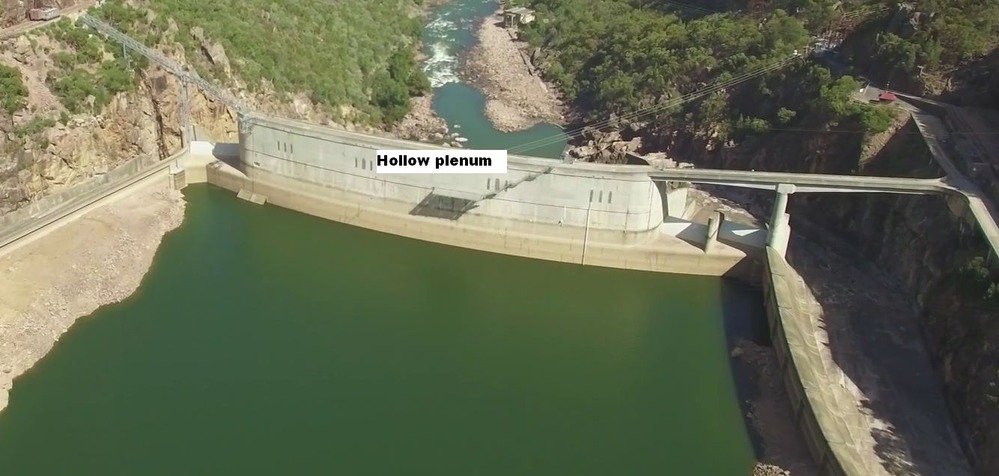
Hollow plenum is labelled. Water entry slots can be seen about halfway up the plenum. When the flood water level reaches the slots, water pours into the plenum, adding temporary mass to the dam wall. This improves the downforce. Inside the plenum are the tops of the long tie-down cables. They are grouted into granite well below the original footings of the dam.
Michael V said:
Burrinjuck dam.Far right is spillway, improved from the original.
Far left and intermediate right are the high flood spillways.
Hollow plenum is labelled. Water entry slots can be seen about halfway up the plenum. When the flood water level reaches the slots, water pours into the plenum, adding temporary mass to the dam wall. This improves the downforce. Inside the plenum are the tops of the long tie-down cables. They are grouted into granite well below the original footings of the dam.
Thanks. My learning for today.
Ian said:
Michael V said:
Burrinjuck dam.Far right is spillway, improved from the original.
Far left and intermediate right are the high flood spillways.
Hollow plenum is labelled. Water entry slots can be seen about halfway up the plenum. When the flood water level reaches the slots, water pours into the plenum, adding temporary mass to the dam wall. This improves the downforce. Inside the plenum are the tops of the long tie-down cables. They are grouted into granite well below the original footings of the dam.
Thanks. My learning for today.
Is there a link on this with more details? I don’t see the point at the moment.
Why not just fill the voids with concrete (density 2.5 t/m3) or compacted soil (density 2t/m3) rather than water (density 1t/m3).
Or just leave off the back face of the “plenum”, so the space fills with water anyway.
The Rev Dodgson said:
Ian said:
Michael V said:
Burrinjuck dam.Far right is spillway, improved from the original.
Far left and intermediate right are the high flood spillways.
Hollow plenum is labelled. Water entry slots can be seen about halfway up the plenum. When the flood water level reaches the slots, water pours into the plenum, adding temporary mass to the dam wall. This improves the downforce. Inside the plenum are the tops of the long tie-down cables. They are grouted into granite well below the original footings of the dam.
Thanks. My learning for today.
Is there a link on this with more details? I don’t see the point at the moment.
Why not just fill the voids with concrete (density 2.5 t/m3) or compacted soil (density 2t/m3) rather than water (density 1t/m3).
Or just leave off the back face of the “plenum”, so the space fills with water anyway.
There’s little on the net about the improvements to Burrinjuck. I am going on my memories when I was lecturing Geology at Sydney University, and we took a group of Engineering Geology students to visit the dam repairs and upgrades. While the students were being lectured by the dam engineers, I was privileged to be shown through the interior of the dam, which had had an exploratory adit put in to investigate the dam wall.
From memory:
Michael V said:
The Rev Dodgson said:
Ian said:Thanks. My learning for today.
Is there a link on this with more details? I don’t see the point at the moment.
Why not just fill the voids with concrete (density 2.5 t/m3) or compacted soil (density 2t/m3) rather than water (density 1t/m3).
Or just leave off the back face of the “plenum”, so the space fills with water anyway.
There’s little on the net about the improvements to Burrinjuck. I am going on my memories when I was lecturing Geology at Sydney University, and we took a group of Engineering Geology students to visit the dam repairs and upgrades. While the students were being lectured by the dam engineers, I was privileged to be shown through the interior of the dam, which had had an exploratory adit put in to investigate the dam wall.
From memory:
- Original contractors cheated, using lower quality concrete than specified, omitting reinforcing steel, and volume-filling with granite boulders during unsupervised night shifts.
- The dam was overtopped in the 1920s, causing the dam wall to crack near its base.
- A study after the 1974 floods (to re-examine catchments and refine flood event frequency statistics) showed that flood events were well underestimated for the Burrinjuck catchment, leading to the assessment that the potential for the dam to fail was much higher than previously imagined. (We were told that it was assessed as the most likely dam in the world to fail.) Warning sirens were installed downstream, at Jugiong and Gundagai, such was the gravity of the assessment.
- The adit showed the size of many boulders to be >>2 m.
- The adit had developed stalctites and stalagmites quite quickly, and water was both dripping and running through the roof of the adit.
- The adit showed that the near-basal crack was a pretty much through-going and continuous failure.
- Concrete had fretted around the (steel plate, water-controlling, cable operated) “flag” valves for the twin pipe feeds to the abandoned power station. The 2” thick steel plates had buckled and become inoperable and were close to failing. Much dangerous work was being done to reinforce this section.
- The low-quality concrete in the dam wall was considered to be unable to withstand a permanent extra load, especially with a major crack in the base of the wall. It was considered that with the extra rear-loading on the wall during a flood, it could stand further temporary downloading via the mechanism of the water-filled plenum. I thought it a nifty solution.
- The dam was through-drilled and cables grouted into rock way below the dam wall. These were tensioned. Some failed.
Wonder why the goverment used Bodgey Bros Dams and Stuff?
Michael V said:
The Rev Dodgson said:
Ian said:Thanks. My learning for today.
Is there a link on this with more details? I don’t see the point at the moment.
Why not just fill the voids with concrete (density 2.5 t/m3) or compacted soil (density 2t/m3) rather than water (density 1t/m3).
Or just leave off the back face of the “plenum”, so the space fills with water anyway.
There’s little on the net about the improvements to Burrinjuck. I am going on my memories when I was lecturing Geology at Sydney University, and we took a group of Engineering Geology students to visit the dam repairs and upgrades. While the students were being lectured by the dam engineers, I was privileged to be shown through the interior of the dam, which had had an exploratory adit put in to investigate the dam wall.
From memory:
- Original contractors cheated, using lower quality concrete than specified, omitting reinforcing steel, and volume-filling with granite boulders during unsupervised night shifts.
- The dam was overtopped in the 1920s, causing the dam wall to crack near its base.
- A study after the 1974 floods (to re-examine catchments and refine flood event frequency statistics) showed that flood events were well underestimated for the Burrinjuck catchment, leading to the assessment that the potential for the dam to fail was much higher than previously imagined. (We were told that it was assessed as the most likely dam in the world to fail.) Warning sirens were installed downstream, at Jugiong and Gundagai, such was the gravity of the assessment.
- The adit showed the size of many boulders to be >>2 m.
- The adit had developed stalctites and stalagmites quite quickly, and water was both dripping and running through the roof of the adit.
- The adit showed that the near-basal crack was a pretty much through-going and continuous failure.
- Concrete had fretted around the (steel plate, water-controlling, cable operated) “flag” valves for the twin pipe feeds to the abandoned power station. The 2” thick steel plates had buckled and become inoperable and were close to failing. Much dangerous work was being done to reinforce this section.
- The low-quality concrete in the dam wall was considered to be unable to withstand a permanent extra load, especially with a major crack in the base of the wall. It was considered that with the extra rear-loading on the wall during a flood, it could stand further temporary downloading via the mechanism of the water-filled plenum. I thought it a nifty solution.
- The dam was through-drilled and cables grouted into rock way below the dam wall. These were tensioned. Some failed.
Yeah alright then this time, but just watch it.
Ian said:
Michael V said:
The Rev Dodgson said:Is there a link on this with more details? I don’t see the point at the moment.
Why not just fill the voids with concrete (density 2.5 t/m3) or compacted soil (density 2t/m3) rather than water (density 1t/m3).
Or just leave off the back face of the “plenum”, so the space fills with water anyway.
There’s little on the net about the improvements to Burrinjuck. I am going on my memories when I was lecturing Geology at Sydney University, and we took a group of Engineering Geology students to visit the dam repairs and upgrades. While the students were being lectured by the dam engineers, I was privileged to be shown through the interior of the dam, which had had an exploratory adit put in to investigate the dam wall.
From memory:
- Original contractors cheated, using lower quality concrete than specified, omitting reinforcing steel, and volume-filling with granite boulders during unsupervised night shifts.
- The dam was overtopped in the 1920s, causing the dam wall to crack near its base.
- A study after the 1974 floods (to re-examine catchments and refine flood event frequency statistics) showed that flood events were well underestimated for the Burrinjuck catchment, leading to the assessment that the potential for the dam to fail was much higher than previously imagined. (We were told that it was assessed as the most likely dam in the world to fail.) Warning sirens were installed downstream, at Jugiong and Gundagai, such was the gravity of the assessment.
- The adit showed the size of many boulders to be >>2 m.
- The adit had developed stalctites and stalagmites quite quickly, and water was both dripping and running through the roof of the adit.
- The adit showed that the near-basal crack was a pretty much through-going and continuous failure.
- Concrete had fretted around the (steel plate, water-controlling, cable operated) “flag” valves for the twin pipe feeds to the abandoned power station. The 2” thick steel plates had buckled and become inoperable and were close to failing. Much dangerous work was being done to reinforce this section.
- The low-quality concrete in the dam wall was considered to be unable to withstand a permanent extra load, especially with a major crack in the base of the wall. It was considered that with the extra rear-loading on the wall during a flood, it could stand further temporary downloading via the mechanism of the water-filled plenum. I thought it a nifty solution.
- The dam was through-drilled and cables grouted into rock way below the dam wall. These were tensioned. Some failed.
Wonder why the goverment used Bodgey Bros Dams and Stuff?
All the same reasons in 1906 as in 2019, I’d reckon. Mates, favours, kickbacks, promises, etc…
Michael V said:
The Rev Dodgson said:
Ian said:Thanks. My learning for today.
Is there a link on this with more details? I don’t see the point at the moment.
Why not just fill the voids with concrete (density 2.5 t/m3) or compacted soil (density 2t/m3) rather than water (density 1t/m3).
Or just leave off the back face of the “plenum”, so the space fills with water anyway.
There’s little on the net about the improvements to Burrinjuck. I am going on my memories when I was lecturing Geology at Sydney University, and we took a group of Engineering Geology students to visit the dam repairs and upgrades. While the students were being lectured by the dam engineers, I was privileged to be shown through the interior of the dam, which had had an exploratory adit put in to investigate the dam wall.
From memory:
- Original contractors cheated, using lower quality concrete than specified, omitting reinforcing steel, and volume-filling with granite boulders during unsupervised night shifts.
- The dam was overtopped in the 1920s, causing the dam wall to crack near its base.
- A study after the 1974 floods (to re-examine catchments and refine flood event frequency statistics) showed that flood events were well underestimated for the Burrinjuck catchment, leading to the assessment that the potential for the dam to fail was much higher than previously imagined. (We were told that it was assessed as the most likely dam in the world to fail.) Warning sirens were installed downstream, at Jugiong and Gundagai, such was the gravity of the assessment.
- The adit showed the size of many boulders to be >>2 m.
- The adit had developed stalctites and stalagmites quite quickly, and water was both dripping and running through the roof of the adit.
- The adit showed that the near-basal crack was a pretty much through-going and continuous failure.
- Concrete had fretted around the (steel plate, water-controlling, cable operated) “flag” valves for the twin pipe feeds to the abandoned power station. The 2” thick steel plates had buckled and become inoperable and were close to failing. Much dangerous work was being done to reinforce this section.
- The low-quality concrete in the dam wall was considered to be unable to withstand a permanent extra load, especially with a major crack in the base of the wall. It was considered that with the extra rear-loading on the wall during a flood, it could stand further temporary downloading via the mechanism of the water-filled plenum. I thought it a nifty solution.
- The dam was through-drilled and cables grouted into rock way below the dam wall. These were tensioned. Some failed.
Thanks MV.
Ian said:
Michael V said:
Burrinjuck dam.Far right is spillway, improved from the original.
Far left and intermediate right are the high flood spillways.
Hollow plenum is labelled. Water entry slots can be seen about halfway up the plenum. When the flood water level reaches the slots, water pours into the plenum, adding temporary mass to the dam wall. This improves the downforce. Inside the plenum are the tops of the long tie-down cables. They are grouted into granite well below the original footings of the dam.
Thanks. My learning for today.
That is really impressive.
Ian said:
Michael V said:
The Rev Dodgson said:Is there a link on this with more details? I don’t see the point at the moment.
Why not just fill the voids with concrete (density 2.5 t/m3) or compacted soil (density 2t/m3) rather than water (density 1t/m3).
Or just leave off the back face of the “plenum”, so the space fills with water anyway.
There’s little on the net about the improvements to Burrinjuck. I am going on my memories when I was lecturing Geology at Sydney University, and we took a group of Engineering Geology students to visit the dam repairs and upgrades. While the students were being lectured by the dam engineers, I was privileged to be shown through the interior of the dam, which had had an exploratory adit put in to investigate the dam wall.
From memory:
- Original contractors cheated, using lower quality concrete than specified, omitting reinforcing steel, and volume-filling with granite boulders during unsupervised night shifts.
- The dam was overtopped in the 1920s, causing the dam wall to crack near its base.
- A study after the 1974 floods (to re-examine catchments and refine flood event frequency statistics) showed that flood events were well underestimated for the Burrinjuck catchment, leading to the assessment that the potential for the dam to fail was much higher than previously imagined. (We were told that it was assessed as the most likely dam in the world to fail.) Warning sirens were installed downstream, at Jugiong and Gundagai, such was the gravity of the assessment.
- The adit showed the size of many boulders to be >>2 m.
- The adit had developed stalctites and stalagmites quite quickly, and water was both dripping and running through the roof of the adit.
- The adit showed that the near-basal crack was a pretty much through-going and continuous failure.
- Concrete had fretted around the (steel plate, water-controlling, cable operated) “flag” valves for the twin pipe feeds to the abandoned power station. The 2” thick steel plates had buckled and become inoperable and were close to failing. Much dangerous work was being done to reinforce this section.
- The low-quality concrete in the dam wall was considered to be unable to withstand a permanent extra load, especially with a major crack in the base of the wall. It was considered that with the extra rear-loading on the wall during a flood, it could stand further temporary downloading via the mechanism of the water-filled plenum. I thought it a nifty solution.
- The dam was through-drilled and cables grouted into rock way below the dam wall. These were tensioned. Some failed.
Wonder why the goverment used Bodgey Bros Dams and Stuff?
roughbarked said:
Ian said:
Michael V said:There’s little on the net about the improvements to Burrinjuck. I am going on my memories when I was lecturing Geology at Sydney University, and we took a group of Engineering Geology students to visit the dam repairs and upgrades. While the students were being lectured by the dam engineers, I was privileged to be shown through the interior of the dam, which had had an exploratory adit put in to investigate the dam wall.
From memory:
- Original contractors cheated, using lower quality concrete than specified, omitting reinforcing steel, and volume-filling with granite boulders during unsupervised night shifts.
- The dam was overtopped in the 1920s, causing the dam wall to crack near its base.
- A study after the 1974 floods (to re-examine catchments and refine flood event frequency statistics) showed that flood events were well underestimated for the Burrinjuck catchment, leading to the assessment that the potential for the dam to fail was much higher than previously imagined. (We were told that it was assessed as the most likely dam in the world to fail.) Warning sirens were installed downstream, at Jugiong and Gundagai, such was the gravity of the assessment.
- The adit showed the size of many boulders to be >>2 m.
- The adit had developed stalctites and stalagmites quite quickly, and water was both dripping and running through the roof of the adit.
- The adit showed that the near-basal crack was a pretty much through-going and continuous failure.
- Concrete had fretted around the (steel plate, water-controlling, cable operated) “flag” valves for the twin pipe feeds to the abandoned power station. The 2” thick steel plates had buckled and become inoperable and were close to failing. Much dangerous work was being done to reinforce this section.
- The low-quality concrete in the dam wall was considered to be unable to withstand a permanent extra load, especially with a major crack in the base of the wall. It was considered that with the extra rear-loading on the wall during a flood, it could stand further temporary downloading via the mechanism of the water-filled plenum. I thought it a nifty solution.
- The dam was through-drilled and cables grouted into rock way below the dam wall. These were tensioned. Some failed.
Wonder why the goverment used Bodgey Bros Dams and Stuff?
It wasn’t the firs time and undoubtedly won’t be the last.
Many of the concrete irrigation canals built during the 20/30’s have had to be replaced due to poor concrete.
roughbarked said:
Many of the concrete irrigation canals built during the 20/30’s have had to be replaced due to poor concrete.
With cheap Chinese plastic?
2.6million just for an access upgrade. https://abergeldie.com.au/projects/dam-construction/burrinjuck-dam-access-upgrade/
party_pants said:
roughbarked said:Many of the concrete irrigation canals built during the 20/30’s have had to be replaced due to poor concrete.
With cheap Chinese plastic?
Too weak, too thin. There were holes you could drive a car through in some places, leaking all that valuable water and causing water table/salinity issues. Cost 90 million to fix about 6km, recently.
Michael V said:
There’s little on the net about the improvements to Burrinjuck. I am going on my memories when I was lecturing Geology at Sydney University, and we took a group of Engineering Geology students to visit the dam repairs and upgrades. While the students were being lectured by the dam engineers, I was privileged to be shown through the interior of the dam, which had had an exploratory adit put in to investigate the dam wall.
From memory:
- Original contractors cheated, using lower quality concrete than specified, omitting reinforcing steel, and volume-filling with granite boulders during unsupervised night shifts.
- The dam was overtopped in the 1920s, causing the dam wall to crack near its base.
- A study after the 1974 floods (to re-examine catchments and refine flood event frequency statistics) showed that flood events were well underestimated for the Burrinjuck catchment, leading to the assessment that the potential for the dam to fail was much higher than previously imagined. (We were told that it was assessed as the most likely dam in the world to fail.) Warning sirens were installed downstream, at Jugiong and Gundagai, such was the gravity of the assessment.
- The adit showed the size of many boulders to be >>2 m.
- The adit had developed stalctites and stalagmites quite quickly, and water was both dripping and running through the roof of the adit.
- The adit showed that the near-basal crack was a pretty much through-going and continuous failure.
- Concrete had fretted around the (steel plate, water-controlling, cable operated) “flag” valves for the twin pipe feeds to the abandoned power station. The 2” thick steel plates had buckled and become inoperable and were close to failing. Much dangerous work was being done to reinforce this section.
- The low-quality concrete in the dam wall was considered to be unable to withstand a permanent extra load, especially with a major crack in the base of the wall. It was considered that with the extra rear-loading on the wall during a flood, it could stand further temporary downloading via the mechanism of the water-filled plenum. I thought it a nifty solution.
- The dam was through-drilled and cables grouted into rock way below the dam wall. These were tensioned. Some failed.
I am so jealous. I wish i’d been on your visit to dam repairs and upgrades.
I did get visits to Syd Opera House, Pheasants Nest Bridge, both during construction and to a lovely sewage treatment works and wollongong steelworks. And to a tall building under construction.
But that’s not the same as a dam. Wish i could have been there.
mollwollfumble said:
Michael V said:There’s little on the net about the improvements to Burrinjuck. I am going on my memories when I was lecturing Geology at Sydney University, and we took a group of Engineering Geology students to visit the dam repairs and upgrades. While the students were being lectured by the dam engineers, I was privileged to be shown through the interior of the dam, which had had an exploratory adit put in to investigate the dam wall.
From memory:
- Original contractors cheated, using lower quality concrete than specified, omitting reinforcing steel, and volume-filling with granite boulders during unsupervised night shifts.
- The dam was overtopped in the 1920s, causing the dam wall to crack near its base.
- A study after the 1974 floods (to re-examine catchments and refine flood event frequency statistics) showed that flood events were well underestimated for the Burrinjuck catchment, leading to the assessment that the potential for the dam to fail was much higher than previously imagined. (We were told that it was assessed as the most likely dam in the world to fail.) Warning sirens were installed downstream, at Jugiong and Gundagai, such was the gravity of the assessment.
- The adit showed the size of many boulders to be >>2 m.
- The adit had developed stalctites and stalagmites quite quickly, and water was both dripping and running through the roof of the adit.
- The adit showed that the near-basal crack was a pretty much through-going and continuous failure.
- Concrete had fretted around the (steel plate, water-controlling, cable operated) “flag” valves for the twin pipe feeds to the abandoned power station. The 2” thick steel plates had buckled and become inoperable and were close to failing. Much dangerous work was being done to reinforce this section.
- The low-quality concrete in the dam wall was considered to be unable to withstand a permanent extra load, especially with a major crack in the base of the wall. It was considered that with the extra rear-loading on the wall during a flood, it could stand further temporary downloading via the mechanism of the water-filled plenum. I thought it a nifty solution.
- The dam was through-drilled and cables grouted into rock way below the dam wall. These were tensioned. Some failed.
I am so jealous. I wish i’d been on your visit to dam repairs and upgrades.
I did get visits to Syd Opera House, Pheasants Nest Bridge, both during construction and to a lovely sewage treatment works and wollongong steelworks. And to a tall building under construction.
But that’s not the same as a dam. Wish i could have been there.
Yeah. It was awesome. A real highlight of my life.