Date: 5/04/2019 10:54:46
From: mollwollfumble
ID: 1371041
Subject: HOMO-LUMO?

Small coloured organic compounds.

Water is not completely colourless, as we know, but let’s assume that it is, and that similar small organic compounds are colourless.

“The vast majority of simple organic compounds (e.g. ethanol) are colourless. Organic compounds tend to be coloured when there is extensive conjugation, causing the energy gap between the HOMO and LUMO to decrease, bringing the absorption band from the UV to the visible region. … HOMO and LUMO are types of molecular orbitals. The acronyms stand for highest occupied molecular orbital and lowest unoccupied molecular orbital. The energy difference between the HOMO and LUMO is termed the HOMO–LUMO gap”.

So, where can I find information about the size of the HOMO-LUMO gap for small coloured organic compounds?
Reply Quote

Date: 5/04/2019 11:14:34
From: mollwollfumble
ID: 1371054
Subject: re: HOMO-LUMO?

mollwollfumble said:


Small coloured organic compounds.

Water is not completely colourless, as we know, but let’s assume that it is, and that similar small organic compounds are colourless.

“The vast majority of simple organic compounds (e.g. ethanol) are colourless. Organic compounds tend to be coloured when there is extensive conjugation, causing the energy gap between the HOMO and LUMO to decrease, bringing the absorption band from the UV to the visible region. … HOMO and LUMO are types of molecular orbitals. The acronyms stand for highest occupied molecular orbital and lowest unoccupied molecular orbital. The energy difference between the HOMO and LUMO is termed the HOMO–LUMO gap”.

So, where can I find information about the size of the HOMO-LUMO gap for small coloured organic compounds?

The smaller the organic molecule, the larger the HOMO-LUMO gap. So as size of molecule increases, and the number of double bonds increases, the colour goes from colourless (absorbs UV) to yellow (absorbs dark blue) to orange (absorbs light blue) to red (absorbs green).

That would go a long way towards explaining the colours and colour bands of Jupiter and Saturn. For example the great red spot would have the deepest convection cell and therefore the largest organic molecules on Jupiter.

Buta-1,3-diene has two double bonds, which isn’t enough to generate a colour, it absorbs in UV.

Reply Quote

Date: 5/04/2019 11:24:02
From: Cymek
ID: 1371061
Subject: re: HOMO-LUMO?

That would go a long way towards explaining the colours and colour bands of Jupiter and Saturn. For example the great red spot would have the deepest convection cell and therefore the largest organic molecules on Jupiter.

I wonder if the organic molecules have evolved over time and the colour of the spot changes

Reply Quote

Date: 5/04/2019 19:09:01
From: mollwollfumble
ID: 1371386
Subject: re: HOMO-LUMO?

Cymek said:


That would go a long way towards explaining the colours and colour bands of Jupiter and Saturn. For example the great red spot would have the deepest convection cell and therefore the largest organic molecules on Jupiter.

I wonder if the organic molecules have evolved over time and the colour of the spot changes

I hadn’t thought of evolved over time – it makes sense in that some are gases and liquids at different temperature so tend to populate different cloud levels.

The red spot does change colour over time, but IMHO that’s because the circulatory storm gets stronger (more red) or weaker (more orange).

Reply Quote

Date: 5/04/2019 19:31:40
From: mollwollfumble
ID: 1371399
Subject: re: HOMO-LUMO?

> So, where can I find information about the size of the HOMO-LUMO gap for small coloured organic compounds?

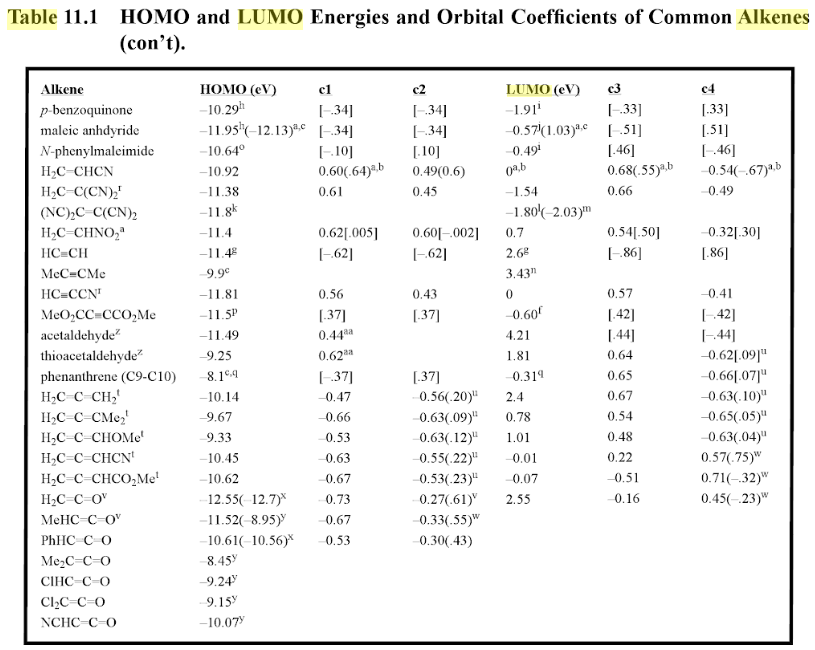
LUMOHOMO = 10 eV for butadiene.

Incomplete Table from preview of Google book “Organic synthesis”. The LUMOHOMO looks too big almost all of these to be coloured.

The gap is only 7.8 eV for phenanthrene, but that’s a big little molecule. Nup, still colourless.

Reply Quote

Date: 5/04/2019 20:03:52
From: mollwollfumble
ID: 1371419
Subject: re: HOMO-LUMO?

Coloured organic compounds are extremely common, but have to be big, hence the problem with Miller-Urey, Miller knew the experiments were working because they turned black. But nobody followed up to find out what black chemicals they were.

Reply Quote