Date: 17/06/2019 13:05:30
From: Tau.Neutrino
ID: 1400622
Subject: Kamioka Observatory - Super Kamiokande
Interesting article on Japan’s Neutrino Detector.
Interesting article on Japan’s Neutrino Detector.
It’s a crappy format.
Tau.Neutrino said:
Inside the ‘secret underground lair’ where scientists are searching the galaxies – ABC News (Australian Broadcasting Corporation)Interesting article on Japan’s Neutrino Detector.
> It’s a crappy format
Agree. Froze my browser.
So, adding gadolinium to the super-k. Interesting. I’ll see what wiki and other sources say about that.
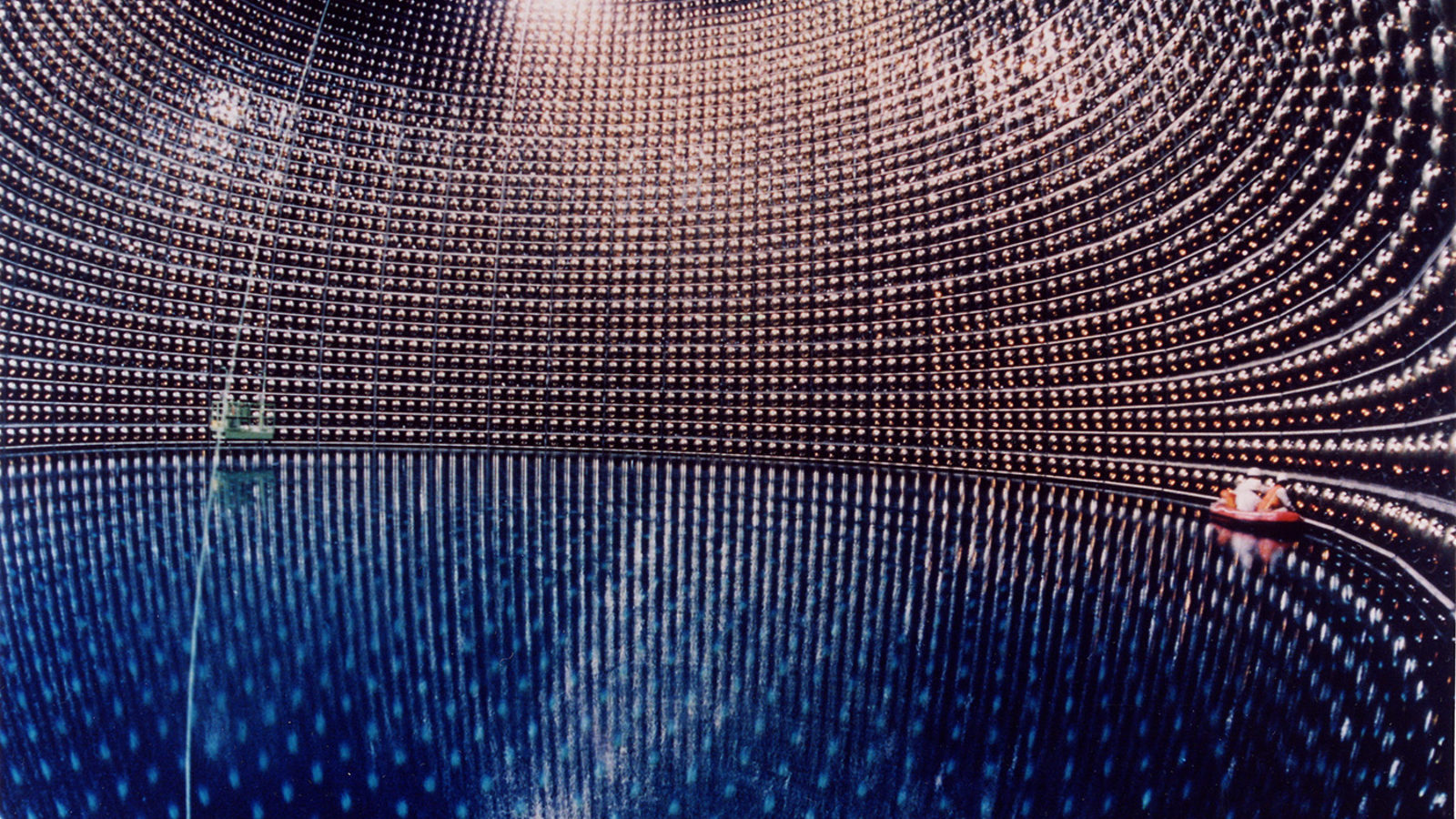
From 2015,
Recently members of the Super-K collaboration gave the go-ahead to a plan to make the detector a thousand times more sensitive with the help of a chemical compound called gadolinium sulfate.
Super-K catches about 30 neutrinos that interact with the hydrogen and oxygen in the water molecules in its tank each day. It keeps its water ultrapure with a filtration system that removes bacteria, ions and gases.
For about half of the year, the Super-K detector is used in the T2K experiment, which produces a beam of neutrinos in Tokai, Japan, some 295 kilometers away, and aims it at Super-K. During the trip to the detector, some of the neutrinos change from one type of neutrino to another. T2K studies that change.
Vagins and Beacom settled proposed to add 100 tons of the compound gadolinium sulfate—Gd2(SO4)3—to Super-K’s ultrapure water.
When a neutrino interacts with water, it releases a charged lepton (a muon, electron, tau or one of their antiparticles) along with a neutron. Neutrons are thousands of times more likely to interact with the gadolinium sulfate than with another water molecule. So when a neutrino traverses Super-K, its muon, electron, or antiparticle (Super-K can’t see tau particles) will generate a first pulse of light, and the neutron will create a second pulse of light: “two pulses, like a knock-knock.”
To extract only the neutrino interactions, scientists will use super-k-gd to focus on the two-signal events and throw out the single-signal events, reducing the background noise considerably.
But you can’t just add 100 tons of a chemical compound to a huge detector without doing some tests first. So Vagins and colleagues built a scaled-down version, which they called Evaluating Gadolinium’s Action on Detector Systems (EGADS). At 0.4 percent the size of Super-K, it uses 240 of the same phototubes and 200 tons (52,000 gallons) of ultrapure water.
> On November 12, 2001, about 6,600 of the photomultiplier tubes (costing about $3000 each) in the Super-Kamiokande detector imploded, apparently in a chain reaction or cascading failure, as the shock wave from the concussion of each imploding tube cracked its neighbours.
Wow. I missed that.
> full refurbishment during Autumn of 2018. On January 29 2019 the detector resumed data-taking.
Good.
> Realtime supernova monitor. To detect and identify such bursts as efficiently and promptly as possible Super-Kamiokande is equipped with an online supernova monitor system. About 10,000 total events are expected in Super-Kamiokande for a supernova explosion at the center of our Galaxy. Super-Kamiokande can measure a burst with no dead-time, up to 30,000 events within the first second of a burst.
Good! I had missed that, too.
> Water purification system. Originally, ion-exchanger (IE) was included in system, but it was removed when IE resin was found to be a significant radon source.
Oops.
Super Kamiokande video released in May 2019.
http://www-sk.icrr.u-tokyo.ac.jp/sk/library/video-e.html
Super-k is now 23 years old.
Not much in the following web link. But it does give a better explanation of how gadolinium can help.
https://www.nature.com/articles/d41586-019-00598-9
Most solar neutrinos reveal themselves by knocking an electron off a water molecule at high speed, thereby producing a faint flash of light (which is what Super-K’s ‘eyes’ see). But other neutrinos — and, in particular, the antineutrinos that constitute the bulk of supernova emissions — interact with a proton in an atomic nucleus instead of with an electron. This collision releases a neutron and a positron, the antimatter version of the electron. The positron’s signal is difficult for the detector to distinguish from that of an electron from a solar neutrino. But the neutron produces its own signature — a γ-ray — when captured by another nucleus.
Gadolinium nuclei are much more effective than are water’s hydrogen or oxygen nuclei at capturing such stray neutrons, and the γ-rays they produce are easier for Super-K to detect, as another flash of light. Thus, when an antineutrino hits, Super-K will see not one flash but two, a few microseconds apart.
Dang it, wikipedia need updating again. Not a whisper on the page about thebuse of gadolinium. Nothing on the official super-k website, either.
mollwollfumble said:
Super Kamiokande video released in May 2019.http://www-sk.icrr.u-tokyo.ac.jp/sk/library/video-e.html
Super-k is now 23 years old.
Not much in the following web link. But it does give a better explanation of how gadolinium can help.
https://www.nature.com/articles/d41586-019-00598-9
Most solar neutrinos reveal themselves by knocking an electron off a water molecule at high speed, thereby producing a faint flash of light (which is what Super-K’s ‘eyes’ see). But other neutrinos — and, in particular, the antineutrinos that constitute the bulk of supernova emissions — interact with a proton in an atomic nucleus instead of with an electron. This collision releases a neutron and a positron, the antimatter version of the electron. The positron’s signal is difficult for the detector to distinguish from that of an electron from a solar neutrino. But the neutron produces its own signature — a γ-ray — when captured by another nucleus.
Gadolinium nuclei are much more effective than are water’s hydrogen or oxygen nuclei at capturing such stray neutrons, and the γ-rays they produce are easier for Super-K to detect, as another flash of light. Thus, when an antineutrino hits, Super-K will see not one flash but two, a few microseconds apart.
Dang it, wikipedia need updating again. Not a whisper on the page about thebuse of gadolinium. Nothing on the official super-k website, either.
I have to send that video to neutrino, otherwise known as Missy.
sibeen said:
It’s a crappy format.
Froze my android, but it does work nicely on windows. Scroll by clicking on the sidebar.
Some technical details, a bit too technical unfortunately, from 2015.
http://www-sk2.icrr.u-tokyo.ac.jp/sk/pub/documents/1311.3738.pdf
The next one is much easier to read, from 2007. GADZOOKS!
https://sci-hub.tw/https://www.sciencedirect.com/science/article/pii/S0920563207001260
On average, there is one supernova explosion somewhere in our universe every second. Consequently, all the neutrinos which have ever been emitted by every supernova since the onset of stellar formation suffuse the universe. These constitute the diffuse supernova neutrino background , also known as the “relic” supernova neutrinos. If observable, the DSNB could provide a steady stream of information about not only stellar collapse and nucleosynthesis but also on the evolving size, speed, and nature of the universe itself.
If we were to introduce a 0.1% solution of gadolinium into Super–Kamiokande, we could collect enough reactor antineutrino data to re-produce KamLAND’s entire planned six-year data-taking run by by Super–K with GdCl3 in seven weeks.
From August 13, 2018
https://arxiv.org/pdf/1402.6411.pdf
A promising technique for detecting final state neutrons is the search for a delayed signal from their capture on Gadolinium dissolved in the target liquid. Even moderately energetic neutrons ranging from tens to hundreds of MeV will quickly lose energy by collisions with free protons and oxygen nuclei in water. Once thermalized, the neutrons are captured, creating unstable nuclei and excited states that emit radiation. Neutron capture in pure water typically produces around 2.2 MeV in gamma particles (γ). However, these low energy photons produce very little optical light and are difficult to detect in large WCh tanks.The introduction of Gadolinium (Gd) salts dissolved in the target liquid is proposed as an effective way to improve the detection efficiency of thermal neutrons. With a significantly larger capture cross-section (49,000 barns compared with 0.3 barns on a free proton), Gd-captures happen roughly 10 times faster, on the order of tens of microseconds. In addition,the Gd-capture produces an 8 MeV cascade of typically 2-3 gammas, producing sufficient optical light to be more reliably detected in large volumes.
Gadolinium dissolved in the water would give a factor of 10 improvement in detection of proton decay.
Here is an explanation for lay people like myself, from 2018, about the prototype. The prototype EGADS is a 200 ton tank containing 0.2% Gd2(SO4)3
https://www.ipmu.jp/sites/default/files/imce/news/43E_Research.pdf
mollwollfumble said:
Super Kamiokande video released in May 2019.http://www-sk.icrr.u-tokyo.ac.jp/sk/library/video-e.html
Super-k is now 23 years old.
Not much in the following web link. But it does give a better explanation of how gadolinium can help.
https://www.nature.com/articles/d41586-019-00598-9
Most solar neutrinos reveal themselves by knocking an electron off a water molecule at high speed, thereby producing a faint flash of light (which is what Super-K’s ‘eyes’ see). But other neutrinos — and, in particular, the antineutrinos that constitute the bulk of supernova emissions — interact with a proton in an atomic nucleus instead of with an electron. This collision releases a neutron and a positron, the antimatter version of the electron. The positron’s signal is difficult for the detector to distinguish from that of an electron from a solar neutrino. But the neutron produces its own signature — a γ-ray — when captured by another nucleus.
Gadolinium nuclei are much more effective than are water’s hydrogen or oxygen nuclei at capturing such stray neutrons, and the γ-rays they produce are easier for Super-K to detect, as another flash of light. Thus, when an antineutrino hits, Super-K will see not one flash but two, a few microseconds apart.
Dang it, wikipedia need updating again. Not a whisper on the page about the use of gadolinium. Nothing on the official super-k website, either.
I fixed wikipedia, added a new section https://en.wikipedia.org/wiki/Super-Kamiokande#Gadolinium