To start, a quick review of some historical systems of top-level taxonomy.
Carl Linnaeus issued various models in the 18th century, but all of them divided the biological world into plants and animals. Some of his calls with regard to splitting up algae appear to have been somewhat arbitrary.
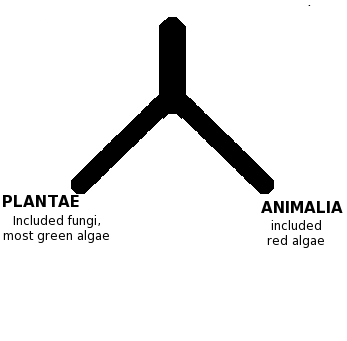
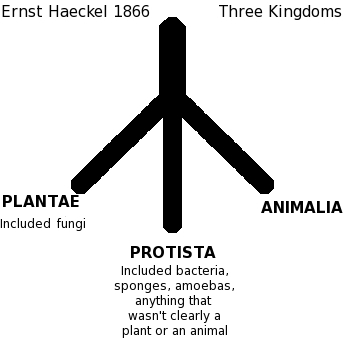
Ernst Haeckel was among the first to try to incorporate unicellular forms into the Tree of Life in a systematic way (1866). As he did not have access to electron microscopes and RNA/DNA had not been discovered, he relied on the form and function that could be seen with the naked eye or with an optical microscope, and there were some errors. He included the fungi with the plants, and anything unicellular was put in one basket, called Protista.
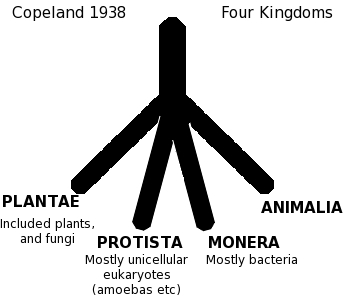
The advent of the electron microscope gave insight into cellular structure that allowed the distinction to be made between forms without a cell nucleus and those with a cell nucleus. Unicellular eukaryotes (ie life forms with a cell nucleus), he kept in Protista, but he moved those without a cell nucleus into a new kingdom called Monera.
At this time, the only members of what we now call Archaea were called Methobacteria, and were considered to be just a weird clade of Bacteria. As the decades passed, more life forms of this type were found, mostly extremophiles of one kind or another, and so they were put in a major group called Archaebacteria (still part of Bacteria).
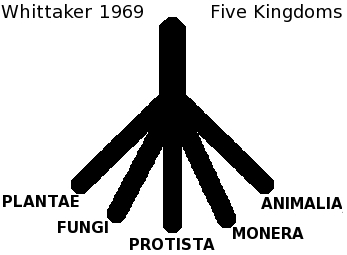
In the 1960s, Fungi were moved into a separate Kingdom, mostly on the basis of their separate form of nutrition.
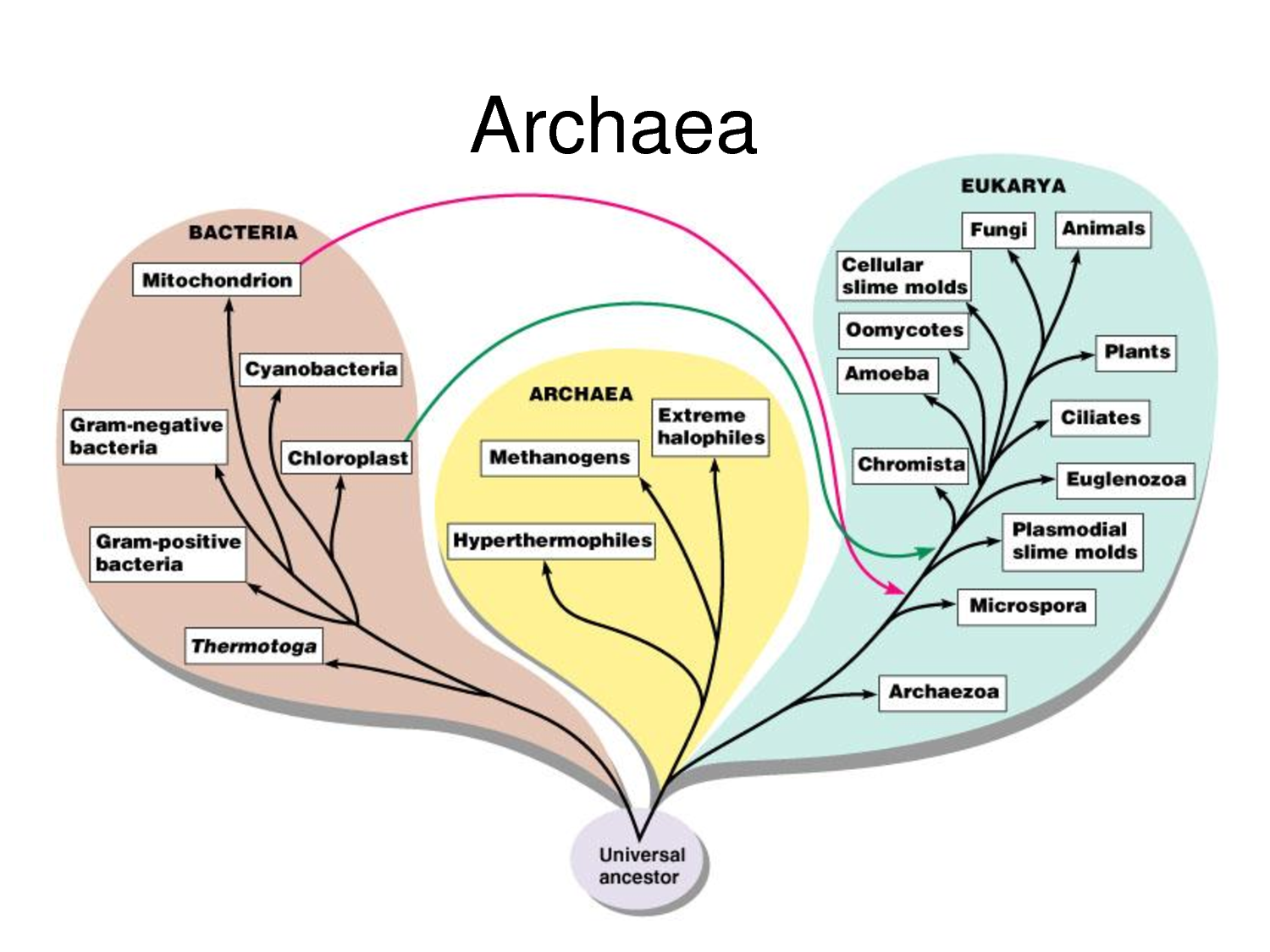
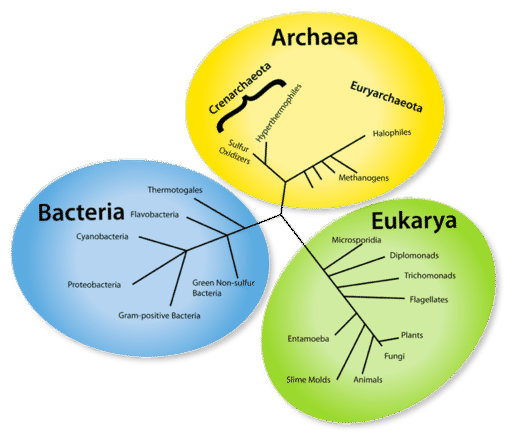
By the 1970s, improved techniques allowed directly comparison of genetic sequences. Woese showed that the “archaebacteria” were not Bacteria at all: they had very different RNA sequences, and diverged very early from Bacteria. They were rebadged as Archaea. Further, he showed that Archaea were much closer to Eukaryotes than they were to Bacteria. By the late 1990s, the Three Domain model was well established. The term Kingdom was still applied to Animalia, Plantae etc but the Kingdom was a lower level than the Domain. By that stage, many more kinds of Archaea had been discovered, and it was known they were not just in extreme environments: they were in human intestines, in peat bogs, in soil, on plant roots, everywhere. Other functional similarities were found between Eukaryota and Archaea: for instance they have multiple RNA polymerases, whereas Bacteria have but one.
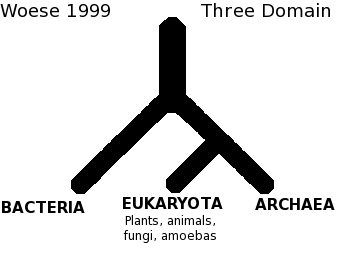
As you can see, the Woese Three Kingdom’s model, which probably remains the most widely accepted, shows Eukaryota and Archaea as two separate, monophyletic clades. It is often said that Eukaryota diverged because of horizontal gene transfer from some kind of Bacteria, or perhaps via Viral Eukaryogenesis. Creation of a cellular nucleus involved a major structural change, and it would seem that most authors reject the idea that it could happen through “normal” mutation-driven evolution.
In the last few years, some studies have challenged the W3K model. Like previous challenges to phylogenic models, this has partly been driven my new information arising from technological change: specifically, the ability to perform massive phylogenomic studies involving dozens or hundreds of subjects in a reasonable time period.
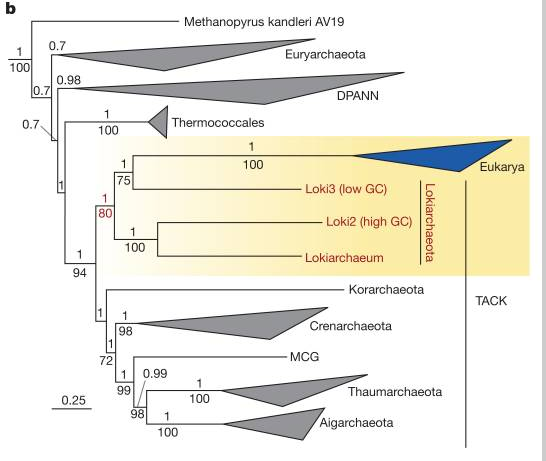
The 2015 Spang et Al paper below, “Complex archaea that bridge the gap between prokaryotes and eukaryotes”, for instance, found that Eukaryota and a small clade of Archaea called the Lokiarchaeota were together monophyletic: that is to say, Eukaryota is more closely related to Lokiarchaeota than to other kinds of Archaea.
https://www.ncbi.nlm.nih.gov/pmc/articles/PMC4444528/
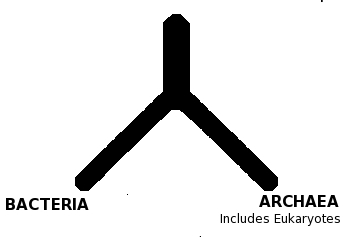
From the standpoint of pure cladistics, this would place all Eukaryota (all plants, animals, fungi, amoebas etc) squarely within the domain Archaea, meaning we are back to a Two Domain system.
Two caveats:
1/ Eukaryota’s relationship to Archaea remains a hot topic so more studies might bring alternative explanations for Spang et al’s results.
2/ Horizontal gene transfer is a bit of a challenge for pure cladistics anyway. Within Eukaryota, things are fairly straightforward: every cell was formed by mitosis or meiosis or fusion between two cells closely related forms. It’s a messier story if a cell has genetic information sourced from two different Domains.