Date: 2/01/2020 15:00:45
From: PermeateFree
ID: 1479914
Subject: Another link in the chain of life

>>For decades, scientists have pondered the so-called “phosphate problem” when seeking to understand the origins of life on Earth. The problem revolves around the fact that phosphorous is one of the six key chemical ingredients of life, yet its scarcity raises the question of how early Earth supplied this essential element. A new study has now provided a possible explanation.

The study, conducted by researchers at the University of Washington, looked at lakes rich in carbonate, which form in dry environments when water drains from the surrounding landscape into depressions. Due to the high evaporation rates of these shallow lakes, the waters become highly salty and alkaline solutions, hence their name alkaline or soda lakes.

The researchers examined phosphorous levels in existing carbonate-rich lakes, which are found on all seven continents. Although phosphorous concentrations are affected by when and where samples are taken, the team found that the levels of phosphorous found in such lakes can be up to 50,000 times that found in seawater, rivers and other types of lakes. This led the researchers to believe that there is a common, natural mechanism responsible for the accumulation of the phosphorous in these lakes.<<

>>“The extremely high phosphate levels in these lakes and ponds would have driven reactions that put phosphorus into the molecular building blocks of RNA, proteins, and fats, all of which were needed to get life going,” says study co-author David Catling, a UW professor of Earth & space sciences.

Adding extra weight to the theory is the fact that the early Earth, when the building blocks of life on Earth were developing, had a very carbon dioxide-rich atmosphere. This would have provided excellent conditions for the creation of carbonate-rich lakes with high levels of phosphorous. Additionally, carbon dioxide from the atmosphere dissolving in water would have created acidic conditions that prompt the release of phosphorous from rocks.<<

https://newatlas.com/science/high-carbonate-lakes-origin-of-life-phosphorous-problem/
Reply Quote

Date: 2/01/2020 19:54:32
From: mollwollfumble
ID: 1479998
Subject: re: Another link in the chain of life

PermeateFree said:


>>For decades, scientists have pondered the so-called “phosphate problem” when seeking to understand the origins of life on Earth. The problem revolves around the fact that phosphorous is one of the six key chemical ingredients of life, yet its scarcity raises the question of how early Earth supplied this essential element. A new study has now provided a possible explanation.

The study, conducted by researchers at the University of Washington, looked at lakes rich in carbonate, which form in dry environments when water drains from the surrounding landscape into depressions. Due to the high evaporation rates of these shallow lakes, the waters become highly salty and alkaline solutions, hence their name alkaline or soda lakes.

The researchers examined phosphorous levels in existing carbonate-rich lakes, which are found on all seven continents. Although phosphorous concentrations are affected by when and where samples are taken, the team found that the levels of phosphorous found in such lakes can be up to 50,000 times that found in seawater, rivers and other types of lakes. This led the researchers to believe that there is a common, natural mechanism responsible for the accumulation of the phosphorous in these lakes.<<

>>“The extremely high phosphate levels in these lakes and ponds would have driven reactions that put phosphorus into the molecular building blocks of RNA, proteins, and fats, all of which were needed to get life going,” says study co-author David Catling, a UW professor of Earth & space sciences.

Adding extra weight to the theory is the fact that the early Earth, when the building blocks of life on Earth were developing, had a very carbon dioxide-rich atmosphere. This would have provided excellent conditions for the creation of carbonate-rich lakes with high levels of phosphorous. Additionally, carbon dioxide from the atmosphere dissolving in water would have created acidic conditions that prompt the release of phosphorous from rocks.<<

https://newatlas.com/science/high-carbonate-lakes-origin-of-life-phosphorous-problem/

Part of my concern is that all three parts of RNA (and also proteins) were generated under different oxidising conditions, suggesting different atmospheres and in turn different ages of the Earth.

Proteins are best generated under conditions with lots of hydrogen and small amounts of oxygen and nitrogen – which suggests Earth’s secondary atmosphere hadn’t yet developed.

Nucleotides from RNA are best generated from HCN with less hydrogen than proteins but much more hydrogen than oxygen.

Sugars from RNA are best generated from CH2O where the oxygen in Earth’s atmosphere has risen to the ratio H2O found in water.

Phosphates from RNA, PO4, comes when the Earth’s hydrogen has nearly vanished when compared with oxygen.

Four different epochs in the history of Earth’s atmosphere.

That’s why I suspect that protein-like chemicals came first, then nucleotides, then sugars, and only RNA when phosphates enter the picture.

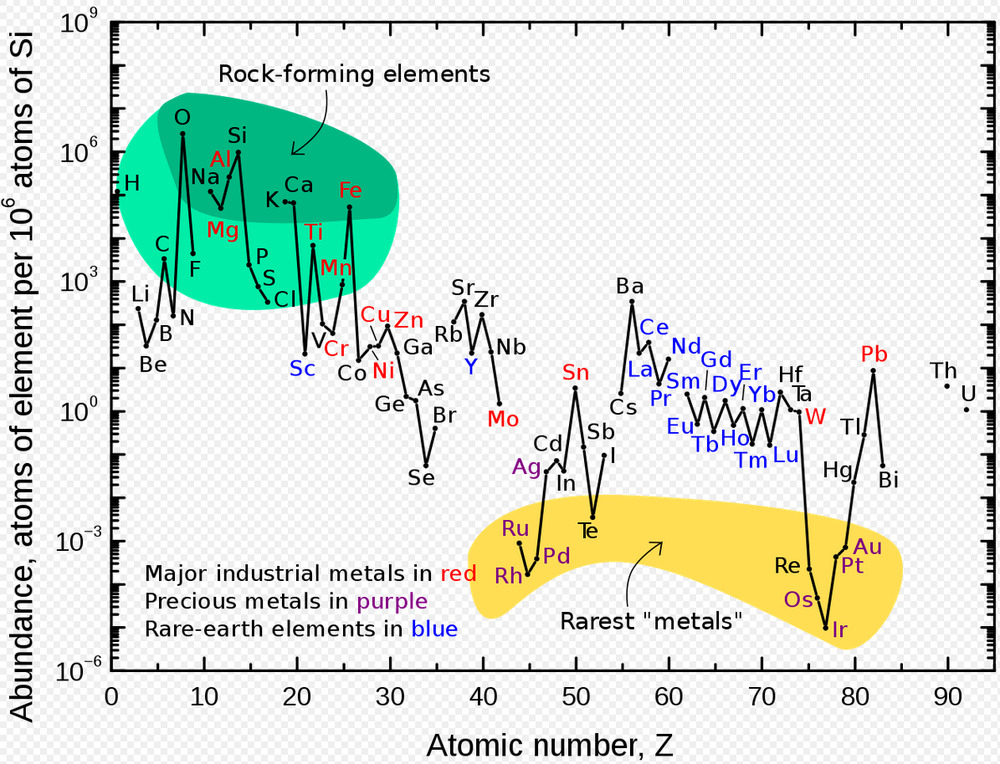
Phosphorus is not rare. See how in the following chart it is more prevalent than both nitrogen and sulfur, and is almost as common as carbon.

Reply Quote