Einstein wins again: Star orbits black hole just like GR predicts
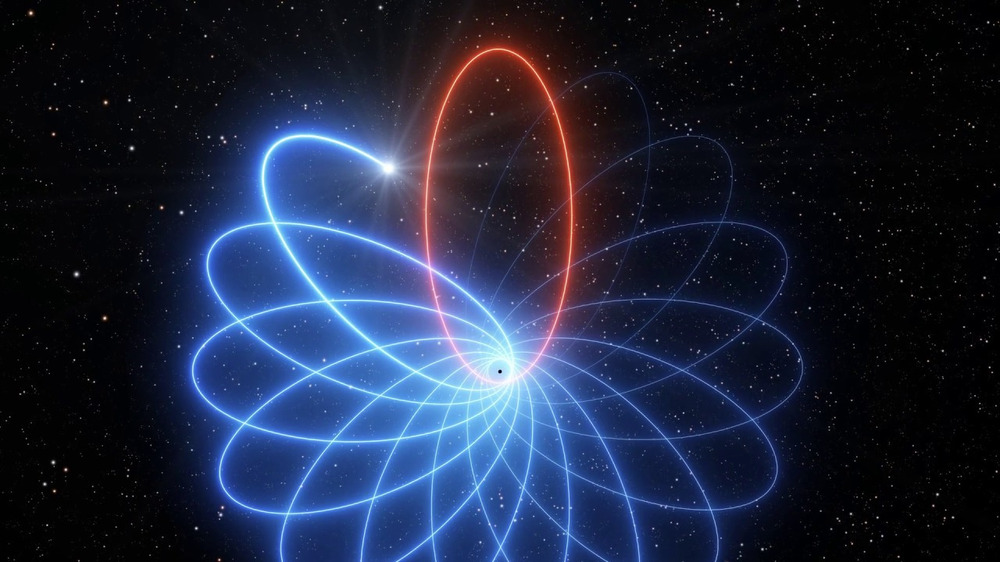
After nearly 30 years, VLT’s new observations show star moves in rosette-shaped orbit.
more…
Einstein wins again: Star orbits black hole just like GR predicts
After nearly 30 years, VLT’s new observations show star moves in rosette-shaped orbit.
more…
I think probably general relativity is non-controversial these days
Is the star being bumped into the next magnetic feild line?
That is BHs have magnetic field lines?
Apparently yes
https://www.iflscience.com/space/magnetic-fields-can-be-strong-black-holes-gravity/
dv said:
I think probably general relativity is non-controversial these days
yeah when we saw it we thumped foreheads into tables
but Newton won again
and the tables thumped foreheads
dv said:
I think probably general relativity is non-controversial these days
I will remind you that Einstein’s ideas are ‘just a theory’.
You know, like evolution is ‘just a theory’.
Next thing, you’ll be saying that theories might have some scientific validity, and where would that leave Genesis? Huh? Where, huh?
captain_spalding said:
dv said:
I think probably general relativity is non-controversial these days
I will remind you that Einstein’s ideas are ‘just a theory’.
You know, like evolution is ‘just a theory’.
Next thing, you’ll be saying that theories might have some scientific validity, and where would that leave Genesis? Huh? Where, huh?
theoretically in the dustbin i guess
captain_spalding said:
dv said:
I think probably general relativity is non-controversial these days
I will remind you that Einstein’s ideas are ‘just a theory’.
You know, like evolution is ‘just a theory’.
Next thing, you’ll be saying that theories might have some scientific validity, and where would that leave Genesis? Huh? Where, huh?
évolution is a theorem
SCIENCE said:
captain_spalding said:
dv said:
I think probably general relativity is non-controversial these days
I will remind you that Einstein’s ideas are ‘just a theory’.
You know, like evolution is ‘just a theory’.
Next thing, you’ll be saying that theories might have some scientific validity, and where would that leave Genesis? Huh? Where, huh?
évolution is a theorem
Well, maybe evolution with an accent aigu, is.
SCIENCE said:
dv said:
I think probably general relativity is non-controversial these days
yeah when we saw it we thumped foreheads into tables
but Newton won again
and the tables thumped foreheads
ChrispenEvan said:
captain_spalding said:
dv said:
I think probably general relativity is non-controversial these days
I will remind you that Einstein’s ideas are ‘just a theory’.
You know, like evolution is ‘just a theory’.
Next thing, you’ll be saying that theories might have some scientific validity, and where would that leave Genesis? Huh? Where, huh?
theoretically in the dustbin i guess
or like fossil fuels, keep them buried, or turn them into CO2
Link to paper
Dynamically important magnetic fields near accreting supermassive black holes
https://www.nature.com/articles/nature13399
Tau.Neutrino said:
Link to paperDynamically important magnetic fields near accreting supermassive black holes
https://www.nature.com/articles/nature13399
opps
Ill try that again
Detection of the Schwarzschild precession in the orbit of the starS2 near the Galactic centre massive black hole
https://www.eso.org/public/archives/releases/sciencepapers/eso2006/eso2006a.pdf
Tau.Neutrino said:
Is the star being bumped into the next magnetic feild line?That is BHs have magnetic field lines?
Apparently yes
https://www.iflscience.com/space/magnetic-fields-can-be-strong-black-holes-gravity/
Not bumped just following
Is the star following the black holes magnetic field lines?
That sounds better.
Tau.Neutrino said:
Tau.Neutrino said:
Is the star being bumped into the next magnetic feild line?That is BHs have magnetic field lines?
Apparently yes
https://www.iflscience.com/space/magnetic-fields-can-be-strong-black-holes-gravity/
Not bumped just following
Is the star following the black holes magnetic field lines?
That sounds better.
I think it’s just precession. Same thing happens to Mercury:
https://en.m.wikipedia.org/wiki/Tests_of_general_relativity
Tau.Neutrino said:
Tau.Neutrino said:
Is the star being bumped into the next magnetic feild line?That is BHs have magnetic field lines?
Apparently yes
https://www.iflscience.com/space/magnetic-fields-can-be-strong-black-holes-gravity/
Not bumped just following
Is the star following the black holes magnetic field lines?
That sounds better.
No.
https://en.wikipedia.org/wiki/Tests_of_general_relativity#Perihelion_precession_of_Mercury
ChrispenEvan said:
Tau.Neutrino said:
Tau.Neutrino said:
Is the star being bumped into the next magnetic feild line?That is BHs have magnetic field lines?
Apparently yes
https://www.iflscience.com/space/magnetic-fields-can-be-strong-black-holes-gravity/
Not bumped just following
Is the star following the black holes magnetic field lines?
That sounds better.
No.
https://en.wikipedia.org/wiki/Tests_of_general_relativity#Perihelion_precession_of_Mercury
Exactly so. The dominant GR deviation of an orbit from a Newtonian orbit is perihelion advance, not spiralling in.
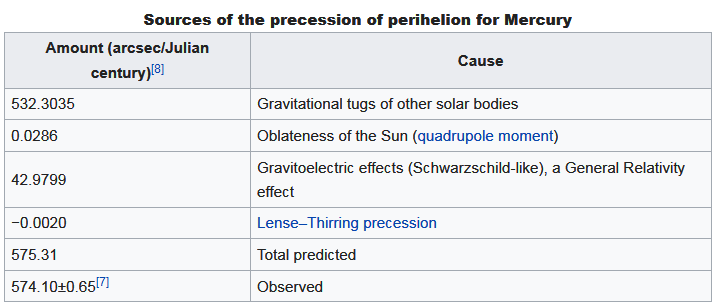
I have to add here that Newtonian theory also allows perihelion advance, but of a different magnitude. How so, how does Newtonian physics allow non-Keplerian orbits? The chart below shows how. GR causes an anomalous perihelion advance of only 8% for Mercury, and the Lens-Thirring effect (frame dragging) is negligible.
The deviation of experiment and observation here is 1.9 sigma. Too large for comfort.
mollwollfumble said:
ChrispenEvan said:
Tau.Neutrino said:Not bumped just following
Is the star following the black holes magnetic field lines?
That sounds better.
No.
https://en.wikipedia.org/wiki/Tests_of_general_relativity#Perihelion_precession_of_Mercury
Exactly so. The dominant GR deviation of an orbit from a Newtonian orbit is perihelion advance, not spiralling in.
I have to add here that Newtonian theory also allows perihelion advance, but of a different magnitude. How so, how does Newtonian physics allow non-Keplerian orbits? The chart below shows how. GR causes an anomalous perihelion advance of only 8% for Mercury, and the Lens-Thirring effect (frame dragging) is negligible.
The deviation of experiment and observation here is 1.9 sigma. Too large for comfort.

Any idea how they calculate the sigma?
As an engineer, it looks way too small ;)