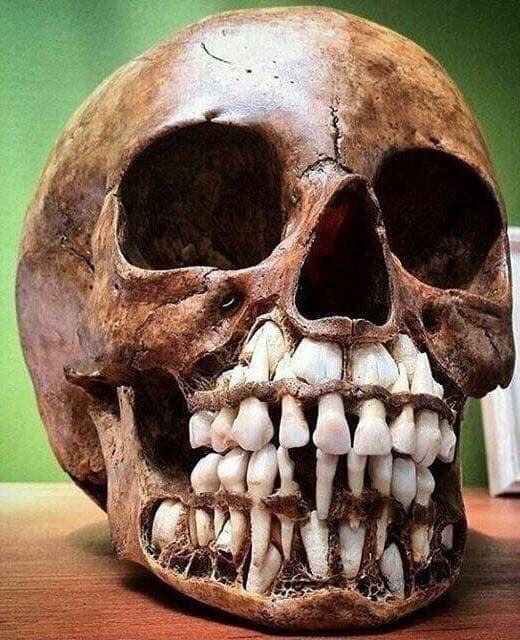
Date: 11/08/2020 05:46:45
From: mollwollfumble
ID: 1602878
Subject: Baby teeth
Which animals other than humans have baby teeth?
Which animals other than humans have baby teeth?
mollwollfumble said:
Which animals other than humans have baby teeth?
Dogs.
Probably other primates.
if they drink milk, they probably do
WP says:
A diphyodont is any animal with two successive sets of teeth, initially the “deciduous” set and consecutively the “permanent” set. Most mammals are diphyodonts—as to chew their food they need a strong, durable and complete set of teeth.
dv said:
WP says:A diphyodont is any animal with two successive sets of teeth, initially the “deciduous” set and consecutively the “permanent” set. Most mammals are diphyodonts—as to chew their food they need a strong, durable and complete set of teeth.
Tamb said:
dv said:
WP says:A diphyodont is any animal with two successive sets of teeth, initially the “deciduous” set and consecutively the “permanent” set. Most mammals are diphyodonts—as to chew their food they need a strong, durable and complete set of teeth.
Where do wisdom teeth fit in this system?
Mine fit in at the back of my mouth.
Michael V said:
Tamb said:
dv said:
WP says:A diphyodont is any animal with two successive sets of teeth, initially the “deciduous” set and consecutively the “permanent” set. Most mammals are diphyodonts—as to chew their food they need a strong, durable and complete set of teeth.
Where do wisdom teeth fit in this system?Mine fit in at the back of my mouth.
Am i correct that the human jaw has decreased in size over the past million year or so?
Michael V said:
Tamb said:
dv said:
WP says:A diphyodont is any animal with two successive sets of teeth, initially the “deciduous” set and consecutively the “permanent” set. Most mammals are diphyodonts—as to chew their food they need a strong, durable and complete set of teeth.
Where do wisdom teeth fit in this system?Mine fit in at the back of my mouth.
Michael V said:
Tamb said:
dv said:
WP says:A diphyodont is any animal with two successive sets of teeth, initially the “deciduous” set and consecutively the “permanent” set. Most mammals are diphyodonts—as to chew their food they need a strong, durable and complete set of teeth.
Where do wisdom teeth fit in this system?Mine fit in at the back of my mouth.
Lucky those are whose wisdom fits their mouth.
dv said:
WP says:A diphyodont is any animal with two successive sets of teeth, initially the “deciduous” set and consecutively the “permanent” set. Most mammals are diphyodonts—as to chew their food they need a strong, durable and complete set of teeth.
Most?
Cats aren’t, I suspect. And that probably means most carnivores. What about herbivores? I’ve never heard of a horse losing its baby teeth, unless that’s what is meant by “never look a gift horse in the mouth”?
Sharks have baby teeth of course, but aren’t “diphyodonts”.
Frogs have baby teeth, but no adult teeth.
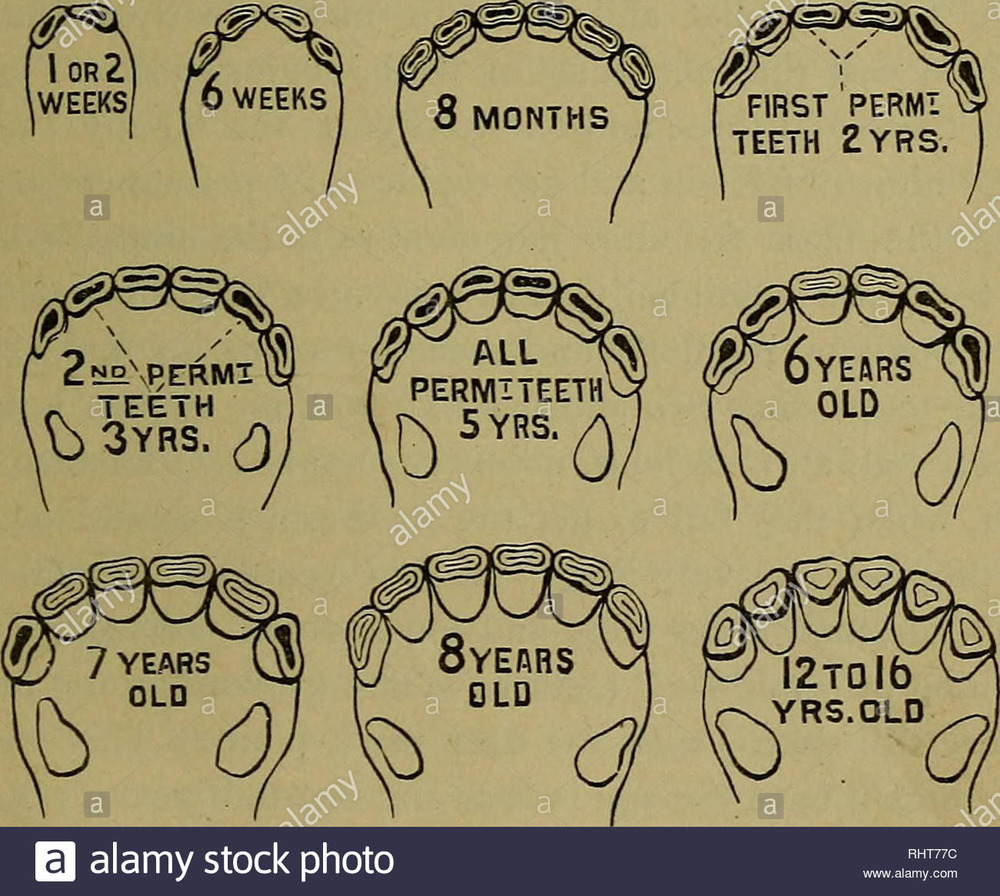
Checks web. Horses do have baby teeth. First permanent teeth appear at age 2. Last permanent teeth appear at age 5.
Some lizards are polyphyodont species.
From book “on the anatomy of vertebrates … mammals:”
The monophyodonts include the monotremes, tuberculates (anteaters) and bruta (including elephant and walrus). All other orders are diphyodonts.
So cats have baby teeth, it seems (amazing).
mollwollfumble said:
dv said:
WP says:A diphyodont is any animal with two successive sets of teeth, initially the “deciduous” set and consecutively the “permanent” set. Most mammals are diphyodonts—as to chew their food they need a strong, durable and complete set of teeth.
Most?
Cats aren’t, I suspect. And that probably means most carnivores. What about herbivores? I’ve never heard of a horse losing its baby teeth, unless that’s what is meant by “never look a gift horse in the mouth”?
Sharks have baby teeth of course, but aren’t “diphyodonts”.
Frogs have baby teeth, but no adult teeth.
Checks web. Horses do have baby teeth. First permanent teeth appear at age 2. Last permanent teeth appear at age 5.
Some lizards are polyphyodont species.
From book “on the anatomy of vertebrates … mammals:”
The monophyodonts include the monotremes, tuberculates (anteaters) and bruta (including elephant and walrus). All other orders are diphyodonts.So cats have baby teeth, it seems (amazing).
elephants have four teeth at any one time that replace periodically six times over their life span.. the replacement is a process of slowly pushing the existing tooth out which sheers off so they alway have teeth to chew their food. ie no ‘gaps’ like humans who lose their teeth have. So while they have no baby teeth as such, they don’t have only one set of teeth for their whole life…
Arts said:
mollwollfumble said:
dv said:
WP says:A diphyodont is any animal with two successive sets of teeth, initially the “deciduous” set and consecutively the “permanent” set. Most mammals are diphyodonts—as to chew their food they need a strong, durable and complete set of teeth.
Most?
Cats aren’t, I suspect. And that probably means most carnivores. What about herbivores? I’ve never heard of a horse losing its baby teeth, unless that’s what is meant by “never look a gift horse in the mouth”?
Sharks have baby teeth of course, but aren’t “diphyodonts”.
Frogs have baby teeth, but no adult teeth.
Checks web. Horses do have baby teeth. First permanent teeth appear at age 2. Last permanent teeth appear at age 5.
Some lizards are polyphyodont species.
From book “on the anatomy of vertebrates … mammals:”
The monophyodonts include the monotremes, tuberculates (anteaters) and bruta (including elephant and walrus). All other orders are diphyodonts.So cats have baby teeth, it seems (amazing).
elephants have four teeth at any one time that replace periodically six times over their life span.. the replacement is a process of slowly pushing the existing tooth out which sheers off so they alway have teeth to chew their food. ie no ‘gaps’ like humans who lose their teeth have. So while they have no baby teeth as such, they don’t have only one set of teeth for their whole life…
four chewing teeth.. not including their tusks which are technically teeth but not for chewing.
mollwollfumble said:
dv said:
WP says:A diphyodont is any animal with two successive sets of teeth, initially the “deciduous” set and consecutively the “permanent” set. Most mammals are diphyodonts—as to chew their food they need a strong, durable and complete set of teeth.
Most?
Cats aren’t, I suspect. And that probably means most carnivores. What about herbivores? I’ve never heard of a horse losing its baby teeth, unless that’s what is meant by “never look a gift horse in the mouth”?
Sharks have baby teeth of course, but aren’t “diphyodonts”.
Frogs have baby teeth, but no adult teeth.
Checks web. Horses do have baby teeth. First permanent teeth appear at age 2. Last permanent teeth appear at age 5.
Some lizards are polyphyodont species.
From book “on the anatomy of vertebrates … mammals:”
The monophyodonts include the monotremes, tuberculates (anteaters) and bruta (including elephant and walrus). All other orders are diphyodonts.So cats have baby teeth, it seems (amazing).
Still looking. Going back to a paper from 1868.
REMARKS ON THE HOMOLOGIES AND NOTATION OF THE TEETH OF THE MAMMALIA.
Read at the Meeting of the British Association for the Advancement of Science, at Norwich, Aug. 20, 1868.
By WILLIAM HENRY FLOWER, F.R.S.
“the Monophyodonts or those that generate a single set of teeth; and the Diphyodonts or those that generate two sets of teeth. The Monophyodonts including the Orders Monotremata which have no real teeth, Edentata (sloths and anteaters) and Cetacea; all the rest of the class being Diphyodonts.”
The nine-banded armadillo has teeth all the same shape, but “preceded by well-developed functional milk-teeth, which closely resemble the permanent teeth in form, and nearly equal them in size, and are not shed until the animal has almost attained its full development.” I’m noting here that sloths are more closely related to anteaters than either is to armadillos.
Among the dugongs and manatees, there appear to be no milk teeth, unless as buds in the womb.
Among the elephants, only the incisors have milk teeth.
Among the rodents, there appear to be no milk teeth for the incisors.
Among the marsupials, there are contradictions. Some naturalists have noted the shedding of milk teeth by marsupials. Other naturalists say that that doesn’t happen: “no marsupial ever has milk incisors or canines, or more than one milk-molar”. “The teeth of Marsupials do not vertically displace and succeed other teeth, with the exception of a single tooth on each side of each jaw.” “Marsupials present a still
further anomaly in not having even this rudimentary milk tooth developed, and being really monophyodonts. At least I have not been able to detect it in the youngest Koalas that I have had an opportunity of examining, and I am inclined to think it doubtful in the Dasyures.”
“In the more typical terrestrial carnivore, such as the Dog, the milk-teeth, as is well known, form a distinct, well grown and functional set, with characters generally resembling those of the permanent teeth, being of a fair proportional size, and not discarded until the animal has attained to half or two thirds of its full growth, although perhaps not retained quite so long as in some of the herbivore. In the Bears, the
milk-teeth are much smaller in proportion to the permanent set than in the Dog, and are shed at a much earlier age; in fact it is quite rare to find in museums, any specimens of Bears’ skulls, however young, in which the permanent set of teeth are not in place”.
“In the ordinary Seals, the milk-teeth are extremely rudimentary in size and form, and perfectly functionless. The majority of them never cut the gums and are absorbed actually before birth. In sea lions the milk-teeth are less rudimentary and evanescent than in the true seals, the canines especially being of moderate size and retained for several weeks.”
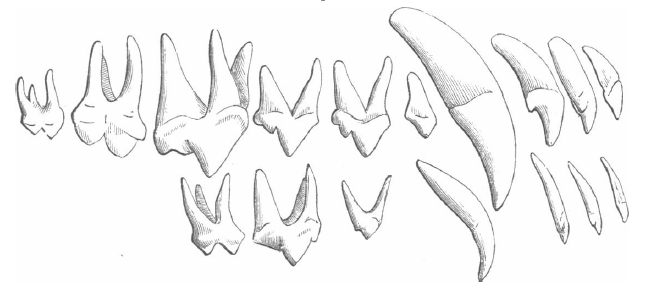
This figure shows permanent teeth (top) and milk teeth (below) of the dog.
The walrus has only extremely rudimentary milk teeth, if any.
In the hippo, “The first premolar in both jaws is a simple conical single-rooted tooth; it appears at the same time with the milk-teeth; as far as I have been able to ascertain it has no predecessor, and it generally disappears before middle life, often leaving no trace of its presence. Is this to be reckoned as a milk-tooth or a permanent tooth?”
I’ve never heard of a horse losing its baby teeth, unless that’s what is meant by “never look a gift horse in the mouth”?
—-
The best way to “age” a horse is the appearance of the adult teeth.. their length, angle, the appearance and disappearance of various features into old age.
If it’s a gift horse be thankful you’ve got any horse.
Arts said:
elephants have four teeth at any one time that replace periodically six times over their life span.. the replacement is a process of slowly pushing the existing tooth out which sheers off so they alway have teeth to chew their food. ie no ‘gaps’ like humans who lose their teeth have. So while they have no baby teeth as such, they don’t have only one set of teeth for their whole life…
Is this shearing off why I’ve never seen gaps among teeth of animals other than humans? Or am I just unobservant?
mollwollfumble said:
Arts said:elephants have four teeth at any one time that replace periodically six times over their life span.. the replacement is a process of slowly pushing the existing tooth out which sheers off so they alway have teeth to chew their food. ie no ‘gaps’ like humans who lose their teeth have. So while they have no baby teeth as such, they don’t have only one set of teeth for their whole life…
Is this shearing off why I’ve never seen gaps among teeth of animals other than humans? Or am I just unobservant?
AFAIK the shearing happens in elephants only.. due to their diet and few teeth, a gap would constitute a dietary loss and demise (which is how an aged elephant is likely to die) <—— knowledge
I suppose it’s possible that other animals also have the shearing, maybe rhinos? <—— speculationI have seen my dog lose their baby teeth and spit them out on the ground. <—— observation
I suspect that the gap filling for canines is not so essential due to the many other teeth in the mouth and that their digestive system can likely still process unmasticated food better , or maybe their permanent teeth have already erupted at that time, allowing for some mastication. <—- semi informed speculation.
Arts said:
mollwollfumble said:
Arts said:elephants have four teeth at any one time that replace periodically six times over their life span.. the replacement is a process of slowly pushing the existing tooth out which sheers off so they alway have teeth to chew their food. ie no ‘gaps’ like humans who lose their teeth have. So while they have no baby teeth as such, they don’t have only one set of teeth for their whole life…
Is this shearing off why I’ve never seen gaps among teeth of animals other than humans? Or am I just unobservant?
AFAIK the shearing happens in elephants only.. due to their diet and few teeth, a gap would constitute a dietary loss and demise (which is how an aged elephant is likely to die) <—— knowledge
I suppose it’s possible that other animals also have the shearing, maybe rhinos? <—— speculationI have seen my dog lose their baby teeth and spit them out on the ground. <—— observation
I suspect that the gap filling for canines is not so essential due to the many other teeth in the mouth and that their digestive system can likely still process unmasticated food better , or maybe their permanent teeth have already erupted at that time, allowing for some mastication. <—- semi informed speculation.
I’ve never seen any of our dogs lose their baby teeth. In fact, I was unaware that they did for many years. And then I watched with some of our pups, and never saw it. Although they have all live inside as well as outside the house, I suspect the chewing of bones from very young means the teeth came out outside and I just wasn’t ever there at the time. I’ve never dug any up in the garden that I know of either.