Date: 28/08/2020 15:37:48
From: PermeateFree
ID: 1611431
Subject: Ancient caiman with 'no parallel in the modern world' left 46 bite marks on sloth leg

About 13 million years ago, a ground sloth wandered too close to the water’s edge, where a caiman lay waiting to strike. The attack likely happened in a flash, and ended with the caiman leaving nearly 50 tooth marks in the sloth’s hind leg, a new study finds.

“There is no chance” the sloth survived, said study senior researcher Rodolfo Salas-Gismondi, a researcher of the BioGeoSciences Lab at Cayetano Heredia University in Lima, Peru. “The tibia of the sloth shows no signal of bone regeneration, which would be evidence of survival.”

The ground sloth (Pseudoprepotherium sp.) bone was found by the Napo River in northeastern Peru in 2004 by study co-author François Pujos, a paleontologist who specializes in sloth evolution at The Scientific Technological Center at the Argentine National Research Council (CCT-CONICET).

It wasn’t immediately clear what had left the 46 bite marks on the sloth’s left tibia. But in the years since Pujos discovered the bone, researchers have learned that the lakes and swamps in the early Amazon “were plethoric in crocodylians, with up to seven species living together at that time,” including a shovel-mouthed crocodile with peg-like teeth, Salas-Gismondi told Live Science in an email. (The crocodylian order includes extinct and living crocodiles, alligators, caimans and gharials.)

All of the evidence incriminated the giant caiman Purussaurus — a behemoth that could grow up to 33 feet (10 meters) long, making it the largest known non-marine predator after the extinction of non-avian dinosaurs, Salas-Gismondi said.
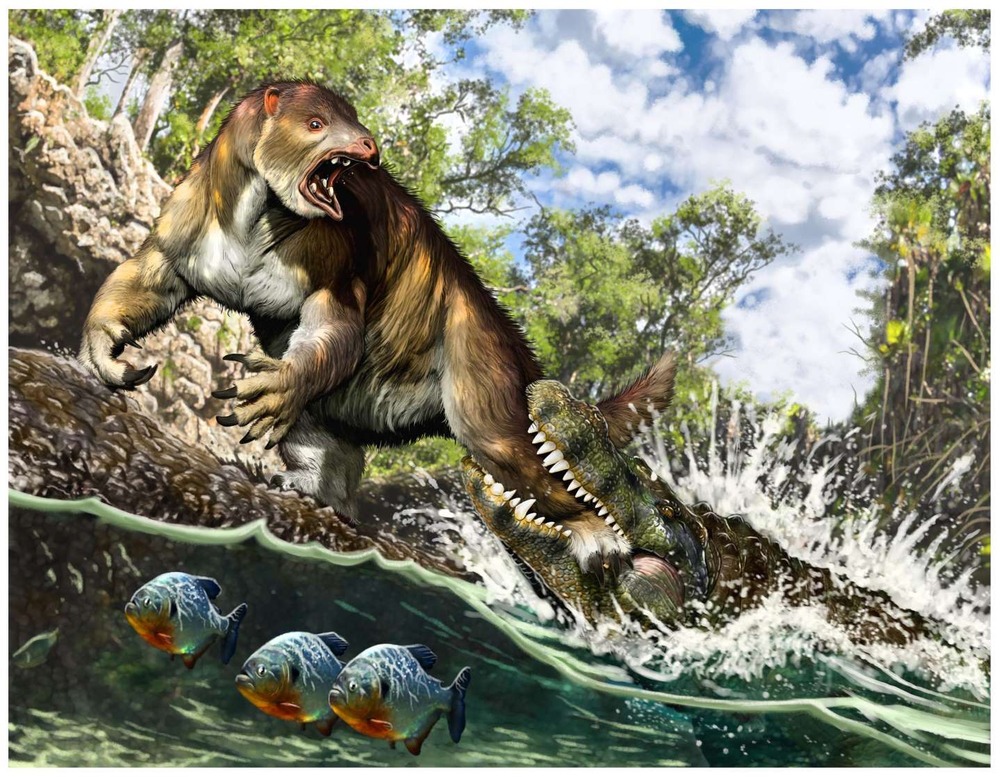
“The dentition and anatomy of Purussaurus perfectly matches with the marks found in the tibia,” he said. This Purussaurus — likely a 13-foot-long (4 m) juvenile based on the size of its tooth marks — likely ambushed the ground sloth, although another scenario is also possible, he said.

“We cannot discard that the marks were produced after death, during dismemberment of the ground sloth carcass,” Salas-Gismondi noted.

This is only the second fossil on record showing evidence of a Purussaurus attack. The other is a shell from the aquatic turtle Podocnemis, which is on display at the Natural History Museum in Lima. That turtle sustained a 25-inch-long (60 centimeter) bite mark on its shell. It “survived the attack,” Salas-Gismondi said, “but lost a big portion of the carapace and the left hindlimb was amputated. We know that the turtle survived because the carapace shows bone regeneration.”

Crunching a turtle shell would have been no problem for Purussaurus, which lived during the Miocene epoch (23 million to 5 million years ago). As an adult, this caiman had a bite force estimated at 7 tons (6.3 metric tons), more than four times the strongest bite ever measured in living and extinct animals, according to earlier research. (The saltwater crocodile Crocodylus porosus has a bite force of 1.6 tons, or 1.5 metric tons.)

“With this bite force, adult Purussaurus individuals were able to incorporate into their diet whatever, no matter the size or hardness,” Salas-Gismondi said. “These animals had no parallel in the modern world.”

https://www.msn.com/en-au/news/us/ancient-caiman-with-no-parallel-in-the-modern-world-left-46-bite-marks-on-sloth-leg/ar-BB18rmsa?ocid=msedgntp

Reply Quote

Date: 28/08/2020 20:34:34
From: mollwollfumble
ID: 1611571
Subject: re: Ancient caiman with 'no parallel in the modern world' left 46 bite marks on sloth leg

PermeateFree said:


About 13 million years ago, a ground sloth wandered too close to the water’s edge, where a caiman lay waiting to strike. The attack likely happened in a flash, and ended with the caiman leaving nearly 50 tooth marks in the sloth’s hind leg, a new study finds.

“There is no chance” the sloth survived, said study senior researcher Rodolfo Salas-Gismondi, a researcher of the BioGeoSciences Lab at Cayetano Heredia University in Lima, Peru. “The tibia of the sloth shows no signal of bone regeneration, which would be evidence of survival.”

The ground sloth (Pseudoprepotherium sp.) bone was found by the Napo River in northeastern Peru in 2004 by study co-author François Pujos, a paleontologist who specializes in sloth evolution at The Scientific Technological Center at the Argentine National Research Council (CCT-CONICET).

It wasn’t immediately clear what had left the 46 bite marks on the sloth’s left tibia. But in the years since Pujos discovered the bone, researchers have learned that the lakes and swamps in the early Amazon “were plethoric in crocodylians, with up to seven species living together at that time,” including a shovel-mouthed crocodile with peg-like teeth, Salas-Gismondi told Live Science in an email. (The crocodylian order includes extinct and living crocodiles, alligators, caimans and gharials.)

All of the evidence incriminated the giant caiman Purussaurus — a behemoth that could grow up to 33 feet (10 meters) long, making it the largest known non-marine predator after the extinction of non-avian dinosaurs, Salas-Gismondi said.

“The dentition and anatomy of Purussaurus perfectly matches with the marks found in the tibia,” he said. This Purussaurus — likely a 13-foot-long (4 m) juvenile based on the size of its tooth marks — likely ambushed the ground sloth, although another scenario is also possible, he said.

“We cannot discard that the marks were produced after death, during dismemberment of the ground sloth carcass,” Salas-Gismondi noted.

This is only the second fossil on record showing evidence of a Purussaurus attack. The other is a shell from the aquatic turtle Podocnemis, which is on display at the Natural History Museum in Lima. That turtle sustained a 25-inch-long (60 centimeter) bite mark on its shell. It “survived the attack,” Salas-Gismondi said, “but lost a big portion of the carapace and the left hindlimb was amputated. We know that the turtle survived because the carapace shows bone regeneration.”

Crunching a turtle shell would have been no problem for Purussaurus, which lived during the Miocene epoch (23 million to 5 million years ago). As an adult, this caiman had a bite force estimated at 7 tons (6.3 metric tons), more than four times the strongest bite ever measured in living and extinct animals, according to earlier research. (The saltwater crocodile Crocodylus porosus has a bite force of 1.6 tons, or 1.5 metric tons.)

“With this bite force, adult Purussaurus individuals were able to incorporate into their diet whatever, no matter the size or hardness,” Salas-Gismondi said. “These animals had no parallel in the modern world.”

https://www.msn.com/en-au/news/us/ancient-caiman-with-no-parallel-in-the-modern-world-left-46-bite-marks-on-sloth-leg/ar-BB18rmsa?ocid=msedgntp

Yike.

Reply Quote