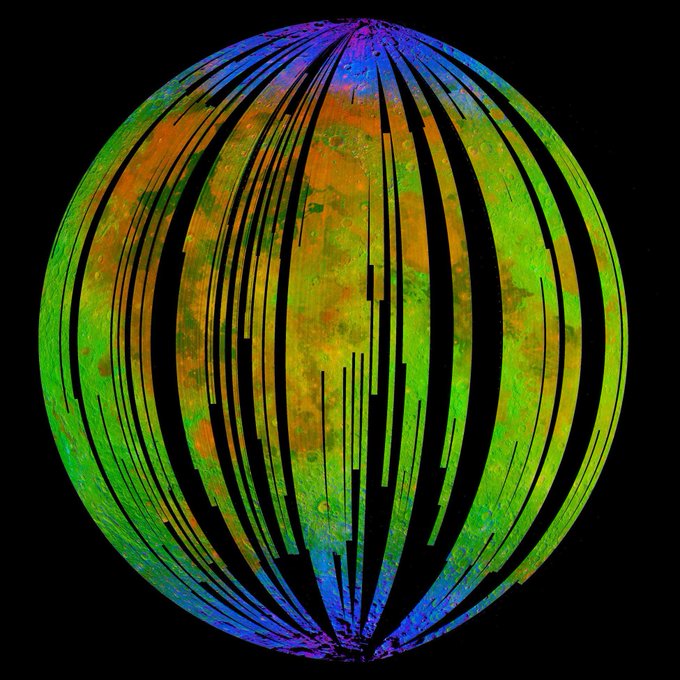
India’s Chandrayaan-1 spacecraft found hematite, a common iron oxide, is quite common the lunar near-side surface. This is surprising as conditions on the moon were thought to be very hostile to rust.
Turns out that the tail end of the Earth’s magnetic field provides enough protection (and enough traces of oxygen) for rust to form, in combination with water particles kicked up by the moon’s interaction with its accompanying dust cloud. NASA takes up the story:
“…Digging through the spectral data returned by Chandrayaan-1 a decade ago, Shuai Li, Researcher at the Hawaii Institute of Geophysics and Planetology at the University of Hawaii saw a signature that closely matched hematite.
But how could rust have possibly formed when the needed ingredients are not present?
Turns out, Earth is to blame — with a little help from the Sun.
The solar wind routinely bombards the Moon with hydrogen, which actually makes it harder for hematite to form because hydrogen adds electrons to the material it interacts with. Hematite needs the opposite: an oxidizer to remove electrons.
“It’s very puzzling,” Li said. “The Moon is a terrible environment for hematite to form in.”