Date: 31/01/2021 09:25:03
From: fsm
ID: 1687868
Subject: Family Photo Snapped by Solar Orbiter

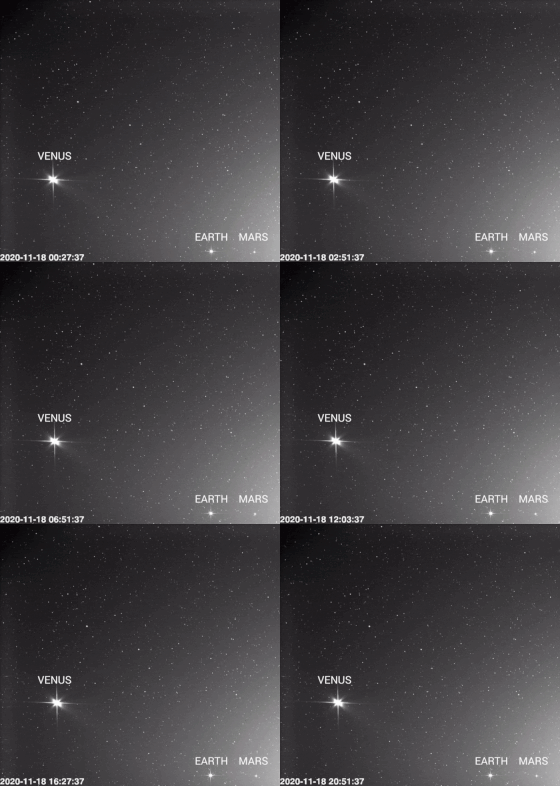
The above image was taken by a spacecraft travelling through the Solar System while it was at a distance of 251 million kilometres (156 million miles) from Earth – more than the distance between Earth and the Sun by nearly half again.

It was snapped by NASA and the European Space Agency’s Solar Orbiter, a mission to study the Sun, on 18 November 2020, while en route to its destination. It joins a burgeoning tradition of photos of Earth taken by instruments far beyond where humans ourselves can venture.

But it’s not just Earth in Solar Orbiter’s image; Venus and Mars make an appearance, too, 48 million and 332 million kilometres from the spacecraft, respectively. It’s a lovely family portrait when you think about it – three rocky planets, so similar in many ways, but so very different from each other – seen through a scientific instrument – the Heliospheric Imager – designed to study the heart of the Solar System.

https://www.sciencealert.com/photo-snapped-by-solar-orbiter-shows-venus-earth-and-mars-gleaming-like-stars

Reply Quote

Date: 31/01/2021 10:57:34
From: captain_spalding
ID: 1687886
Subject: re: Family Photo Snapped by Solar Orbiter

fsm said:


The above image was taken by a spacecraft travelling through the Solar System while it was at a distance of 251 million kilometres (156 million miles) from Earth – more than the distance between Earth and the Sun by nearly half again.

It was snapped by NASA and the European Space Agency’s Solar Orbiter, a mission to study the Sun, on 18 November 2020, while en route to its destination. It joins a burgeoning tradition of photos of Earth taken by instruments far beyond where humans ourselves can venture.

But it’s not just Earth in Solar Orbiter’s image; Venus and Mars make an appearance, too, 48 million and 332 million kilometres from the spacecraft, respectively. It’s a lovely family portrait when you think about it – three rocky planets, so similar in many ways, but so very different from each other – seen through a scientific instrument – the Heliospheric Imager – designed to study the heart of the Solar System.

https://www.sciencealert.com/photo-snapped-by-solar-orbiter-shows-venus-earth-and-mars-gleaming-like-stars

I think i can see my house…

Reply Quote

Date: 31/01/2021 11:15:28
From: mollwollfumble
ID: 1687896
Subject: re: Family Photo Snapped by Solar Orbiter

Solar Orbiter? Checks web.

Taking the closest ever images of the Sun, observing the solar wind and the Sun’s polar regions like never before, unravelling the mysteries of the solar cycle.

Launch date: February 2020. First images released in July 2020. Beginning of routine science operations: November 2021. The closest distance to the Sun: 42 million kilometres.

SolO makes observations of the Sun from an eccentric orbit moving as close as ≈60 solar radii (RS), or 0.284 astronomical units (au), placing it inside Mercury’s perihelion of 0.3075 au. During the mission the orbital inclination will be raised to about 24°.

First closest approach to Sun, Sept 2023. Will have 8 Venus flybys, once every two Venus years or so.

This is not nearly as close to the Sun as Parker Solar Probe. But Parker Solar Probe doesn’t take pictures of the Sun, only the Solar Corona.

I hope hope hope that it will take photos of variable cosmic objects on the far side of the Sun from the Earth.

Reply Quote