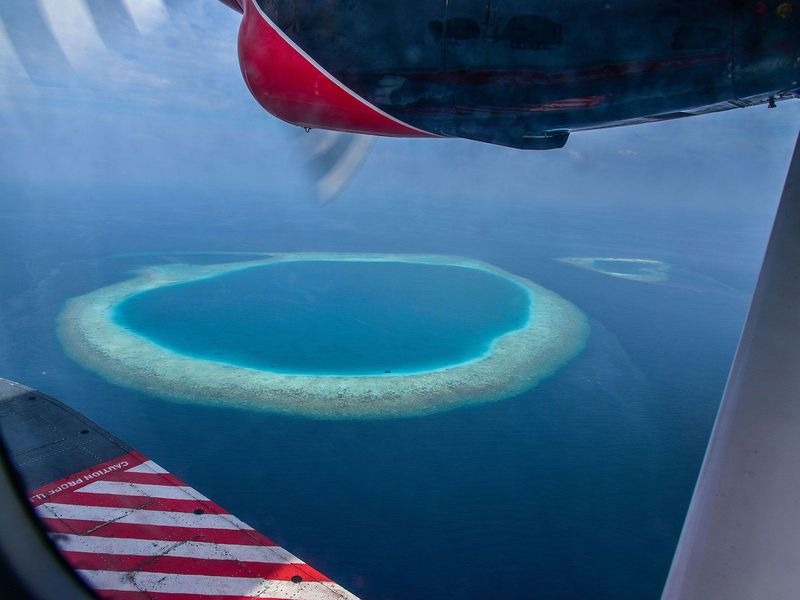
The ring-shaped coral islands known as atolls, like this one in the Maldives Islands in the Indian Ocean, may trace their formation to sea levels repeatedly rising and falling over hundreds of thousands of years, geologists say.
During the famous voyage of the HMS Beagle, which circumnavigated the globe from 1831 to 1836, naturalist Charles Darwin wasn’t thinking only about evolution. He was also working with navigators to chart the coral reefs that the Beagle encountered in the South Pacific and Indian oceans. Along the way, Darwin hatched new ideas about the formation of reefs — including the shimmering island rings of coral known as atolls.
Once upon a time, Darwin proposed, there must have been a volcano rising from the seafloor. Coral grew in a ring around it, as tiny marine organisms cemented themselves into a reef circling the volcano’s flanks. And then, at some point, the volcano eroded away, sinking beneath the waves and leaving the atoll ring behind.
https://thumbs-prod.si-cdn.com/79pUsqNKcatokK4CNzJdjWdT0Uc=/fit-in/1072×0/filters:focal(198×171:199×172)/https://public-media.si-cdn.com/filer/39/18/39189cc2-263e-4466-b32a-11510109e7f1/g-atoll-darwin-model.gif
Instead, he says, atolls form thanks to sea levels fluctuating cyclically over hundreds of thousands of years. When seas fall, exposing a pre-existing pile of carbonate rocks, rainwater dissolves the center of those rocks and leaves behind a depression. When seas rise, corals build themselves up in a ring around that depression, forming an atoll. No volcano is needed.
https://thumbs-prod.si-cdn.com/7ETo-tizo1tBGr2KKf3q_az_wrg=/fit-in/1072×0/filters:focal(201×201:202×202)/https://public-media.si-cdn.com/filer/48/bf/48bf6c6d-b755-4483-abfc-7b30d07b6382/g-atoll-droxler-jorry-model.gif
Over the last 500,000 years or so, those dramatic shifts in sea level — up to 135 meters (440 feet) — created many atolls, Droxler and Jorry argue. As a first step, imagine if sea levels drop and expose the top of a flat-topped bank of carbonate rocks. Rain falls from the sky, pooling on top of the carbonates. Because rainwater is usually mildly acidic, it starts to dissolve the rocks. This process is known as karstification, and it’s the same thing that happens in places like Kentucky when rainwater percolates through underground limestone and dissolves it, forming dramatic caverns such as Mammoth Cave.
Global sea levels have risen and fallen over geological history, driven by changes in global climate. Over the last half a million years, sea levels fluctuated even more dramatically. Changes in Earth’s orbit cooled the planet, locking up much of its water in ice sheets near the poles and causing global sea levels to drop. Later much of the ice melted, causing sea levels to rise again. These changes in sea level may have driven the formation of many atolls.
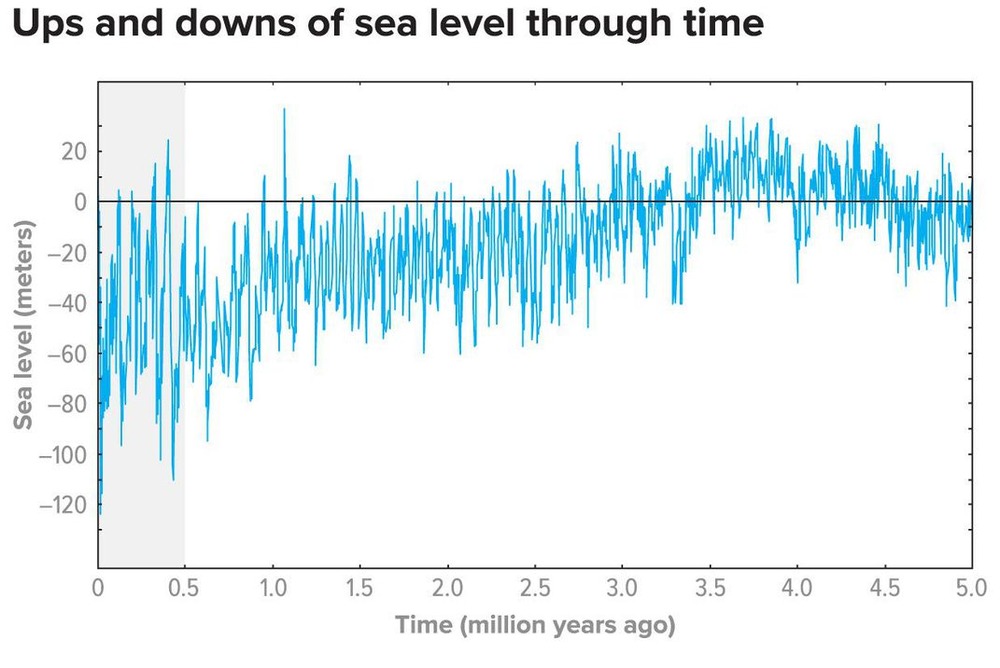
Over thousands to hundreds of thousands of years, as sea levels drop and rise and drop again, a circular atoll gradually forms around the central depression, or lagoon. Darwin didn’t recognize that this process formed atolls because geologists of his era had not yet understood ice ages and the regular fluctuations in sea level, Droxler says.
Darwin’s ideas about atolls might not be entirely wrong. At least some reefs in Tahiti might have formed in the way he envisioned, a team of researchers argued in a 2014 paper. “But we have also known for a long time that there are several other ways for atolls to develop,” says Anna Weiss, a paleontologist at Midwestern State University in Wichita Falls, Texas, who studies ancient reefs. “It’s a mistake to overgeneralize things in geoscience.” Several reefs in Belize, for instance, rise from atop a chunk of continental crust that tectonic forces thrust close to the ocean surface. And one study of a particular atoll in the Maldives argues that it was shaped more by waves crashing into it than by karstification.
https://www.smithsonianmag.com/science-nature/why-some-geologists-say-charles-darwins-theory-coral-atoll-formation-wrong-180977052/