Date: 7/04/2021 02:34:42
From: PermeateFree
ID: 1721339
Subject: Bald Eagle Killer Identified

An interesting and informative read with possible serious environmental outcomes.
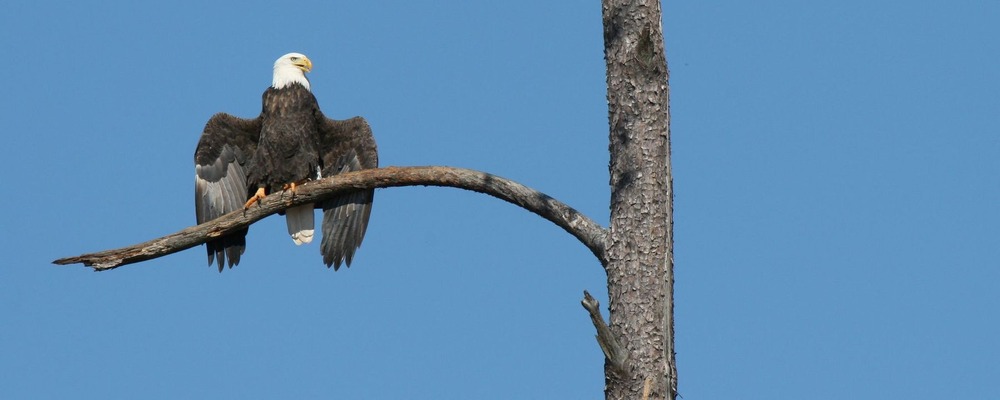
Late in 1994 around DeGray Lake in Arkansas, people started seeing bald eagles miss their perches as they tried to land and fly into rock walls. Within just a few months, 29 of the animals had died. Two years after the first episode, 26 more eagles perished after displaying similar behaviors. When wildlife biologists examined the dead eagles and other affected waterbirds, they found extensive lesions throughout the brain and spinal cord. By 1998, at least 10 episodes of the new disease—termed avian vacuolar myelinopathy (AVM)—had occurred throughout the southeastern US, but no one knew the cause.

Researchers have been making progress on the case bit by bit since then. In 2005, they linked the deaths with a newly discovered cyanobacterial species (later named Aetokthonos hydrillicola; the genus means “eagle killer”) that grows on an invasive plant (Hydrilla verticillata) in humanmade reservoirs near where the birds have died. In a study published today (March 25) in Science, the authors show that this cyanobacterium generates a neurotoxin that is the causative agent of the disease. Specifically, the cyanobacterium incorporates the element bromine—both natural and human-introduced—when it’s seasonally available from the environment, forming a toxin the authors named aetokthonotoxin for “poison that kills the eagle.”


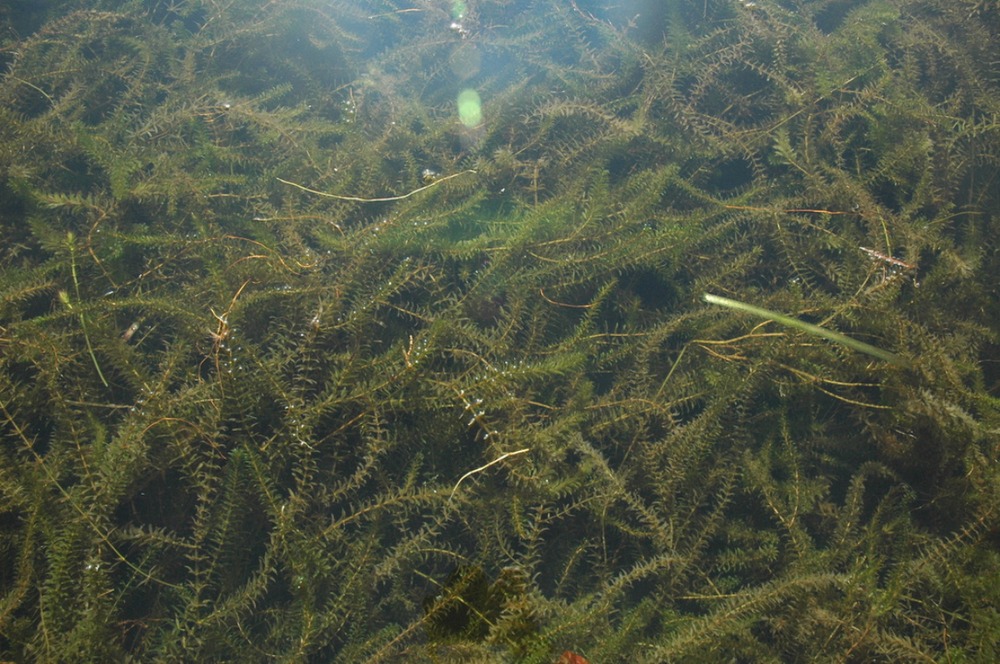
The invasive plant Hydrilla grows in Lake Juliette, Georgia.
“This paper represents really careful and long-term investigation of a great mystery,” says Michael Stoskopf, a wildlife biologist and veterinarian at North Carolina State University who has studied AVM in the past but did not participate in the new work. “This was an interestingly frustrating diagnostic problem when it first arose,” he adds, and now this paper “tells an important story of how it’s possible to figure these things out, how it’s important to have multidisciplinary approaches when investigating, and how challenging toxicology with intermittent agents can be.”

In 2001, Susan Wilde was a marine scientist in South Carolina when her husband showed her a news story about at least 16 bald eagles found dead around the Strom Thurmond Reservoir in Georgia and South Carolina, where she’d done her dissertation research. She and her colleague Tom Murphy, an eagle biologist at the South Carolina Department of Natural Resources, speculated that toxic algae were causing the deaths, even though the researchers who’d investigated hadn’t found any humanmade or algal toxins or infectious disease agents at the sites.

Wilde, Murphy, and their collaborators traveled to the lakes in South Carolina where there were birds with AVM and found that all of those water systems had a lot of plants. They determined that in South Carolina, North Carolina, and Georgia, the dominant invasive plant was H. verticillata, a long-stemmed perennial with many branches and small, pointed leaves that grows entirely submerged in water. It had invaded waterbodies in the southeast after being brought from India for use as an aquarium plant.

Wilde, who is now an ecologist at the University of Georgia, started looking at these plants to see if she could detect any cyanobacteria growing on them that could be a source of the toxin. Using typical methods to isolate cyanobacteria—agitating and washing the plants’ leaves—she didn’t detect any. Then, she turned to fluorescence microscopy, which allowed her to see clusters of cyanobacteria coating the underside of the plants’ leaves.

“This Aetokthonos is stuck so hard to the leaf that it just doesn’t come off,” Wilde explains. Plus, “they’re exactly the same color as the leaf, so the only way to really observe them is mount the entire leaf upside down, and then look at it on the microscope using fluorescence, which allows you to see the cyanopigments. It really makes it obvious at that point, but it’s pretty invisible until you go through those steps.” She requested plant samples from the other locations where eagles had been found with neural lesions and, in the work published in 2005, determined that this species of cyanobacteria, which had not been described before, was also growing on those plants.

In the new study, Wilde and colleagues grew the cyanobacteria in the lab and used a tube to put it directly into the stomachs of chickens, but the birds didn’t get AVM. Then the team analyzed the cyanobacteria directly from plants in affected areas and detected a compound with a formula similar to other toxins that contained bromine, which had not been found in their lab-grown Aetokthonos.

The researchers found higher bromine levels in Hydrilla leaves than in sediments or in reservoir water and hypothesize that as temperatures drop in the late fall, causing cooler deep waters to mix with warmer surface waters, Aetokthonos has more access to bromine—leached from rocks and also from human activities, such as water treatment plants—allowing it to produce the putative toxin. They sequenced the cyanobacterial genome and found the gene cluster likely responsible for aetokthonotoxin production.

When the group added potassium bromide to their cyanobacterial cultures, the bacteria produced the toxin. Then the team confirmed that the toxin kills C. elegans and zebrafish and causes brain lesions in chickens.

The route of transmission that researchers have observed already is through the food chain: smaller animals eat the affected plants, which are consumed by larger animals that then get sick. Wilde says she plans to establish monitoring programs that the public could participate in by reporting smaller animals that are behaving strangely or new Hydrilla invasions that might then be managed.


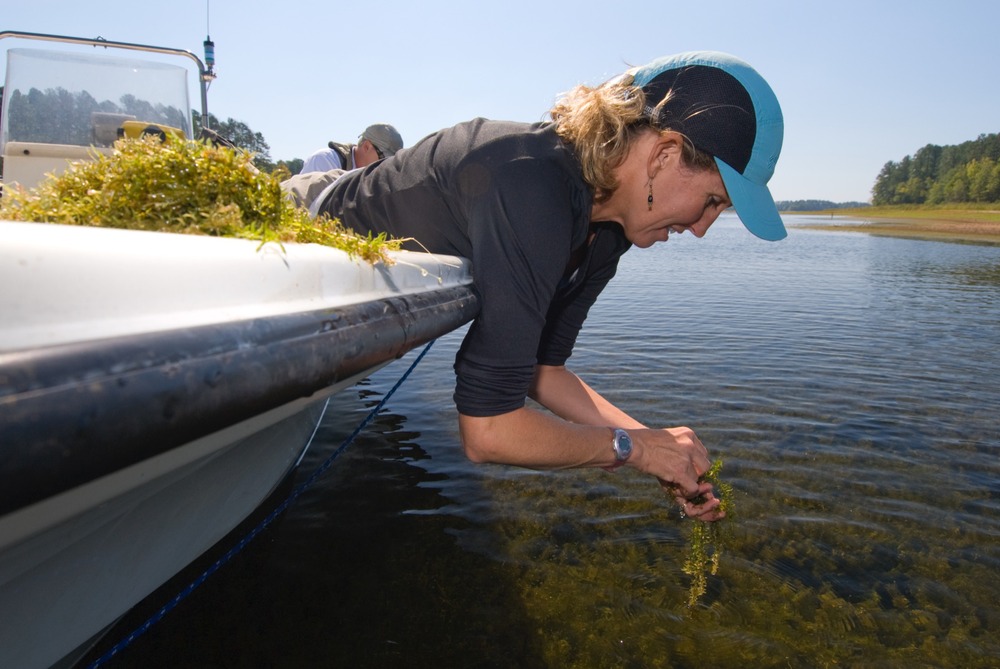
Susan Wilde samples the invasive plant Hydrilla in Strom Thurmond Reservoir, South Carolina.
In addition to supporting surveillance programs, the new study sets the course for future work, says Faith Wiley, a wildlife toxicologist at Augusta University in Georgia. “Now that we do have the toxin, it’s been identified, and it’s been isolated, there’re so many other research avenues now that weren’t available to us before,” says Wiley, who has collaborated with Wilde on AVM research in the past but did not participate in the new study.

For example, she continues, having the purified toxin will allow researchers to investigate if it affects mammals. Initially, researchers thought that the disease just affected birds, but the list of animals that can get AVM has expanded to include reptiles, fish, and invertebrates, Wiley explains. “Mammalian susceptibility has been the big question mark the whole time. And while there’s been tentative evidence to suggest that mammals might be susceptible, most of the studies that have been done have either been inconclusive or they weren’t able to able to show the actual formation of vacuolar myelinopathy in any of the mammals.” Wilde confirms that her team is already planning to start with mice.

Another future direction is figuring out “the mechanism by which this small organic molecule is causing this symptom,” says William Gerwick, who studies cyanobacterial products at the Scripps Institution of Oceanography at the University of California, San Diego, and was not involved in the work. “What is the receptor for it or the enzyme that it’s interfering with? How does it work to bring about this pathology?”

Yet another open question is whether the toxin accumulates in the fatty tissues of animals, given that it’s lipid soluble, or whether eagles are just getting the toxin from the guts of their prey, Wilde tells The Scientist. “The eagles, unfortunately, are a very good sentinel, because they are at the top of the food chain and more likely to be eating some fish or waterfowl that are a little easier to catch, maybe because they have toxin in them.”

https://www.the-scientist.com/news-opinion/bald-eagle-killer-identified-68595

Reply Quote

Date: 7/04/2021 06:04:19
From: mollwollfumble
ID: 1721344
Subject: re: Bald Eagle Killer Identified

PermeateFree said:


An interesting and informative read with possible serious environmental outcomes.

Late in 1994 around DeGray Lake in Arkansas, people started seeing bald eagles miss their perches as they tried to land and fly into rock walls. Within just a few months, 29 of the animals had died. Two years after the first episode, 26 more eagles perished after displaying similar behaviors. When wildlife biologists examined the dead eagles and other affected waterbirds, they found extensive lesions throughout the brain and spinal cord. By 1998, at least 10 episodes of the new disease—termed avian vacuolar myelinopathy (AVM)—had occurred throughout the southeastern US, but no one knew the cause.

Researchers have been making progress on the case bit by bit since then. In 2005, they linked the deaths with a newly discovered cyanobacterial species (later named Aetokthonos hydrillicola; the genus means “eagle killer”) that grows on an invasive plant (Hydrilla verticillata) in humanmade reservoirs near where the birds have died. In a study published today (March 25) in Science, the authors show that this cyanobacterium generates a neurotoxin that is the causative agent of the disease. Specifically, the cyanobacterium incorporates the element bromine—both natural and human-introduced—when it’s seasonally available from the environment, forming a toxin the authors named aetokthonotoxin for “poison that kills the eagle.”


The invasive plant Hydrilla grows in Lake Juliette, Georgia.

“This paper represents really careful and long-term investigation of a great mystery,” says Michael Stoskopf, a wildlife biologist and veterinarian at North Carolina State University who has studied AVM in the past but did not participate in the new work. “This was an interestingly frustrating diagnostic problem when it first arose,” he adds, and now this paper “tells an important story of how it’s possible to figure these things out, how it’s important to have multidisciplinary approaches when investigating, and how challenging toxicology with intermittent agents can be.”

In 2001, Susan Wilde was a marine scientist in South Carolina when her husband showed her a news story about at least 16 bald eagles found dead around the Strom Thurmond Reservoir in Georgia and South Carolina, where she’d done her dissertation research. She and her colleague Tom Murphy, an eagle biologist at the South Carolina Department of Natural Resources, speculated that toxic algae were causing the deaths, even though the researchers who’d investigated hadn’t found any humanmade or algal toxins or infectious disease agents at the sites.

Wilde, Murphy, and their collaborators traveled to the lakes in South Carolina where there were birds with AVM and found that all of those water systems had a lot of plants. They determined that in South Carolina, North Carolina, and Georgia, the dominant invasive plant was H. verticillata, a long-stemmed perennial with many branches and small, pointed leaves that grows entirely submerged in water. It had invaded waterbodies in the southeast after being brought from India for use as an aquarium plant.

Wilde, who is now an ecologist at the University of Georgia, started looking at these plants to see if she could detect any cyanobacteria growing on them that could be a source of the toxin. Using typical methods to isolate cyanobacteria—agitating and washing the plants’ leaves—she didn’t detect any. Then, she turned to fluorescence microscopy, which allowed her to see clusters of cyanobacteria coating the underside of the plants’ leaves.

“This Aetokthonos is stuck so hard to the leaf that it just doesn’t come off,” Wilde explains. Plus, “they’re exactly the same color as the leaf, so the only way to really observe them is mount the entire leaf upside down, and then look at it on the microscope using fluorescence, which allows you to see the cyanopigments. It really makes it obvious at that point, but it’s pretty invisible until you go through those steps.” She requested plant samples from the other locations where eagles had been found with neural lesions and, in the work published in 2005, determined that this species of cyanobacteria, which had not been described before, was also growing on those plants.

In the new study, Wilde and colleagues grew the cyanobacteria in the lab and used a tube to put it directly into the stomachs of chickens, but the birds didn’t get AVM. Then the team analyzed the cyanobacteria directly from plants in affected areas and detected a compound with a formula similar to other toxins that contained bromine, which had not been found in their lab-grown Aetokthonos.

The researchers found higher bromine levels in Hydrilla leaves than in sediments or in reservoir water and hypothesize that as temperatures drop in the late fall, causing cooler deep waters to mix with warmer surface waters, Aetokthonos has more access to bromine—leached from rocks and also from human activities, such as water treatment plants—allowing it to produce the putative toxin. They sequenced the cyanobacterial genome and found the gene cluster likely responsible for aetokthonotoxin production.

When the group added potassium bromide to their cyanobacterial cultures, the bacteria produced the toxin. Then the team confirmed that the toxin kills C. elegans and zebrafish and causes brain lesions in chickens.

The route of transmission that researchers have observed already is through the food chain: smaller animals eat the affected plants, which are consumed by larger animals that then get sick. Wilde says she plans to establish monitoring programs that the public could participate in by reporting smaller animals that are behaving strangely or new Hydrilla invasions that might then be managed.


Susan Wilde samples the invasive plant Hydrilla in Strom Thurmond Reservoir, South Carolina.

In addition to supporting surveillance programs, the new study sets the course for future work, says Faith Wiley, a wildlife toxicologist at Augusta University in Georgia. “Now that we do have the toxin, it’s been identified, and it’s been isolated, there’re so many other research avenues now that weren’t available to us before,” says Wiley, who has collaborated with Wilde on AVM research in the past but did not participate in the new study.

For example, she continues, having the purified toxin will allow researchers to investigate if it affects mammals. Initially, researchers thought that the disease just affected birds, but the list of animals that can get AVM has expanded to include reptiles, fish, and invertebrates, Wiley explains. “Mammalian susceptibility has been the big question mark the whole time. And while there’s been tentative evidence to suggest that mammals might be susceptible, most of the studies that have been done have either been inconclusive or they weren’t able to able to show the actual formation of vacuolar myelinopathy in any of the mammals.” Wilde confirms that her team is already planning to start with mice.

Another future direction is figuring out “the mechanism by which this small organic molecule is causing this symptom,” says William Gerwick, who studies cyanobacterial products at the Scripps Institution of Oceanography at the University of California, San Diego, and was not involved in the work. “What is the receptor for it or the enzyme that it’s interfering with? How does it work to bring about this pathology?”

Yet another open question is whether the toxin accumulates in the fatty tissues of animals, given that it’s lipid soluble, or whether eagles are just getting the toxin from the guts of their prey, Wilde tells The Scientist. “The eagles, unfortunately, are a very good sentinel, because they are at the top of the food chain and more likely to be eating some fish or waterfowl that are a little easier to catch, maybe because they have toxin in them.”

https://www.the-scientist.com/news-opinion/bald-eagle-killer-identified-68595

Startlingly good work, this must have been very difficult to prove. Going back to original technical articles:

https://onlinelibrary.wiley.com/doi/abs/10.1002/tox.20111

“Our working hypothesis is that the agent of this disease is an uncharacterized neurotoxin produced by a novel cyanobacterial epiphyte of the order Stigonematales. This undescribed species covers up to 95% of the surface area of leaves in reservoirs where bird deaths have occurred from the disease. In addition, this species is rare or not found on hydrilla collected at sites where AVM disease has not been diagnosed. Laboratory feeding trials and a sentinel bird study using naturally occurring blooms of cyanobacteria on hydrilla leaves and farm‐raised mallard ducks (Anas platyrhynchos) induced the disease experimentally.”

https://science.sciencemag.org/content/371/6536/eaax9050

“H. verticillata hyperaccumulates bromide from the environment, potentially supplying the cyanobacterium with this biosynthesis precursor. Isolation and structure elucidation of the metabolite revealed a structurally unusual pentabrominated biindole alkaloid, which we called aetokthonotoxin (AETX). Genome sequencing of A. hydrillicola allowed the identification of the AETX biosynthetic gene cluster. We confirmed that AETX is the causative agent of VM.”

Reply Quote

Date: 7/04/2021 06:21:23
From: roughbarked
ID: 1721345
Subject: re: Bald Eagle Killer Identified

It only highlights the issue of altering ecosystems via human inervention.

Reply Quote

Date: 7/04/2021 12:56:05
From: Ogmog
ID: 1721521
Subject: re: Bald Eagle Killer Identified

Why search for the disease effecting FISHING EAGLES among rabbits and such?

Reply Quote

Date: 7/04/2021 13:09:40
From: roughbarked
ID: 1721524
Subject: re: Bald Eagle Killer Identified

Ogmog said:


Why search for the disease effecting FISHING EAGLES among rabbits and such?

Because fish isn’t all they eat.

Reply Quote

Date: 7/04/2021 13:16:25
From: Tamb
ID: 1721525
Subject: re: Bald Eagle Killer Identified

roughbarked said:


Ogmog said:

Why search for the disease effecting FISHING EAGLES among rabbits and such?

Because fish isn’t all they eat.

Bald Eagle Diet :

The primary diet of the Bald eagle is the fish although they eat a variety of other animals and birds that are available easily. …
Bald eagles are said to be opportunists when it comes to diet, as these birds also steal food from other birds or animals.
Bald eagles are also scavengers and may prey on sick and dying fish, birds and animals.

Reply Quote

Date: 7/04/2021 13:21:27
From: Cymek
ID: 1721529
Subject: re: Bald Eagle Killer Identified

Tamb said:


roughbarked said:

Ogmog said:

Why search for the disease effecting FISHING EAGLES among rabbits and such?

Because fish isn’t all they eat.

Bald Eagle Diet :

The primary diet of the Bald eagle is the fish although they eat a variety of other animals and birds that are available easily. …
Bald eagles are said to be opportunists when it comes to diet, as these birds also steal food from other birds or animals.
Bald eagles are also scavengers and may prey on sick and dying fish, birds and animals.

Would all carnivores be scavengers to some extent

Reply Quote

Date: 7/04/2021 13:23:07
From: Tamb
ID: 1721530
Subject: re: Bald Eagle Killer Identified

Cymek said:


Tamb said:

roughbarked said:

Because fish isn’t all they eat.

Bald Eagle Diet :

The primary diet of the Bald eagle is the fish although they eat a variety of other animals and birds that are available easily. …
Bald eagles are said to be opportunists when it comes to diet, as these birds also steal food from other birds or animals.
Bald eagles are also scavengers and may prey on sick and dying fish, birds and animals.

Would all carnivores be scavengers to some extent


AFAIK, yes.

Reply Quote

Date: 7/04/2021 13:26:53
From: roughbarked
ID: 1721532
Subject: re: Bald Eagle Killer Identified

Cymek said:


Tamb said:

roughbarked said:

Because fish isn’t all they eat.

Bald Eagle Diet :

The primary diet of the Bald eagle is the fish although they eat a variety of other animals and birds that are available easily. …
Bald eagles are said to be opportunists when it comes to diet, as these birds also steal food from other birds or animals.
Bald eagles are also scavengers and may prey on sick and dying fish, birds and animals.

Would all carnivores be scavengers to some extent

Someanimals prefer to kill moving prey but that does not stop them from eating carrion.

Reply Quote

Date: 7/04/2021 13:27:55
From: Cymek
ID: 1721533
Subject: re: Bald Eagle Killer Identified

roughbarked said:


Cymek said:

Tamb said:

Bald Eagle Diet :

The primary diet of the Bald eagle is the fish although they eat a variety of other animals and birds that are available easily. …
Bald eagles are said to be opportunists when it comes to diet, as these birds also steal food from other birds or animals.
Bald eagles are also scavengers and may prey on sick and dying fish, birds and animals.

Would all carnivores be scavengers to some extent

Someanimals prefer to kill moving prey but that does not stop them from eating carrion.

I wouldn’t have thought so.

Reply Quote

Date: 7/04/2021 13:28:27
From: roughbarked
ID: 1721535
Subject: re: Bald Eagle Killer Identified

Cymek said:


roughbarked said:

Cymek said:

Would all carnivores be scavengers to some extent

Someanimals prefer to kill moving prey but that does not stop them from eating carrion.

I wouldn’t have thought so.

hunger is what it is.

Reply Quote

Date: 7/04/2021 13:29:23
From: Tamb
ID: 1721537
Subject: re: Bald Eagle Killer Identified

Cymek said:


roughbarked said:

Cymek said:

Would all carnivores be scavengers to some extent

Someanimals prefer to kill moving prey but that does not stop them from eating carrion.

I wouldn’t have thought so.


Some humans eat roadkill.

Reply Quote