Date: 24/09/2021 19:05:05
From: dv
ID: 1794713
Subject: German politics

The Federal election in Germany will be held tomorrow. Germany has a mixed-member proportional system somewhat akin to NZ’s.

Chancellor Angela Merkel is not running and leadership of the Christian Democratic Union has passed to Armin Laschet.

The only two parties that might lead government are the SPD and CDU/CSU. Either would have to form a coalition with minor parties
Polling seems to indicate this will be a close run election. The Social Democrats have their noses in front at present but neither outcome would be a surprise.

Reply Quote

Date: 25/09/2021 00:38:23
From: SCIENCE
ID: 1794850
Subject: re: German politics

https://www.bbc.com/news/world-europe-58655702

Reply Quote

Date: 25/09/2021 05:00:12
From: mollwollfumble
ID: 1794858
Subject: re: German politics

> Angela Merkel

I have an enormous amount of respect for Angela Merkel. I don’t say that about many people.
Perhaps I shouldn’t?

> Armin Laschet

That’s an unfortunate name. Armin la what?

In Germany, the Greens have a large following. If they win power, it would be worthwhile watching what happens. Watch how the conflict between idealism vs political expediency pans out.

Reply Quote

Date: 25/09/2021 05:38:51
From: roughbarked
ID: 1794859
Subject: re: German politics

mollwollfumble said:


> Angela Merkel

I have an enormous amount of respect for Angela Merkel. I don’t say that about many people.
Perhaps I shouldn’t?

> Armin Laschet

That’s an unfortunate name. Armin la what?

In Germany, the Greens have a large following. If they win power, it would be worthwhile watching what happens. Watch how the conflict between idealism vs political expediency pans out.

They’ll need more of a kick along. https://www.politico.eu/europe-poll-of-polls/germany/

Reply Quote

Date: 25/09/2021 10:40:29
From: Peak Warming Man
ID: 1794940
Subject: re: German politics

Angelia’s right wing government has served Germany well but they have been in power for a long time now.
Maybe a bit of input from the left for a while wouldn’t go astray, the “it’s time” factor could be at play.

Reply Quote

Date: 25/09/2021 11:30:07
From: Witty Rejoinder
ID: 1794969
Subject: re: German politics

Peak Warming Man said:


Angelia’s right wing government has served Germany well but they have been in power for a long time now.
Maybe a bit of input from the left for a while wouldn’t go astray, the “it’s time” factor could be at play.

The centre right CDU/CSU and centre left SPD have been in coalition for the past 5 years so government has been very consensus driven for that time.

Reply Quote

Date: 25/09/2021 19:15:41
From: mollwollfumble
ID: 1795203
Subject: re: German politics

I didn’t realise until today.

Angel Merkel “obtained a doctorate in quantum chemistry in 1986 and worked as a research scientist until 1989”.

No wonder I haver a high respect for her.

Reply Quote

Date: 25/09/2021 19:18:21
From: party_pants
ID: 1795207
Subject: re: German politics

mollwollfumble said:


I didn’t realise until today.

Angel Merkel “obtained a doctorate in quantum chemistry in 1986 and worked as a research scientist until 1989”.

No wonder I haver a high respect for her.

Yes. in East Germany.

Reply Quote

Date: 25/09/2021 21:20:00
From: SCIENCE
ID: 1795249
Subject: re: German politics

Reply Quote

Date: 25/09/2021 21:24:36
From: buffy
ID: 1795251
Subject: re: German politics

SCIENCE said:


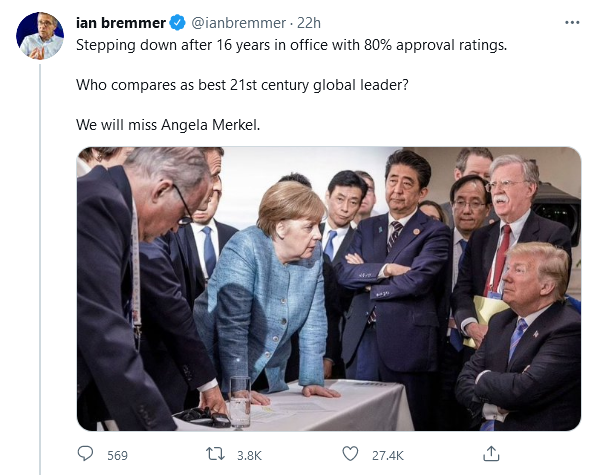
That’s unfair. She’s got all the brains and nous and he’s got none.

Reply Quote

Date: 25/09/2021 21:25:41
From: buffy
ID: 1795252
Subject: re: German politics

buffy said:


SCIENCE said:


That’s unfair. She’s got all the brains and nous and he’s got none.

And he’s doing the crossed arms and the not looking her in the eye thing.

Reply Quote

Date: 26/09/2021 19:11:46
From: Witty Rejoinder
ID: 1795611
Subject: re: German politics

Reply Quote

Date: 26/09/2021 19:16:16
From: buffy
ID: 1795612
Subject: re: German politics

Witty Rejoinder said:


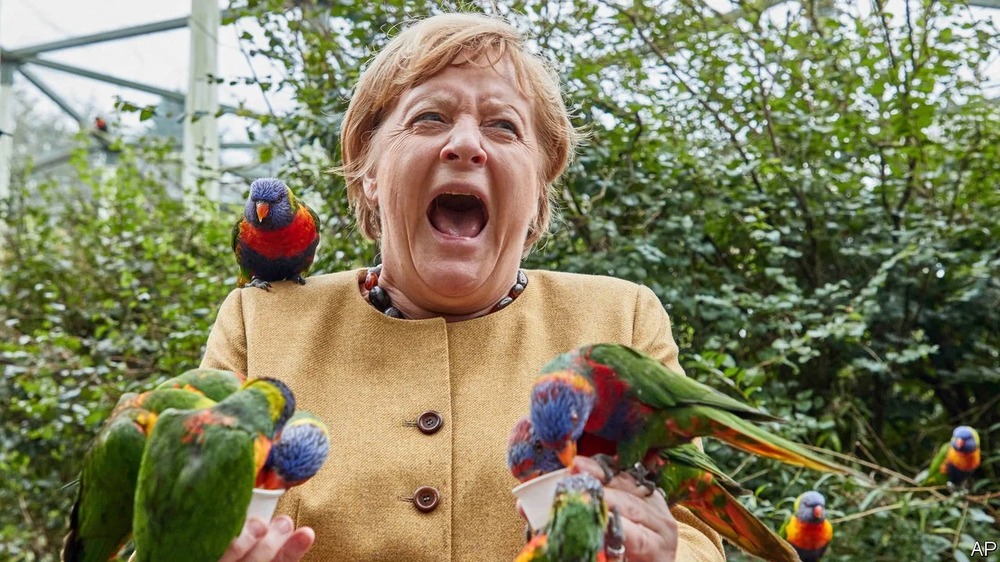
Some birds are more polite. My sister and friend at Healesville Sanctuary some years ago.

Reply Quote

Date: 26/09/2021 19:17:24
From: Bogsnorkler
ID: 1795613
Subject: re: German politics

Witty Rejoinder said:


https://www.youtube.com/watch?v=Tszidfq32DQ

Angela Merkel Can’t Stop Rolling Her Eyes

an oldie but a goodie.

Reply Quote

Date: 27/09/2021 12:15:33
From: Peak Warming Man
ID: 1795832
Subject: re: German politics

It’s not all about policies, you’ve got to know what the Teutonic people like, little things like hand gestures can make all the difference.

Reply Quote

Date: 27/09/2021 12:17:46
From: SCIENCE
ID: 1795836
Subject: re: German politics

national social democrats

Reply Quote

Date: 27/09/2021 12:21:06
From: Tamb
ID: 1795837
Subject: re: German politics

SCIENCE said:


national social democrats

Fingers apart not together.

Reply Quote

Date: 27/09/2021 12:22:43
From: SCIENCE
ID: 1795841
Subject: re: German politics

Tamb said:

SCIENCE said:

national social democrats

Fingers apart not together.

international social democrats

Reply Quote

Date: 27/09/2021 16:48:43
From: dv
ID: 1795947
Subject: re: German politics

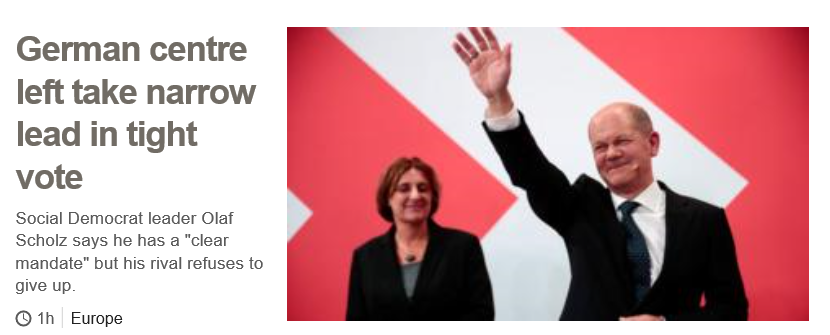
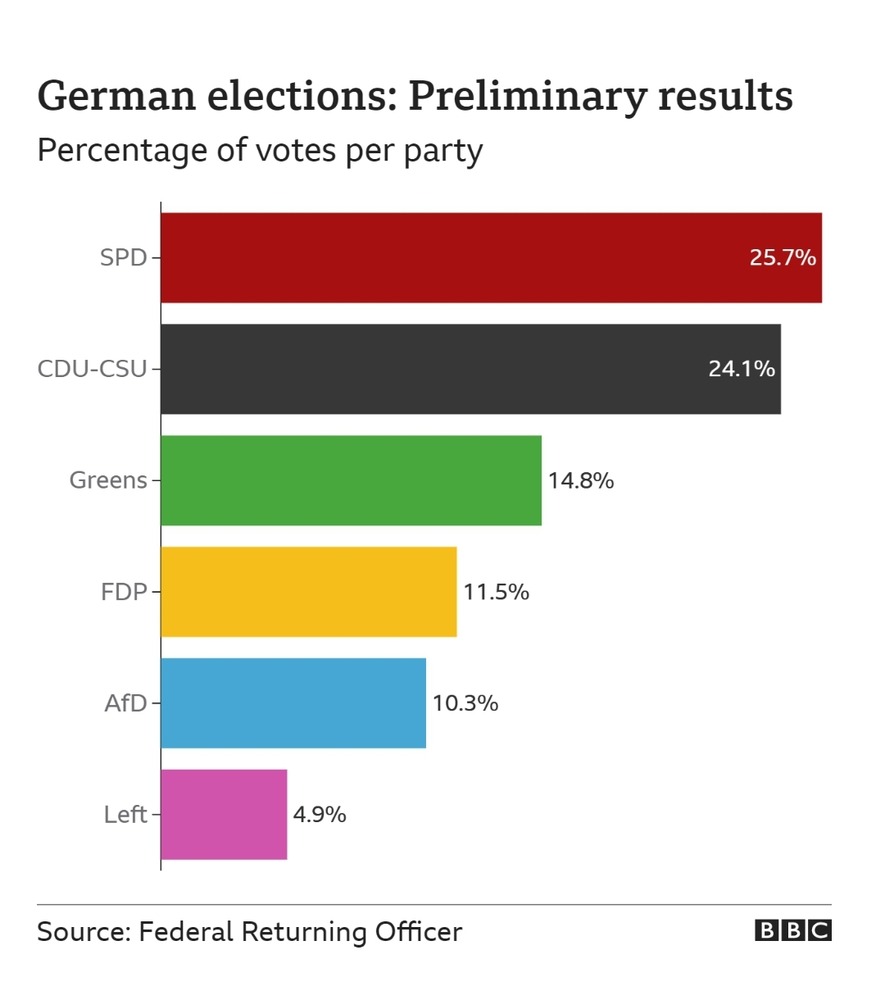
Social Democrats will gain the most seats but negotiations will take place to form government.

The Greens have done very well and SDP + Greens + FDP would be enough. FDP are a centrist party.

Might be difficult for Christian Democrats to put a coalition together.

Commentators are saying it’s unlikely the CDU would support the SDP in government

Reply Quote

Date: 27/09/2021 17:15:04
From: dv
ID: 1795954
Subject: re: German politics

Looks like Social Democrats plus The Left plus Greens = 49.4% of the seats, that would have been a nice and easy coalition to manage.

Reply Quote

Date: 28/09/2021 03:00:49
From: Ogmog
ID: 1796083
Subject: re: German politics

Bogsnorkler said:

https://www.youtube.com/watch?v=Tszidfq32DQ

Angela Merkel Can’t Stop Rolling Her Eyes

an oldie but a goodie.

LOLOL Never saw that it’s hilarious!

Reply Quote

Date: 28/09/2021 09:53:56
From: dv
ID: 1796135
Subject: re: German politics

Christian Democratic Union’s 24% voteshare is their worst result ever.

Reply Quote

Date: 27/10/2021 12:08:54
From: SCIENCE
ID: 1809016
Subject: re: German politics

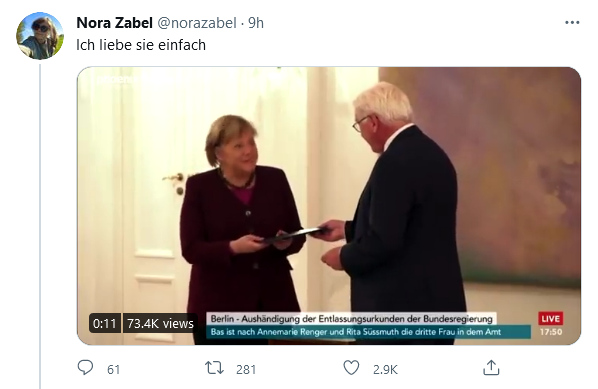
https://twitter.com/norazabel/status/1453027055881310217

Reply Quote

Date: 27/10/2021 12:30:22
From: Witty Rejoinder
ID: 1809034
Subject: re: German politics

SCIENCE said:


https://twitter.com/norazabel/status/1453027055881310217

Nein sprechan das Deutch.

Reply Quote

Date: 27/10/2021 12:32:12
From: Boris
ID: 1809036
Subject: re: German politics

Witty Rejoinder said:


SCIENCE said:

https://twitter.com/norazabel/status/1453027055881310217

Nein sprechan das Deutch.

me neither so i haven’t a clue whet you wrote there witty!

Reply Quote

Date: 27/10/2021 12:32:14
From: SCIENCE
ID: 1809037
Subject: re: German politics

Witty Rejoinder said:

SCIENCE said:

https://twitter.com/norazabel/status/1453027055881310217

Nein sprechan das Deutch.

If Only They’d Won World War Two

Reply Quote

Date: 27/10/2021 12:41:31
From: Cymek
ID: 1809041
Subject: re: German politics

SCIENCE said:


Witty Rejoinder said:

SCIENCE said:

https://twitter.com/norazabel/status/1453027055881310217

Nein sprechan das Deutch.

If Only They’d Won World War Two

Reply Quote

Date: 8/12/2021 21:32:58
From: SCIENCE
ID: 1823026
Subject: re: German politics

Ms Merkel, who is no longer a member of parliament, looked on from the spectators’ gallery as parliament voted. Politicians gave her a standing ovation as the session started.

More to come.

Reply Quote

Date: 8/12/2021 22:11:32
From: dv
ID: 1823031
Subject: re: German politics

SCIENCE said:


Ms Merkel, who is no longer a member of parliament, looked on from the spectators’ gallery as parliament voted. Politicians gave her a standing ovation as the session started.

More to come.

As expected, Olaf Scholz of the Social Democrats is the new Chancellor.

Reply Quote

Date: 26/03/2023 19:28:40
From: SCIENCE
ID: 2012652
Subject: re: German politics

Good Guys With Guns Would Never Have Let This Happen

https://www.abc.net.au/news/2023-03-26/shooting-kills-two-hamburg-germany/102147660

Reply Quote

Date: 22/12/2024 22:18:35
From: SCIENCE
ID: 2228535
Subject: re: German politics

dv said:

JudgeMental said:

I see the guy who rammed his car into the crowd in germany was a zionist.

Alternative für Deutschland supporter. Kind of a weird profile.

So he was defending himself then, fair play.

Reply Quote

Date: 23/12/2024 09:02:22
From: SCIENCE
ID: 2228571
Subject: re: German politics

Faeser said on Sunday the task was to “paint a picture” of a suspect “who does not fit any existing mould”. He had acted in “an unbelievably cruel and brutal manner, like an Islamist terrorist, though he was clearly ideologically hostile to Islam”, she said.

Nice blame¡

Reply Quote

Date: 28/12/2024 02:00:27
From: SCIENCE
ID: 2229985
Subject: re: German politics

https://www.abc.net.au/news/2024-12-27/german-president-announces-february-snap-elections/104767004

Reply Quote

Date: 23/02/2025 02:22:59
From: dv
ID: 2252861
Subject: re: German politics

The Federal election will be held tomorrow, though we here in Australia won’t be seeing any results until Monday.

Like NZ, Germany uses a mixed representation system, where people vote for a particular constituent representative, but also vote for a party for the purpose of proportional representation using overhang members drawn from a list. If you’re a smaller party that doesn’t really have enough votes in any one area to win seats, then your only shot is to get those overhang members, but you need to beat a 5% minimum nationally to get those. If you get 4.9%, you get nothing, Good Day sir!

There are four major parties who are pretty much assured of getting past that 5% minimum.

CDU/CSU: Germany’s major centre-right party. The party of Merkel is now led by Friedrich Merz, who took over from Merkel in 2022. He is on the conservative side of the party and has relatively strict migration policies.

SPD: Social democrats, the major centre-left party. Scholtz is the leader and current chancellor

AfD: the far right. They have a dual leadership structure.

Greens: well you know what Greens are. They also have a dual leadership structure.

There are four other parties that might get seats:

FDP: right of centre but kind of socially liberal

The Left: the largest socialist party

BSW: weird kind of socialist but socially conservative party? Opposed to EU, not keen on renewables but big on nationalisation and social programs. They split off from the Left.

The election would, in the normal course of events, not have been held until late in the year, but the collapse of the three-party governing coalition necessitated an early election. The coalition had been led by the SPD, supported by the liberal FDP and Greens. It proved impossible to find compromise between the Greens and FDP.

If recent polling is anything to go by, the biggest party in the Bundestag will be the CDU/CSU, and probably AdF will be the second largest. All the parties other than AdF have a pact not to form government with AdF and we might well be back to a CDU/CSU led coalition with the SPD.

Recent polling has been about

CDU/CSU 30% AdF 20% SPD 15% Green 13% Left 7% BSW 5% FDP 5%

Under Merz I don’t think the Left, Greens or BSW could have place in the government. So, I would think the governing coalition will be either CDU/CSU-SPD or CDU/CSU-SPD-FDP

Reply Quote

Date: 24/02/2025 10:07:55
From: dv
ID: 2253128
Subject: re: German politics

dv said:

The election would, in the normal course of events, not have been held until late in the year, but the collapse of the three-party governing coalition necessitated an early election. The coalition had been led by the SPD, supported by the liberal FDP and Greens. It proved impossible to find compromise between the Greens and FDP.

If recent polling is anything to go by, the biggest party in the Bundestag will be the CDU/CSU, and probably AdF will be the second largest. All the parties other than AdF have a pact not to form government with AdF and we might well be back to a CDU/CSU led coalition with the SPD.

Recent polling has been about

CDU/CSU 30% AdF 20% SPD 15% Green 13% Left 7% BSW 5% FDP 5%

Under Merz I don’t think the Left, Greens or BSW could have place in the government. So, I would think the governing coalition will be either CDU/CSU-SPD or CDU/CSU-SPD-FDP

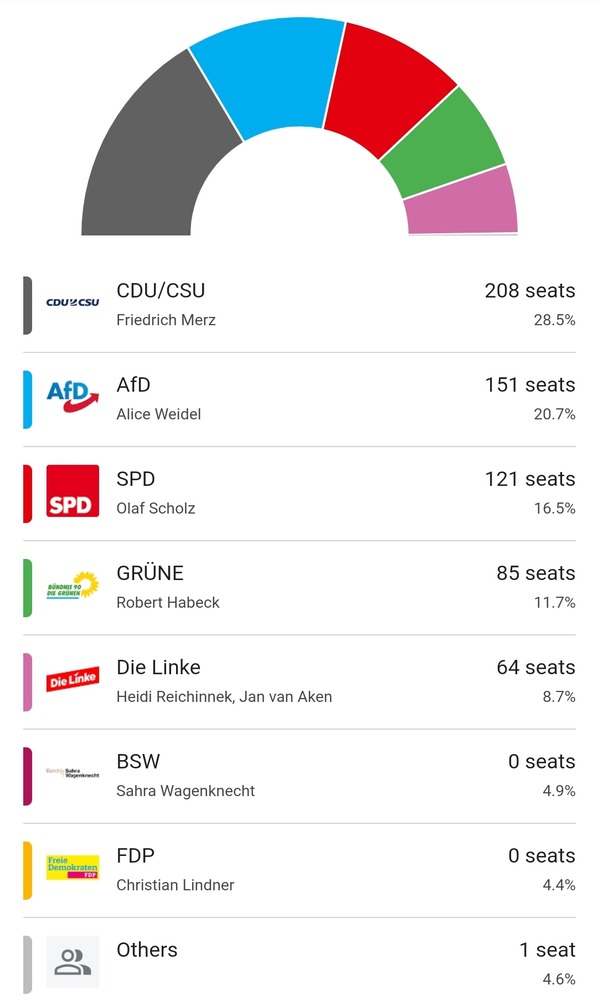
Counting is ongoing but so far the results are pretty much in line with polling.

If BSW does not exceed 5% then CDU/CSU plus SPD will be enough to get past 50% of seats and I expect that’s how it will go.

If BSW does get 5%, then they are also entitled to seats, which would mean CDU/CSU + SPD will not quite be 50% of seats. It appears the other centre right party FDP is not going to reach the threshold, but the only parties are left wing parties (Greens, BSW, the Left). It would be an awkward coalition and might suffer the same instabilities as the previous one unless everyone stays cool in order to remove the temptation for CDU/CSU to call on the AfD. So all things considered it might be better if BSW does not reach the threshold. Counting is as I say ongoing.

Reply Quote

Date: 24/02/2025 10:51:44
From: Divine Angel
ID: 2253148
Subject: re: German politics

Ohhhh well that explains this.

Reply Quote

Date: 24/02/2025 11:06:00
From: dv
ID: 2253151
Subject: re: German politics

Divine Angel said:


Ohhhh well that explains this.


It’s a decent result. A CDU/CSU – SPD coalition will be pretty boring but boring is what’s needed right now from the leader of the free world

Reply Quote

Date: 24/02/2025 12:07:58
From: dv
ID: 2253177
Subject: re: German politics

Germany’s Merz vows ‘independence’ from Trump’s America, warning NATO may soon be dead
Election winner likens the Trump administration to Putin’s Russia as he bids to take Europe in a new direction.
https://www.politico.eu/article/friedrich-merz-germany-election-united-states-donald-trump-nato/
BERLIN — Friedrich Merz did not even wait for the final results in Germany’s election before delivering what could well be a defining verdict on U.S. President Donald Trump, consigning Europe’s 80-year alliance with the United States to the past.

The Trump administration does not care about Europe and is aligning with Russia, said Merz, who is on course to become Germany’s new leader. The continent, he warned, must urgently strengthen its defenses and potentially even find a replacement for NATO — within months.

Merz’s comments mark a historic watershed: They reveal how deeply Trump has shaken the political foundations of Europe, which has depended on American security guarantees since 1945.

Reply Quote

Date: 24/02/2025 12:10:36
From: Cymek
ID: 2253180
Subject: re: German politics

dv said:


Germany’s Merz vows ‘independence’ from Trump’s America, warning NATO may soon be dead
Election winner likens the Trump administration to Putin’s Russia as he bids to take Europe in a new direction.
https://www.politico.eu/article/friedrich-merz-germany-election-united-states-donald-trump-nato/
BERLIN — Friedrich Merz did not even wait for the final results in Germany’s election before delivering what could well be a defining verdict on U.S. President Donald Trump, consigning Europe’s 80-year alliance with the United States to the past.

The Trump administration does not care about Europe and is aligning with Russia, said Merz, who is on course to become Germany’s new leader. The continent, he warned, must urgently strengthen its defenses and potentially even find a replacement for NATO — within months.

Merz’s comments mark a historic watershed: They reveal how deeply Trump has shaken the political foundations of Europe, which has depended on American security guarantees since 1945.

Europe should be able to get it’s act together to counter an aggressive Russia without help from the USA.
Military equipment is a commercial deal and even so you should not be too dependent on a third party for that.

Reply Quote

Date: 24/02/2025 12:11:38
From: Bubblecar
ID: 2253181
Subject: re: German politics

dv said:


Germany’s Merz vows ‘independence’ from Trump’s America, warning NATO may soon be dead
Election winner likens the Trump administration to Putin’s Russia as he bids to take Europe in a new direction.
https://www.politico.eu/article/friedrich-merz-germany-election-united-states-donald-trump-nato/
BERLIN — Friedrich Merz did not even wait for the final results in Germany’s election before delivering what could well be a defining verdict on U.S. President Donald Trump, consigning Europe’s 80-year alliance with the United States to the past.

The Trump administration does not care about Europe and is aligning with Russia, said Merz, who is on course to become Germany’s new leader. The continent, he warned, must urgently strengthen its defenses and potentially even find a replacement for NATO — within months.

Merz’s comments mark a historic watershed: They reveal how deeply Trump has shaken the political foundations of Europe, which has depended on American security guarantees since 1945.

Good to see they’re being realistic about it.

No more “Just be patient and wait for Trump to go” nonsense, the world situation is too urgent and the USA may continue down the loony path for generations yet.

Reply Quote

Date: 24/02/2025 12:24:18
From: dv
ID: 2253183
Subject: re: German politics

Cymek said:


dv said:

Germany’s Merz vows ‘independence’ from Trump’s America, warning NATO may soon be dead
Election winner likens the Trump administration to Putin’s Russia as he bids to take Europe in a new direction.
https://www.politico.eu/article/friedrich-merz-germany-election-united-states-donald-trump-nato/
BERLIN — Friedrich Merz did not even wait for the final results in Germany’s election before delivering what could well be a defining verdict on U.S. President Donald Trump, consigning Europe’s 80-year alliance with the United States to the past.

The Trump administration does not care about Europe and is aligning with Russia, said Merz, who is on course to become Germany’s new leader. The continent, he warned, must urgently strengthen its defenses and potentially even find a replacement for NATO — within months.

Merz’s comments mark a historic watershed: They reveal how deeply Trump has shaken the political foundations of Europe, which has depended on American security guarantees since 1945.

Europe should be able to get it’s act together to counter an aggressive Russia without help from the USA.
Military equipment is a commercial deal and even so you should not be too dependent on a third party for that.

Quite.
Even after Trump there could be 8 years of Vance, basically like Trump but of average intelligence, and then God knows who.

Reply Quote

Date: 24/02/2025 12:27:22
From: Divine Angel
ID: 2253187
Subject: re: German politics

dv said:


Cymek said:

dv said:

Germany’s Merz vows ‘independence’ from Trump’s America, warning NATO may soon be dead
Election winner likens the Trump administration to Putin’s Russia as he bids to take Europe in a new direction.
https://www.politico.eu/article/friedrich-merz-germany-election-united-states-donald-trump-nato/
BERLIN — Friedrich Merz did not even wait for the final results in Germany’s election before delivering what could well be a defining verdict on U.S. President Donald Trump, consigning Europe’s 80-year alliance with the United States to the past.

The Trump administration does not care about Europe and is aligning with Russia, said Merz, who is on course to become Germany’s new leader. The continent, he warned, must urgently strengthen its defenses and potentially even find a replacement for NATO — within months.

Merz’s comments mark a historic watershed: They reveal how deeply Trump has shaken the political foundations of Europe, which has depended on American security guarantees since 1945.

Europe should be able to get it’s act together to counter an aggressive Russia without help from the USA.
Military equipment is a commercial deal and even so you should not be too dependent on a third party for that.

Quite.
Even after Trump there could be 8 years of Vance, basically like Trump but of average intelligence, and then God knows who.

If he plays his cards right, Vance could have 10 years in power.

Reply Quote

Date: 24/02/2025 16:00:43
From: Michael V
ID: 2253272
Subject: re: German politics

dv said:


Cymek said:

dv said:

Germany’s Merz vows ‘independence’ from Trump’s America, warning NATO may soon be dead
Election winner likens the Trump administration to Putin’s Russia as he bids to take Europe in a new direction.
https://www.politico.eu/article/friedrich-merz-germany-election-united-states-donald-trump-nato/
BERLIN — Friedrich Merz did not even wait for the final results in Germany’s election before delivering what could well be a defining verdict on U.S. President Donald Trump, consigning Europe’s 80-year alliance with the United States to the past.

The Trump administration does not care about Europe and is aligning with Russia, said Merz, who is on course to become Germany’s new leader. The continent, he warned, must urgently strengthen its defenses and potentially even find a replacement for NATO — within months.

Merz’s comments mark a historic watershed: They reveal how deeply Trump has shaken the political foundations of Europe, which has depended on American security guarantees since 1945.

Europe should be able to get it’s act together to counter an aggressive Russia without help from the USA.
Military equipment is a commercial deal and even so you should not be too dependent on a third party for that.

Quite.
Even after Trump there could be 8 years of Vance, basically like Trump but of average intelligence, and then God knows who.

Vance is an opportunist, not a leader. I doubt he will rise to the surface unless that happens whilst he is VP.

Reply Quote

Date: 24/02/2025 16:02:34
From: Divine Angel
ID: 2253274
Subject: re: German politics

Michael V said:


dv said:

Cymek said:

Europe should be able to get it’s act together to counter an aggressive Russia without help from the USA.
Military equipment is a commercial deal and even so you should not be too dependent on a third party for that.

Quite.
Even after Trump there could be 8 years of Vance, basically like Trump but of average intelligence, and then God knows who.

Vance is an opportunist, not a leader. I doubt he will rise to the surface unless that happens whilst he is VP.

Well, with Musk pulling the strings…

Reply Quote

Date: 24/02/2025 16:28:05
From: Michael V
ID: 2253284
Subject: re: German politics

Divine Angel said:


Michael V said:

dv said:

Quite.
Even after Trump there could be 8 years of Vance, basically like Trump but of average intelligence, and then God knows who.

Vance is an opportunist, not a leader. I doubt he will rise to the surface unless that happens whilst he is VP.

Well, with Musk pulling the strings…

Fair.

Reply Quote

Date: 24/02/2025 16:33:19
From: dv
ID: 2253286
Subject: re: German politics

It would take some doing for the US to completely disengage from Europe militarily. They have dozens of military bases there, station about 100 nuclear weapons there, about 50000 troops.
The cost of undoing all this would be considerable so one would imagine that the brass on both sides are rather hoping that this all blows over…

Reply Quote

Date: 24/02/2025 17:04:33
From: SCIENCE
ID: 2253307
Subject: re: German politics

dv said:

It would take some doing for the US to completely disengage from Europe militarily. They have dozens of military bases there, station about 100 nuclear weapons there, about 50000 troops.
The cost of undoing all this would be considerable so one would imagine that the brass on both sides are rather hoping that this all blows over…

so the deep state is real

Reply Quote

Date: 26/02/2025 23:43:05
From: dv
ID: 2254066
Subject: re: German politics

The final turnout was 82.5%.

This is an increase from 76.6% in 2021, and the highest turnout since reunification.

Reply Quote

Date: 26/02/2025 23:48:53
From: party_pants
ID: 2254067
Subject: re: German politics

Is the word ready for a nuclear armed Germany?

I think i am.

… and Japan too

Reply Quote

Date: 27/02/2025 00:08:53
From: Michael V
ID: 2254075
Subject: re: German politics

party_pants said:


Is the word ready for a nuclear armed Germany?

I think i am.

… and Japan too

I’m not ready for nuclear arms, period.

Reply Quote

Date: 27/02/2025 00:12:50
From: party_pants
ID: 2254078
Subject: re: German politics

Michael V said:


party_pants said:

Is the word ready for a nuclear armed Germany?

I think i am.

… and Japan too

I’m not ready for nuclear arms, period.

They cannot be univented.

Reply Quote

Date: 27/02/2025 00:33:11
From: dv
ID: 2254079
Subject: re: German politics

party_pants said:


Is the word ready for a nuclear armed Germany?

I think i am.

… and Japan too

I doubt they want to be the ones to break that seal.

But lpitw, they can pay France to make nuclear weapons which can then be hosted in Germany

Reply Quote

Date: 27/02/2025 00:35:32
From: party_pants
ID: 2254080
Subject: re: German politics

dv said:


party_pants said:

Is the word ready for a nuclear armed Germany?

I think i am.

… and Japan too

I doubt they want to be the ones to break that seal.

But lpitw, they can pay France to make nuclear weapons which can then be hosted in Germany

Yeah. That might work. Maybe Poland too.

Reply Quote

Date: 27/02/2025 09:30:58
From: captain_spalding
ID: 2254109
Subject: re: German politics

party_pants said:


Is the word ready for a nuclear armed Germany?

I think i am.

… and Japan too

Let’s face it:

if UIkraine had held on to just one nuclear weapon, Putin would have had serious second thoughts about the invasion.

Reply Quote

Date: 9/03/2025 22:10:35
From: dv
ID: 2258956
Subject: re: German politics

https://youtu.be/hBYSk1YWyJo?si=aCC4AB6ZvVIlDmzQ

Merz plans to use the old Bundestag (parliament) to raise the debt limit in order to fund military spending. The new one doesn’t sit until 25 March.

A two-thirds majority is needed in order to increase the debt limit.

Reply Quote

Date: 19/03/2025 11:43:26
From: dv
ID: 2262334
Subject: re: German politics

dv said:


https://youtu.be/hBYSk1YWyJo?si=aCC4AB6ZvVIlDmzQ

Merz plans to use the old Bundestag (parliament) to raise the debt limit in order to fund military spending. The new one doesn’t sit until 25 March.

A two-thirds majority is needed in order to increase the debt limit.

This was achieved.

https://www.youtube.com/watch?v=fU5qPl4Rd08&t=1s
Germany’s passes trillion-euro bill to boost spending on defense, infrastructure, climate

The CDU/CSU and Social Democrats had to come to an accommodation with the Greens in order to reach 2/3. They promised 100 billion Euros for climate protection measures.

Reply Quote

Date: 29/05/2025 07:45:07
From: SCIENCE
ID: 2286923
Subject: re: German politics

Mr Weimer’s proposal was not welcomed by everyone. An MP from the far-Right AfD party wrote on X: “The German government wants to make Germany the world centre of Islamism and anti-Semitism.”

damn it we remember when life was simple and the code words for unquestioning agreement were always CHINA and communism

Reply Quote

Date: 16/06/2025 16:00:50
From: dv
ID: 2292866
Subject: re: German politics

Veterans Day: ‘Visibility, recognition, respect’ for German troops
The president of the German parliament, Julia Klöckner, officially opened the country’s first national Veterans Day on Sunday, saying it was “high time” for such an occasion.

“This day has created something which has always been lacking: public visibility, recognition and respect for all those who have served in our country’s armed forces,” she said at an event in Berlin.

Speaking on a stage in front of the Reichstag, the seat of Germany’s parliament, Klöckner highlighted the role of the German army, known as the Bundeswehr, as a “parliamentary army” which is answerable to parliament – as opposed to an individual head of state as commander-in-chief.

“That is why we as parliamentarians carry particular responsibility,” she said. “And today, we honor those people who were prepared to serve this country, our country, our values.”

Writing on social media, German Chancellor Friedrich Merz called the Bundeswehr a “key component of our society” and said: “The men and women who serve, or have served, in it deserve our thanks, our recognition and our respect. This service for our country belongs in center of our society.”

On Saturday, Defense Minister Boris Pistorius praised the professionalism of German troops and said that the challenges facing them will increase in years to come.

“In the last two-and-a-half years, I have experienced first hand the professionalism of our troops, whether on exercises at home or abroad, in tanks or planes, on NATO’s eastern flank in Lithuania or when evacuating citizens in Sudan,” he told the Rheinische Post newspaper.

“The threat has increased in recent years,” he nevertheless warned. “We have to be clear: we have to be able to defend our country and our alliance if it is attacked.”

Reply Quote

Date: 6/10/2025 14:13:22
From: dv
ID: 2321318
Subject: re: German politics

https://www.dailymail.co.uk/news/article-15164671/Ex-German-Chancellor-71-blames-Poland-Baltic-states-Putins-war-Ukraine.html

Wow

The EU should have begun cutting trade with Russia as soon as they took Crimea.

Reply Quote

Date: 8/10/2025 08:42:46
From: SCIENCE
ID: 2321712
Subject: re: German politics

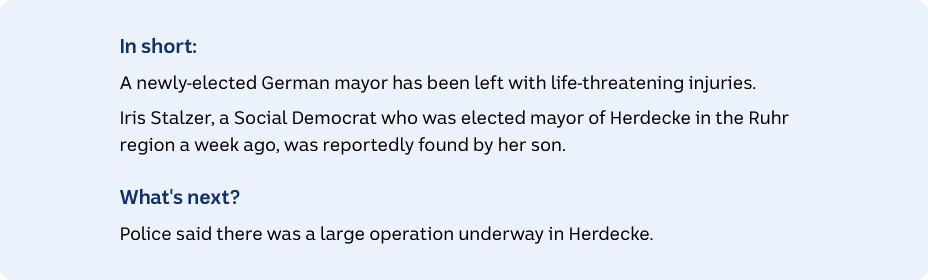
https://www.abc.net.au/news/2025-10-08/herdecke-mayor-iris-stalzer-stabbed-in-germany-/105864280

Reply Quote

Date: 23/10/2025 10:24:04
From: dv
ID: 2325955
Subject: re: German politics

https://www.dagens.com/politics/germany-steps-in-to-pay-us-base-staff-in-october

In a move highlighting the ongoing financial impasse in Washington, Germany will cover the salaries of thousands of civilian staff working at American military bases on its soil this October.

The German Finance Ministry confirmed the decision on Wednesday, calling it an “exceptional expense.”

Reply Quote

Date: 23/10/2025 10:27:02
From: SCIENCE
ID: 2325958
Subject: re: German politics

dv said:

https://www.dagens.com/politics/germany-steps-in-to-pay-us-base-staff-in-october

In a move highlighting the ongoing financial impasse in Washington, Germany will cover the salaries of thousands of civilian staff working at American military bases on its soil this October.

The German Finance Ministry confirmed the decision on Wednesday, calling it an “exceptional expense.”

so that kkk guy is a genius, getting lazy NATO countries to finally pay their fair share

Reply Quote

Date: 23/10/2025 10:28:01
From: roughbarked
ID: 2325959
Subject: re: German politics

SCIENCE said:

dv said:

https://www.dagens.com/politics/germany-steps-in-to-pay-us-base-staff-in-october

In a move highlighting the ongoing financial impasse in Washington, Germany will cover the salaries of thousands of civilian staff working at American military bases on its soil this October.

The German Finance Ministry confirmed the decision on Wednesday, calling it an “exceptional expense.”

so that kkk guy is a genius, getting lazy NATO countries to finally pay their fair share

Method in Madness?

Reply Quote

Date: 23/10/2025 10:40:56
From: Michael V
ID: 2325971
Subject: re: German politics

SCIENCE said:

dv said:

https://www.dagens.com/politics/germany-steps-in-to-pay-us-base-staff-in-october

In a move highlighting the ongoing financial impasse in Washington, Germany will cover the salaries of thousands of civilian staff working at American military bases on its soil this October.

The German Finance Ministry confirmed the decision on Wednesday, calling it an “exceptional expense.”

so that kkk guy is a genius, getting lazy NATO countries to finally pay their fair share

Ha!

:)

Reply Quote

Date: 23/10/2025 11:58:59
From: SCIENCE
ID: 2326008
Subject: re: German politics

roughbarked said:

SCIENCE said:

dv said:

https://www.dagens.com/politics/germany-steps-in-to-pay-us-base-staff-in-october

In a move highlighting the ongoing financial impasse in Washington, Germany will cover the salaries of thousands of civilian staff working at American military bases on its soil this October.

The German Finance Ministry confirmed the decision on Wednesday, calling it an “exceptional expense.”

so that kkk guy is a genius, getting lazy NATO countries to finally pay their fair share

Method in Madness?

we’ve played strategy games before and atypical behaviour is all well and good and can get an early advantage up to the point when the victims realise they can just team up with someone predictable and leave yous unable to leverage the strength of consistency but we suppose we haven’t played 50000 dimensional snakes and ladders so we leave it to the experts

Reply Quote

Date: 12/01/2026 09:14:02
From: SCIENCE
ID: 2349200
Subject: re: German politics

SCIENCE said:

is this foreign

The US president warned Iranian leaders against using force against demonstrators and said the US stood “ready to help”.

interference

Reply Quote

Date: 3/02/2026 22:11:04
From: Witty Rejoinder
ID: 2357098
Subject: re: German politics

Germany’s Far Right Is on the Threshold of Power. This Man Is Leading the Charge.
Ulrich Siegmund is the friendly new face of the controversial AfD party.
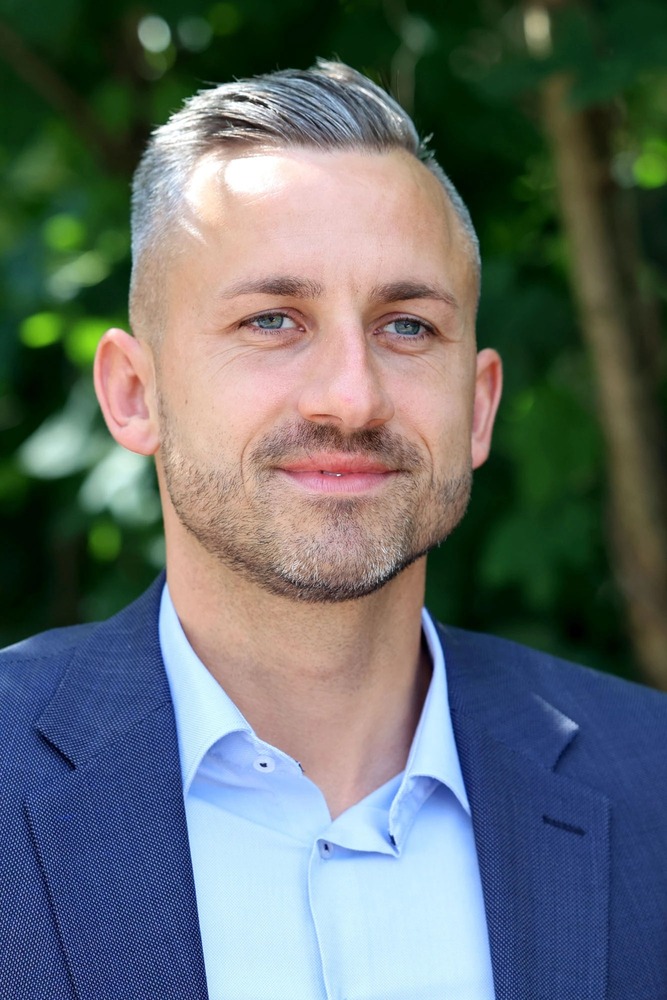
AfD politician Ulrich Siegmund

By Marc Felix Serrao
01/30/2026 05:00 AM EST

Marc Felix Serrao is a correspondent with the Axel Springer Global Reporters Network, of which POLITICO is part.

MAGDEBURG, Germany — At a lectern in a regional parliament just before Christmas, Ulrich Siegmund begins to set up a joke.

“No one should be forced to pay for disinformation,” Siegmund thunders. He is the floor leader of the far-right Alternative for Germany party in the former East German state of Saxony-Anhalt, and he launches into a diatribe against a familiar target: Germany’s giant publicly funded broadcasters ARD and ZDF, institutions comparable to a supercharged blend of PBS, NPR and local public television and radio. Critics, not just from the far-right, have accused ARD and ZDF of runaway costs and a pronounced leftward political bias for many years.

The channels, Siegmund tells his fellow lawmakers, must shrink and report neutrally, “without indoctrination, without all the nonsense.” As one of many examples, he cites a recent documentary titled “Radical Christians in Germany: A Crusade from the Right.” And then comes the joke: “We all know that feeling — you sit on a train and hope that no radical Christian sits down next to you.”

The AfD benches erupt in laughter. Even a member of the center-right Christian Democrats cracks a smile.

Siegmund is tall, slim, telegenic. His graying hair is slicked back; the edges of his three-day beard are precisely trimmed. He wears a tailored navy suit, white shirt and pocket square. When he speaks, even when he attacks, a faint smile flutters on his face.

In recent months, this 35-year-old regional politician has turned into a new leading figure on Germany’s far right, now one of the two largest parties in the national parliament, the Bundestag, neck-and-neck with the Christian Democrats, known as the CDU, and its sister party, the CSU.

Siegmund is already a skilled politician, the kind who can set up what looks like a parliamentary defeat that actually serves to build his political momentum.

Which is exactly what he does next. Siegmund’s caucus proposes that Saxony-Anhalt withdraw from the treaties that underpin Germany’s public broadcasting system. The motion is doomed. A Christian Democrat praises the regional public broadcaster as “reliable,” prompting an AfD heckler to shout: “Yes, for you!” The vote ends 66 to 16 against Siegmund. Support only came from the AfD.

A blowout, but only at first glance. The parliament in the state capital Magdeburg is not Siegmund’s primary stage. Shortly after the speech, he posts a clip on social media under the headline: “This is how they manipulate us.” On TikTok alone, more than 600,000 users follow him; Instagram and Facebook add nearly 300,000 each — more than nearly any other German politician.

The video draws a lot of support. “I’m hoping for an absolute majority for the AfD,” one supporter comments.

That hope may no longer be far-fetched.

Later this year, Siegmund has a realistic chance to deliver the AfD its first outright victory one of Germany’s 16 states. Recent polls put the AfD in Saxony-Anhalt at 39 percent, once even at 40. A gain of just two or three points could be enough for Siegmund to secure an absolute majority in the 83-seat state parliament and take over the premier’s office in the stately Palais am Fürstenwall.

It would be the party’s first electoral prize, one that would surmount what’s become known as Germany’s “firewall” — an unwritten but rigid pact among Germany’s other parties to block out the AfD by refusing any cooperation: no coalitions, no confidence deals, no informal alliances.

They view the party as a force whose ethno-nationalist agenda and repeated extremist controversies violate the country’s postwar consensus, forged to prevent Germany from ever again going down the kind of path that lead to WWII. The AfD’s hardline anti-immigration rhetoric, bouts of historical revisionism, and notably its Russia-friendly posture have made cooperation politically, and for many, morally, untenable. As Germany’s chancellor Friedrich Merz recently said: “We are worlds apart from that party.”

Most of the time, German parties come to power in states and nationally by forming coalitions. As long as the firewall holds, the only way the AfD can take power is by winning a straight-up majority. Which is what it seems poised to do in the September elections.

Much will depend on how many of the state’s smaller parties fail to clear Germany’s five-percent threshold; Votes for those parties are discarded when seats are distributed, boosting the relative strength of the larger ones. The pro-business Free Democrats and the Greens are currently at risk, as are the center-left Social Democrats and the new left-populist BSW party. If those factions don’t clear the threshold, AfD could win less than half of the vote but take power in parliament with an absolute majority of seats.

And that would immediately launch Siegmund to the forefront of German politics.

Nationally, the AfD is led by 46-year-old Alice Weidel, whose cool, abrasive style attracts attention but little affection. Her co-chair Tino Chrupalla, a 50-year-old painter, appears more down-to-earth yet often awkward. By contrast, the young candidate from Saxony-Anhalt presents a more personable, media-savvy image.

HALLE, GERMANYJANUARY 25: Alice Weidel, chancellor candidate of the far-right Alternative for Germany (AfD) political party, speaks to supporters as they wave German flags
Alice Weidel, chancellor candidate of the far-right Alternative for Germany (AfD) political party, speaks to supporters on Jan. 25, 2025 in Halle, Germany. | Sean Gallup/Getty Images

As governor, Siegmund would be the AfD’s first-ever leader tested in a relevant executive office — a role fraught with risk. Success, however, would make him a contender for the party’s top candidacy in the next national elections, presumably in 2029.

For now, Weidel is the front-runner, and Siegmund is smart enough not to challenge her leadership role. His goal, he says, is to help Weidel on her way to become Germany’s first AfD chancellor.

I’m sitting in a small, austere meeting room inside the state parliament in Magdeburg when Siegmund enters, smiling broadly and offering a quick handshake before taking his seat. He pours himself a glass of water and starts talking about my hometown. “You’re from Hanover, how interesting.” Strictly speaking, that’s nonsense. My hometown routinely ranks among Germany’s dullest cities. But the reception is oddly disarming.

I’m here to understand what sets this AfD politician apart from a party so often defined by its hostility to the political “mainstream.” What, if anything, lies beneath his notably softer public manner?

Our conversation follows a pattern. When I ask Siegmund about balancing work and family — his wife works at a school, he is the father of a young daughter — he asks about my own family. He mentions going to the gym twice a week and running a half marathon in just over 90 minutes, and he then asks what sports I do.

In Germany, few politicians master this kind of engaging conversational style. In the AfD in particular, it is highly unusual. The party is notorious for treating journalists with suspicion.

Siegmund even speaks about mainstream rivals without derision. The Free Democrats in his state, he says, are “perfectly reasonable” to deal with. With the CDU’s parliamentary group, “the human side works about 80 percent of the time.” When he passes colleagues in the hallways, they greet each other. In the federal parliament in Berlin, such normality between the AfD and other parties’ politicians would be unthinkable.

Siegmund broke with the CDU more than a decade ago over Germany’s euro rescue policies, which he describes as ideology-driven and economically damaging: “For me, that was the point at which I could no longer, and no longer wished to, go along.” The dispute led him to the AfD.

“What drives me is the determination to step in precisely where Germany needs me the most,” Siegmund says about his political motivation. “For me, Saxony-Anhalt is a first and crucial step toward putting the entire country back on its feet.”

Oliver Kirchner, Siegmund’s co-leader in the AfD caucus and 24 years his senior, says it was during the Covid-19 pandemic that he first recognized the young man’s talent. He is, Kirchner notes, “also visually appealing” and doesn’t make the kinds of gaffes that trigger attacks from his opponents.

The contrast between the two men is stark. Kirchner — short, bald and combative — delivers tirades about “globalist communists” and the “lying chancellor,” barely looking up from his manuscript. He seldom smiles, and if he does, it carries a grim edge. When Kirchner led the party into the recent 2021 state election, the AfD suffered its first ever decline in eastern Germany, slipping from 24 to 21 percent. Soon after, Siegmund rose to the top.

To say the party is on a winning streak because of him is not quite accurate. Rather, Siegmund has a chance of winning despite his party being a drag on his prospects.

The AfD in Saxony-Anhalt has long been plagued by infighting and scandal. A former leader was forced out after allegations of cronyism, megalomania and a speech in which he referred to Turks as “camel drivers.” More recently, the party voted to expel a former general secretary, now a federal lawmaker, over alleged conflicts between his political and business interests. The accused is fighting back, accusing his former colleagues of cronyism and doctored expense trips, including to Disneyland. He has threatened to reveal more.

Both locally and nationally, Siegmund’s own party could prove his biggest obstacle on the road to power.

“I don’t want an AfD premier,” Peter Nitschke tells me. The entrepreneur and president of Saxony-Anhalt’s construction industry association, is meeting me in his office in a village an hour’s drive south of Magdeburg. “But if Mr. Siegmund governs, I’ll live with it. I certainly wouldn’t leave my home because of it.” By contrast, the outgoing CDU premier, Rainer Haseloff, has announced that he would move away if the AfD took power.

I am visiting Nitschke to find out how business leaders in this eastern German state view the prospect of an AfD-led government. In western Germany and in Berlin in particular, any visible engagement with the far-right party or any attempt to question its isolation provokes outrage. In the east, those constraints have been weakening for some time. I want to find out how far this change has progressed.

The Harz, a low mountain range that barely registers for visitors from southern Germany’s Alps, was once the borderland between East and West. Nitschke grew up under the East’s socialist dictatorship. The early 1990s, just after the fall of the Berlin Wall and German reunification, were the best years of his life, he says. “Everything seemed possible.”

That spirit, he believes, has since faded: “Germany has become bureaucratic and fearful.” The AfD’s rise is, in his view, the result of a leftward drift among all the other parties on the national level, “including my own, unfortunately.” Nitschke has been a CDU member for decades. He does not support the AfD. But in our conversation, his rejection of the party is free of alarmism.

In his daily life, Nitschke says, there is no political firewall. “If I excluded all AfD voters and members, I couldn’t build a single bathroom anymore.” His state association of tilers, carpenters and road builders would collapse.

This approach differs sharply from attitudes in western Germany and in the country’s capital. In the East, this fear of treating the party as a normal political player is gone, Nitschke says.

Nitschke tells me he last encountered Siegmund at a business-association dialogue in Magdeburg in November. The AfD politician has been courting support from the private sector for some time.

All the state’s parliamentary leaders were invited, Nitschke says, “of course including Mr. Siegmund.” There were presentations and a kind of speed-dating for business representatives: Each political representative had his or her own table, and business leaders could circulate between them, stopping to strike up conversations. Three tables drew the biggest crowds, Nitschke says: those of the CDU, the Free Democrats, and the AfD.

Siegmund had a convincing manner, Nitschke recollects. Part of that, he believes, stems from his professional background. In his mid-20s, before finishing a business degree, Siegmund co-founded a small company producing scented room fragrances. He is still a shareholder.

It probably helps his relations with the region’s commercial interests that Siegmund’s background is more middle than working class. Siegmund’s mother, a civil engineer, died in 2019. His father is an electrical engineer and also now active in local politics for the AfD.

All this may not make him an economic expert, but it has given him firsthand exposure to entrepreneurship, an experience most German politicians lack.

In the parliament of Magdeburg, Saxony-Anhalt’s economy minister Sven Schulze is stretching his legs beneath a conference table at the end of a long legislative day in mid-December. The CDU’s top candidate for the state election is Siegmund’s only serious rival. Asked what he can do that his AfD opponent cannot, the 46-year-old grins: “Govern.”

Politics, Schulze says, is not about speeches but substance and the value one brings to a state. Beyond his experience as a minister, he cites his networks in Berlin and Brussels as an important political asset, crucial for attracting major investment.

Broad-shouldered and pragmatic, Schulze is, from the AfD’s perspective, a tough opponent: an authentic East German, father of three, trained as an industrial engineer, with years in the private sector. Not one easy to slam as an out-of-touch liberal.

If the AfD were to win outright, Schulze predicts chaos — not fascism, as other CDU politicians might warn, but disorder. “Mr. Siegmund has no governing experience, little substance and no suitable personnel,” he says.

A month after our conversation, the CDU takes a step widely seen as an effort to block Siegmund’s rise. Haseloff, the long-time CDU governor, resigns and the state parliament elects Schulze as his successor. The leadership swap shows the CDU’s nervousness: The party is hoping that the power of incumbency can shore up not only its own candidate, but save the firewall.

Virtually at the same time, the AfD in Saxony-Anhalt makes moves of its own, unveiling a draft “governing program.” It is a radical break with the political mainstream, though hardly a surprising one. The 156-page document, due to be debated and adopted at a party convention in April, nods to Hungary’s Viktor Orbán as a governance model and demands public arts funding to be redirected away from “anti-German” projects toward work that strengthens national identity. It also proposes a “baby bonus” of €2,000 for the first two children and €4,000 for each additional child, available only if at least one parent holds German citizenship and the family has lived in Saxony-Anhalt for at least a year.

Within the CDU, many expect fierce resistance from Berlin if the AfD were to take power in Saxony-Anhalt. The federal government, they believe, currently led by CDU chancellor Merz, would do everything possible to make life difficult for a state ruled by the far right. One potential lever is the Länderfinanzausgleich, Germany’s fiscal equalization system, which redistributes funds from wealthier states to poorer ones. Saxony-Anhalt belongs to the latter. There could be attempts, the argument goes, to freeze those payments, under the premise that one cannot finance alleged fascists.

Saxony-Anhalt, Magdeburg: Ulrich Siegmund (AfD) speaks in the plenary hall of the state
Ulrich Siegmund (AfD) speaks in the plenary hall of the state parliament. | Klaus-Dietmar Gabbert/picture alliance via Getty Images

The right-wing intellectual and publisher Götz Kubitschek, whose estate lies in Saxony-Anhalt, goes even further. We meet in a restaurant in the medieval town of Naumburg, a two-hour drive south of Magdeburg. He tells me he expects Berlin to invoke Bundeszwang, federal coercion, under Article 37 of Germany’s constitution, allowing the federal government to force a state to follow its obligations.

This would be a dramatic escalation in the republic’s cooperative federal system. How it would work in practice remains an open question – Bundeszwang has never been used in post-war Germany. If, say, Saxony-Anhalt refused to provide the federally required accommodation and basic support for asylum seekers, Berlin could respond by issuing binding directives, potentially through a federal commissioner, compelling state and local authorities to restore those services. It would be a kind of showdown between Germany’s federal and state government that hasn’t been seen before.

Siegmund’s state party still has enormous homework to do before taking on the responsibilities of governing, Kubitschek says. “They have to prepare like the biggest overachievers.”

Siegmund, like most upstarts, sees his inexperience as a virtue. “Maybe we’ll make mistakes,” he concedes. “But worse than today? That’s impossible.” His shadow cabinet, he says, will include seasoned party figures and former politicians from other parties. He is not naming names.

On the evening of September 6, 2026, the name Ulrich Siegmund may remain a footnote in German politics. Or it could enter the history books as the starting point of a right-wing revolution, one that began in the state of Saxony-Anhalt.

https://www.politico.com/news/magazine/2026/01/30/germany-has-built-a-firewall-against-the-far-right-in-the-fall-this-young-nationalist-may-test-it-00748999?
Reply Quote

Date: 4/02/2026 11:07:20
From: ruby
ID: 2357197
Subject: re: German politics

Witty Rejoinder said:


Germany’s Far Right Is on the Threshold of Power. This Man Is Leading the Charge.
Ulrich Siegmund is the friendly new face of the controversial AfD party.

AfD politician Ulrich Siegmund

By Marc Felix Serrao
01/30/2026 05:00 AM EST

Marc Felix Serrao is a correspondent with the Axel Springer Global Reporters Network, of which POLITICO is part.

MAGDEBURG, Germany — At a lectern in a regional parliament just before Christmas, Ulrich Siegmund begins to set up a joke.

“No one should be forced to pay for disinformation,” Siegmund thunders. He is the floor leader of the far-right Alternative for Germany party in the former East German state of Saxony-Anhalt, and he launches into a diatribe against a familiar target: Germany’s giant publicly funded broadcasters ARD and ZDF, institutions comparable to a supercharged blend of PBS, NPR and local public television and radio. Critics, not just from the far-right, have accused ARD and ZDF of runaway costs and a pronounced leftward political bias for many years.

The channels, Siegmund tells his fellow lawmakers, must shrink and report neutrally, “without indoctrination, without all the nonsense.” As one of many examples, he cites a recent documentary titled “Radical Christians in Germany: A Crusade from the Right.” And then comes the joke: “We all know that feeling — you sit on a train and hope that no radical Christian sits down next to you.”

The AfD benches erupt in laughter. Even a member of the center-right Christian Democrats cracks a smile.

Siegmund is tall, slim, telegenic. His graying hair is slicked back; the edges of his three-day beard are precisely trimmed. He wears a tailored navy suit, white shirt and pocket square. When he speaks, even when he attacks, a faint smile flutters on his face.

In recent months, this 35-year-old regional politician has turned into a new leading figure on Germany’s far right, now one of the two largest parties in the national parliament, the Bundestag, neck-and-neck with the Christian Democrats, known as the CDU, and its sister party, the CSU.

Siegmund is already a skilled politician, the kind who can set up what looks like a parliamentary defeat that actually serves to build his political momentum.

Which is exactly what he does next. Siegmund’s caucus proposes that Saxony-Anhalt withdraw from the treaties that underpin Germany’s public broadcasting system. The motion is doomed. A Christian Democrat praises the regional public broadcaster as “reliable,” prompting an AfD heckler to shout: “Yes, for you!” The vote ends 66 to 16 against Siegmund. Support only came from the AfD.

A blowout, but only at first glance. The parliament in the state capital Magdeburg is not Siegmund’s primary stage. Shortly after the speech, he posts a clip on social media under the headline: “This is how they manipulate us.” On TikTok alone, more than 600,000 users follow him; Instagram and Facebook add nearly 300,000 each — more than nearly any other German politician.

The video draws a lot of support. “I’m hoping for an absolute majority for the AfD,” one supporter comments.

That hope may no longer be far-fetched.

Later this year, Siegmund has a realistic chance to deliver the AfD its first outright victory one of Germany’s 16 states. Recent polls put the AfD in Saxony-Anhalt at 39 percent, once even at 40. A gain of just two or three points could be enough for Siegmund to secure an absolute majority in the 83-seat state parliament and take over the premier’s office in the stately Palais am Fürstenwall.

It would be the party’s first electoral prize, one that would surmount what’s become known as Germany’s “firewall” — an unwritten but rigid pact among Germany’s other parties to block out the AfD by refusing any cooperation: no coalitions, no confidence deals, no informal alliances.

They view the party as a force whose ethno-nationalist agenda and repeated extremist controversies violate the country’s postwar consensus, forged to prevent Germany from ever again going down the kind of path that lead to WWII. The AfD’s hardline anti-immigration rhetoric, bouts of historical revisionism, and notably its Russia-friendly posture have made cooperation politically, and for many, morally, untenable. As Germany’s chancellor Friedrich Merz recently said: “We are worlds apart from that party.”

Most of the time, German parties come to power in states and nationally by forming coalitions. As long as the firewall holds, the only way the AfD can take power is by winning a straight-up majority. Which is what it seems poised to do in the September elections.

Much will depend on how many of the state’s smaller parties fail to clear Germany’s five-percent threshold; Votes for those parties are discarded when seats are distributed, boosting the relative strength of the larger ones. The pro-business Free Democrats and the Greens are currently at risk, as are the center-left Social Democrats and the new left-populist BSW party. If those factions don’t clear the threshold, AfD could win less than half of the vote but take power in parliament with an absolute majority of seats.

And that would immediately launch Siegmund to the forefront of German politics.

Nationally, the AfD is led by 46-year-old Alice Weidel, whose cool, abrasive style attracts attention but little affection. Her co-chair Tino Chrupalla, a 50-year-old painter, appears more down-to-earth yet often awkward. By contrast, the young candidate from Saxony-Anhalt presents a more personable, media-savvy image.

HALLE, GERMANYJANUARY 25: Alice Weidel, chancellor candidate of the far-right Alternative for Germany (AfD) political party, speaks to supporters as they wave German flags
Alice Weidel, chancellor candidate of the far-right Alternative for Germany (AfD) political party, speaks to supporters on Jan. 25, 2025 in Halle, Germany. | Sean Gallup/Getty Images

As governor, Siegmund would be the AfD’s first-ever leader tested in a relevant executive office — a role fraught with risk. Success, however, would make him a contender for the party’s top candidacy in the next national elections, presumably in 2029.

For now, Weidel is the front-runner, and Siegmund is smart enough not to challenge her leadership role. His goal, he says, is to help Weidel on her way to become Germany’s first AfD chancellor.

I’m sitting in a small, austere meeting room inside the state parliament in Magdeburg when Siegmund enters, smiling broadly and offering a quick handshake before taking his seat. He pours himself a glass of water and starts talking about my hometown. “You’re from Hanover, how interesting.” Strictly speaking, that’s nonsense. My hometown routinely ranks among Germany’s dullest cities. But the reception is oddly disarming.

I’m here to understand what sets this AfD politician apart from a party so often defined by its hostility to the political “mainstream.” What, if anything, lies beneath his notably softer public manner?

Our conversation follows a pattern. When I ask Siegmund about balancing work and family — his wife works at a school, he is the father of a young daughter — he asks about my own family. He mentions going to the gym twice a week and running a half marathon in just over 90 minutes, and he then asks what sports I do.

In Germany, few politicians master this kind of engaging conversational style. In the AfD in particular, it is highly unusual. The party is notorious for treating journalists with suspicion.

Siegmund even speaks about mainstream rivals without derision. The Free Democrats in his state, he says, are “perfectly reasonable” to deal with. With the CDU’s parliamentary group, “the human side works about 80 percent of the time.” When he passes colleagues in the hallways, they greet each other. In the federal parliament in Berlin, such normality between the AfD and other parties’ politicians would be unthinkable.

Siegmund broke with the CDU more than a decade ago over Germany’s euro rescue policies, which he describes as ideology-driven and economically damaging: “For me, that was the point at which I could no longer, and no longer wished to, go along.” The dispute led him to the AfD.

“What drives me is the determination to step in precisely where Germany needs me the most,” Siegmund says about his political motivation. “For me, Saxony-Anhalt is a first and crucial step toward putting the entire country back on its feet.”

Oliver Kirchner, Siegmund’s co-leader in the AfD caucus and 24 years his senior, says it was during the Covid-19 pandemic that he first recognized the young man’s talent. He is, Kirchner notes, “also visually appealing” and doesn’t make the kinds of gaffes that trigger attacks from his opponents.

The contrast between the two men is stark. Kirchner — short, bald and combative — delivers tirades about “globalist communists” and the “lying chancellor,” barely looking up from his manuscript. He seldom smiles, and if he does, it carries a grim edge. When Kirchner led the party into the recent 2021 state election, the AfD suffered its first ever decline in eastern Germany, slipping from 24 to 21 percent. Soon after, Siegmund rose to the top.

To say the party is on a winning streak because of him is not quite accurate. Rather, Siegmund has a chance of winning despite his party being a drag on his prospects.

The AfD in Saxony-Anhalt has long been plagued by infighting and scandal. A former leader was forced out after allegations of cronyism, megalomania and a speech in which he referred to Turks as “camel drivers.” More recently, the party voted to expel a former general secretary, now a federal lawmaker, over alleged conflicts between his political and business interests. The accused is fighting back, accusing his former colleagues of cronyism and doctored expense trips, including to Disneyland. He has threatened to reveal more.

Both locally and nationally, Siegmund’s own party could prove his biggest obstacle on the road to power.

“I don’t want an AfD premier,” Peter Nitschke tells me. The entrepreneur and president of Saxony-Anhalt’s construction industry association, is meeting me in his office in a village an hour’s drive south of Magdeburg. “But if Mr. Siegmund governs, I’ll live with it. I certainly wouldn’t leave my home because of it.” By contrast, the outgoing CDU premier, Rainer Haseloff, has announced that he would move away if the AfD took power.

I am visiting Nitschke to find out how business leaders in this eastern German state view the prospect of an AfD-led government. In western Germany and in Berlin in particular, any visible engagement with the far-right party or any attempt to question its isolation provokes outrage. In the east, those constraints have been weakening for some time. I want to find out how far this change has progressed.

The Harz, a low mountain range that barely registers for visitors from southern Germany’s Alps, was once the borderland between East and West. Nitschke grew up under the East’s socialist dictatorship. The early 1990s, just after the fall of the Berlin Wall and German reunification, were the best years of his life, he says. “Everything seemed possible.”

That spirit, he believes, has since faded: “Germany has become bureaucratic and fearful.” The AfD’s rise is, in his view, the result of a leftward drift among all the other parties on the national level, “including my own, unfortunately.” Nitschke has been a CDU member for decades. He does not support the AfD. But in our conversation, his rejection of the party is free of alarmism.

In his daily life, Nitschke says, there is no political firewall. “If I excluded all AfD voters and members, I couldn’t build a single bathroom anymore.” His state association of tilers, carpenters and road builders would collapse.

This approach differs sharply from attitudes in western Germany and in the country’s capital. In the East, this fear of treating the party as a normal political player is gone, Nitschke says.

Nitschke tells me he last encountered Siegmund at a business-association dialogue in Magdeburg in November. The AfD politician has been courting support from the private sector for some time.

All the state’s parliamentary leaders were invited, Nitschke says, “of course including Mr. Siegmund.” There were presentations and a kind of speed-dating for business representatives: Each political representative had his or her own table, and business leaders could circulate between them, stopping to strike up conversations. Three tables drew the biggest crowds, Nitschke says: those of the CDU, the Free Democrats, and the AfD.

Siegmund had a convincing manner, Nitschke recollects. Part of that, he believes, stems from his professional background. In his mid-20s, before finishing a business degree, Siegmund co-founded a small company producing scented room fragrances. He is still a shareholder.

It probably helps his relations with the region’s commercial interests that Siegmund’s background is more middle than working class. Siegmund’s mother, a civil engineer, died in 2019. His father is an electrical engineer and also now active in local politics for the AfD.

All this may not make him an economic expert, but it has given him firsthand exposure to entrepreneurship, an experience most German politicians lack.

In the parliament of Magdeburg, Saxony-Anhalt’s economy minister Sven Schulze is stretching his legs beneath a conference table at the end of a long legislative day in mid-December. The CDU’s top candidate for the state election is Siegmund’s only serious rival. Asked what he can do that his AfD opponent cannot, the 46-year-old grins: “Govern.”

Politics, Schulze says, is not about speeches but substance and the value one brings to a state. Beyond his experience as a minister, he cites his networks in Berlin and Brussels as an important political asset, crucial for attracting major investment.

Broad-shouldered and pragmatic, Schulze is, from the AfD’s perspective, a tough opponent: an authentic East German, father of three, trained as an industrial engineer, with years in the private sector. Not one easy to slam as an out-of-touch liberal.

If the AfD were to win outright, Schulze predicts chaos — not fascism, as other CDU politicians might warn, but disorder. “Mr. Siegmund has no governing experience, little substance and no suitable personnel,” he says.

A month after our conversation, the CDU takes a step widely seen as an effort to block Siegmund’s rise. Haseloff, the long-time CDU governor, resigns and the state parliament elects Schulze as his successor. The leadership swap shows the CDU’s nervousness: The party is hoping that the power of incumbency can shore up not only its own candidate, but save the firewall.

Virtually at the same time, the AfD in Saxony-Anhalt makes moves of its own, unveiling a draft “governing program.” It is a radical break with the political mainstream, though hardly a surprising one. The 156-page document, due to be debated and adopted at a party convention in April, nods to Hungary’s Viktor Orbán as a governance model and demands public arts funding to be redirected away from “anti-German” projects toward work that strengthens national identity. It also proposes a “baby bonus” of €2,000 for the first two children and €4,000 for each additional child, available only if at least one parent holds German citizenship and the family has lived in Saxony-Anhalt for at least a year.

Within the CDU, many expect fierce resistance from Berlin if the AfD were to take power in Saxony-Anhalt. The federal government, they believe, currently led by CDU chancellor Merz, would do everything possible to make life difficult for a state ruled by the far right. One potential lever is the Länderfinanzausgleich, Germany’s fiscal equalization system, which redistributes funds from wealthier states to poorer ones. Saxony-Anhalt belongs to the latter. There could be attempts, the argument goes, to freeze those payments, under the premise that one cannot finance alleged fascists.

Saxony-Anhalt, Magdeburg: Ulrich Siegmund (AfD) speaks in the plenary hall of the state
Ulrich Siegmund (AfD) speaks in the plenary hall of the state parliament. | Klaus-Dietmar Gabbert/picture alliance via Getty Images

The right-wing intellectual and publisher Götz Kubitschek, whose estate lies in Saxony-Anhalt, goes even further. We meet in a restaurant in the medieval town of Naumburg, a two-hour drive south of Magdeburg. He tells me he expects Berlin to invoke Bundeszwang, federal coercion, under Article 37 of Germany’s constitution, allowing the federal government to force a state to follow its obligations.

This would be a dramatic escalation in the republic’s cooperative federal system. How it would work in practice remains an open question – Bundeszwang has never been used in post-war Germany. If, say, Saxony-Anhalt refused to provide the federally required accommodation and basic support for asylum seekers, Berlin could respond by issuing binding directives, potentially through a federal commissioner, compelling state and local authorities to restore those services. It would be a kind of showdown between Germany’s federal and state government that hasn’t been seen before.

Siegmund’s state party still has enormous homework to do before taking on the responsibilities of governing, Kubitschek says. “They have to prepare like the biggest overachievers.”

Siegmund, like most upstarts, sees his inexperience as a virtue. “Maybe we’ll make mistakes,” he concedes. “But worse than today? That’s impossible.” His shadow cabinet, he says, will include seasoned party figures and former politicians from other parties. He is not naming names.

On the evening of September 6, 2026, the name Ulrich Siegmund may remain a footnote in German politics. Or it could enter the history books as the starting point of a right-wing revolution, one that began in the state of Saxony-Anhalt.

https://www.politico.com/news/magazine/2026/01/30/germany-has-built-a-firewall-against-the-far-right-in-the-fall-this-young-nationalist-may-test-it-00748999?

Yikes.
Thanks for posting another insightful article Witty

Reply Quote