Date: 25/09/2021 10:43:47
From: roughbarked
ID: 1794941
Subject: Chinese politics

China’s most powerful regulators intensify a crackdown on cryptocurrencies, with a blanket ban on all crypto transactions and mining, hitting bitcoin and other major rivals and pressuring crypto and blockchain-related stocks.
https://www.abc.net.au/news/2021-09-25/chinas-top-regulators-ban-crypto-trading-/100491122

Reply Quote

Date: 25/09/2021 10:50:18
From: Peak Warming Man
ID: 1794946
Subject: re: Chinese politics

Well if as the journalists say that to produce a bitcoin it costs as much electricity as all the electricity that New Zealand uses then you cant blame them, electricity is not cheap these days.

Reply Quote

Date: 25/09/2021 10:51:06
From: roughbarked
ID: 1794947
Subject: re: Chinese politics

Peak Warming Man said:


Well if as the journalists say that to produce a bitcoin it costs as much electricity as all the electricity that New Zealand uses then you cant blame them, electricity is not cheap these days.

Not getting any cheaper soon either.

Reply Quote

Date: 25/09/2021 11:42:50
From: party_pants
ID: 1794978
Subject: re: Chinese politics

Yeah, China is cracking down on anything it can’t have direct control over.

Reply Quote

Date: 25/09/2021 11:53:40
From: captain_spalding
ID: 1794981
Subject: re: Chinese politics

party_pants said:


Yeah, China is cracking down on anything it can’t have direct control over.

No wonder they’re pals with the Taliban these days.

Their common slogan: ‘Whatever it is, you shouldn’t be doing it’.

Reply Quote

Date: 25/09/2021 11:59:40
From: roughbarked
ID: 1794985
Subject: re: Chinese politics

captain_spalding said:


party_pants said:

Yeah, China is cracking down on anything it can’t have direct control over.

No wonder they’re pals with the Taliban these days.

Their common slogan: ‘Whatever it is, you shouldn’t be doing it’.

Off with your head.

Reply Quote

Date: 25/09/2021 12:05:49
From: transition
ID: 1794990
Subject: re: Chinese politics

captain_spalding said:


party_pants said:

Yeah, China is cracking down on anything it can’t have direct control over.

No wonder they’re pals with the Taliban these days.

Their common slogan: ‘Whatever it is, you shouldn’t be doing it’.

dunno, of a nationalist perspective, it might serve the national interest, though the internationalists of various flavors may not like the move

may naive view is cryptos probably undermine governments’ control, the sentiments for it don’t necessary really care much about what is required to administer whatever territory, a not insignificant purpose of government

Reply Quote

Date: 25/09/2021 12:06:30
From: transition
ID: 1794992
Subject: re: Chinese politics

transition said:


captain_spalding said:

party_pants said:

Yeah, China is cracking down on anything it can’t have direct control over.

No wonder they’re pals with the Taliban these days.

Their common slogan: ‘Whatever it is, you shouldn’t be doing it’.

dunno, of a nationalist perspective, it might serve the national interest, though the internationalists of various flavors may not like the move

may naive view is cryptos probably undermine governments’ control, the sentiments for it don’t necessary really care much about what is required to administer whatever territory, a not insignificant purpose of government

my naive view, that ought’ve been writ

Reply Quote

Date: 25/09/2021 13:29:47
From: SCIENCE
ID: 1795041
Subject: re: Chinese politics

transition said:

transition said:

captain_spalding said:

No wonder they’re pals with the Taliban these days.

Their common slogan: ‘Whatever it is, you shouldn’t be doing it’.

dunno, of a nationalist perspective, it might serve the national interest, though the internationalists of various flavors may not like the move

may naive view is cryptos probably undermine governments’ control, the sentiments for it don’t necessary really care much about what is required to administer whatever territory, a not insignificant purpose of government

my naive view, that ought’ve been writ

so CHINA has direct control over Taliban makes sense

Reply Quote

Date: 25/09/2021 13:29:57
From: SCIENCE
ID: 1795042
Subject: re: Chinese politics

The deal with Ms Meng calls for the US Justice Department to dismiss fraud charges late next year in exchange for Ms Meng accepting responsibility for misrepresenting her company’s business dealings in Iran.

An hour after Ms Meng’s plane left Canada for China, Prime Minister Justin Trudeau held a news conference announcing the release of the two Canadians.

Reply Quote

Date: 25/09/2021 13:55:44
From: transition
ID: 1795055
Subject: re: Chinese politics

SCIENCE said:


transition said:

transition said:

dunno, of a nationalist perspective, it might serve the national interest, though the internationalists of various flavors may not like the move

may naive view is cryptos probably undermine governments’ control, the sentiments for it don’t necessary really care much about what is required to administer whatever territory, a not insignificant purpose of government

my naive view, that ought’ve been writ

so CHINA has direct control over Taliban makes sense

yeah I was more talking cryptos, block-chain, that sort of thing, should have quoted opening post, I was on the way out the door probably, in a hurry

Reply Quote

Date: 25/09/2021 14:04:15
From: Michael V
ID: 1795058
Subject: re: Chinese politics

SCIENCE said:


The deal with Ms Meng calls for the US Justice Department to dismiss fraud charges late next year in exchange for Ms Meng accepting responsibility for misrepresenting her company’s business dealings in Iran.

An hour after Ms Meng’s plane left Canada for China, Prime Minister Justin Trudeau held a news conference announcing the release of the two Canadians.

Pawns…

Reply Quote

Date: 25/09/2021 14:07:17
From: captain_spalding
ID: 1795065
Subject: re: Chinese politics

Michael V said:


SCIENCE said:

The deal with Ms Meng calls for the US Justice Department to dismiss fraud charges late next year in exchange for Ms Meng accepting responsibility for misrepresenting her company’s business dealings in Iran.

An hour after Ms Meng’s plane left Canada for China, Prime Minister Justin Trudeau held a news conference announcing the release of the two Canadians.

Pawns…

How dare you say that about our largest trading partner?!

Reply Quote

Date: 25/09/2021 14:08:55
From: Kingy
ID: 1795067
Subject: re: Chinese politics

Michael V said:


SCIENCE said:

The deal with Ms Meng calls for the US Justice Department to dismiss fraud charges late next year in exchange for Ms Meng accepting responsibility for misrepresenting her company’s business dealings in Iran.

An hour after Ms Meng’s plane left Canada for China, Prime Minister Justin Trudeau held a news conference announcing the release of the two Canadians.

Pawns…

Hostages.

Reply Quote

Date: 25/09/2021 14:11:05
From: Michael V
ID: 1795072
Subject: re: Chinese politics

captain_spalding said:


Michael V said:

SCIENCE said:

The deal with Ms Meng calls for the US Justice Department to dismiss fraud charges late next year in exchange for Ms Meng accepting responsibility for misrepresenting her company’s business dealings in Iran.

An hour after Ms Meng’s plane left Canada for China, Prime Minister Justin Trudeau held a news conference announcing the release of the two Canadians.

Pawns…

How dare you say that about our largest trading partner?!

I like to live life dangerously.

Reply Quote

Date: 25/09/2021 14:12:41
From: captain_spalding
ID: 1795074
Subject: re: Chinese politics

Michael V said:

I like to live life dangerously.

Your Huawei-made router has already relayed your remarks to the CCP, comrade.

Reply Quote

Date: 25/09/2021 14:17:14
From: Kingy
ID: 1795079
Subject: re: Chinese politics

Michael V said:


captain_spalding said:

Michael V said:

Pawns…

How dare you say that about our largest trading partner?!

I like to live life dangerously.

In breaking news, two Australian businessmen have been arrested in China on suspicion of (insert bullshit here), which is in no way related to an Australian Forum members Lies and Slander posted online recently.

Reply Quote

Date: 25/09/2021 14:36:10
From: Michael V
ID: 1795091
Subject: re: Chinese politics

captain_spalding said:


Michael V said:

I like to live life dangerously.

Your Huawei-made router has already relayed your remarks to the CCP, comrade.

And doubtless the mobile phone, too.

Reply Quote

Date: 25/09/2021 14:37:27
From: Michael V
ID: 1795093
Subject: re: Chinese politics

Kingy said:


Michael V said:

captain_spalding said:

How dare you say that about our largest trading partner?!

I like to live life dangerously.

In breaking news, two Australian businessmen have been arrested in China on suspicion of (insert bullshit here), which is in no way related to an Australian Forum members Lies and Slander posted online recently.

Uh-oh.

Reply Quote

Date: 25/09/2021 14:38:47
From: Tamb
ID: 1795094
Subject: re: Chinese politics

Michael V said:


captain_spalding said:

Michael V said:

I like to live life dangerously.

Your Huawei-made router has already relayed your remarks to the CCP, comrade.

And doubtless the mobile phone, too.


Being on satellite my desktop location is Brisbane.

Reply Quote

Date: 25/09/2021 15:25:05
From: SCIENCE
ID: 1795109
Subject: re: Chinese politics

transition said:


SCIENCE said:

transition said:

my naive view, that ought’ve been writ

so CHINA has direct control over Taliban makes sense

yeah I was more talking cryptos, block-chain, that sort of thing, should have quoted opening post, I was on the way out the door probably, in a hurry

yeah we didn’t quote back enough, it was more about how CHINA cracks what it can’t control but then we haven’t heard about them cracking or controlling the T’ban yet

we mean they’re both supposedly quite patriarchal societies right, peas in a pod

Reply Quote

Date: 27/09/2021 03:56:42
From: mollwollfumble
ID: 1795701
Subject: re: Chinese politics

captain_spalding said:

Their common slogan: ‘Whatever it is, you shouldn’t be doing it’.

Correct. And that’s why they don’t have Covid.

Reply Quote

Date: 27/09/2021 06:05:45
From: captain_spalding
ID: 1795704
Subject: re: Chinese politics

mollwollfumble said:


captain_spalding said:

Their common slogan: ‘Whatever it is, you shouldn’t be doing it’.

Correct. And that’s why they don’t have Covid.

Probably NSW wouldn’t have it, either, if the NSW police were allowed to use the control methods that are considered ok in China.

Reply Quote

Date: 29/09/2021 02:25:35
From: SCIENCE
ID: 1796442
Subject: re: Chinese politics

Laugh Out Loud So It Was All Western Propaganda Yet Again

https://www.abc.net.au/news/2021-09-29/pacific-lowy-institute-aid-development-china-influence/100498518

surprise surprise

Reply Quote

Date: 29/09/2021 06:06:58
From: transition
ID: 1796448
Subject: re: Chinese politics

SCIENCE said:


Laugh Out Loud So It Was All Western Propaganda Yet Again

https://www.abc.net.au/news/2021-09-29/pacific-lowy-institute-aid-development-china-influence/100498518

surprise surprise

read that, cheers

Reply Quote

Date: 29/09/2021 19:52:41
From: SCIENCE
ID: 1796801
Subject: re: Chinese politics

Two “Laugh Out Loud Yeah Right Sure Thing” Moments For You All, From Your ABC


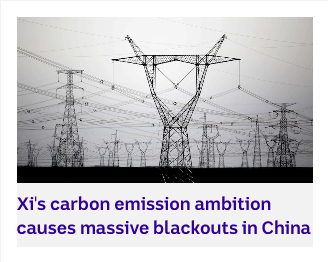
Yeah that’s right, that’s the cause of blackouts, carbon ambition, good guys.


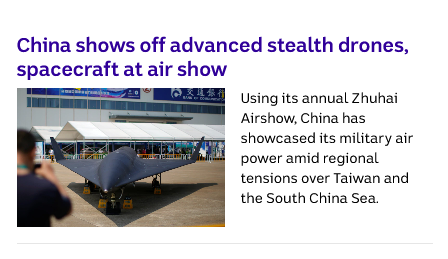
Showing off stealth equipment, well there you go.

Reply Quote

Date: 29/09/2021 21:26:52
From: Witty Rejoinder
ID: 1796836
Subject: re: Chinese politics

Bombard the headquarters: Xi Jinping’s crackdown keeps growing
The new ‘common prosperity’ doctrine hearkens back to the Mao era

RICHARD MCGREGOR, Contributing writer
SEPTEMBER 29, 2021 06:00 JST

Billionaires banished. Celebrities canceled. Private businesses wiped out overnight with the stroke of the ruling communist party’s pen, along with a ban on the once-common practice of raising money offshore.

All of which has been prompting officials, investors and indeed anyone with a stake in the future of the world’s largest country to ask — what on earth is going on in President Xi Jinping’s China?

Ultra-leftist Chinese offered their own enthusiastic take, calling the policy upheaval a new revolution and urging a harder line against everything from runaway capitalism to effeminate male pop stars.

Not so fast, replied Hu Xijin, the editor of the party tabloid, the Global Times, who stepped in to warn against stirring up “confusion and panic.” Hu is notorious in the West as a vocal hypernationalist. In this dispute, he was cast as the voice of cool moderation.

The extreme debate has prompted Chinese commentators to raise the specter of a new Cultural Revolution, an overwrought but telling comparison given the death and destruction wrought by Mao Zedong during the decade from 1966.

The unusually public battle in September between the two commentariats, both amplified by state media and social media platforms, stirred mainstream officials into action.

Their explanations were more soothing, even if the placement of their rejoinders was not. Splashed across the front page of the People’s Daily, the Chinese Communist Party’s official mouthpiece, a spot usually reserved for important political announcements, Liu He, Xi’s chief economic adviser, praised the private sector and insisted it was indispensable to China’s development.

Earlier, the securities regulator had offered similar assurances. These came after a national security probe into Didi Chuxing, the Uber of China, was sprung days after Didi’s listing in New York, cratering the company’s share price.

But it will take more than reassuring words from Xi’s inner circle to clear up the mess left by the helter-skelter of policy announcements in recent months.

If senior officials close to Xi are being forced to clarify the country’s policy direction, then one can be sure that lower-level officials whose task it is to implement them have little idea.

Bonfire of the Vanities

The political and policy upheaval started last October with a speech in Shanghai by Jack Ma, the founder of Alibaba Group Holding, in which he attacked the country’s financial regulators as having a “pawnshop mentality.”

The central government’s reaction was swift. Ma was summonsed to Beijing and the $30 billion to $40 billion initial public offering of Alibaba’s fintech arm, Ant Group, planned for Hong Kong and Shanghai a few days later, was canceled.

The highflying billionaire was transformed overnight into a supplicant, abjectly apologizing to the same officials he had been lording over days earlier and offering the state any part of the company that they thought they might need to take.
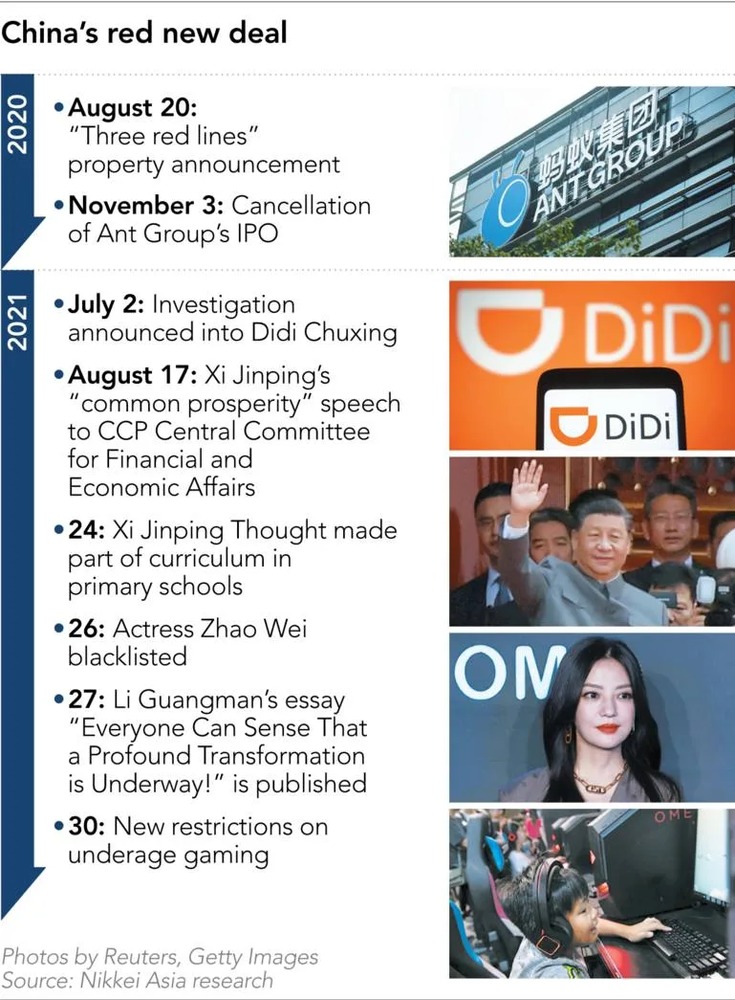
His penitence was not nearly enough. Escorted back to the Alibaba headquarters in Hangzhou by security officials, Ma was effectively forced out of the company. Once a ubiquitous presence in China, Ma has barely been glimpsed since.

The downfall of the country’s best-known billionaire was the trigger, first for a regulatory blizzard targeting large swathes of the private sector, including pop culture-makers and celebrity-driven media.

In the following months, Xi and his supporters progressively rolled out a more far-reaching agenda that amounts to a big bet that he can overhaul the economy and the rules that have underwritten the country’s decadeslong boom.

In the short term, the number of individuals and industries, as well as pastimes that support industries, that have been buffeted by Xi’s latest campaign is astounding.

Fintech. Youth gaming culture. Bitcoin mining. Tax evaders. Cloud computing, data management and algorithms. Overseas IPOs. Private tutoring companies. The rules surrounding these technologies, practices and businesses have been turned upside down in the space of a few months.

Celebrity ranking lists have been banned, though it is doubtful that can be sustained. On top of that, at least one celebrity was caught evading taxes and publicly shamed.

Zhao Wei, a famous actor and filmmaker, disappeared from sight almost overnight and saw her name erased from video platforms. She has not been charged with a crime, though some have speculated her closeness to Alibaba made her a target.

No oligarchs allowed

It is hard to pin the crackdown on one event or trigger, and most of the individual actions have their own dynamic and logic.

It is in part regulatory, because of the overreach of privately owned tech giants; in part political, because of the need by the party to stay in control of the economy and eliminate alternative power centers; and in part geopolitical, driven by the policy to decouple key sectors from the U.S.

There is also a whiff in China’s crackdown of what America did in response to the excesses of robber-baron capitalism in the U.S. in the late 19th century, which resulted in groundbreaking anti-monopoly measures.

There is a reason why Chinese commentators compare the rise of local tech companies like Alibaba (e-commerce and finance) and Tencent Holdings (gaming and messaging) to 1890s corporate America.

Both eras featured new businesses that enjoyed periods of “barbaric growth” and monopoly dominance before politicians stepped up and used state power to rein them in.

“This is not the end of the socialist market economy, but China has decided to make the market a bit more socialist,” said Bert Hofman, formerly the head of the World Bank in China.

The party has long worried about the creation of a politically powerful “oligarch” class, as happened in Russia in the 1990s. They were always going to make sure that did not happen in China.

The one thread that ties together just about all the recent measures is the singular figure of Xi. In power since late 2012, he has ruthlessly eliminated rivals and now commands every powerful position in the country.

Xi has compiled an enormously ambitious agenda, for himself, the ruling party and the country, with hard short- and long-term targets. The economic, cultural and political upheaval in recent months reflects that more than anything else.

Just over the horizon is the 20th party congress toward the end of next year, the once every five years meeting of the country’s top communist leaders who will convene to consecrate a new Politburo and general secretary.

Having abolished term limits for the presidency in early 2018, Xi has been preparing the ground to take advantage of the rule change and buck recent tradition by winning a third five-year term.

The first step is securing his reappointment at the next plenum, or full meeting, of the Central Committee, in November, the last before next year’s congress. The meeting will focus on why the party “succeeded in the past 100 years and know how it can sustain the success in the future” according to Xinhua, the official news service. Doubtless, Xi will figure in such assessments.

But as powerful as he is, Xi still needs to prepare a road map for the future for his colleagues.

But Xi cannot run on a cult of personality alone, which provides him with a leg-up to a third term. Without a policy agenda, he would be vulnerable to attacks from his legion of enemies.

Running in parallel to internal leadership struggles is geopolitical competition with the U.S., a defining and hydra-headed contest strewed across military, regional, high-tech and ideological battlefields.

Chinese companies are already required to keep all their data onshore, as are U.S. companies, like Apple, operating in China. But as the national security investigation into Didi Chuxing illustrated, Beijing will not allow Washington’s regulators even the tiniest of footholds in their companies amid the threat their data could be turned over to U.S. authorities. Zero-sum thinking is driving policy calculations on both sides of the Pacific.

“Common prosperity”

For Xi to command the country and the world, he needs to prevail in his final policy battlefield, in remaking the Chinese economy to ensure it delivers for the urban middle class.

It is here, in Xi’s agenda for “common prosperity,” the buzzword of the new era, that the contradictions are most at play. After all, Xi is presenting not just a “new deal” for China, but a “red new deal” designed to strengthen and entrench party rule.

Beijing’s label for its economic system, “socialism with Chinese characteristics,” has long prompted snickers outside of the country, as a rhetorical fig leaf that allows a communist party to preside over unbridled capitalism. No one is laughing anymore.

But while Xi wants the state to occupy the commanding heights of the economy, he also needs a thriving private sector to build businesses, create jobs and drive the kind of risk-taking needed to compete with the U.S. and other developed countries on technology and innovation.

Can he pull it off? Skeptics abound, including Kevin Rudd, a former prime minister of Australia and a Chinese-speaking expert on the country. Rudd told the Asia Society that external threats had empowered the “politics, ideology, security and intelligence” faction surrounding Xi. “And that team, frankly, don’t know the first thing about how an economy ticks.”

New red guards

On top of that is the hot political climate, of the kind embodied in the screed published in late August by Li Guangman. A hitherto marginal blogger whose writings had been largely confined to obscure neo-Maoist outlets, Li on this occasion was afforded prime real estate in state media to back radical changes to the economy and society.

“This transformation will wipe away all the dust,” Li wrote in an essay that first appeared on the social media platform WeChat. “Capital markets will no longer be a heaven where capitalists can make a fortune overnight. The cultural marketplace will no longer be a heaven for sissy-boy celebrities.”

The fact that Hu Xijin of the Global Times felt compelled to rebut Li’s essay publicly was highly significant, according to Yawei Liu, of the Carter Center.

The usual targets of Hu’s venom are liberal Chinese and the West. Lately, he has tangled more and more with Chinese ultranationalists inside his own country who have faulted Hu for being weak.

“Hu is an insider with strong knowledge of how the Chinese government approaches propaganda. Either his own conscience has dictated his behavior, or he was encouraged by someone inside the government to challenge Li,” Liu said. “There is one thing for certain: This debate indicates there is a raging debate inside the CCP on the merits of reform and opening up, and on where China is today in terms of social and political stability.”

The language of Li’s essay uncomfortably echoed the Cultural Revolution, the decadelong period of chaos unleashed in 1966 by Mao Zedong. Paranoid about rivals, Mao set violent grassroots gangs, “Red Guards” and the like, on anyone thought to be dissenting from Mao’s leadership.

The comparisons to the Cultural Revolution are considered overheated by many China experts. Not only is Xi’s China vastly different from the country that Mao commanded, but Xi himself has no taste for such disorder.

“Xi Jinping is an intensely difficult person to read, but one of the things I’m most confident about is he thought the Cultural Revolution was a total disaster,” said Joseph Torigian of American University in Washington.

“For Xi, the Cultural Revolution was somewhat like Putin’s Dresden moment — a lesson in what people might do when government loses control.” (As a KGB officer stationed in Dresden, East Germany, when the Berlin Wall was coming down in 1989, Putin lamented how the Soviet government in Moscow was paralyzed in trying to respond.)

In the 1980s, Xi himself criticized the Cultural Revolution as a “manifestation of ‘big democracy,’” not in “accord with science nor the rule of law, but instead, in accord with superstition.”

Carl Minzner of Fordham University in New York, however, is not dismissive of the comparison, saying the “problem is that specific policies adopted by particular leaders sometimes have the opposite result of their initial goals.

“The key question is what risk is there that Xi’s revival of key elements of Maoist politics — single-man rule, total party domination of society and state, and the primacy of ideology — could lead, intentionally or not, to a revival of other features of Maoist China?”

Widening gap

Xi’s new overarching policy of common prosperity did not fall from the sky.

China has debated income inequality ever since Deng Xiaoping set the market loose in the late 1970s and backed “letting some people get rich first” to kick start the economy.

“Since 1978, China has been living with an awkward compromise between Marxist ideology and an increasingly market-driven economy,” Hofman said.

Every decade has had similar convulsions over whether, in the Chinese political parlance, policies should be “surnamed socialist” or “surnamed capitalist.”

It is also true that China, judged at least by income, has become less unequal over the past decade. A tightening labor market has pushed wages up faster than GDP growth since 2010.

But as in the West, the gap has widened in wealth accumulation, in ownership of shares and property and other assets.

Conspicuous consumption has grown along the way. China does not just produce more than half of the world’s steel, its consumers account for nearly half of all luxury goods sold globally.

But as happened in the US, rising inequality is gnawing away at the social compact in China. The cost of living, and of raising children, is becoming prohibitive, which has so far nullified the government’s efforts to persuade women to have more children.

China’s population will soon begin contracting, something that the ruling party sees as a fatal weakness in the long term.

In that respect, Xi’s soak-the-rich policy is likely to be popular, just as his anti-corruption campaign starting in 2013 was as well. Many Chinese are doubtless happy to see big shots get their comeuppance.

“What is the global trend?” prominent economist Ren Zeping asked in Caixin, a Chinese financial publication. “It is to reduce the profits and monopolies of real estate, finance, education, Internet, and other industries, as well as the long-term squeezing of people’s livelihood.”

In their place, Beijing’s wants renewed focus on high-end manufacturing, science and technology, green energy sources and infrastructure, all of which will also help it compete with Washington.

So far, so easy. The policy implementation, however, will not be nearly so popular.

China’s wealthy have seen the writing on the wall for some time, with a flurry of billionaires and their companies announcing new foundations to give away large chunks of their fortunes. Alibaba and Tencent made their announcements in late August to early September almost in tandem, committing billions of dollars to new charitable foundations.

But as the U.S. illustrates, no amount of ostentatious and generous philanthropy can address entrenched inequality and fiscal shortfalls on their own, nor can they systematically target specific problems.

For that, you need a functioning tax system, and here, China struggles.

After years of debate, the government still balks at taxing residential property, because there is always a bubble here or there that could pop and damage the financial system.

The only way that real estate is taxed is through capital gains after sale. Otherwise, capital gains are not taxed at all.

The bubbles are not imaginary. China Evergrande Group, China’s biggest property developer, is currently trying to stave off collapse, with debts reportedly around $300 billion. The Evergrande crisis will induce greater policy caution in the short term.

China has high marginal rates to tax income but little compliance with them. In Beijing, in the noughties, the tax bureaus in different parts of the city were still competing to attract businesses to file their returns in their localities by offering lower rates, as they would benefit from the new revenue.

In 2020, personal incomes tax made up less than 10 percent of the central government’s revenues. More than a third came from value-added tax revenue.

Enforcing personal tax compliance brings with it political pain, which so far the government has shied away from. But with the fiscal burden growing, to pay for pensions in a rapidly aging society and correct years of underinvestment in health and education, not to say underwrite a growing bill for defense and internal security, the government will surely have to bite the bullet.

Apart from having to restructure the fiscal system, mainstream Chinese economists worry that the leftward turn will anesthetize the economy’s productive potential.

“We must be vigilant against common prosperity becoming a Great Leap Forward or something that blights development,” said Li Daokui, a former adviser to the Chinese central bank. It was a remarkable, and brave comparison, as upward of 30 million to 40 million Chinese died in a policy-induced famine in the few years beginning with 1958.

Xi’s new policies have a whiff of the campaigns of communist yesteryear, aimed at rearing perfect and politically compliant citizens, and they have been satirized as such in China.

“The socialist successor of the new era does not attend after-school tutoring, does not play video games, does not chase celebrities,” said one internet post.

“They finish all their homework at school, read President Xi’s selected works for one hour every day, go to sleep before 10 p.m., take the initiative to do chores, urge their parents to have more children, and help look after the elderly.”

The post was soon censored and taken down.

In his early days in office, commentators hunting for a reassuring spin on Xi’s authoritarian rule often cited a local political idiom, that the Chinese leader was signaling left, only to turn right.

As far as politics go, it is a tactic as familiar in democracies as in communist-led states, as leaders throw red meat to their bases to shore up support before shifting back to the center.

After nearly a decade in office, nobody says that about Xi anymore. The Chinese leader turned left from the start, and he has stayed there.

Richard McGregor is a senior fellow at the Lowy Institute in Sydney.

https://asia.nikkei.com/Spotlight/The-Big-Story/Bombard-the-headquarters-Xi-Jinping-s-crackdown-keeps-growing?
Reply Quote

Date: 29/09/2021 22:02:45
From: SCIENCE
ID: 1796844
Subject: re: Chinese politics

Witty Rejoinder said:

“The socialist successor of the new era does not attend after-school tutoring, does not play video games, does not chase celebrities,” said one internet post.

“They finish all their homework at school, read President Xi’s selected works for one hour every day, go to sleep before 10 p.m., take the initiative to do chores, urge their parents to have more children, and help look after the elderly.”

so they are Good Catholics kind of makes sense

Reply Quote

Date: 29/09/2021 22:05:54
From: Bubblecar
ID: 1796845
Subject: re: Chinese politics

SCIENCE said:


Witty Rejoinder said:

“The socialist successor of the new era does not attend after-school tutoring, does not play video games, does not chase celebrities,” said one internet post.

“They finish all their homework at school, read President Xi’s selected works for one hour every day, go to sleep before 10 p.m., take the initiative to do chores, urge their parents to have more children, and help look after the elderly.”

so they are Good Catholics kind of makes sense

Surely the Chinese government can dispense with a human population and just invest in robots.

Reply Quote

Date: 29/09/2021 22:58:00
From: SCIENCE
ID: 1796851
Subject: re: Chinese politics

Bubblecar said:

SCIENCE said:

Witty Rejoinder said:

“The socialist successor of the new era does not attend after-school tutoring, does not play video games, does not chase celebrities,” said one internet post.

“They finish all their homework at school, read President Xi’s selected works for one hour every day, go to sleep before 10 p.m., take the initiative to do chores, urge their parents to have more children, and help look after the elderly.”

so they are Good Catholics kind of makes sense

Surely the Chinese government can dispense with a human population and just invest in robots.

we mean we are pretty sure that give government some power and they will go and fuck some people over

but the whole story that CHINA are a bunch of slanty-eyed baby-eating hate-filled hive-minded bio-robots with no respect for human life or rights or decency

doesn’t quite match the impression you might get that they’re trying as hard as they can to prevent COVID-19 deaths and disease

Reply Quote

Date: 29/09/2021 23:04:19
From: Bubblecar
ID: 1796853
Subject: re: Chinese politics

SCIENCE said:

Bubblecar said:

SCIENCE said:

so they are Good Catholics kind of makes sense

Surely the Chinese government can dispense with a human population and just invest in robots.

we mean we are pretty sure that give government some power and they will go and fuck some people over

but the whole story that CHINA are a bunch of slanty-eyed baby-eating hate-filled hive-minded bio-robots with no respect for human life or rights or decency

doesn’t quite match the impression you might get that they’re trying as hard as they can to prevent COVID-19 deaths and disease

It’s important to make a distinction between a nation’s people, in all their diversity, and their government. Especially in a place like China where the people have very limited say in regard to their government and its policies.

Reply Quote

Date: 29/09/2021 23:41:42
From: party_pants
ID: 1796861
Subject: re: Chinese politics

Very long, did read.

China has a few big problems to deal with. n addition to those mentioned in the article is the one-party state and lack of open political debate. The problem is that the CCP’s ruling faction think they can control the full complexity of the social and economic system by issuing decrees, which are not always thought through.

For example, the Evergrande collapse (or the crisis at any rate) is due to the CCP realising the way these companies are run is unsustainable, they rely upon a rampant bull market as their basic operating model, and the CCP has recognised this and issued new decrees on the capitlisation and debt to assets ratios etc that property developers can have. But in doing so it is almost bankrupting one of the largest property developers overnight by not giving them any sort of transition period. The small number of people in charge and the lack of public debate on the issue seems to suggest they don’t have a process for thinking it through.

The thing is though, that the CCP won’t tolerate public debate, let alone criticism. They won’t even tolerate anything else being more popular than the CCP. The be popular in the public opinion os to be in conflict with the CCP and ripe for a cutting down to size. Popular culture and celebrities are being cracked down upon (even non-political ones), even online gaming is being cut down because it is popular. Sure they have a problem with oligarchs, but the bigger objection is that these people possess a power and influence separate from the CCP.

Some people are already calling this the third phase of the CCP. They can make sensible economic and taxation reforms without arresting people and stripping them of their social status along with their assets. It is very heavy handed tactics from a small group in charge who don’t think things through.

Reply Quote

Date: 18/10/2021 22:39:44
From: SCIENCE
ID: 1805422
Subject: re: Chinese politics

hahahahahahaha Evergrande hahaha oh wait the phqu https://www.abc.net.au/news/2021-10-18/sydney-apartment-awning-at-risk-of-collapse-building-order-finds/100548336

Reply Quote

Date: 18/10/2021 22:43:04
From: Tau.Neutrino
ID: 1805423
Subject: re: Chinese politics

SCIENCE said:


hahahahahahaha Evergrande hahaha oh wait the phqu https://www.abc.net.au/news/2021-10-18/sydney-apartment-awning-at-risk-of-collapse-building-order-finds/100548336

I see Evergrande are in a bit of trouble.

Reply Quote

Date: 18/10/2021 22:48:20
From: party_pants
ID: 1805425
Subject: re: Chinese politics

SCIENCE said:


hahahahahahaha Evergrande hahaha oh wait the phqu https://www.abc.net.au/news/2021-10-18/sydney-apartment-awning-at-risk-of-collapse-building-order-finds/100548336

At least the inspectors are doing their job and are free to make adverse findings and place work orders on the developers.

Reply Quote

Date: 18/10/2021 22:50:47
From: The Rev Dodgson
ID: 1805426
Subject: re: Chinese politics

party_pants said:


SCIENCE said:

hahahahahahaha Evergrande hahaha oh wait the phqu https://www.abc.net.au/news/2021-10-18/sydney-apartment-awning-at-risk-of-collapse-building-order-finds/100548336

At least the inspectors are doing their job and are free to make adverse findings and place work orders on the developers.

I was just going to say that.

And at least they picked these things up before it was finished.

Reply Quote

Date: 18/10/2021 22:51:35
From: party_pants
ID: 1805427
Subject: re: Chinese politics

Tau.Neutrino said:


SCIENCE said:

hahahahahahaha Evergrande hahaha oh wait the phqu https://www.abc.net.au/news/2021-10-18/sydney-apartment-awning-at-risk-of-collapse-building-order-finds/100548336

I see Evergrande are in a bit of trouble.

Not just them. I think China are heading for recession.

They haven’t had one in nearly 50 years, so even experienced officials and economists there won’t know what to do.

Reply Quote

Date: 19/10/2021 06:10:36
From: SCIENCE
ID: 1805445
Subject: re: Chinese politics

The Rev Dodgson said:

party_pants said:

SCIENCE said:

hahahahahahaha Evergrande hahaha oh wait the phqu https://www.abc.net.au/news/2021-10-18/sydney-apartment-awning-at-risk-of-collapse-building-order-finds/100548336

At least the inspectors are doing their job and are free to make adverse findings and place work orders on the developers.

I was just going to say that.

And at least they picked these things up before it was finished.

isn’t the point that the buildings aren’t finished

Reply Quote

Date: 12/11/2021 08:45:27
From: SCIENCE
ID: 1815033
Subject: re: Chinese politics

Just Don’t Mention The French IndoCHINA ¡
https://www.abc.net.au/news/2021-11-12/paul-keating-wrong-on-china-chris-uhlmann-qa/100614466

Reply Quote

Date: 25/11/2021 21:52:00
From: SCIENCE
ID: 1818999
Subject: re: Chinese politics

https://inews.co.uk/opinion/priti-patel-anti-protest-powers-stuffed-policing-bill-1316830

oh sorry left thread

Reply Quote

Date: 8/12/2021 21:36:34
From: SCIENCE
ID: 1823027
Subject: re: Chinese politics

https://www.abc.net.au/news/2021-12-01/china-australia-trade-wars-us-kurt-campbell-lowy-institute/100664732

ellipsis

White House Indo-Pacific adviser Kurt Campbell has told the Lowy Institute that Beijing’s coordinated sanctions on a range of Australian products – including coal, barley, wine, timber and lobsters – was designed to bring Australia “to its knees”. “I think China’s preference would have been to break Australia. To drive Australia to its knees … I don’t believe that’s going to be the way it’s going to play out. “I believe that China will engage because it is in its own interest to have a good relationship with Australia.”

ellipsis

What is AdBlue and why could an international shortage bring Australia’s economy to its knees? China is the world’s biggest producer of urea and in recent weeks has been moving to dramatically tighten its grip on supplies to keep a lid on surging prices. National Road Transport Association chief Warren Clark said there were a few theories about what drove China’s actions, but the most likely one was self-interest. Last month, South Korea resorted to the drastic step of importing 27,000 litres of urea solution from Australia after China cracked down on exports.

ellipsis

https://www.abc.net.au/news/2021-12-08/adblue-shortage-a-serious-threat-to-australias-supply-chain/100683230

Reply Quote

Date: 1/09/2022 23:45:33
From: SCIENCE
ID: 1927384
Subject: re: Chinese politics

Taiwan tycoon donates $15 to train each of 3 million ‘civilian warriors’ for defence against Chinese invasion

https://www.abc.net.au/news/2022-09-01/taiwan-tycoon-to-train-three-million-civilian-warriors/101397854

Reply Quote

Date: 1/09/2022 23:57:45
From: dv
ID: 1927386
Subject: re: Chinese politics

SCIENCE said:

Taiwan tycoon donates $15 to train each of 3 million ‘civilian warriors’ for defence against Chinese invasion

https://www.abc.net.au/news/2022-09-01/taiwan-tycoon-to-train-three-million-civilian-warriors/101397854

$0.000005 each won’t go far

Reply Quote

Date: 2/09/2022 00:03:53
From: party_pants
ID: 1927389
Subject: re: Chinese politics

SCIENCE said:

Taiwan tycoon donates $15 to train each of 3 million ‘civilian warriors’ for defence against Chinese invasion

https://www.abc.net.au/news/2022-09-01/taiwan-tycoon-to-train-three-million-civilian-warriors/101397854

Articles says he is donating $47 million (I presume AUD equivalent). The initial figure is 1 billion Taiwan Dollars.

Reply Quote

Date: 3/12/2022 10:03:34
From: JudgeMental
ID: 1962753
Subject: re: Chinese politics

https://theconversation.com/yes-the-chinese-protests-are-about-politics-and-freedom-but-they-are-also-about-what-covid-might-do-if-it-is-let-loose-now-195553

Link

Reply Quote

Date: 3/12/2022 10:18:28
From: SCIENCE
ID: 1962755
Subject: re: Chinese politics

JudgeMental said:

https://theconversation.com/yes-the-chinese-protests-are-about-politics-and-freedom-but-they-are-also-about-what-covid-might-do-if-it-is-let-loose-now-195553

Link

lol you idiot

I would suggest Xi is actually more worried that a relaxed policy will lead to more deaths among the elderly.

Chinese drone workers are hivemind, they’re heartless propaganda fed brainless economic units who don’t have a single care for others, what would they know about life and not death

Reply Quote

Date: 3/12/2022 10:24:40
From: SCIENCE
ID: 1962757
Subject: re: Chinese politics

JudgeMental said:


https://theconversation.com/yes-the-chinese-protests-are-about-politics-and-freedom-but-they-are-also-about-what-covid-might-do-if-it-is-let-loose-now-195553

Link

lol you genius

The saddest thing about the protests in Iran and China is the inability of the outside world to do anything.

totally nothing done from outside, foreign Interference only works in one direction

Reply Quote

Date: 15/03/2025 13:39:30
From: Spiny Norman
ID: 2260993
Subject: re: Chinese politics

First Sighting Of China’s Huge Invasion Barges – Quick Analysis

China is building a number of ginormous barges, equipped with bridges, for the expected invasion of Taiwan. These will allow much larger quantities of heavy vehicles and troops to be landed, and also increase the number of places where a viable landing can be made. New imagery provides new insights into how they might be used.

https://www.youtube.com/watch?v=TXMiIBrUlhc

Well shit. :(

Reply Quote

Date: 15/03/2025 13:56:05
From: Spiny Norman
ID: 2260999
Subject: re: Chinese politics

The $1.3 Trillion Mistake That Weakened the U.S. Navy

Not What You Think channel.

https://www.youtube.com/watch?v=lTUXtm3lues

Reply Quote

Date: 15/03/2025 15:10:27
From: Woodie
ID: 2261016
Subject: re: Chinese politics

Spiny Norman said:


First Sighting Of China’s Huge Invasion Barges – Quick Analysis

China is building a number of ginormous barges, equipped with bridges, for the expected invasion of Taiwan. These will allow much larger quantities of heavy vehicles and troops to be landed, and also increase the number of places where a viable landing can be made. New imagery provides new insights into how they might be used.

https://www.youtube.com/watch?v=TXMiIBrUlhc

Well shit. :(

“Taiwan produces over 60% of the world’s semiconductors and around 90% of the most advanced ones, making it a key player in the global chip industry”

When there is a rapid shift by “the west” to get this production out of Taiwan, then I might take Chinese threats of invasion of Taiwan seriously, rather than just hurrupff and a bit sabre rattling.

Yes, I am aware of some token efforts to establish TSMC in the US, but that doesn’t seem to be moving that fast.

Reply Quote

Date: 15/03/2025 15:11:21
From: party_pants
ID: 2261017
Subject: re: Chinese politics

Woodie said:


Spiny Norman said:

First Sighting Of China’s Huge Invasion Barges – Quick Analysis

China is building a number of ginormous barges, equipped with bridges, for the expected invasion of Taiwan. These will allow much larger quantities of heavy vehicles and troops to be landed, and also increase the number of places where a viable landing can be made. New imagery provides new insights into how they might be used.

https://www.youtube.com/watch?v=TXMiIBrUlhc

Well shit. :(

“Taiwan produces over 60% of the world’s semiconductors and around 90% of the most advanced ones, making it a key player in the global chip industry”

When there is a rapid shift by “the west” to get this production out of Taiwan, then I might take Chinese threats of invasion of Taiwan seriously, rather than just hurrupff and a bit sabre rattling.

Yes, I am aware of some token efforts to establish TSMC in the US, but that doesn’t seem to be moving that fast.

Who’d want to invest in the USA right now?

Reply Quote

Date: 15/03/2025 15:13:30
From: AussieDJ
ID: 2261018
Subject: re: Chinese politics

party_pants said:


Woodie said:

Spiny Norman said:

First Sighting Of China’s Huge Invasion Barges – Quick Analysis

China is building a number of ginormous barges, equipped with bridges, for the expected invasion of Taiwan. These will allow much larger quantities of heavy vehicles and troops to be landed, and also increase the number of places where a viable landing can be made. New imagery provides new insights into how they might be used.

https://www.youtube.com/watch?v=TXMiIBrUlhc

Well shit. :(

“Taiwan produces over 60% of the world’s semiconductors and around 90% of the most advanced ones, making it a key player in the global chip industry”

When there is a rapid shift by “the west” to get this production out of Taiwan, then I might take Chinese threats of invasion of Taiwan seriously, rather than just hurrupff and a bit sabre rattling.

Yes, I am aware of some token efforts to establish TSMC in the US, but that doesn’t seem to be moving that fast.

Who’d want to invest in the USA right now?

^ This ^

Reply Quote

Date: 15/03/2025 15:33:10
From: Woodie
ID: 2261027
Subject: re: Chinese politics

AussieDJ said:


party_pants said:

Woodie said:

“Taiwan produces over 60% of the world’s semiconductors and around 90% of the most advanced ones, making it a key player in the global chip industry”

When there is a rapid shift by “the west” to get this production out of Taiwan, then I might take Chinese threats of invasion of Taiwan seriously, rather than just hurrupff and a bit sabre rattling.

Yes, I am aware of some token efforts to establish TSMC in the US, but that doesn’t seem to be moving that fast.

Who’d want to invest in the USA right now?

^ This ^

“In April 2024, the United States Department of Commerce provided TSMC Arizona with a grant for a total of $6.6 billion in funding under the CHIPS and Science Act. Additionally, the two countries are investing in joint research initiatives and workforce development programs to provide a steady pipeline of skilled workers for the semiconductor industry. TSMC’s expansion into the United States has also been met with significant challenges, particularly in its Arizona plant, facing a 1-year delay on its planned operating date.”

Well wadda ya know. Under Biden as well.

Reply Quote

Date: 15/03/2025 15:39:10
From: Witty Rejoinder
ID: 2261032
Subject: re: Chinese politics

Woodie said:


AussieDJ said:

party_pants said:

Who’d want to invest in the USA right now?

^ This ^

“In April 2024, the United States Department of Commerce provided TSMC Arizona with a grant for a total of $6.6 billion in funding under the CHIPS and Science Act. Additionally, the two countries are investing in joint research initiatives and workforce development programs to provide a steady pipeline of skilled workers for the semiconductor industry. TSMC’s expansion into the United States has also been met with significant challenges, particularly in its Arizona plant, facing a 1-year delay on its planned operating date.”

Well wadda ya know. Under Biden as well.

Trump wants to abolish the CHIPs act.

Reply Quote

Date: 23/03/2025 19:54:16
From: dv
ID: 2264088
Subject: re: Chinese politics

Chinese state media has reacted gleefully to the Trump administration’s decision to slash government funding to media organisations such as Radio Free Asia (RFA) and Voice of America (VOA).

The Global Times, a daily English-language tabloid and Chinese Communist party mouthpiece, celebrated the cuts to the US Agency for Global Media (USAGM), which oversees broadcasters such as VOA and RFA.

https://www.theguardian.com/media/2025/mar/18/chinese-state-media-celebrates-trumps-cuts-to-voice-of-america-and-radio-free-asia

Reply Quote

Date: 23/03/2025 20:17:52
From: SCIENCE
ID: 2264098
Subject: re: Chinese politics

dv said:

Chinese state media has reacted gleefully to the Trump administration’s decision to slash government funding to media organisations such as Radio Free Asia (RFA) and Voice of America (VOA).

The Global Times, a daily English-language tabloid and Chinese Communist party mouthpiece, celebrated the cuts to the US Agency for Global Media (USAGM), which oversees broadcasters such as VOA and RFA.

https://www.theguardian.com/media/2025/mar/18/chinese-state-media-celebrates-trumps-cuts-to-voice-of-america-and-radio-free-asia

we’re astounded

Reply Quote

Date: 29/01/2026 16:14:26
From: Witty Rejoinder
ID: 2355043
Subject: re: Chinese politics

‘Nobody is safe’: What Xi’s purges say about his control over China’s military
Lisa Visentin
January 28, 2026 — 11:56am

Singapore: In the end, Zhang Youxia’s downfall was as stunning as it was clinical.

The fate of China’s top general was sealed in a single line of a defence ministry press release on Saturday that accused him of “grave violations of discipline and the law”. But his political demise is not a routine purge. It’s a bombshell to a system that has grown accustomed to President Xi Jinping’s ruthless anti-corruption drives.

“Xi Jinping has completed one of the biggest purges of China’s military leadership in the history of the People’s Republic,” says Neil Thomas, a fellow at the Asia Society Policy Institute’s Centre for China Analysis.

Zhang’s ouster, alongside General Liu Zhenli, who was also placed under investigation, all but completes Xi’s decapitation of the top brass of the People’s Liberation Army (PLA), handing him total control over the Chinese Communist Party’s military wing.

“Zhang’s removal means that truly nobody in the leadership is safe now,” Jonathan Czin, a former CIA China analyst, told Reuters, saying the probe marked a “profound shift” in Chinese politics.

It also fuels speculation about power struggles and warring factions within the party’s upper echelons. At 75, Zhang was knifed even though he could have been retired at the 21st Party Congress next year, when Xi is expected to seek an unprecedented fourth term in power.

And it raises obvious questions about the PLA’s future direction in particular. What does this mean for Xi’s demand, according to the US intelligence, that the armed forces be capable of executing an invasion of Taiwan by 2027?

‘The official, internal story is not always the truth about what happened.’
Bill Bishop, China analyst
One possible explanation advanced by some experts is that disagreement with Xi over PLA development and Taiwan strategy led to the senior officers’ downfall.

“Zhang and Liu likely failed to meet Xi Jinping’s requirements for force building related to a Taiwan invasion, and may even have engaged in open disagreement or defiance within the PLA,” said K.Tristan Tang, from the Pacific Forum think tank, in a report that analysed official PLA statements over recent months.

Corruption and graft has been an endemic problem in PLA, but Xi’s purges have also been used to root out potential disloyalty fermenting in the ranks.

The famous “black box” of Chinese elite politics – untouched by the sunlight of transparency – means we may never know the real reason for Zhang’s political demise. But within hours of his ouster, the rumour mill had cranked into overdrive.

Online, wild speculation circulated that Zhang was mobilising a coup against Xi. The Wall Street Journal published allegations that Zhang was accused of leaking information about the country’s nuclear weapons program to the US, citing anonymous sources who claimed knowledge of a Chinese high-level briefing about the generals.

But this drew heavy scepticism from seasoned China watchers.

“The official, internal story is not always the truth about what happened, so just because they may be telling other officials he leaked nuclear secrets does not mean he actually did,” wrote analyst Bill Bishop in his Sinocism newsletter.

“But it might make for a useful charge internally, as it shows him to be an even greater villain than if he were simply corrupt, as he was working for the main enemy.”

Zhang was expected to survive
As vice-chairman of the Central Military Commission – China’s supreme military decision-making body – Zhang was not just the most senior PLA figure, he was one of the few generals with actual combat experience, albeit from the Sino-Vietnamese conflicts of the 1970s and ’80s.

This fact and his close ties to Xi – the pair grew up together as “princeling” sons of China’s communist revolutionary elite – were thought to be key to his survival as generals were felled around him.

With Zhang and Liu’s removal, Xi has purged all but one of the six generals he appointed to the commission in 2022. Just two remain: Xi himself as chair and Zhang Shengmin (no relation to Zhang Youxia), who has overseen the anti-corruption purges in the military.

Former Pentagon official Drew Thompson, who met Zhang when he travelled to the US for a week-long defence delegation in 2012, said he had heard rumours since 2023 that Zhang was under investigation.

“I assessed that Zhang Youxia’s combat experience, his self-confidence, intellect and life-long commitment to the defence of China and the Communist Party would protect him. I thought that his life-long relationship with Xi Jinping would be his insurance,” Thompson wrote in a Substack essay.

A fiercely worded commentary in the PLA Daily, the official mouthpiece of the armed forces, on Sunday indicated the reasons for Zhang and Liu’s downfall went beyond standard corruption allegations, hinting at political tension.

It accused the generals of having “seriously trampled upon” the system of responsibility under the military commission chairman (Xi) and fuelled “political and corruption problems that weaken the Party’s absolute leadership over the military”.

“This could suggest that Zhang was becoming too powerful for Xi’s liking, or simply that he betrayed the chairman’s trust by helping corrupt the procurement bureaucracy and/or not doing his utmost to create a cleaner fighting force,” says Thomas.

Where to for the PLA and Taiwan?

Some China analysts point to signs that Zhang was likely to have been more conservative on attacking Taiwan than Xi, particularly in the near term.

“I think he could assess US and Taiwan military capabilities objectively and explain to Xi Jinping what the military risks and costs of an operation to take Taiwan would be,” Thompson wrote of Zhang.

“I worry about the consequences of someone other than Zhang Youxia providing Xi Jinping with military advice.”

Tang concluded that Zhang likely saw Xi’s 2027 timeline for military readiness on Taiwan as unachievable and “clearly placed this goal closer to 2035”. Together with Liu, “their presence instead posed a challenge to Xi’s authority”, he wrote.

“Although the probability of achieving the 2027 Taiwan invasion capability remains extremely low, Xi Jinping will likely appoint successors who are willing to execute his military blueprint in place of Zhang and Liu.”

Thomas assesses that China’s threat toward Taiwan is now “weaker in the short term but stronger in the long term”.

A high command in disarray, he said, increases the gamble for Xi of massive military escalation, but in the longer term, “a less corrupt, more loyal, and more capable military could more credibly coerce Taipei into submission and deter Washington from intervening”.

For now, one thing is clear. Xi is in total control of China’s military and will stop at nothing to secure absolute loyalty.

https://www.theage.com.au/world/asia/nobody-is-safe-what-xi-s-purges-say-about-his-control-over-china-s-military-20260127-p5nxau.html

Reply Quote

Date: 29/01/2026 17:45:53
From: SCIENCE
ID: 2355090
Subject: re: Chinese politics

Witty Rejoinder said:

‘Nobody is safe’: What Xi’s purges say about his control over China’s military
Lisa Visentin
January 28, 2026 — 11:56am

Singapore: In the end, Zhang Youxia’s downfall was as stunning as it was clinical.

The fate of China’s top general was sealed in a single line of a defence ministry press release on Saturday that accused him of “grave violations of discipline and the law”. But his political demise is not a routine purge. It’s a bombshell to a system that has grown accustomed to President Xi Jinping’s ruthless anti-corruption drives.

“Xi Jinping has completed one of the biggest purges of China’s military leadership in the history of the People’s Republic,” says Neil Thomas, a fellow at the Asia Society Policy Institute’s Centre for China Analysis.

Zhang’s ouster, alongside General Liu Zhenli, who was also placed under investigation, all but completes Xi’s decapitation of the top brass of the People’s Liberation Army (PLA), handing him total control over the Chinese Communist Party’s military wing.

“Zhang’s removal means that truly nobody in the leadership is safe now,” Jonathan Czin, a former CIA China analyst, told Reuters, saying the probe marked a “profound shift” in Chinese politics.

It also fuels speculation about power struggles and warring factions within the party’s upper echelons. At 75, Zhang was knifed even though he could have been retired at the 21st Party Congress next year, when Xi is expected to seek an unprecedented fourth term in power.

And it raises obvious questions about the PLA’s future direction in particular. What does this mean for Xi’s demand, according to the US intelligence, that the armed forces be capable of executing an invasion of Taiwan by 2027?

‘The official, internal story is not always the truth about what happened.’
Bill Bishop, China analyst
One possible explanation advanced by some experts is that disagreement with Xi over PLA development and Taiwan strategy led to the senior officers’ downfall.

“Zhang and Liu likely failed to meet Xi Jinping’s requirements for force building related to a Taiwan invasion, and may even have engaged in open disagreement or defiance within the PLA,” said K.Tristan Tang, from the Pacific Forum think tank, in a report that analysed official PLA statements over recent months.

Corruption and graft has been an endemic problem in PLA, but Xi’s purges have also been used to root out potential disloyalty fermenting in the ranks.

The famous “black box” of Chinese elite politics – untouched by the sunlight of transparency – means we may never know the real reason for Zhang’s political demise. But within hours of his ouster, the rumour mill had cranked into overdrive.

Online, wild speculation circulated that Zhang was mobilising a coup against Xi. The Wall Street Journal published allegations that Zhang was accused of leaking information about the country’s nuclear weapons program to the US, citing anonymous sources who claimed knowledge of a Chinese high-level briefing about the generals.

But this drew heavy scepticism from seasoned China watchers.

“The official, internal story is not always the truth about what happened, so just because they may be telling other officials he leaked nuclear secrets does not mean he actually did,” wrote analyst Bill Bishop in his Sinocism newsletter.

“But it might make for a useful charge internally, as it shows him to be an even greater villain than if he were simply corrupt, as he was working for the main enemy.”

Zhang was expected to survive
As vice-chairman of the Central Military Commission – China’s supreme military decision-making body – Zhang was not just the most senior PLA figure, he was one of the few generals with actual combat experience, albeit from the Sino-Vietnamese conflicts of the 1970s and ’80s.

This fact and his close ties to Xi – the pair grew up together as “princeling” sons of China’s communist revolutionary elite – were thought to be key to his survival as generals were felled around him.

With Zhang and Liu’s removal, Xi has purged all but one of the six generals he appointed to the commission in 2022. Just two remain: Xi himself as chair and Zhang Shengmin (no relation to Zhang Youxia), who has overseen the anti-corruption purges in the military.

Former Pentagon official Drew Thompson, who met Zhang when he travelled to the US for a week-long defence delegation in 2012, said he had heard rumours since 2023 that Zhang was under investigation.

“I assessed that Zhang Youxia’s combat experience, his self-confidence, intellect and life-long commitment to the defence of China and the Communist Party would protect him. I thought that his life-long relationship with Xi Jinping would be his insurance,” Thompson wrote in a Substack essay.

A fiercely worded commentary in the PLA Daily, the official mouthpiece of the armed forces, on Sunday indicated the reasons for Zhang and Liu’s downfall went beyond standard corruption allegations, hinting at political tension.

It accused the generals of having “seriously trampled upon” the system of responsibility under the military commission chairman (Xi) and fuelled “political and corruption problems that weaken the Party’s absolute leadership over the military”.

“This could suggest that Zhang was becoming too powerful for Xi’s liking, or simply that he betrayed the chairman’s trust by helping corrupt the procurement bureaucracy and/or not doing his utmost to create a cleaner fighting force,” says Thomas.

Where to for the PLA and Taiwan?

Some China analysts point to signs that Zhang was likely to have been more conservative on attacking Taiwan than Xi, particularly in the near term.

“I think he could assess US and Taiwan military capabilities objectively and explain to Xi Jinping what the military risks and costs of an operation to take Taiwan would be,” Thompson wrote of Zhang.

“I worry about the consequences of someone other than Zhang Youxia providing Xi Jinping with military advice.”

Tang concluded that Zhang likely saw Xi’s 2027 timeline for military readiness on Taiwan as unachievable and “clearly placed this goal closer to 2035”. Together with Liu, “their presence instead posed a challenge to Xi’s authority”, he wrote.

“Although the probability of achieving the 2027 Taiwan invasion capability remains extremely low, Xi Jinping will likely appoint successors who are willing to execute his military blueprint in place of Zhang and Liu.”

Thomas assesses that China’s threat toward Taiwan is now “weaker in the short term but stronger in the long term”.

A high command in disarray, he said, increases the gamble for Xi of massive military escalation, but in the longer term, “a less corrupt, more loyal, and more capable military could more credibly coerce Taipei into submission and deter Washington from intervening”.

For now, one thing is clear. Xi is in total control of China’s military and will stop at nothing to secure absolute loyalty.

https://www.theage.com.au/world/asia/nobody-is-safe-what-xi-s-purges-say-about-his-control-over-china-s-military-20260127-p5nxau.html

these CHINA men are so good at copying others

Reply Quote

Date: 3/02/2026 16:24:11
From: Witty Rejoinder
ID: 2357018
Subject: re: Chinese politics

China’s efforts to boost the birth rate have failed. Is coercion next?
China’s birth rate has fallen to a record low, prompting concerns about the country’s demographic future and the potential for more coercive measures.

January 31, 2026
By Simon Elegant

Women may hold up half the sky, as Chinese Communist Party founder Mao Zedong once famously declared, but these days they must do so while also holding a baby — or preferably three — in their arms at the same time.

Since the end of the disastrous “one child policy” a decade ago, Chinese authorities have tried with increasing desperation to boost the country’s birth rate: They allowed families to have two children. Then three. They encouraged people to get married, and made it harder to get divorced. They’ve offered tax incentives to have babies and financial support for raising them.

When these efforts failed, the authorities moved to more punitive measures like taxing condoms and making it harder to get abortions and vasectomies. Family planning officials — once responsible for keeping birth numbers low — intrusively call women of childbearing age every month to ask why they’re not pregnant yet.

Beijing’s abject failure to boost the birth rate was underscored this month when official data showed only 7.9 million babies were born in China last year, down 17 percent from 2024, falling to the lowest level since Mao established the People’s Republic of China in 1949.

The issue risks turning into an existential crisis for Beijing, which sees a growing economy with a large workforce as critical to enabling China to realize leader Xi Jinping’s vision to eclipse the United States as a superpower. The unfolding demographic crash is on course to slash China’s working-age population as the overall population ages, straining the health care and pension systems.

Now, experts are worried that Chinese authorities may be tempted to return to their former habits and use the machinery of the state to bludgeon demographic trends to their will.

China’s large population-planning bureaucracy is “currently being repurposed in the service of the state’s new pronatalist goals,” said Carl Minzner, a senior fellow in China studies at the Council on Foreign Relations.

“Party authorities are steering China back to an earlier, more patriarchal era with respect to women,” Minzner said. “I’m particularly worried what might happen if Chinese authorities decide to prioritize China’s demographic future as a political imperative.”

First instituted in 1979 as China’s population neared a billion, the one-child program led to an entire generation of only children. To keep the population low, family planning officials oversaw forced sterilizations and abortions, imposed crippling fines for excess births, surveilled women, and kidnapped children.

When it became clear that the birth rate was in sharp decline, Beijing in January 2016 reversed course, allowing two births per family. It made no difference. Only five years later, another pronouncement came from Beijing: Couples should now aim to have three children.

Minzner said Chinese authorities might set out explicit fertility targets and make them part of performance evaluation systems for local officials.

There is already some evidence that the authorities are considering doing this.

A man holding a child in 1983 in the city now known as Beijing walks past a billboard encouraging birth control. China’s one-child policy had gone into effect four years earlier. (Liu Heung Shing/AP)
There have been reports of Communist Party attempts to tie cadres’ careers to the size of their own families.

In one case, the health commission in the southern city of Quanzhou urged party members and officials to take the lead in having three children, according to a policy proposal leaked to Jiemian News, a state-affiliated news site, in 2024. Local authorities later said the document was an internal draft and that they would decide later whether to release it publicly.

While local officials were the key drivers of abuses during the one-child years, then as now they were responding to policy set in Beijing.

Xi has begun emphasizing pronatalist policies, even if it means a rethinking of his own pronouncements about the status of women in Chinese society. China’s women, Xi said in 2023, must not only think of their own work but should “actively cultivate a new culture of marriage and childbearing” based on “national development and national progress.”

China’s fertility rate currently hovers around one child per woman of childbearing age, far below the replacement rate of about two needed to maintain a stable population.

China’s population has fallen for four consecutive years, and the pace of decline has been worsening: Official statistics showed a net loss of 3.4 million people last year, taking the population count to 1.4 billion.

Most demographers forecast the population dropping to about 500 million or 600 million by 2100, though the demographer Yi Fuxian, who studies China’s demographics at the University of Wisconsin at Madison, believes it could fall to as low as 330 million.

The reality for women in China today is a far cry from the ideals of equality laid out by Mao. Instead, women are increasingly being viewed as baby-making machines, activists and scholars say.

“The relaxation of the one-child policy did not create a fertility recovery,” said Yun Zhou, a demographer at the University of Michigan who specializes in China’s population policies. “What it did create was intensified labor market discrimination for women.”

Zhou cites as an example the case of China’s generous maternity leave, which can last up to a year. Instead of encouraging women to give birth, the policy is making it much more difficult for women to get and maintain jobs because of fears that they might leave their jobs to start a family.

A man with a child on a street in Shanghai this month. One demographer said China’s population, currently at 1.4 billion, could fall to 330 million by 2100. (Jade Gao/AFP/Getty Images)
It is not matched by an equally generous paternity leave policy, Zhou said. “So even at the hiring stage, there is intense preference for men, and women must navigate these discriminations, not only while they are on the job, but also before they even get the job.”

The promotion of marriage and increased barriers to divorce have also had a significant impact.

For the Communist Party, marriage is deeply important as a “a guarantor of social stability,” said Leta Hong Fincher, a journalist and writer who has penned several studies on the repression of feminism in China. In a country where the vast majority of children are born to married couples, it also goes hand in hand with fertility.

But the number of marriages has also experienced a precipitous drop in recent years, Hong Fincher said, with a record low 6 million registered in the most recent figures, from 2024, less than half the 2013 number.

Another new policy proving severely detrimental to Chinese women is the government’s imposition in 2020 of a “cooling-off period” of 30 days before courts could grant divorce petitions.

The online reaction was swift and furious, with people arguing that the cooling-off period can trap women in abusive relationships.

Their predictions proved all too prescient. In July 2023, a husband stabbed his wife to death during a meeting arranged during the 30-day cooling-off period. And in May 2024, a man in Guizhou poisoned his 10-year-old son and 7-year-old daughter with pesticide during the cooling-off period.

During annual legislative meetings last year, Jiang Shengnan, one of the few women active in high-level Chinese politics, proposed eliminating the “divorce cooling-off period” clause from the Civil Code. Her proposal failed to gain any traction.

In China, “officials just do not respect women” or women’s rights when making policy, said Li Maizi, a feminist and LGBT activist who was one of the “Feminist Five” arrested and detained for their activities in 2015. She now lives in New York City.

This could turn out to be even more self-defeating for a Communist Party trying to grow its population, Minzner said. It could be, he said, a recipe for “angering an entire generation of young Chinese women, polarizing gender relations between men and women yet further, and causing marriage and fertility rates to crash to global lows.”

https://www.washingtonpost.com/world/2026/01/31/china-birth-rate-crisis/

Reply Quote

Date: 3/02/2026 17:10:08
From: Cymek
ID: 2357043
Subject: re: Chinese politics

Witty Rejoinder said:


China’s efforts to boost the birth rate have failed. Is coercion next?
China’s birth rate has fallen to a record low, prompting concerns about the country’s demographic future and the potential for more coercive measures.

January 31, 2026
By Simon Elegant

Women may hold up half the sky, as Chinese Communist Party founder Mao Zedong once famously declared, but these days they must do so while also holding a baby — or preferably three — in their arms at the same time.

Since the end of the disastrous “one child policy” a decade ago, Chinese authorities have tried with increasing desperation to boost the country’s birth rate: They allowed families to have two children. Then three. They encouraged people to get married, and made it harder to get divorced. They’ve offered tax incentives to have babies and financial support for raising them.

When these efforts failed, the authorities moved to more punitive measures like taxing condoms and making it harder to get abortions and vasectomies. Family planning officials — once responsible for keeping birth numbers low — intrusively call women of childbearing age every month to ask why they’re not pregnant yet.

Beijing’s abject failure to boost the birth rate was underscored this month when official data showed only 7.9 million babies were born in China last year, down 17 percent from 2024, falling to the lowest level since Mao established the People’s Republic of China in 1949.

The issue risks turning into an existential crisis for Beijing, which sees a growing economy with a large workforce as critical to enabling China to realize leader Xi Jinping’s vision to eclipse the United States as a superpower. The unfolding demographic crash is on course to slash China’s working-age population as the overall population ages, straining the health care and pension systems.

Now, experts are worried that Chinese authorities may be tempted to return to their former habits and use the machinery of the state to bludgeon demographic trends to their will.

China’s large population-planning bureaucracy is “currently being repurposed in the service of the state’s new pronatalist goals,” said Carl Minzner, a senior fellow in China studies at the Council on Foreign Relations.

“Party authorities are steering China back to an earlier, more patriarchal era with respect to women,” Minzner said. “I’m particularly worried what might happen if Chinese authorities decide to prioritize China’s demographic future as a political imperative.”

First instituted in 1979 as China’s population neared a billion, the one-child program led to an entire generation of only children. To keep the population low, family planning officials oversaw forced sterilizations and abortions, imposed crippling fines for excess births, surveilled women, and kidnapped children.

When it became clear that the birth rate was in sharp decline, Beijing in January 2016 reversed course, allowing two births per family. It made no difference. Only five years later, another pronouncement came from Beijing: Couples should now aim to have three children.

Minzner said Chinese authorities might set out explicit fertility targets and make them part of performance evaluation systems for local officials.

There is already some evidence that the authorities are considering doing this.

A man holding a child in 1983 in the city now known as Beijing walks past a billboard encouraging birth control. China’s one-child policy had gone into effect four years earlier. (Liu Heung Shing/AP)
There have been reports of Communist Party attempts to tie cadres’ careers to the size of their own families.

In one case, the health commission in the southern city of Quanzhou urged party members and officials to take the lead in having three children, according to a policy proposal leaked to Jiemian News, a state-affiliated news site, in 2024. Local authorities later said the document was an internal draft and that they would decide later whether to release it publicly.

While local officials were the key drivers of abuses during the one-child years, then as now they were responding to policy set in Beijing.

Xi has begun emphasizing pronatalist policies, even if it means a rethinking of his own pronouncements about the status of women in Chinese society. China’s women, Xi said in 2023, must not only think of their own work but should “actively cultivate a new culture of marriage and childbearing” based on “national development and national progress.”

China’s fertility rate currently hovers around one child per woman of childbearing age, far below the replacement rate of about two needed to maintain a stable population.

China’s population has fallen for four consecutive years, and the pace of decline has been worsening: Official statistics showed a net loss of 3.4 million people last year, taking the population count to 1.4 billion.

Most demographers forecast the population dropping to about 500 million or 600 million by 2100, though the demographer Yi Fuxian, who studies China’s demographics at the University of Wisconsin at Madison, believes it could fall to as low as 330 million.

The reality for women in China today is a far cry from the ideals of equality laid out by Mao. Instead, women are increasingly being viewed as baby-making machines, activists and scholars say.

“The relaxation of the one-child policy did not create a fertility recovery,” said Yun Zhou, a demographer at the University of Michigan who specializes in China’s population policies. “What it did create was intensified labor market discrimination for women.”

Zhou cites as an example the case of China’s generous maternity leave, which can last up to a year. Instead of encouraging women to give birth, the policy is making it much more difficult for women to get and maintain jobs because of fears that they might leave their jobs to start a family.

A man with a child on a street in Shanghai this month. One demographer said China’s population, currently at 1.4 billion, could fall to 330 million by 2100. (Jade Gao/AFP/Getty Images)
It is not matched by an equally generous paternity leave policy, Zhou said. “So even at the hiring stage, there is intense preference for men, and women must navigate these discriminations, not only while they are on the job, but also before they even get the job.”

The promotion of marriage and increased barriers to divorce have also had a significant impact.

For the Communist Party, marriage is deeply important as a “a guarantor of social stability,” said Leta Hong Fincher, a journalist and writer who has penned several studies on the repression of feminism in China. In a country where the vast majority of children are born to married couples, it also goes hand in hand with fertility.

But the number of marriages has also experienced a precipitous drop in recent years, Hong Fincher said, with a record low 6 million registered in the most recent figures, from 2024, less than half the 2013 number.

Another new policy proving severely detrimental to Chinese women is the government’s imposition in 2020 of a “cooling-off period” of 30 days before courts could grant divorce petitions.

The online reaction was swift and furious, with people arguing that the cooling-off period can trap women in abusive relationships.

Their predictions proved all too prescient. In July 2023, a husband stabbed his wife to death during a meeting arranged during the 30-day cooling-off period. And in May 2024, a man in Guizhou poisoned his 10-year-old son and 7-year-old daughter with pesticide during the cooling-off period.

During annual legislative meetings last year, Jiang Shengnan, one of the few women active in high-level Chinese politics, proposed eliminating the “divorce cooling-off period” clause from the Civil Code. Her proposal failed to gain any traction.

In China, “officials just do not respect women” or women’s rights when making policy, said Li Maizi, a feminist and LGBT activist who was one of the “Feminist Five” arrested and detained for their activities in 2015. She now lives in New York City.

This could turn out to be even more self-defeating for a Communist Party trying to grow its population, Minzner said. It could be, he said, a recipe for “angering an entire generation of young Chinese women, polarizing gender relations between men and women yet further, and causing marriage and fertility rates to crash to global lows.”

https://www.washingtonpost.com/world/2026/01/31/china-birth-rate-crisis/

They only reason I assume is to achieve dominance and to hell with the long term future of the planet.

Reply Quote

Date: 3/02/2026 17:13:54
From: Witty Rejoinder
ID: 2357044
Subject: re: Chinese politics

Cymek said:


Witty Rejoinder said:

China’s efforts to boost the birth rate have failed. Is coercion next?
China’s birth rate has fallen to a record low, prompting concerns about the country’s demographic future and the potential for more coercive measures.

January 31, 2026
By Simon Elegant

Women may hold up half the sky, as Chinese Communist Party founder Mao Zedong once famously declared, but these days they must do so while also holding a baby — or preferably three — in their arms at the same time.

Since the end of the disastrous “one child policy” a decade ago, Chinese authorities have tried with increasing desperation to boost the country’s birth rate: They allowed families to have two children. Then three. They encouraged people to get married, and made it harder to get divorced. They’ve offered tax incentives to have babies and financial support for raising them.

When these efforts failed, the authorities moved to more punitive measures like taxing condoms and making it harder to get abortions and vasectomies. Family planning officials — once responsible for keeping birth numbers low — intrusively call women of childbearing age every month to ask why they’re not pregnant yet.

Beijing’s abject failure to boost the birth rate was underscored this month when official data showed only 7.9 million babies were born in China last year, down 17 percent from 2024, falling to the lowest level since Mao established the People’s Republic of China in 1949.

The issue risks turning into an existential crisis for Beijing, which sees a growing economy with a large workforce as critical to enabling China to realize leader Xi Jinping’s vision to eclipse the United States as a superpower. The unfolding demographic crash is on course to slash China’s working-age population as the overall population ages, straining the health care and pension systems.

Now, experts are worried that Chinese authorities may be tempted to return to their former habits and use the machinery of the state to bludgeon demographic trends to their will.

China’s large population-planning bureaucracy is “currently being repurposed in the service of the state’s new pronatalist goals,” said Carl Minzner, a senior fellow in China studies at the Council on Foreign Relations.

“Party authorities are steering China back to an earlier, more patriarchal era with respect to women,” Minzner said. “I’m particularly worried what might happen if Chinese authorities decide to prioritize China’s demographic future as a political imperative.”

First instituted in 1979 as China’s population neared a billion, the one-child program led to an entire generation of only children. To keep the population low, family planning officials oversaw forced sterilizations and abortions, imposed crippling fines for excess births, surveilled women, and kidnapped children.

When it became clear that the birth rate was in sharp decline, Beijing in January 2016 reversed course, allowing two births per family. It made no difference. Only five years later, another pronouncement came from Beijing: Couples should now aim to have three children.

Minzner said Chinese authorities might set out explicit fertility targets and make them part of performance evaluation systems for local officials.

There is already some evidence that the authorities are considering doing this.

A man holding a child in 1983 in the city now known as Beijing walks past a billboard encouraging birth control. China’s one-child policy had gone into effect four years earlier. (Liu Heung Shing/AP)
There have been reports of Communist Party attempts to tie cadres’ careers to the size of their own families.

In one case, the health commission in the southern city of Quanzhou urged party members and officials to take the lead in having three children, according to a policy proposal leaked to Jiemian News, a state-affiliated news site, in 2024. Local authorities later said the document was an internal draft and that they would decide later whether to release it publicly.

While local officials were the key drivers of abuses during the one-child years, then as now they were responding to policy set in Beijing.

Xi has begun emphasizing pronatalist policies, even if it means a rethinking of his own pronouncements about the status of women in Chinese society. China’s women, Xi said in 2023, must not only think of their own work but should “actively cultivate a new culture of marriage and childbearing” based on “national development and national progress.”

China’s fertility rate currently hovers around one child per woman of childbearing age, far below the replacement rate of about two needed to maintain a stable population.

China’s population has fallen for four consecutive years, and the pace of decline has been worsening: Official statistics showed a net loss of 3.4 million people last year, taking the population count to 1.4 billion.

Most demographers forecast the population dropping to about 500 million or 600 million by 2100, though the demographer Yi Fuxian, who studies China’s demographics at the University of Wisconsin at Madison, believes it could fall to as low as 330 million.

The reality for women in China today is a far cry from the ideals of equality laid out by Mao. Instead, women are increasingly being viewed as baby-making machines, activists and scholars say.

“The relaxation of the one-child policy did not create a fertility recovery,” said Yun Zhou, a demographer at the University of Michigan who specializes in China’s population policies. “What it did create was intensified labor market discrimination for women.”

Zhou cites as an example the case of China’s generous maternity leave, which can last up to a year. Instead of encouraging women to give birth, the policy is making it much more difficult for women to get and maintain jobs because of fears that they might leave their jobs to start a family.

A man with a child on a street in Shanghai this month. One demographer said China’s population, currently at 1.4 billion, could fall to 330 million by 2100. (Jade Gao/AFP/Getty Images)
It is not matched by an equally generous paternity leave policy, Zhou said. “So even at the hiring stage, there is intense preference for men, and women must navigate these discriminations, not only while they are on the job, but also before they even get the job.”

The promotion of marriage and increased barriers to divorce have also had a significant impact.

For the Communist Party, marriage is deeply important as a “a guarantor of social stability,” said Leta Hong Fincher, a journalist and writer who has penned several studies on the repression of feminism in China. In a country where the vast majority of children are born to married couples, it also goes hand in hand with fertility.

But the number of marriages has also experienced a precipitous drop in recent years, Hong Fincher said, with a record low 6 million registered in the most recent figures, from 2024, less than half the 2013 number.

Another new policy proving severely detrimental to Chinese women is the government’s imposition in 2020 of a “cooling-off period” of 30 days before courts could grant divorce petitions.

The online reaction was swift and furious, with people arguing that the cooling-off period can trap women in abusive relationships.

Their predictions proved all too prescient. In July 2023, a husband stabbed his wife to death during a meeting arranged during the 30-day cooling-off period. And in May 2024, a man in Guizhou poisoned his 10-year-old son and 7-year-old daughter with pesticide during the cooling-off period.

During annual legislative meetings last year, Jiang Shengnan, one of the few women active in high-level Chinese politics, proposed eliminating the “divorce cooling-off period” clause from the Civil Code. Her proposal failed to gain any traction.

In China, “officials just do not respect women” or women’s rights when making policy, said Li Maizi, a feminist and LGBT activist who was one of the “Feminist Five” arrested and detained for their activities in 2015. She now lives in New York City.

This could turn out to be even more self-defeating for a Communist Party trying to grow its population, Minzner said. It could be, he said, a recipe for “angering an entire generation of young Chinese women, polarizing gender relations between men and women yet further, and causing marriage and fertility rates to crash to global lows.”

https://www.washingtonpost.com/world/2026/01/31/china-birth-rate-crisis/

They only reason I assume is to achieve dominance and to hell with the long term future of the planet.

A steady population size is probably optimal when it comes to managing the economy. I don’t think the Chinese leadership are keen on anything more than that and besides they can take over the world anyway with the status quo if they actually had a properly governed country and not the shit show they have now.

Reply Quote

Date: 3/02/2026 22:13:16
From: SCIENCE
ID: 2357100
Subject: re: Chinese politics

Witty Rejoinder said:

Cymek said:

Witty Rejoinder said:

China’s efforts to boost the birth rate have failed. Is coercion next?
China’s birth rate has fallen to a record low, prompting concerns about the country’s demographic future and the potential for more coercive measures.

January 31, 2026
By Simon Elegant

Women may hold up half the sky, as Chinese Communist Party founder Mao Zedong once famously declared, but these days they must do so while also holding a baby — or preferably three — in their arms at the same time.

Since the end of the disastrous “one child policy” a decade ago, Chinese authorities have tried with increasing desperation to boost the country’s birth rate: They allowed families to have two children. Then three. They encouraged people to get married, and made it harder to get divorced. They’ve offered tax incentives to have babies and financial support for raising them.

When these efforts failed, the authorities moved to more punitive measures like taxing condoms and making it harder to get abortions and vasectomies. Family planning officials — once responsible for keeping birth numbers low — intrusively call women of childbearing age every month to ask why they’re not pregnant yet.

Beijing’s abject failure to boost the birth rate was underscored this month when official data showed only 7.9 million babies were born in China last year, down 17 percent from 2024, falling to the lowest level since Mao established the People’s Republic of China in 1949.

The issue risks turning into an existential crisis for Beijing, which sees a growing economy with a large workforce as critical to enabling China to realize leader Xi Jinping’s vision to eclipse the United States as a superpower. The unfolding demographic crash is on course to slash China’s working-age population as the overall population ages, straining the health care and pension systems.

Now, experts are worried that Chinese authorities may be tempted to return to their former habits and use the machinery of the state to bludgeon demographic trends to their will.

China’s large population-planning bureaucracy is “currently being repurposed in the service of the state’s new pronatalist goals,” said Carl Minzner, a senior fellow in China studies at the Council on Foreign Relations.

“Party authorities are steering China back to an earlier, more patriarchal era with respect to women,” Minzner said. “I’m particularly worried what might happen if Chinese authorities decide to prioritize China’s demographic future as a political imperative.”

First instituted in 1979 as China’s population neared a billion, the one-child program led to an entire generation of only children. To keep the population low, family planning officials oversaw forced sterilizations and abortions, imposed crippling fines for excess births, surveilled women, and kidnapped children.

When it became clear that the birth rate was in sharp decline, Beijing in January 2016 reversed course, allowing two births per family. It made no difference. Only five years later, another pronouncement came from Beijing: Couples should now aim to have three children.

Minzner said Chinese authorities might set out explicit fertility targets and make them part of performance evaluation systems for local officials.

There is already some evidence that the authorities are considering doing this.

A man holding a child in 1983 in the city now known as Beijing walks past a billboard encouraging birth control. China’s one-child policy had gone into effect four years earlier. (Liu Heung Shing/AP)
There have been reports of Communist Party attempts to tie cadres’ careers to the size of their own families.

In one case, the health commission in the southern city of Quanzhou urged party members and officials to take the lead in having three children, according to a policy proposal leaked to Jiemian News, a state-affiliated news site, in 2024. Local authorities later said the document was an internal draft and that they would decide later whether to release it publicly.

While local officials were the key drivers of abuses during the one-child years, then as now they were responding to policy set in Beijing.

Xi has begun emphasizing pronatalist policies, even if it means a rethinking of his own pronouncements about the status of women in Chinese society. China’s women, Xi said in 2023, must not only think of their own work but should “actively cultivate a new culture of marriage and childbearing” based on “national development and national progress.”

China’s fertility rate currently hovers around one child per woman of childbearing age, far below the replacement rate of about two needed to maintain a stable population.

China’s population has fallen for four consecutive years, and the pace of decline has been worsening: Official statistics showed a net loss of 3.4 million people last year, taking the population count to 1.4 billion.

Most demographers forecast the population dropping to about 500 million or 600 million by 2100, though the demographer Yi Fuxian, who studies China’s demographics at the University of Wisconsin at Madison, believes it could fall to as low as 330 million.

The reality for women in China today is a far cry from the ideals of equality laid out by Mao. Instead, women are increasingly being viewed as baby-making machines, activists and scholars say.

“The relaxation of the one-child policy did not create a fertility recovery,” said Yun Zhou, a demographer at the University of Michigan who specializes in China’s population policies. “What it did create was intensified labor market discrimination for women.”

Zhou cites as an example the case of China’s generous maternity leave, which can last up to a year. Instead of encouraging women to give birth, the policy is making it much more difficult for women to get and maintain jobs because of fears that they might leave their jobs to start a family.

A man with a child on a street in Shanghai this month. One demographer said China’s population, currently at 1.4 billion, could fall to 330 million by 2100. (Jade Gao/AFP/Getty Images)
It is not matched by an equally generous paternity leave policy, Zhou said. “So even at the hiring stage, there is intense preference for men, and women must navigate these discriminations, not only while they are on the job, but also before they even get the job.”

The promotion of marriage and increased barriers to divorce have also had a significant impact.

For the Communist Party, marriage is deeply important as a “a guarantor of social stability,” said Leta Hong Fincher, a journalist and writer who has penned several studies on the repression of feminism in China. In a country where the vast majority of children are born to married couples, it also goes hand in hand with fertility.

But the number of marriages has also experienced a precipitous drop in recent years, Hong Fincher said, with a record low 6 million registered in the most recent figures, from 2024, less than half the 2013 number.

Another new policy proving severely detrimental to Chinese women is the government’s imposition in 2020 of a “cooling-off period” of 30 days before courts could grant divorce petitions.

The online reaction was swift and furious, with people arguing that the cooling-off period can trap women in abusive relationships.

Their predictions proved all too prescient. In July 2023, a husband stabbed his wife to death during a meeting arranged during the 30-day cooling-off period. And in May 2024, a man in Guizhou poisoned his 10-year-old son and 7-year-old daughter with pesticide during the cooling-off period.

During annual legislative meetings last year, Jiang Shengnan, one of the few women active in high-level Chinese politics, proposed eliminating the “divorce cooling-off period” clause from the Civil Code. Her proposal failed to gain any traction.

In China, “officials just do not respect women” or women’s rights when making policy, said Li Maizi, a feminist and LGBT activist who was one of the “Feminist Five” arrested and detained for their activities in 2015. She now lives in New York City.

This could turn out to be even more self-defeating for a Communist Party trying to grow its population, Minzner said. It could be, he said, a recipe for “angering an entire generation of young Chinese women, polarizing gender relations between men and women yet further, and causing marriage and fertility rates to crash to global lows.”

https://www.washingtonpost.com/world/2026/01/31/china-birth-rate-crisis/

They only reason I assume is to achieve dominance and to hell with the long term future of the planet.

A steady population size is probably optimal when it comes to managing the economy. I don’t think the Chinese leadership are keen on anything more than that and besides they can take over the world anyway with the status quo if they actually had a properly governed country and not the shit show they have now.

Muhammad fuckibn Abdullah there’s a fascist state forcing dead women to carry doomed fetuses and literally treating people who miscarry as criminals in a world where humans are overconsuming and overpolluting and the problem is CHINA with its low birth rate deity damn

Reply Quote

Date: 3/02/2026 22:30:54
From: Witty Rejoinder
ID: 2357106
Subject: re: Chinese politics

SCIENCE said:

Witty Rejoinder said:

Cymek said:

They only reason I assume is to achieve dominance and to hell with the long term future of the planet.

A steady population size is probably optimal when it comes to managing the economy. I don’t think the Chinese leadership are keen on anything more than that and besides they can take over the world anyway with the status quo if they actually had a properly governed country and not the shit show they have now.

Muhammad fuckibn Abdullah there’s a fascist state forcing dead women to carry doomed fetuses and literally treating people who miscarry as criminals in a world where humans are overconsuming and overpolluting and the problem is CHINA with its low birth rate deity damn

Give Xi time. China excels at beating the west at their own game.

Reply Quote

Date: 21/02/2026 15:40:54
From: Spiny Norman
ID: 2362863
Subject: re: Chinese politics

China’s Military Countdown to Taiwan War Capability.

According to the Pentagon’s latest annual report to Congress, the People’s Liberation Army believes it will have the capability to fight and potentially win a war over Taiwan by 2027.

That doesn’t mean war is guaranteed, but China wants the option.

In this video, I break down the full 104-page report so you don’t have to. We’ll cover:

• What “National Total War” actually means
• Why 2027 keeps showing up
• The ongoing pressure campaign around Taiwan
• Blockade vs invasion scenarios
• Cyber intrusions like Volt Typhoon
• China’s space and counterspace buildup
• Nuclear expansion and deterrence strategy
• Russia cooperation and global exercises
• Internal corruption and readiness challenges

This isn’t just about ships and missiles. It’s about cyber access inside U.S. infrastructure, long-range strike out to 2,000 nautical miles, ISR satellites, kill chains, and political warfare designed to make U.S. intervention painful.

https://www.youtube.com/watch?v=pqVmmB1DmRY

Reply Quote

Date: 5/03/2026 17:58:32
From: Spiny Norman
ID: 2366566
Subject: re: Chinese politics

Flood the Zone: China’s Real Plan to Take Taiwan

China isn’t just building ships. It’s building a way to flood Taiwan with men and material faster than Taiwan, or the United States, can respond.

In this video, I break down the PLA’s over-the-shore logistics strategy for a Taiwan contingency. From civilian landing craft to the three-part artificial pier system known as Shuiqiao, China is working to solve the hardest problem in amphibious warfare:

Getting enough combat power ashore, fast enough, to force surrender.

We’ll talk about:

• Why logistics, not missiles, will decide Taiwan
• How civilian shipping could be mobilized in an invasion
• What the Shuiqiao floating pier system actually does
• Why this looks a lot like the WWII Mulberry Harbors
• And whether this system would survive mines, missiles, and drones

Xi Jinping has been clear about his intentions for years. When leaders tell you what they plan to do, it’s usually smart to listen.

https://www.youtube.com/watch?v=yJ-X8k2lEA4

Reply Quote

Date: 6/03/2026 08:22:11
From: Witty Rejoinder
ID: 2366693
Subject: re: Chinese politics

China’s latest blueprint aims to close US technology gap and break old habits

Lisa Visentin
March 5, 2026 — 5:33pm

Beijing: Before an audience of dutifully applauding cadres at Beijing’s Great Hall of the People, Chinese President Xi Jinping put his country on track for its lowest growth target in three decades, signalling China’s tentative shift away from chasing high-speed expansion.

The growth target of 4.5 to 5 per cent for 2026 was announced by Premier Li Qiang as he delivered the annual work report to the National People’s Congress, China’s rubber-stamp parliament, on Thursday.

China has set its lowest growth target in decades at the National People’s Congress in Beijing.

China also plans to boost its defence spending by 7 per cent this year, the lowest rate in five years. But it follows three years of annual ​rises of 7.2 per cent, as speculation swirls over Xi’s plans for China’s military after his sweeping anti-corruption drives decapitated its senior ranks.

The Communist Party also unveiled its next five-year plan to the congress on Thursday, laying out Xi’s blueprint to the end of the decade. It affirmed his long-term focus on positioning China to challenge the US for supremacy in high-tech industries and AI, and reduce its reliance on American technology such as semiconductors to achieve this.

“At the strategic level, is absolutely about the US,” said Neil Thomas, a China expert at the Asia Society Policy Institute.

“Xi’s focus on industrial self-reliance and indigenous innovation has been turbocharged by Donald Trump’s trade and technology wars that he started in his first term. The global uncertainty that’s been introduced in Trump’s second term has only reinforced those trends.”

But the latest plan also deals with standard domestic policy challenges in areas such as health and education. It emphasises Chinese policymakers’ often-articulated goal of shifting the country’s economic model away from an export-dominated machine to one more focused on domestic consumption, though critics say there has been little meaningful follow-through with tangible policy changes.

The congress, under Xi’s watch, has become an even more stage-managed affair than in the past, with surprises rare as 3000 delegates gather each year to wave through pre-determined policy objectives, plans and targets.

The pageantry and performative democracy presages a big month in Beijing. Xi will host US President Donald Trump in several weeks against the backdrop of an unresolved trade feud between the world’s two biggest economies and as the US’s foreign policy decisions are adding to global uncertainty.

America’s war against Iran is threatening to bog it down in the Middle East once again, and sap its resources away from the Indo-Pacific region, where China is increasingly asserting its influence, while Beijing’s source of oil imports from Tehran has potentially been destabilised.

In his address to the parliament, Li praised China’s ability to withstand Trump’s tariff rises, saying “multilateralism and free trade are under severe threat”.

He also conceded China was facing major economic challenges, noting “the imbalance between strong supply and weak demand is acute”, some businesses were “facing difficulties in their operations, and it is more challenging for people to secure employment and earn
more”.

The shaved-down growth rate had already been foreshadowed by the party and was widely anticipated by China watchers, as the country’s economy falters under flagging domestic demand and a years-long property market slump.

“Even with a minor jump in consumption, a growth rate of 4.5 per cent is basically confirmation that China is going to continue to rely on exports for their economy,” said Richard McGregor, from the Lowy Institute think tank.

By picking winners and heavily subsidising certain industries – such as electric vehicles and solar panels – Beijing has created a knock-on problem of over-competition, which is driving down prices and fuelling a deflationary spiral.

So-called zombie companies that should have collapsed have otherwise been sustained by government funds rather than profits.

With domestic demand weak, companies have increasingly looked to overseas buyers. This helped underwrite China’s record $US 1.2 trillion global export surplus last year, but it has fuelled frustrations in the US, Europe and Asia that cheap Chinese products are being dumped in their markets and crippling their industries.

“Beijing is facing an essentially zombified financial system, which cannot die but continues wreaking havoc on the more dynamic sectors of the economy,” said research firm the Rhodium group in a recent analysis.

It has cast doubt on China’s growth rate, estimating that it was about 3 per cent last year.

https://www.theage.com.au/world/asia/china-s-latest-blueprint-aims-to-close-us-technology-gap-and-break-old-habits-20260304-p5o7lu.html

Reply Quote

Date: 6/03/2026 11:47:47
From: buffy
ID: 2366786
Subject: re: Chinese politics

Witty Rejoinder said:


China’s latest blueprint aims to close US technology gap and break old habits

Lisa Visentin
March 5, 2026 — 5:33pm

Beijing: Before an audience of dutifully applauding cadres at Beijing’s Great Hall of the People, Chinese President Xi Jinping put his country on track for its lowest growth target in three decades, signalling China’s tentative shift away from chasing high-speed expansion.

The growth target of 4.5 to 5 per cent for 2026 was announced by Premier Li Qiang as he delivered the annual work report to the National People’s Congress, China’s rubber-stamp parliament, on Thursday.

China has set its lowest growth target in decades at the National People’s Congress in Beijing.

China also plans to boost its defence spending by 7 per cent this year, the lowest rate in five years. But it follows three years of annual ​rises of 7.2 per cent, as speculation swirls over Xi’s plans for China’s military after his sweeping anti-corruption drives decapitated its senior ranks.

The Communist Party also unveiled its next five-year plan to the congress on Thursday, laying out Xi’s blueprint to the end of the decade. It affirmed his long-term focus on positioning China to challenge the US for supremacy in high-tech industries and AI, and reduce its reliance on American technology such as semiconductors to achieve this.

“At the strategic level, is absolutely about the US,” said Neil Thomas, a China expert at the Asia Society Policy Institute.

“Xi’s focus on industrial self-reliance and indigenous innovation has been turbocharged by Donald Trump’s trade and technology wars that he started in his first term. The global uncertainty that’s been introduced in Trump’s second term has only reinforced those trends.”

But the latest plan also deals with standard domestic policy challenges in areas such as health and education. It emphasises Chinese policymakers’ often-articulated goal of shifting the country’s economic model away from an export-dominated machine to one more focused on domestic consumption, though critics say there has been little meaningful follow-through with tangible policy changes.

The congress, under Xi’s watch, has become an even more stage-managed affair than in the past, with surprises rare as 3000 delegates gather each year to wave through pre-determined policy objectives, plans and targets.

The pageantry and performative democracy presages a big month in Beijing. Xi will host US President Donald Trump in several weeks against the backdrop of an unresolved trade feud between the world’s two biggest economies and as the US’s foreign policy decisions are adding to global uncertainty.

America’s war against Iran is threatening to bog it down in the Middle East once again, and sap its resources away from the Indo-Pacific region, where China is increasingly asserting its influence, while Beijing’s source of oil imports from Tehran has potentially been destabilised.

In his address to the parliament, Li praised China’s ability to withstand Trump’s tariff rises, saying “multilateralism and free trade are under severe threat”.

He also conceded China was facing major economic challenges, noting “the imbalance between strong supply and weak demand is acute”, some businesses were “facing difficulties in their operations, and it is more challenging for people to secure employment and earn
more”.

The shaved-down growth rate had already been foreshadowed by the party and was widely anticipated by China watchers, as the country’s economy falters under flagging domestic demand and a years-long property market slump.

“Even with a minor jump in consumption, a growth rate of 4.5 per cent is basically confirmation that China is going to continue to rely on exports for their economy,” said Richard McGregor, from the Lowy Institute think tank.

By picking winners and heavily subsidising certain industries – such as electric vehicles and solar panels – Beijing has created a knock-on problem of over-competition, which is driving down prices and fuelling a deflationary spiral.

So-called zombie companies that should have collapsed have otherwise been sustained by government funds rather than profits.

With domestic demand weak, companies have increasingly looked to overseas buyers. This helped underwrite China’s record $US 1.2 trillion global export surplus last year, but it has fuelled frustrations in the US, Europe and Asia that cheap Chinese products are being dumped in their markets and crippling their industries.

“Beijing is facing an essentially zombified financial system, which cannot die but continues wreaking havoc on the more dynamic sectors of the economy,” said research firm the Rhodium group in a recent analysis.

It has cast doubt on China’s growth rate, estimating that it was about 3 per cent last year.

https://www.theage.com.au/world/asia/china-s-latest-blueprint-aims-to-close-us-technology-gap-and-break-old-habits-20260304-p5o7lu.html

I kind of stopped reading after “Before an audience of dutifully applauding cadres”. Has Lisa watched a Trump press conference? They don’t just applaud, they fall over themselves to fawn.

Reply Quote

Date: 6/03/2026 12:07:24
From: SCIENCE
ID: 2366795
Subject: re: Chinese politics

buffy said:

Witty Rejoinder said:

China’s latest blueprint aims to close US technology gap and break old habits

Lisa Visentin
March 5, 2026 — 5:33pm

Beijing: Before an audience of dutifully applauding cadres at Beijing’s Great Hall of the People, Chinese President Xi Jinping put his country on track for its lowest growth target in three decades, signalling China’s tentative shift away from chasing high-speed expansion.

The growth target of 4.5 to 5 per cent for 2026 was announced by Premier Li Qiang as he delivered the annual work report to the National People’s Congress, China’s rubber-stamp parliament, on Thursday.

China has set its lowest growth target in decades at the National People’s Congress in Beijing.

China also plans to boost its defence spending by 7 per cent this year, the lowest rate in five years. But it follows three years of annual ​rises of 7.2 per cent, as speculation swirls over Xi’s plans for China’s military after his sweeping anti-corruption drives decapitated its senior ranks.

The Communist Party also unveiled its next five-year plan to the congress on Thursday, laying out Xi’s blueprint to the end of the decade. It affirmed his long-term focus on positioning China to challenge the US for supremacy in high-tech industries and AI, and reduce its reliance on American technology such as semiconductors to achieve this.

“At the strategic level, is absolutely about the US,” said Neil Thomas, a China expert at the Asia Society Policy Institute.

“Xi’s focus on industrial self-reliance and indigenous innovation has been turbocharged by Donald Trump’s trade and technology wars that he started in his first term. The global uncertainty that’s been introduced in Trump’s second term has only reinforced those trends.”

But the latest plan also deals with standard domestic policy challenges in areas such as health and education. It emphasises Chinese policymakers’ often-articulated goal of shifting the country’s economic model away from an export-dominated machine to one more focused on domestic consumption, though critics say there has been little meaningful follow-through with tangible policy changes.

The congress, under Xi’s watch, has become an even more stage-managed affair than in the past, with surprises rare as 3000 delegates gather each year to wave through pre-determined policy objectives, plans and targets.

The pageantry and performative democracy presages a big month in Beijing. Xi will host US President Donald Trump in several weeks against the backdrop of an unresolved trade feud between the world’s two biggest economies and as the US’s foreign policy decisions are adding to global uncertainty.

America’s war against Iran is threatening to bog it down in the Middle East once again, and sap its resources away from the Indo-Pacific region, where China is increasingly asserting its influence, while Beijing’s source of oil imports from Tehran has potentially been destabilised.

In his address to the parliament, Li praised China’s ability to withstand Trump’s tariff rises, saying “multilateralism and free trade are under severe threat”.

He also conceded China was facing major economic challenges, noting “the imbalance between strong supply and weak demand is acute”, some businesses were “facing difficulties in their operations, and it is more challenging for people to secure employment and earn
more”.

The shaved-down growth rate had already been foreshadowed by the party and was widely anticipated by China watchers, as the country’s economy falters under flagging domestic demand and a years-long property market slump.

“Even with a minor jump in consumption, a growth rate of 4.5 per cent is basically confirmation that China is going to continue to rely on exports for their economy,” said Richard McGregor, from the Lowy Institute think tank.

By picking winners and heavily subsidising certain industries – such as electric vehicles and solar panels – Beijing has created a knock-on problem of over-competition, which is driving down prices and fuelling a deflationary spiral.

So-called zombie companies that should have collapsed have otherwise been sustained by government funds rather than profits.

With domestic demand weak, companies have increasingly looked to overseas buyers. This helped underwrite China’s record $US 1.2 trillion global export surplus last year, but it has fuelled frustrations in the US, Europe and Asia that cheap Chinese products are being dumped in their markets and crippling their industries.

“Beijing is facing an essentially zombified financial system, which cannot die but continues wreaking havoc on the more dynamic sectors of the economy,” said research firm the Rhodium group in a recent analysis.

It has cast doubt on China’s growth rate, estimating that it was about 3 per cent last year.

https://www.theage.com.au/world/asia/china-s-latest-blueprint-aims-to-close-us-technology-gap-and-break-old-habits-20260304-p5o7lu.html

I kind of stopped reading after “Before an audience of dutifully applauding cadres”. Has Lisa watched a Trump press conference? They don’t just applaud, they fall over themselves to fawn.

look it’s all pageantry and performative democracy when some other country goes through the motions, only the greatest freest country can have a monopoly on genuine team sports

Reply Quote

Date: 6/03/2026 12:30:19
From: Witty Rejoinder
ID: 2366823
Subject: re: Chinese politics

buffy said:


Witty Rejoinder said:

China’s latest blueprint aims to close US technology gap and break old habits

Lisa Visentin
March 5, 2026 — 5:33pm

Beijing: Before an audience of dutifully applauding cadres at Beijing’s Great Hall of the People, Chinese President Xi Jinping put his country on track for its lowest growth target in three decades, signalling China’s tentative shift away from chasing high-speed expansion.

The growth target of 4.5 to 5 per cent for 2026 was announced by Premier Li Qiang as he delivered the annual work report to the National People’s Congress, China’s rubber-stamp parliament, on Thursday.

China has set its lowest growth target in decades at the National People’s Congress in Beijing.

China also plans to boost its defence spending by 7 per cent this year, the lowest rate in five years. But it follows three years of annual ​rises of 7.2 per cent, as speculation swirls over Xi’s plans for China’s military after his sweeping anti-corruption drives decapitated its senior ranks.

The Communist Party also unveiled its next five-year plan to the congress on Thursday, laying out Xi’s blueprint to the end of the decade. It affirmed his long-term focus on positioning China to challenge the US for supremacy in high-tech industries and AI, and reduce its reliance on American technology such as semiconductors to achieve this.

“At the strategic level, is absolutely about the US,” said Neil Thomas, a China expert at the Asia Society Policy Institute.

“Xi’s focus on industrial self-reliance and indigenous innovation has been turbocharged by Donald Trump’s trade and technology wars that he started in his first term. The global uncertainty that’s been introduced in Trump’s second term has only reinforced those trends.”

But the latest plan also deals with standard domestic policy challenges in areas such as health and education. It emphasises Chinese policymakers’ often-articulated goal of shifting the country’s economic model away from an export-dominated machine to one more focused on domestic consumption, though critics say there has been little meaningful follow-through with tangible policy changes.

The congress, under Xi’s watch, has become an even more stage-managed affair than in the past, with surprises rare as 3000 delegates gather each year to wave through pre-determined policy objectives, plans and targets.

The pageantry and performative democracy presages a big month in Beijing. Xi will host US President Donald Trump in several weeks against the backdrop of an unresolved trade feud between the world’s two biggest economies and as the US’s foreign policy decisions are adding to global uncertainty.

America’s war against Iran is threatening to bog it down in the Middle East once again, and sap its resources away from the Indo-Pacific region, where China is increasingly asserting its influence, while Beijing’s source of oil imports from Tehran has potentially been destabilised.

In his address to the parliament, Li praised China’s ability to withstand Trump’s tariff rises, saying “multilateralism and free trade are under severe threat”.

He also conceded China was facing major economic challenges, noting “the imbalance between strong supply and weak demand is acute”, some businesses were “facing difficulties in their operations, and it is more challenging for people to secure employment and earn
more”.

The shaved-down growth rate had already been foreshadowed by the party and was widely anticipated by China watchers, as the country’s economy falters under flagging domestic demand and a years-long property market slump.

“Even with a minor jump in consumption, a growth rate of 4.5 per cent is basically confirmation that China is going to continue to rely on exports for their economy,” said Richard McGregor, from the Lowy Institute think tank.

By picking winners and heavily subsidising certain industries – such as electric vehicles and solar panels – Beijing has created a knock-on problem of over-competition, which is driving down prices and fuelling a deflationary spiral.

So-called zombie companies that should have collapsed have otherwise been sustained by government funds rather than profits.

With domestic demand weak, companies have increasingly looked to overseas buyers. This helped underwrite China’s record $US 1.2 trillion global export surplus last year, but it has fuelled frustrations in the US, Europe and Asia that cheap Chinese products are being dumped in their markets and crippling their industries.

“Beijing is facing an essentially zombified financial system, which cannot die but continues wreaking havoc on the more dynamic sectors of the economy,” said research firm the Rhodium group in a recent analysis.

It has cast doubt on China’s growth rate, estimating that it was about 3 per cent last year.

https://www.theage.com.au/world/asia/china-s-latest-blueprint-aims-to-close-us-technology-gap-and-break-old-habits-20260304-p5o7lu.html

I kind of stopped reading after “Before an audience of dutifully applauding cadres”. Has Lisa watched a Trump press conference? They don’t just applaud, they fall over themselves to fawn.

I suppose the caveat is that the Trump administration is the exception and not the rule. Also the NPC meets for one week a year and that unlike the US all the representatives were applauding.

Reply Quote

Date: 6/03/2026 12:48:08
From: buffy
ID: 2366846
Subject: re: Chinese politics

Witty Rejoinder said:


buffy said:

Witty Rejoinder said:

China’s latest blueprint aims to close US technology gap and break old habits

Lisa Visentin
March 5, 2026 — 5:33pm

Beijing: Before an audience of dutifully applauding cadres at Beijing’s Great Hall of the People, Chinese President Xi Jinping put his country on track for its lowest growth target in three decades, signalling China’s tentative shift away from chasing high-speed expansion.

The growth target of 4.5 to 5 per cent for 2026 was announced by Premier Li Qiang as he delivered the annual work report to the National People’s Congress, China’s rubber-stamp parliament, on Thursday.

China has set its lowest growth target in decades at the National People’s Congress in Beijing.

China also plans to boost its defence spending by 7 per cent this year, the lowest rate in five years. But it follows three years of annual ​rises of 7.2 per cent, as speculation swirls over Xi’s plans for China’s military after his sweeping anti-corruption drives decapitated its senior ranks.

The Communist Party also unveiled its next five-year plan to the congress on Thursday, laying out Xi’s blueprint to the end of the decade. It affirmed his long-term focus on positioning China to challenge the US for supremacy in high-tech industries and AI, and reduce its reliance on American technology such as semiconductors to achieve this.

“At the strategic level, is absolutely about the US,” said Neil Thomas, a China expert at the Asia Society Policy Institute.

“Xi’s focus on industrial self-reliance and indigenous innovation has been turbocharged by Donald Trump’s trade and technology wars that he started in his first term. The global uncertainty that’s been introduced in Trump’s second term has only reinforced those trends.”

But the latest plan also deals with standard domestic policy challenges in areas such as health and education. It emphasises Chinese policymakers’ often-articulated goal of shifting the country’s economic model away from an export-dominated machine to one more focused on domestic consumption, though critics say there has been little meaningful follow-through with tangible policy changes.

The congress, under Xi’s watch, has become an even more stage-managed affair than in the past, with surprises rare as 3000 delegates gather each year to wave through pre-determined policy objectives, plans and targets.

The pageantry and performative democracy presages a big month in Beijing. Xi will host US President Donald Trump in several weeks against the backdrop of an unresolved trade feud between the world’s two biggest economies and as the US’s foreign policy decisions are adding to global uncertainty.

America’s war against Iran is threatening to bog it down in the Middle East once again, and sap its resources away from the Indo-Pacific region, where China is increasingly asserting its influence, while Beijing’s source of oil imports from Tehran has potentially been destabilised.

In his address to the parliament, Li praised China’s ability to withstand Trump’s tariff rises, saying “multilateralism and free trade are under severe threat”.

He also conceded China was facing major economic challenges, noting “the imbalance between strong supply and weak demand is acute”, some businesses were “facing difficulties in their operations, and it is more challenging for people to secure employment and earn
more”.

The shaved-down growth rate had already been foreshadowed by the party and was widely anticipated by China watchers, as the country’s economy falters under flagging domestic demand and a years-long property market slump.

“Even with a minor jump in consumption, a growth rate of 4.5 per cent is basically confirmation that China is going to continue to rely on exports for their economy,” said Richard McGregor, from the Lowy Institute think tank.

By picking winners and heavily subsidising certain industries – such as electric vehicles and solar panels – Beijing has created a knock-on problem of over-competition, which is driving down prices and fuelling a deflationary spiral.

So-called zombie companies that should have collapsed have otherwise been sustained by government funds rather than profits.

With domestic demand weak, companies have increasingly looked to overseas buyers. This helped underwrite China’s record $US 1.2 trillion global export surplus last year, but it has fuelled frustrations in the US, Europe and Asia that cheap Chinese products are being dumped in their markets and crippling their industries.

“Beijing is facing an essentially zombified financial system, which cannot die but continues wreaking havoc on the more dynamic sectors of the economy,” said research firm the Rhodium group in a recent analysis.

It has cast doubt on China’s growth rate, estimating that it was about 3 per cent last year.

https://www.theage.com.au/world/asia/china-s-latest-blueprint-aims-to-close-us-technology-gap-and-break-old-habits-20260304-p5o7lu.html

I kind of stopped reading after “Before an audience of dutifully applauding cadres”. Has Lisa watched a Trump press conference? They don’t just applaud, they fall over themselves to fawn.

I suppose the caveat is that the Trump administration is the exception and not the rule. Also the NPC meets for one week a year and that unlike the US all the representatives were applauding.

I think you will find all the journos at a Trump presser are fawning…

Reply Quote

Date: 6/03/2026 12:52:14
From: Witty Rejoinder
ID: 2366849
Subject: re: Chinese politics

buffy said:


Witty Rejoinder said:

buffy said:

I kind of stopped reading after “Before an audience of dutifully applauding cadres”. Has Lisa watched a Trump press conference? They don’t just applaud, they fall over themselves to fawn.

I suppose the caveat is that the Trump administration is the exception and not the rule. Also the NPC meets for one week a year and that unlike the US all the representatives were applauding.

I think you will find all the journos at a Trump presser are fawning…


No they’re not. There are still some objective and principled journos who haven’t been banned yet.

Reply Quote

Date: 6/03/2026 13:01:25
From: SCIENCE
ID: 2366851
Subject: re: Chinese politics

LOL

Reply Quote

Date: 28/03/2026 09:00:49
From: Witty Rejoinder
ID: 2374135
Subject: re: Chinese politics

On Beijing’s streets, ‘erratic’ Trump is playing in China’s favour

Donald Trump says his state visit to China has been rescheduled for May, and all signs from Beijing suggest they are eager for it to go ahead.

Lisa Visentin
March 27, 2026

Beijing: It’s a frosty afternoon in early spring and hundreds of Beijingers have shaken off a late seasonal blast of snow to take a stroll through the Ming City Wall Ruins Park.

They have come in droves with their cameras for the park’s plum trees, which are popping with pink and white blossoms. It’s an overly pretty backdrop for chatter about the perilous state of world affairs.

Yet, this is what Mr Miao and his friend are bantering about – the United States’ attacks on Venezuela and Iran, and climbing oil prices – as they wander through the grounds on a Saturday afternoon.

“Trump is erratic. I think he is an entrepreneur, not a politician and strategist,” says Mr Miao, a 66-year-old retired financier, who agrees to share his thoughts on the condition that only his surname is used.

He sees opportunities for Trump’s chaotic decision-making to play in China’s favour, pointing to the Iran war.

“It was a mistake to attack Iran, as it will consume the national strength of the United States. Once the war starts, it is impossible to end it as soon as he imagined,” he says.

“The US’s ultimate goal is to counter China, but this may become more remote now.”

It’s a view shared by some experts, both within and outside China, as America again risks becoming bogged down in a war in the Middle East and redeploys its military resources from the Indo-Pacific to the region.

In its joint strikes on Iran with Israel, the US has heavily tapped into its stockpiles of missiles and interceptor systems, which cannot be quickly replenished. Some Western defence analysts say the longer the war drags on, the more Washington’s ability to project force in the Indo-Pacific, which is key to deterring China from making a move to control Taiwan, will be diminished.

It can be challenging to gauge the views of regular people in China on global politics and, in particular, US-China relations under the countries’ leaders, Donald Trump and Xi Jinping. People are often cautious about speaking to Western media, concerned their views will form part of what the Chinese system broadly deems an “anti-China” story.

Adding to this, China’s domestic news ecosystem is tightly controlled by the government, and organic online discussions on social media platforms are heavily censored to remove commentary not sanctioned by Beijing.

By the time Trump called last week for a “month or so” delay to his state visit to Beijing to meet with Xi, citing the war in Iran, Chinese state media had given it sparse coverage.

Beijing had not confirmed the dates (which Washington had briefed out as March 31 to April 2), giving news outlets little to work with.

On Wednesday, Trump posted to Truth Social that the summit had been rescheduled for May 14 to 15, suggesting he intends to wind down the war by then. In keeping with past practice, Beijing won’t confirm Xi’s schedule until a few days before the event.

“I haven’t heard the news ,” says Mr Jiang, a 35-year-old energy researcher, who is strolling with his wife through the Beijing park, taking photos of their young son playing in the blossoms.

But it’s good for the China-US relationship, he says.

“Recently, many things have happened in the international arena, like Iran and Venezuela, that are not good for peace,” he says.

“So the US and China, as the G2, have a responsibility to co-operate,” Jiang says, referencing the “group of two” concept revived by Trump to refer to the superpowers.

A fragile truce endures
While Beijing has been tight-lipped about the summit plans, there have been plenty of signals that it is keen to keep the fragile truce minted between Trump and Xi in South Korea last year on track.

US President Donald Trump has described his talks with Chinese counterpart Xi Jinping as a roaring success.

“It really depends on the situation in Iran ,” says Professor Wu Xinbo, dean of American studies at Shanghai’s Fudan University.

But he says Beijing remains committed to making it happen and that preparations are well advanced.

“China is very much looking forward to his visit and the expected return visit by President Xi to the US later this year. There is high expectation on both visits,” he says.

Many analysts also point to the mild response from Beijing to the US attacks on its friends and key oil suppliers, even as the leadership of Venezuela and Iran were dismantled and, in Tehran’s case, assassinated – acts that strike at the heart of China’s instinctive paranoia about regime change.

Speaking on the sidelines of China’s big annual political meetings earlier this month, Foreign Minister Wang Yi avoided directly criticising the US by name while broadly condemning the war on Iran as a breach of sovereignty that “shouldn’t have happened”.

This language is a remarkable shift from Beijing’s often strident criticism of the US, says Associate Professor Dylan Loh, an expert on Chinese foreign policy at Nanyang Technological University in Singapore.

“This was very different from last year’s press conference, where Wang Yi directly called out the US and said that things like they had no moral legitimacy,” Loh says.

“It is quite clear that China is prioritising the Xi-Trump summit over the damage to its national and economic interests in Venezuela and Iran.”

Other observers have made similar assessments of Chinese Premier Li Qiang’s address to the China Development Forum this week, where he swiped at the US indirectly by condemning protectionism, power politics and “arbitrary and reckless conduct”.

This implicit criticism “stands in stark contrast to their optimism about the fact that they believe President Xi and President Trump can maintain a stable US-China relationship going forward,” says Daniel Kritenbrink, a former US ambassador to Vietnam now with The Asia Group consultancy.

Kritenbrink says Iran will be the key issue on the table when Trump’s visit to Beijing proceeds.

China would “have to be uneasy about the regime change aspects of US and Israeli military action, but I think their primary interests are on maintaining stable oil flows from the Middle East, which currently are disrupted,” he says.

“That in and of itself will put some pressure on this detente.”

Wu says Beijing is likely to advocate for a role in stabilising the Middle East and in any peace deal that limits Iran’s nuclear capacity and that this topic will push aside other foreign policy agenda items at the summit table, such as Russia’s war in Ukraine.

’It is quite clear that China is prioritising the Xi-Trump summit over the damage to its national and economic interests in Venezuela and Iran.’
Associate professor Dylan Loh

China was one of the six major powers that signed on to the Iranian nuclear deal negotiated by the Obama administration and ditched by Trump during his first term.

“If there’s going to be an international mechanism, I think China would certainly like to be part of the process because we are also a stakeholder in the Middle East,” he says.

Low expectations of a grand bargain in Beijing
The Beijing summit is set to be the first of several potential face-to-face meetings between Trump and Xi this year. It would open the door for Xi to be hosted at the White House later in the year and the pair could also meet at the APEC summit to be held in China’s tech capital, Shenzhen, in November.

This string of opportunities, general uncertainty over Trump’s core tariff structure after it was struck down by the Supreme Court last month, and the US preoccupation with the Middle East, have diluted expectations of a wide-ranging deal being sealed in Beijing.

“A successful meeting is a meeting that proceeds and happens at all,” Loh says.

Experts are generally anticipating the Trump-Xi summit will extend the trade truce and that it will potentially secure some further agreement in areas regarded as low-hanging fruit, such as co-operation on fentanyl, China lifting its orders for US soyabeans and Boeing aircraft, and continued access to rare earth materials.

The Chinese side is expected to push Washington to relax its strict controls on advanced tech and chip exports to China; to remove Chinese companies from US trade blacklists; and to allow its companies to invest more in America.

Government officials and defence experts in Taipei, Washington and elsewhere will be closely watching Trump for any signs of shifting resolve towards Taiwan’s security.

Xi, who regards it as China’s core goal to unify the self-governing island with the mainland, by force if necessary, is expected to stress Beijing’s long-held complaints about US arms sales to Taipei.

Some analysts have speculated he could push Trump to scale back these sales or to shift Washington’s rhetorical position of “does not support” to “opposes” Taiwan’s independence.

In the meantime, China is capitalising on the global chaos caused by Trump’s war, the ensuing energy crisis, and his tariff campaign to talk up Beijing’s status as a more reliable, stable global partner.

In what is a victory of optics, if not substance, a cavalcade of US allies has made its way to Beijing in recent months, including Canada’s Mark Carney and Britain’s Keir Starmer – the first visit by their countries’ leaders to China in almost a decade.

“They all realise that as the US becomes a less reliable partner under Trump, they need to diversify their diplomatic outreach and improve relations. China is a very necessary option for them,” Wu says.

Confidence in China’s role on the world stage
On a Saturday morning at a public newsstand outside Beijing’s Workers Stadium sports complex, people are mingling and reading copies of Chinese state newspapers, The People’s Daily and The Global Times, which are posted on a notice board.

The papers carry reports about Ukraine’s concerns that the US could reduce its weapons supply to Kyiv due to the Middle East conflict, and speculation that Washington is preparing to deploy military resources from bases in South Korea to the region.

“ has been very unstable and hard to predict,” says Mr An, 71, a retired radio factory worker, who has pulled up to the newsstand on his bicycle.

He has heard the US president is expected to visit the city in May and he wants it to happen.

“Let me put it simply – a visit is always better than a non-visit. The US and China are not enemies. We aspire for a harmonious world,” he says.

Since Trump unveiled his tariff agenda in April last year, Beijing has hammered home its resolve to fight back even if it means “eating bitterness” in the short term, as Xi puts it, and enduring economic pain.

Mr An echoes this view, which sceptics might dismiss as parroting propaganda. While it’s inevitable that the relentless drumbeat of Beijing’s narrative will shape public opinion in China, it can also be easy to write off what is a genuine confidence among the public about their country’s place in the world.

“China now has a certain level of strength to face off against the United States. We have a lot of ways to strike back. After all, China has rich resources, a huge population and a complete industrial chain,” he says.

“China is not afraid of sanctions. China can get through it.”

https://www.theage.com.au/world/asia/on-beijing-s-streets-erratic-trump-is-playing-in-china-s-favour-20260324-p5uc3r.html

Reply Quote

Date: 3/04/2026 14:35:08
From: Witty Rejoinder
ID: 2376185
Subject: re: Chinese politics

China poised to reap rewards of global green shift as energy panic grips Asia

Lisa Visentin
March 31, 2026 — 11:31am

Beijing: In a long-haul truck parked by the roadside in Beijing’s northern fringes, Mrs Leng’s husband is taking a nap on a thin mattress that has been propped behind the driver’s seat.

This small space in the truck’s cab – barely enough to fit two people lying side-by-side – is the couple’s bedroom, living room and dining room.

With an estimated 1.3 billion barrels of stockpiled crude oil in its reserves, China is better placed than most countries to shield its citizens from the energy crisis triggered by Iran’s stranglehold over the Strait of Hormuz. But it is not completely immune.

Truckers like the Lengs, who eke out an existence living in their vehicles while ferrying goods across the country’s vast road networks, are some of the most vulnerable to fuel price hikes.

“I feel very anxious about it,” says Mrs Leng, 37, who gives only her surname.

“Our life will become more and more difficult . Even if we don’t drive the truck, we have to keep paying fees such as insurance.”

Their 24-hour drive from Shandong province to Beijing and back, carting loads of steel and grain, will now cost them at least 5000 yuan ($1000) more each month. Chinese authorities lifted the prices of diesel and petrol last week – the second time in March – in response to the skyrocketing global oil price.

But the government softened the most recent blow, capping the petrol price rise to 11 per cent when it should have gone up 21 per cent under the country’s pricing mechanism. Diesel was increased by 13 per cent, well below the 24 per cent expected.

Overall, the price of petrol has risen about 1 yuan per litre this month, a manageable expense for many motorists. For those whose pay cheque is made on China’s roads and highways, it’s a different story.

Prices at the bowser are now even hitting holiday plans, with thousands cancelling Easter getaways, choosing to stay closer to home.

“There is an idiom in Chinese: When the city gate catches fire, the fish in the moat suffer,” said Mr Wang, a businessman using a pseudonym, who was washing his Land Rover at a petrol station in Beijing on Saturday.

As the owner of a luxury British SUV, he is not the portrait of a struggling Chinese consumer, but he is angry at what he sees as US President Donald Trump’s reckless decision to attack Iran and the flow-on consequences for ordinary people.

“The oil price had been on a downward trajectory. Now Chinese people have to pay a price,” he says.

Still, China is not grappling with the same panic-induced issues facing Asian neighbours such as Japan and South Korea, which source between 70 and 90 per cent of their crude oil from the Middle East.

Beijing has not needed to direct citizens to take shorter showers or use their washing machines only on weekends, as Seoul has done. The images of Australian motorists hoarding fuel, petrol bowsers running dry, and widespread consumer alarm at skyrocketing prices haven’t played out in China.

China is the world’s biggest importer of energy and sources half of its crude from the Middle East, but over the past year, it has ramped up its stockpiles of cheap, sanctioned oil from Iran, Venezuela and Russia, giving it at least a three- to four-month buffer.

“Those reserves were accumulated at prices much lower than today’s, giving refiners the financial space to smooth out price increases as the government wishes,” said Thomas Gatley from Gavekal Dragonomics in a recent research note.

Beijing has also ordered its refiners to halt exports of petrol, diesel, and jet fuel overseas to shore up its own supplies. Its close economic ties with Tehran, which sells 90 per cent of its oil to China, mean it’s better placed than most countries to negotiate ongoing supply from Iran’s shadow fleet as well as via its own tankers that must traverse the strait.

Another major factor for Chinese consumers is that many already drive electric vehicles. More than half of all car sales in China are now EVs or hybrids.

And while motorbikes are the main low-cost traffic-dodging transport in Asia’s congested capitals of Manila, Jakarta and Kuala Lumpur, not so in Beijing, where millions of people instead use cheap electric scooters.

Motorists in China have, for years, been heavily incentivised to go electric. This year, Beijing will release 160,000 new vehicle quotas for electric or hybrid vehicles, while those who want a new petrol car will have to compete for just 20,000 licence plates.

It’s part of the government’s decade-long electrification agenda aimed at building up China’s energy security and self-sufficiency by weaning it off imported fossil fuels. Its electricity generation remains heavily dependent on coal, but wind and solar are the next biggest sources.

“China’s national energy strategy was already increasingly insulated from what might happen in the Persian Gulf,” said David Fishman, an expert on China’s energy market with the Lantau Group.

It also means China is poised to reap the benefits of a global surge in the take-up of green technology after the Iranian oil crisis. It’s already proving a boon for China’s oversaturated EV industry, which has struggled with slumping domestic sales. Chinese EV giant BYD said its Australian inquiries were up 50 per cent since the Iran war started.

“Everything that the world is going to suddenly be looking to are products that are coming out of China,” said Fishman.

China is not just the world’s top manufacturer of EVs, but also solar panels, batteries, wind turbines and other green technology.

These industries have been propped up by generous state subsidies, fuelling intense competition among Chinese companies, which has fast-tracked tech advancements and enabled them to outprice competitors in overseas markets. This has been a major source of tension for Beijing’s trading partners, including Australia, which has seen its own nascent solar panel industry wiped out.

But with consumers more price-conscious than ever, it is China that now stands ready to sell them the salve – if not for this oil crisis, then the next one.

https://www.theage.com.au/world/asia/china-poised-to-reap-rewards-of-global-green-shift-as-energy-panic-grips-asia-20260327-p5zjat.html

Reply Quote

Date: 10/04/2026 19:51:52
From: dv
ID: 2378943
Subject: re: Chinese politics

The leaders of Taiwan and the PRC have met for the first time in over a decade.

https://www.theguardian.com/world/2026/apr/10/xi-jinping-cheng-li-wu-china-taiwan-meeting-bejing

Reply Quote

Date: 10/04/2026 19:53:45
From: Peak Warming Man
ID: 2378944
Subject: re: Chinese politics

dv said:


The leaders of Taiwan and the PRC have met for the first time in over a decade.

https://www.theguardian.com/world/2026/apr/10/xi-jinping-cheng-li-wu-china-taiwan-meeting-bejing

Is Taiwan about to take over control of mainland China?

Reply Quote

Date: 17/04/2026 15:40:57
From: roughbarked
ID: 2381545
Subject: re: Chinese politics


Beijing has dismissed concerns while Jakarta says examination of the device is continuing.

Reply Quote