Date: 18/12/2021 19:46:21
From: Tau.Neutrino
ID: 1826438
Subject: The top Phys.org articles of 2021

The top Phys.org articles of 2021

2021 was a good year for research of all kinds. The strongest coronal mass ejection in years made headlines this past May, prompting experts around the world to urge world leaders to take it as a warning. Future storms, many noted, could wreak havoc on electrical grids, satellites and the internet. The time to act is now, they strongly suggested.

more…

Reply Quote

Date: 19/12/2021 08:25:53
From: The Rev Dodgson
ID: 1826542
Subject: re: The top Phys.org articles of 2021

Tau.Neutrino said:


The top Phys.org articles of 2021

2021 was a good year for research of all kinds. The strongest coronal mass ejection in years made headlines this past May, prompting experts around the world to urge world leaders to take it as a warning. Future storms, many noted, could wreak havoc on electrical grids, satellites and the internet. The time to act is now, they strongly suggested.

more…

Thanks Tao, excellent link, and the listed articles are accessible, at least the one I tried was.

Reply Quote

Date: 22/12/2021 05:27:18
From: mollwollfumble
ID: 1827477
Subject: re: The top Phys.org articles of 2021

The Rev Dodgson said:


Tau.Neutrino said:

The top Phys.org articles of 2021

2021 was a good year for research of all kinds. The strongest coronal mass ejection in years made headlines this past May, prompting experts around the world to urge world leaders to take it as a warning. Future storms, many noted, could wreak havoc on electrical grids, satellites and the internet. The time to act is now, they strongly suggested.

more…

Thanks Tao, excellent link, and the listed articles are accessible, at least the one I tried was.

Agree. Excellent collection of articles.

“Scientists around the world noticed that the Earth is spinning faster than normal—faster than has ever been recorded before. Over the past few decades, atomic clocks have provided time so accurately that the day/night cycle can be measured more precisely than ever before—precisely enough to notice minute changes. And lately, the planet seems to be spinning faster for unknown reasons.”

Um, what !

“Several decades ago, the development of atomic clocks began allowing scientists to record the passage of time in incredibly small increments, in turn, allowing for measuring the length of a given day down to the millisecond. And that has led to the discovery that the spin of the planet is actually far more variable than once thought. Since such measurements began, scientists have also found that the Earth was slowing its spin very gradually (compensated by the insertion of a leap second now and then)—until this past year, when it began spinning faster—so much so that some in the field have begun to wonder if a negative leap negative second might be needed this year, an unprecedented suggestion. Scientists also noted that this past summer, on July 19, the shortest day ever was recorded—it was 1.4602 milliseconds shorter than the standard.”

1.46 milliseconds is huge.

Hang on. Neutron stars also slow their spin very gradually, and the suddenly start spinning faster. This is technically called “glitch”. The equivalent for Earth would involve an earthquake at whatever depth (perhaps the deepest ever) that rearranges the Earth’s contents in a more stable way.

Or it could be due to the weather.

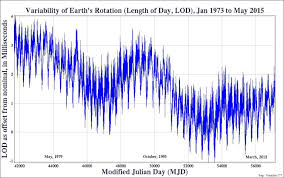
This is what it used to look like.
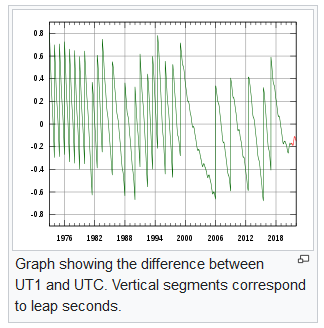
And here’s a more recent graph, with leap seconds subtracted off
Reply Quote

Date: 22/12/2021 09:25:38
From: The Rev Dodgson
ID: 1827514
Subject: re: The top Phys.org articles of 2021

mollwollfumble said:


The Rev Dodgson said:

Tau.Neutrino said:

The top Phys.org articles of 2021

2021 was a good year for research of all kinds. The strongest coronal mass ejection in years made headlines this past May, prompting experts around the world to urge world leaders to take it as a warning. Future storms, many noted, could wreak havoc on electrical grids, satellites and the internet. The time to act is now, they strongly suggested.

more…

Thanks Tao, excellent link, and the listed articles are accessible, at least the one I tried was.

Agree. Excellent collection of articles.

“Scientists around the world noticed that the Earth is spinning faster than normal—faster than has ever been recorded before. Over the past few decades, atomic clocks have provided time so accurately that the day/night cycle can be measured more precisely than ever before—precisely enough to notice minute changes. And lately, the planet seems to be spinning faster for unknown reasons.”

Um, what !

“Several decades ago, the development of atomic clocks began allowing scientists to record the passage of time in incredibly small increments, in turn, allowing for measuring the length of a given day down to the millisecond. And that has led to the discovery that the spin of the planet is actually far more variable than once thought. Since such measurements began, scientists have also found that the Earth was slowing its spin very gradually (compensated by the insertion of a leap second now and then)—until this past year, when it began spinning faster—so much so that some in the field have begun to wonder if a negative leap negative second might be needed this year, an unprecedented suggestion. Scientists also noted that this past summer, on July 19, the shortest day ever was recorded—it was 1.4602 milliseconds shorter than the standard.”

1.46 milliseconds is huge.

Hang on. Neutron stars also slow their spin very gradually, and the suddenly start spinning faster. This is technically called “glitch”. The equivalent for Earth would involve an earthquake at whatever depth (perhaps the deepest ever) that rearranges the Earth’s contents in a more stable way.

Or it could be due to the weather.

This is what it used to look like.

And here’s a more recent graph, with leap seconds subtracted off


My first reaction was that all that melting polar ice being distributed around the globe should be slowing us down, but maybe it’s just being exceeded by all the glacial ice from near the Equator speeding us up.

Or maybe changes in ocean currents are more significant.

Or maybe all that surface stuff is insignificant anyway.

Reply Quote