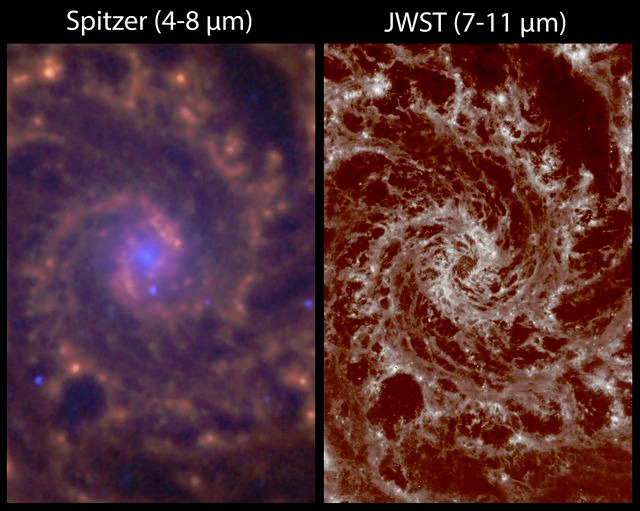
Date: 13/07/2022 03:11:46
From: mollwollfumble
ID: 1908028
Subject: Webb First Images

I think this is the official release website https://www.nasa.gov/webbfirstimages

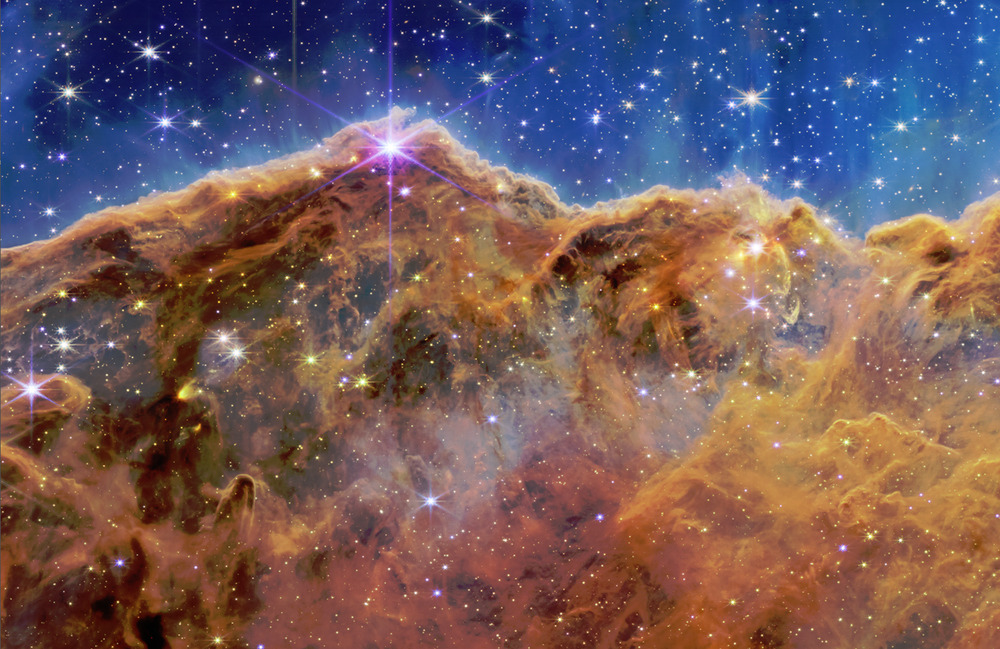
Carina Nebula. Neither a full nebula nor the Eta Carina subset, unfortunately. But great detail of the part that they did see.

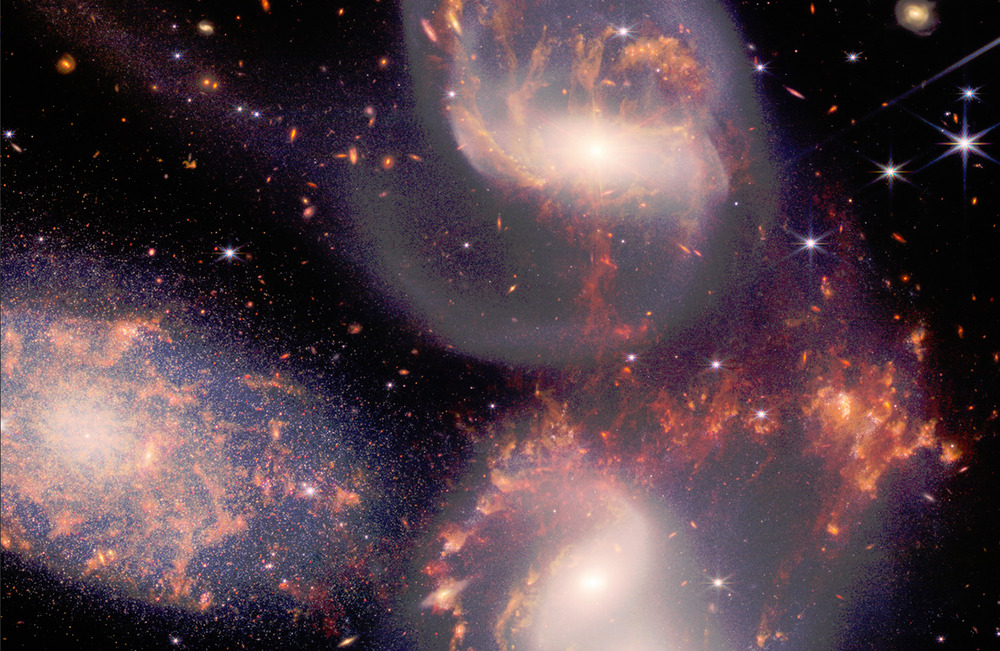
Stephan’s quintet

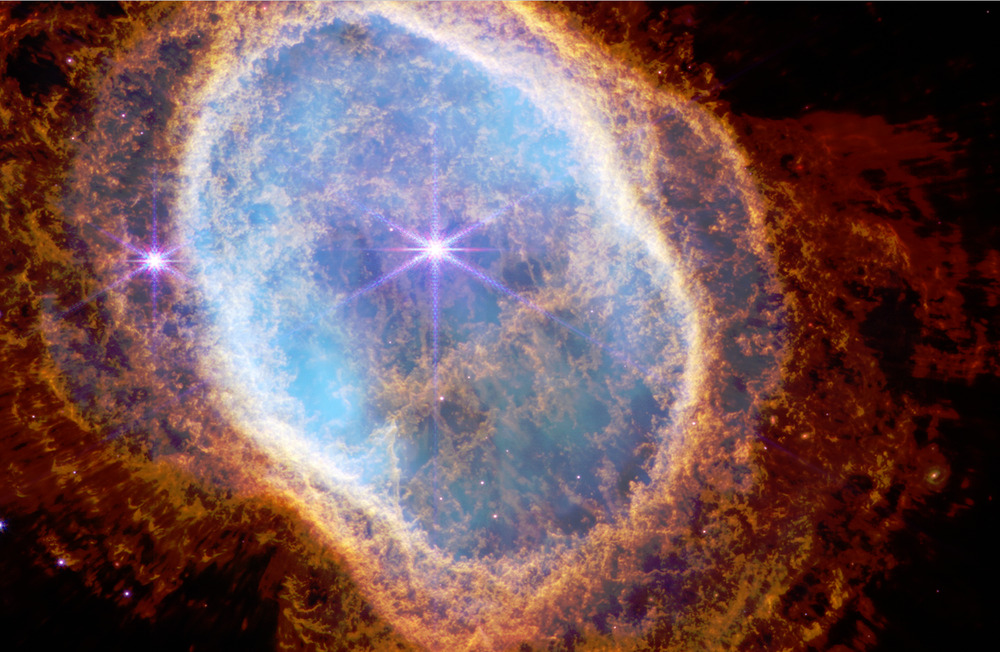
Southern Ring Nebula

Exoplanet atmosphere Wasp-96 b

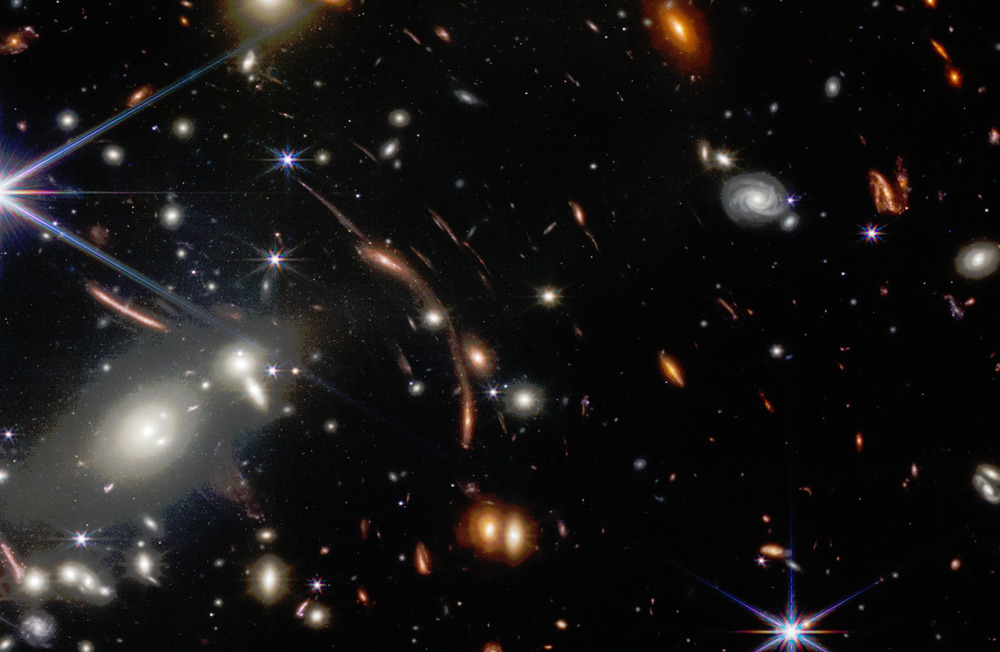
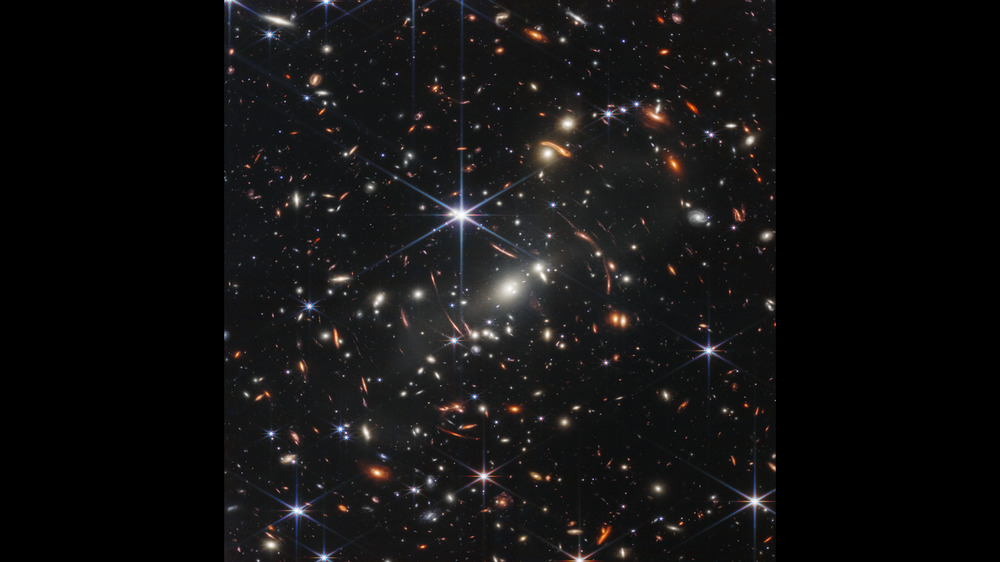
SMACS 0723 (are they sure this isn’t SLACS 0723 ?)

Reply Quote

Date: 13/07/2022 07:15:32
From: Spiny Norman
ID: 1908034
Subject: re: Webb First Images

Wow, just wow. Those are amazing photos.

Reply Quote

Date: 13/07/2022 08:07:05
From: Tau.Neutrino
ID: 1908037
Subject: re: Webb First Images

Spiny Norman said:


Wow, just wow. Those are amazing photos.

+1

Impressive photos.

Reply Quote

Date: 13/07/2022 08:18:51
From: mollwollfumble
ID: 1908040
Subject: re: Webb First Images

Spiny Norman said:


Wow, just wow. Those are amazing photos.

Carina nebula. Hubble, same view.

Hubble

Webb
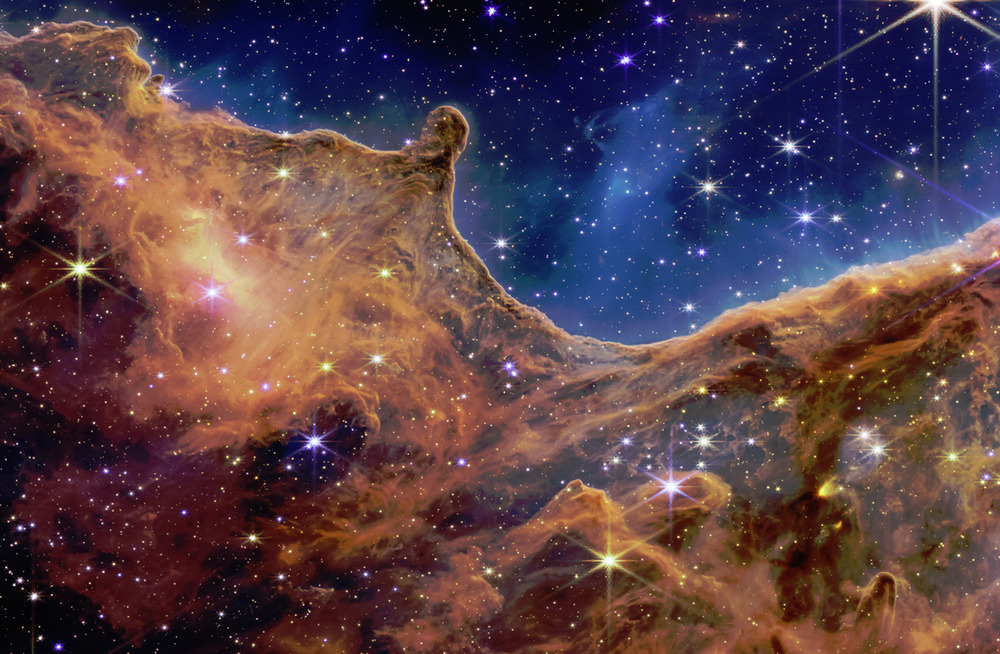
Explanation from https://www.nasa.gov/image-feature/goddard/2022/nasa-s-webb-reveals-cosmic-cliffs-glittering-landscape-of-star-birth

This landscape of “mountains” and “valleys” speckled with glittering stars is actually the edge of a nearby, young, star-forming region called NGC 3324 in the Carina Nebula. Captured in infrared light by NASA’s new James Webb Space Telescope, this image reveals for the first time previously invisible areas of star birth.

Called the Cosmic Cliffs, Webb’s seemingly three-dimensional picture looks like craggy mountains on a moonlit evening. In reality, it is the edge of the giant, gaseous cavity within NGC 3324, and the tallest “peaks” in this image are about 7 light-years high. The cavernous area has been carved from the nebula by the intense ultraviolet radiation and stellar winds from extremely massive, hot, young stars located in the center of the bubble, above the area shown in this image.

The blistering, ultraviolet radiation from the young stars is sculpting the nebula’s wall by slowly eroding it away. Dramatic pillars tower above the glowing wall of gas, resisting this radiation. The “steam” that appears to rise from the celestial “mountains” is actually hot, ionized gas and hot dust streaming away from the nebula due to the relentless radiation.

Webb reveals emerging stellar nurseries and individual stars that are completely hidden in visible-light pictures. Because of Webb’s sensitivity to infrared light, it can peer through cosmic dust to see these objects. Protostellar jets, which emerge clearly in this image, shoot out from some of these young stars. The youngest sources appear as red dots in the dark, dusty region of the cloud. Objects in the earliest, rapid phases of star formation are difficult to capture, but Webb’s extreme sensitivity, spatial resolution, and imaging capability can chronicle these elusive events.

These observations of NGC 3324 will shed light on the process of star formation. Star birth propagates over time, triggered by the expansion of the eroding cavity. As the bright, ionized rim moves into the nebula, it slowly pushes into the gas and dust. If the rim encounters any unstable material, the increased pressure will trigger the material to collapse and form new stars.

Conversely, this type of disturbance may also prevent star formation as the star-making material is eroded away. This is a very delicate balance between sparking star formation and stopping it. Webb will address some of the great, open questions of modern astrophysics: What determines the number of stars that form in a certain region? Why do stars form with a certain mass?

Located roughly 7,600 light-years away, NGC 3324 was imaged by Webb’s Near-Infrared Camera (NIRCam) and Mid-Infrared Instrument (MIRI).

NIRCam – with its crisp resolution and unparalleled sensitivity – unveils hundreds of previously hidden stars, and even numerous background galaxies.

In MIRI’s view, young stars and their dusty, planet-forming disks shine brightly in the mid-infrared, appearing pink and red. MIRI reveals structures that are embedded in the dust and uncovers the stellar sources of massive jets and outflows. With MIRI, the hot dust, hydrocarbons, and other chemical compounds on the surface of the ridges glow, giving the appearance of jagged rocks.

NGC 3324 was first catalogued by James Dunlop in 1826. Visible from the Southern Hemisphere, it is located at the northwest corner of the Carina Nebula (NGC 3372), which resides in the constellation Carina. The Carina Nebula is home to the Keyhole Nebula and the active, unstable supergiant star called Eta Carinae.

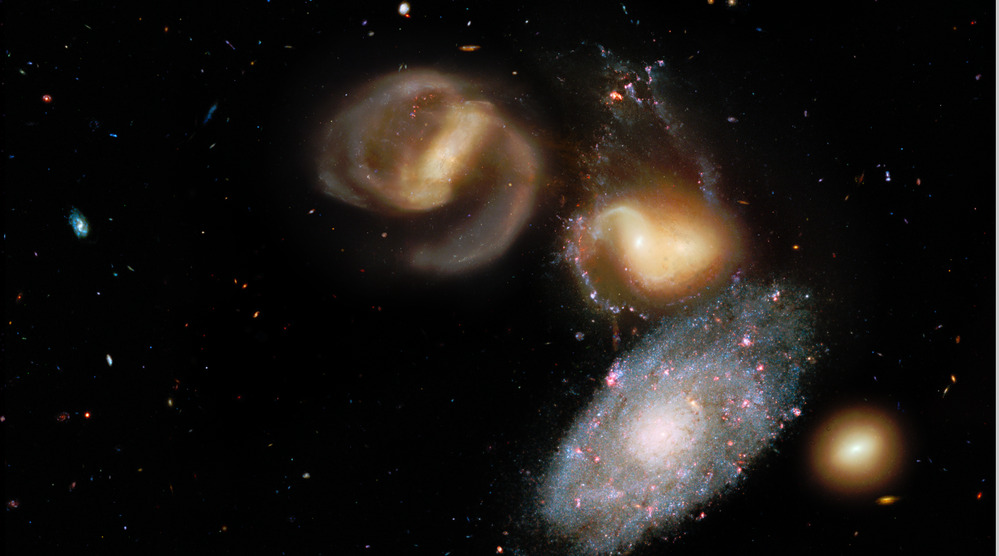
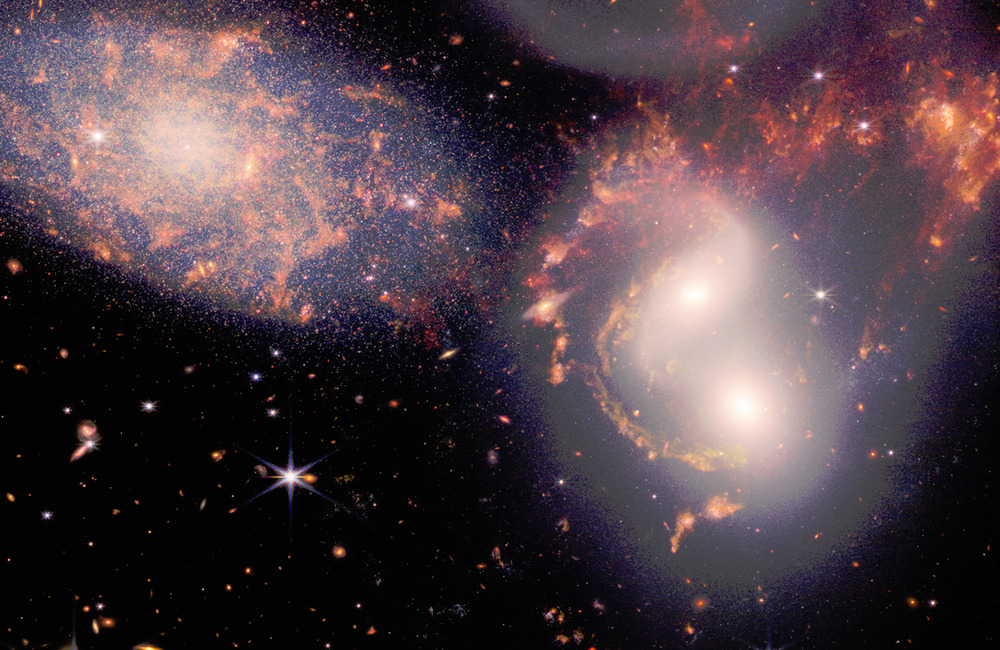
Stefan’s quintet. Hubble vs Webb

Hubble
Webb
From https://www.nasa.gov/image-feature/goddard/2022/nasa-s-webb-sheds-light-on-galaxy-evolution-black-holes

Stephan’s Quintet, a visual grouping of five galaxies, is best known for being prominently featured in the holiday classic film, “It’s a Wonderful Life.” Today, NASA’s James Webb Space Telescope reveals Stephan’s Quintet in a new light. This enormous mosaic is Webb’s largest image to date, covering about one-fifth of the Moon’s diameter. It contains over 150 million pixels and is constructed from almost 1,000 separate image files. The information from Webb provides new insights into how galactic interactions may have driven galaxy evolution in the early universe.

With its powerful, infrared vision and extremely high spatial resolution, Webb shows never-before-seen details in this galaxy group. Sparkling clusters of millions of young stars and starburst regions of fresh star birth grace the image. Sweeping tails of gas, dust and stars are being pulled from several of the galaxies due to gravitational interactions. Most dramatically, Webb captures huge shock waves as one of the galaxies, NGC 7318B, smashes through the cluster.

Together, the five galaxies of Stephan’s Quintet are also known as the Hickson Compact Group 92 (HCG 92). Although called a “quintet,” only four of the galaxies are truly close together and caught up in a cosmic dance. The fifth and leftmost galaxy, called NGC 7320, is well in the foreground compared with the other four. NGC 7320 resides 40 million light-years from Earth, while the other four galaxies (NGC 7317, NGC 7318A, NGC 7318B, and NGC 7319) are about 290 million light-years away. This is still fairly close in cosmic terms, compared with more distant galaxies billions of light-years away. Studying such relatively nearby galaxies like these helps scientists better understand structures seen in a much more distant universe.

Webb studied the active galactic nucleus in great detail with the Near-Infrared Spectrograph (NIRSpec) and Mid-Infrared Instrument (MIRI). These instruments’ integral field units (IFUs) – which are a combination of a camera and spectrograph – provided the Webb team with a “data cube,” or collection of images of the galactic core’s spectral features.

Much like medical magnetic resonance imaging (MRI), the IFUs allow scientists to “slice and dice” the information into many images for detailed study. Webb pierced through the shroud of dust surrounding the nucleus to reveal hot gas near the active black hole and measure the velocity of bright outflows. The telescope saw these outflows driven by the black hole in a level of detail never seen before.

In NGC 7320, the leftmost and closest galaxy in the visual grouping, Webb was able to resolve individual stars and even the galaxy’s bright core.

As a bonus, Webb revealed a vast sea of thousands of distant background galaxies reminiscent of Hubble’s Deep Fields.

Located in the constellation Pegasus, Stephan’s Quintet was discovered by the French astronomer Édouard Stephan in 1877.

Reply Quote

Date: 13/07/2022 16:52:41
From: dv
ID: 1908224
Subject: re: Webb First Images

Side by side comparison

Reply Quote

Date: 13/07/2022 17:08:30
From: Witty Rejoinder
ID: 1908230
Subject: re: Webb First Images

Are any of these new JWT images, like the Hubble Deep Field, of seemingly empty space?

Reply Quote

Date: 13/07/2022 17:13:41
From: dv
ID: 1908232
Subject: re: Webb First Images

Witty Rejoinder said:


Are any of these new JWT images, like the Hubble Deep Field, of seemingly empty space?

That would be a bit of a waste…

Reply Quote

Date: 13/07/2022 17:18:30
From: fsm
ID: 1908235
Subject: re: Webb First Images

Here is a link to the full size version of this image. It’s pretty amazing…

https://stsci-opo.org/STScI-01G7JJADTH90FR98AKKJFKSS0B.png

Reply Quote

Date: 13/07/2022 17:19:35
From: Witty Rejoinder
ID: 1908236
Subject: re: Webb First Images

dv said:


Witty Rejoinder said:

Are any of these new JWT images, like the Hubble Deep Field, of seemingly empty space?

That would be a bit of a waste…

The use of the word ‘deep’ had me wondering.

Reply Quote

Date: 13/07/2022 19:02:14
From: Bubblecar
ID: 1908251
Subject: re: Webb First Images

Witty Rejoinder said:


dv said:

Witty Rejoinder said:

Are any of these new JWT images, like the Hubble Deep Field, of seemingly empty space?

That would be a bit of a waste…

The use of the word ‘deep’ had me wondering.

Apart from the foreground stars (the ones with diffraction spikes) that field of galaxies would be appear empty to the naked eye.

But it was known that the giant galaxy cluster was there and would be gravitationally lensing much more distant galaxies, as Hubble has photographed the same field.

Reply Quote

Date: 14/07/2022 03:13:21
From: mollwollfumble
ID: 1908378
Subject: re: Webb First Images

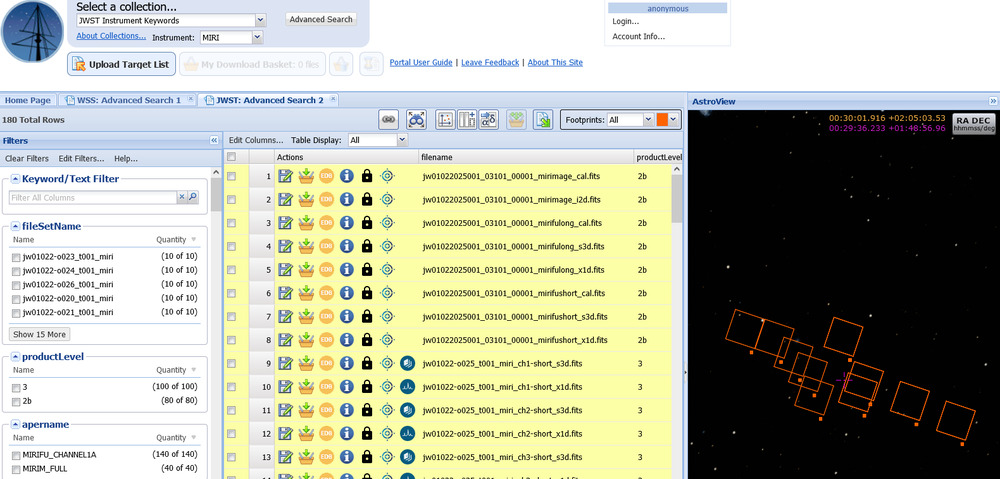
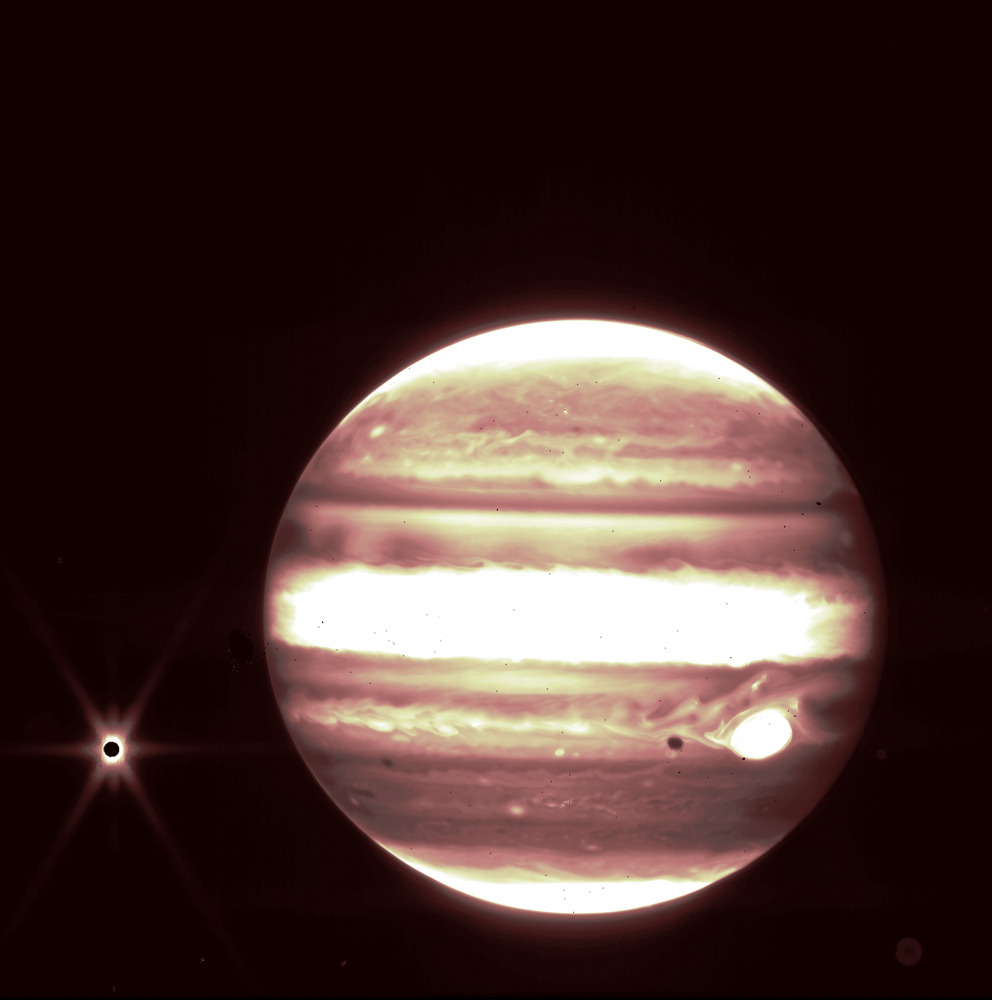
I heard that the JWST had taken images of Jupiter that looked really good, so tried downloading them from MAST.
I found 180 images of Jupiter using the MIRI instrument, probably others from other instruments.
But they’re all locked, unable to access.

I found some unlocked images from NIRCam from JWST on MAST, but despite being unlocked I still don’t have access to any of them as a public user.
I may have a username and password somewhere. Or perhaps not.

This is what the download page for images of Jupiter looks like.

https://mast.stsci.edu/portal/Mashup/Clients/Mast/Portal.html

Reply Quote

Date: 15/07/2022 12:26:08
From: Bubblecar
ID: 1909015
Subject: re: Webb First Images

This is a worthwhile look at the images in more detail.

Has that ABC scrolling-story look some don’t like, but it actually works well this topic.

https://www.abc.net.au/news/2022-07-14/james-webb-telescope-first-images-details-breakdown/101231818

Reply Quote

Date: 15/07/2022 23:51:27
From: Dark Orange
ID: 1909227
Subject: re: Webb First Images

An analysis of the images:

https://www.youtube.com/watch?v=Njp5ClLsBRg&ab_channel=AntonPetrov

Reply Quote

Date: 15/07/2022 23:56:48
From: Dark Orange
ID: 1909230
Subject: re: Webb First Images

Some preview Jupiter images:

https://blogs.nasa.gov/webb/2022/07/14/webb-images-of-jupiter-and-more-now-available-in-commissioning-data/

Reply Quote

Date: 16/07/2022 12:57:47
From: mollwollfumble
ID: 1909417
Subject: re: Webb First Images

Dark Orange said:


Some preview Jupiter images:

https://blogs.nasa.gov/webb/2022/07/14/webb-images-of-jupiter-and-more-now-available-in-commissioning-data/

Thanks for that!

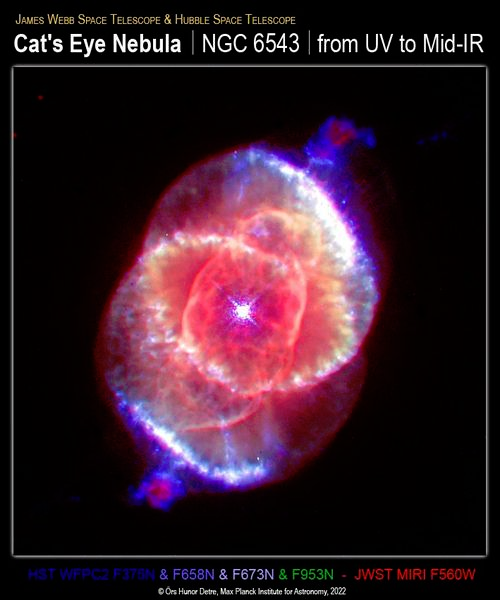
This one is Webb + Hubble.

Reply Quote

Date: 20/07/2022 11:06:40
From: dv
ID: 1910883
Subject: re: Webb First Images

NASA is unsure how much of an effect space rocks will have on Webb’s lifetime after the event ‘exceeded prelaunch expectations of damage.’

A small space rock has proven to have a big effect on NASA’s newly operational deep-space telescope.

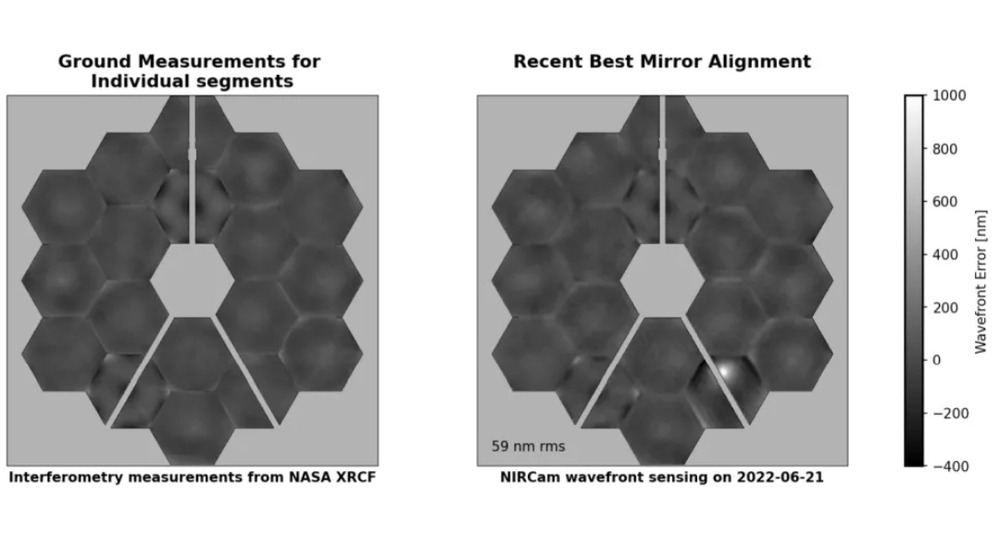
A micrometeoroid struck the James Webb Space Telescope between May 22 and 24, impacting one of the observatory’s 18 hexagonal golden mirrors. NASA had disclosed the micrometeoroid strike in June and noted that the debris was more sizeable than pre-launch modeling had accounted for. Now, scientists on the mission have shared an image that drives home the severity of the blow in a report(opens in new tab) released July 12 describing what scientists on the mission learned about using the observatory during its first six months in space.

Happily, in this case the overall effect on Webb was small. That said, the report outlines the investigation and modeling that engineers are undertaking to assess the long-term effects of micrometeroids on Webb.

https://www.space.com/james-webb-space-telescope-micrometeoroid-damage

Reply Quote

Date: 21/07/2022 03:23:35
From: mollwollfumble
ID: 1911245
Subject: re: Webb First Images

dv said:


NASA is unsure how much of an effect space rocks will have on Webb’s lifetime after the event ‘exceeded prelaunch expectations of damage.’

A small space rock has proven to have a big effect on NASA’s newly operational deep-space telescope.

A micrometeoroid struck the James Webb Space Telescope between May 22 and 24, impacting one of the observatory’s 18 hexagonal golden mirrors. NASA had disclosed the micrometeoroid strike in June and noted that the debris was more sizeable than pre-launch modeling had accounted for. Now, scientists on the mission have shared an image that drives home the severity of the blow in a report(opens in new tab) released July 12 describing what scientists on the mission learned about using the observatory during its first six months in space.

Happily, in this case the overall effect on Webb was small. That said, the report outlines the investigation and modeling that engineers are undertaking to assess the long-term effects of micrometeroids on Webb.

https://www.space.com/james-webb-space-telescope-micrometeoroid-damage


Thanks for posting that!

Here’s another new image from Webb.

Reply Quote

Date: 21/07/2022 06:15:43
From: Michael V
ID: 1911250
Subject: re: Webb First Images

mollwollfumble said:


dv said:

NASA is unsure how much of an effect space rocks will have on Webb’s lifetime after the event ‘exceeded prelaunch expectations of damage.’

A small space rock has proven to have a big effect on NASA’s newly operational deep-space telescope.

A micrometeoroid struck the James Webb Space Telescope between May 22 and 24, impacting one of the observatory’s 18 hexagonal golden mirrors. NASA had disclosed the micrometeoroid strike in June and noted that the debris was more sizeable than pre-launch modeling had accounted for. Now, scientists on the mission have shared an image that drives home the severity of the blow in a report(opens in new tab) released July 12 describing what scientists on the mission learned about using the observatory during its first six months in space.

Happily, in this case the overall effect on Webb was small. That said, the report outlines the investigation and modeling that engineers are undertaking to assess the long-term effects of micrometeroids on Webb.

https://www.space.com/james-webb-space-telescope-micrometeoroid-damage


Thanks for posting that!

Here’s another new image from Webb.

Wow!

Reply Quote

Date: 25/07/2022 11:05:19
From: mollwollfumble
ID: 1912825
Subject: re: Webb First Images

https://www.inverse.com/science/webb-trappist-habitable-planets

A preliminary and unofficial image from the Trappist 1 star and planets.

The star is one of the hottest targets in astronomy, as the TRAPPIST system’s planets are good candidates for potentially hosting life.

This is the spectrum.

The image of TRAPPIST-1 is pixellated and, to the untrained eye, doesn’t reveal much detail. Webb’s NIRISS (Near InfraRed Imager and Slitless Spectrograph) instrument observed TRAPPIST-1 on July 18. Ultimately, this image is compiled with observations done during a quick setup shot with the NIRISS instrument to ensure the telescope was pointed and calibrated properly.

At the time, it is believed one of TRAPPIST’s seven Earth-sized planets was passing in front of the star, at least according to the Reddit threads (Inverse is trying to confirm this detail). The purported photo-bomber, TRAPPIST-1b, isn’t in the star’s habitable zone. It orbits much too close to the red dwarf for life to stand a chance on its surface. But a glimpse at the makeup of its atmosphere would still be a huge step forward for exoplanet science.

Here’s the story: The data the new images are made from is Webb Telescope data collected on July 18. But the images are the work of a Redditor who goes by u/arizonaskies2022. (Inverse attempted to contact the Redditor through the platform for this story but received no response.)

This citizen scientist did the hard work of processing the publicly-available Webb data. They then posted the image on Reddit’s r/jameswebb forum on July 20.

“Both images are public raw data files I found and downloaded from MAST website,” writes u/arizonaskies2022 in a comment on their Reddit post.

“I did minimal processing. Neither image is cropped, just a little stretch and color.”

Webb’s NIRISS (Near InfraRed Imager and Slitless Spectrograph) instrument observed TRAPPIST-1 on Monday.

“The data was immediately made public,” a spokesperson for the Space Telescope Science Institute tells Inverse.

The Space Telescope Science Institute manages both the Webb and Hubble telescopes, and most of the raw data from the telescopes’ instruments are publicly accessible online. If someone has the right software and enough knowledge to turn the data into images or spectra, then they can. The Institute even hosts webinars to teach people how to do this kind of processing.

There are just a few exceptions to that rule; the scientists who helped design Webb’s instruments get a few months of exclusive access to data from their own observations.

For all the TRAPPIST-1 fans out there, know that this is not the last we will see of this stellar exoplanet haven.

TRAPPIST-1 is a small, cool (both in temperature and in the sense of being interesting) star about 40 light-years from Earth. It is the host to seven rocky planets about the size of our Earth, and three of them are in the habitable zone — the area around a star where temperatures are just right for liquid water to exist on the surface of a planet.

Because it’s so close, and because it features so many Earth-like worlds in its habitable zone, the TRAPPIST-1 system is one of the hottest spots in the galaxy to search for potential life, or at least potentially habitable alien worlds.

If TRAPPIST-1b did pass in front of the star during Webb’s observations on July 18, then some of the star’s light may have filtered through the exoplanet’s atmosphere. By comparing TRAPPIST-1’s spectrum before, during, and after the planet’s transit, astronomers could draw some conclusions about the make-up of TRAPPIST-1b’s atmosphere.

More is coming: The Webb Telescope has already observed TRAPPIST-1 at least twice in two weeks of science operations. We can’t wait.

Reply Quote

Date: 25/07/2022 12:38:13
From: mollwollfumble
ID: 1912885
Subject: re: Webb First Images

mollwollfumble said:


https://www.inverse.com/science/webb-trappist-habitable-planets

A preliminary and unofficial image from the Trappist 1 star and planets.

The star is one of the hottest targets in astronomy, as the TRAPPIST system’s planets are good candidates for potentially hosting life.

This is the spectrum.

The image of TRAPPIST-1 is pixellated and, to the untrained eye, doesn’t reveal much detail. Webb’s NIRISS (Near InfraRed Imager and Slitless Spectrograph) instrument observed TRAPPIST-1 on July 18. Ultimately, this image is compiled with observations done during a quick setup shot with the NIRISS instrument to ensure the telescope was pointed and calibrated properly.

At the time, it is believed one of TRAPPIST’s seven Earth-sized planets was passing in front of the star, at least according to the Reddit threads (Inverse is trying to confirm this detail). The purported photo-bomber, TRAPPIST-1b, isn’t in the star’s habitable zone. It orbits much too close to the red dwarf for life to stand a chance on its surface. But a glimpse at the makeup of its atmosphere would still be a huge step forward for exoplanet science.

Here’s the story: The data the new images are made from is Webb Telescope data collected on July 18. But the images are the work of a Redditor who goes by u/arizonaskies2022. (Inverse attempted to contact the Redditor through the platform for this story but received no response.)

This citizen scientist did the hard work of processing the publicly-available Webb data. They then posted the image on Reddit’s r/jameswebb forum on July 20.

“Both images are public raw data files I found and downloaded from MAST website,” writes u/arizonaskies2022 in a comment on their Reddit post.

“I did minimal processing. Neither image is cropped, just a little stretch and color.”

Webb’s NIRISS (Near InfraRed Imager and Slitless Spectrograph) instrument observed TRAPPIST-1 on Monday.

“The data was immediately made public,” a spokesperson for the Space Telescope Science Institute tells Inverse.

The Space Telescope Science Institute manages both the Webb and Hubble telescopes, and most of the raw data from the telescopes’ instruments are publicly accessible online. If someone has the right software and enough knowledge to turn the data into images or spectra, then they can. The Institute even hosts webinars to teach people how to do this kind of processing.

There are just a few exceptions to that rule; the scientists who helped design Webb’s instruments get a few months of exclusive access to data from their own observations.

For all the TRAPPIST-1 fans out there, know that this is not the last we will see of this stellar exoplanet haven.

TRAPPIST-1 is a small, cool (both in temperature and in the sense of being interesting) star about 40 light-years from Earth. It is the host to seven rocky planets about the size of our Earth, and three of them are in the habitable zone — the area around a star where temperatures are just right for liquid water to exist on the surface of a planet.

Because it’s so close, and because it features so many Earth-like worlds in its habitable zone, the TRAPPIST-1 system is one of the hottest spots in the galaxy to search for potential life, or at least potentially habitable alien worlds.

If TRAPPIST-1b did pass in front of the star during Webb’s observations on July 18, then some of the star’s light may have filtered through the exoplanet’s atmosphere. By comparing TRAPPIST-1’s spectrum before, during, and after the planet’s transit, astronomers could draw some conclusions about the make-up of TRAPPIST-1b’s atmosphere.

More is coming: The Webb Telescope has already observed TRAPPIST-1 at least twice in two weeks of science operations. We can’t wait.

esselte said:


Tau.Neutrino said:

dv said:

And one is of an object whose speed to distance ratio is high, and one is dimly lit whereas one is literally made of suns.

The one on the left is well lit so you don’t need to use a flash.

I hope those Webb people accounted for objects in mirror are closer than they appear.

Now that you mention it, this was a serious issue for two space telescopes, COBE the Cosmic Background Explorer and WMAP the Wilkinson Microwave Anisotropy probe.

Both of those worked in the microwave range, but the effect may still occur to a lesser extent in the shorter electromagnetic range of mid infrared where the Webb does most of its work.

So yes, I hope those Webb people accounted for objects in mirror are closer than they appear.

Reply Quote

Date: 6/08/2022 19:11:03
From: mollwollfumble
ID: 1917928
Subject: re: Webb First Images

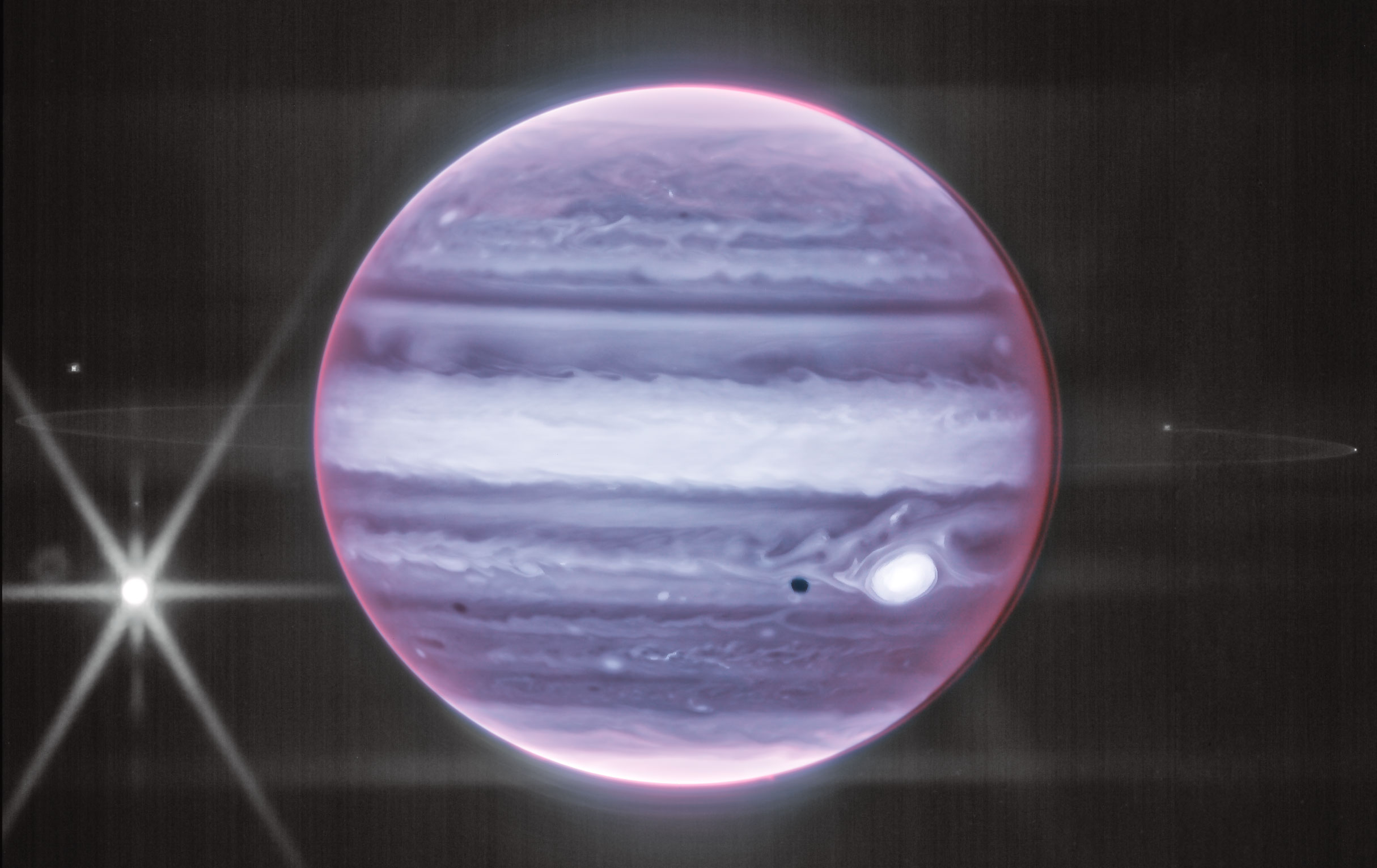
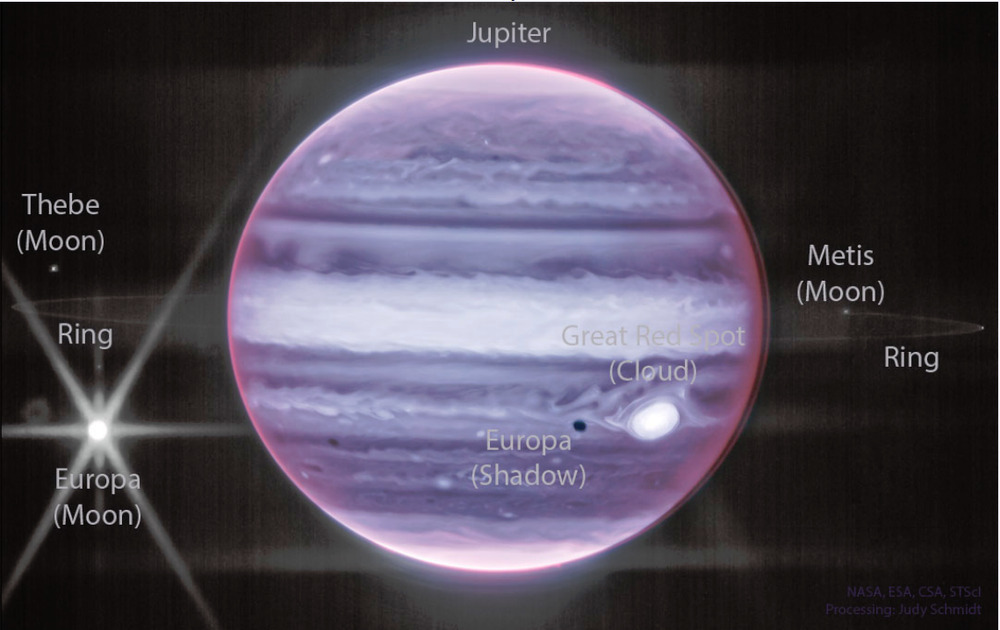
Jupiter and its ring. A new Webb image.

https://apod.nasa.gov/apod/ap220720.html

https://apod.nasa.gov/apod/image/2207/JupiterRing_WebbSchmidt_2429.jpg

Reply Quote

Date: 6/08/2022 19:16:47
From: mollwollfumble
ID: 1917930
Subject: re: Webb First Images

mollwollfumble said:


Jupiter and its ring. A new Webb image.

https://apod.nasa.gov/apod/ap220720.html

https://apod.nasa.gov/apod/image/2207/JupiterRing_WebbSchmidt_2429.jpg


Cartwheel Galaxy.

Reply Quote