Red Supergiant Star Betelgeuse Is Slowly Recovering After “Blowing Its Top”: NASA
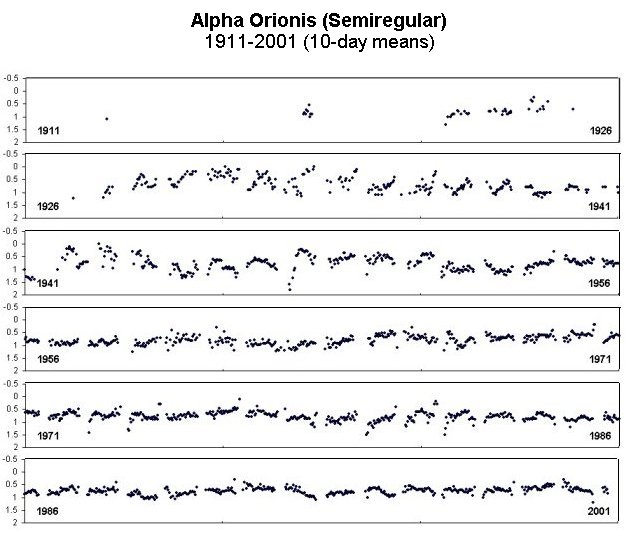
(A note here. Way back I said that Betelgeuse is a semi-regular variable. It’s periodic but the period changes quite markedly, like the Sun’s sunspot period, and that that irregularity of period, together with the times when Betelgeuse is hidden by the Sun, can make it appear brighter or fainter than expected. In other words I was saying that appearances here can be deceiving. Anyway, on with the article).
Researchers suggest that after seeing the Hubble Telescope data, the bright red supergiant star “Betelgeuse” physically blew its top in 2019, losing a significant portion of its visible surface and causing a massive Surface Mass Ejection (SME). A typical star has never exhibited behaviour like this previously. Never before has a huge stellar surface mass ejection been seen. We are left with a situation that we don’t fully comprehend.
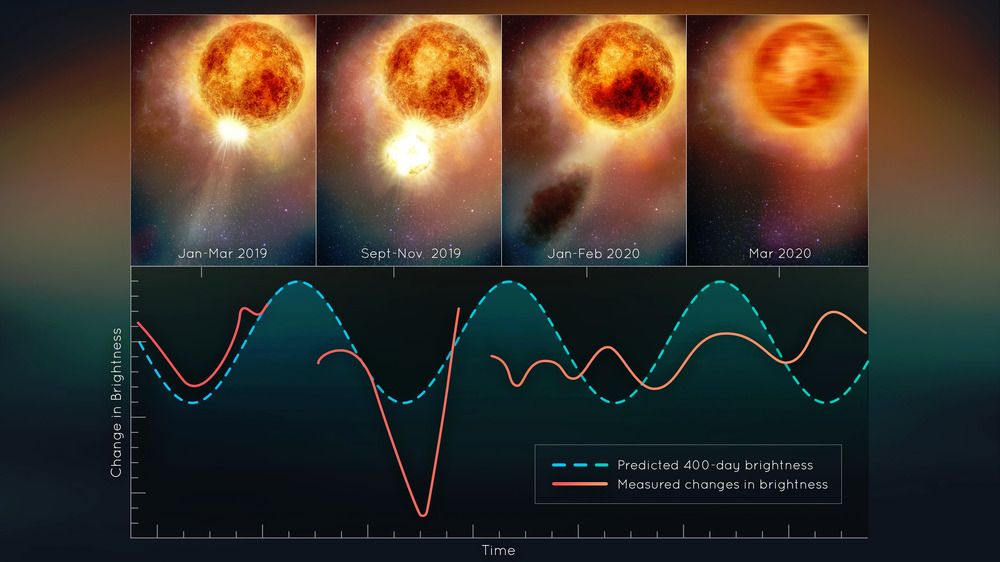
These new discoveries provide insight into how red stars age, lose mass, and eventually supernovae when their nuclear fusion furnaces exhaust their fuel. Their fate is highly impacted by the degree of mass loss. Betelgeuse’s eruption blasted around 400 billion times the mass of an ordinary CME.A chunk of the star’s top was blown off, leaving a massive cool patch on its surface and a dust cloud all around it. Betelgeuse as a result saw a dramatic decrease in brightness, which was noticeable even by amateur observers.
The dimming was actually a sign of a smaller explosion that had previously happened, which is more apparent now. Dupree emphasised that while dramatic, Betelgeuse’s demise is not imminent only because it launched a portion of itself into space. In actuality, the star is regaining strength after the explosion.
The magnitude of its periodicity is shown in the following diagram. The magnitude increased until the star rapidly dimmed. And since then the period and the magnitude markedly decreased. And is now starting to increase again.
For me this is extremely important in astronomy because the method by which giant stars shed mass, to form for example planetary nebulae, is unknown. A star sheds a large fraction (sometimes up to 50%) of its mass before it goes supernova, for example. And it looks now from Betelgeuse as if the gas of a planetary nebula builds up slowly during the asymptotic giant branch (AGB) phase (or perhaps before) by a series of giant but otherwise normal coronal mass ejections.