Date: 14/10/2022 10:48:46
From: mollwollfumble
ID: 1943977
Subject: webb Neptune

Not many image releases from Webb.

But this one dates from Sept 21. BTW Triton to Webb is brighter than Neptune.

https://www.nasa.gov/feature/goddard/2022/new-webb-image-captures-clearest-view-of-neptune-s-rings-in-decades

Webb’s Near-Infrared Camera (NIRCam) images objects in the near-infrared range from 0.6 to 5 microns, so Neptune does not appear blue to Webb. In fact, the methane gas so strongly absorbs red and infrared light that the planet is quite dark at these near-infrared wavelengths, except where high-altitude clouds are present. Such methane-ice clouds are prominent as bright streaks and spots, which reflect sunlight before it is absorbed by methane gas. Images from other observatories, including the Hubble Space Telescope and the W.M. Keck Observatory, have recorded these rapidly evolving cloud features over the years.

More subtly, a thin line of brightness circling the planet’s equator could be a visual signature of global atmospheric circulation that powers Neptune’s winds and storms. The atmosphere descends and warms at the equator, and thus glows at infrared wavelengths more than the surrounding, cooler gases.

Neptune’s 164-year orbit means its northern pole, at the top of this image, is just out of view for astronomers, but the Webb images hint at an intriguing brightness in that area. A previously-known vortex at the southern pole is evident in Webb’s view, but for the first time Webb has revealed a continuous band of high-latitude clouds surrounding it.

Webb also captured seven of Neptune’s 14 known moons. Dominating this Webb portrait of Neptune is a very bright point of light sporting the signature diffraction spikes seen in many of Webb’s images, but this is not a star. Rather, this is Neptune’s large and unusual moon, Triton.

Covered in a frozen sheen of condensed nitrogen, Triton reflects an average of 70 percent of the sunlight that hits it. It far outshines Neptune in this image because the planet’s atmosphere is darkened by methane absorption at these near-infrared wavelengths. Triton orbits Neptune in an unusual backward (retrograde) orbit, leading astronomers to speculate that this moon was originally a Kuiper belt object that was gravitationally captured by Neptune. Additional Webb studies of both Triton and Neptune.

Reply Quote

Date: 14/10/2022 23:39:48
From: mollwollfumble
ID: 1944364
Subject: re: webb Neptune

Also Webb, not Neptune.

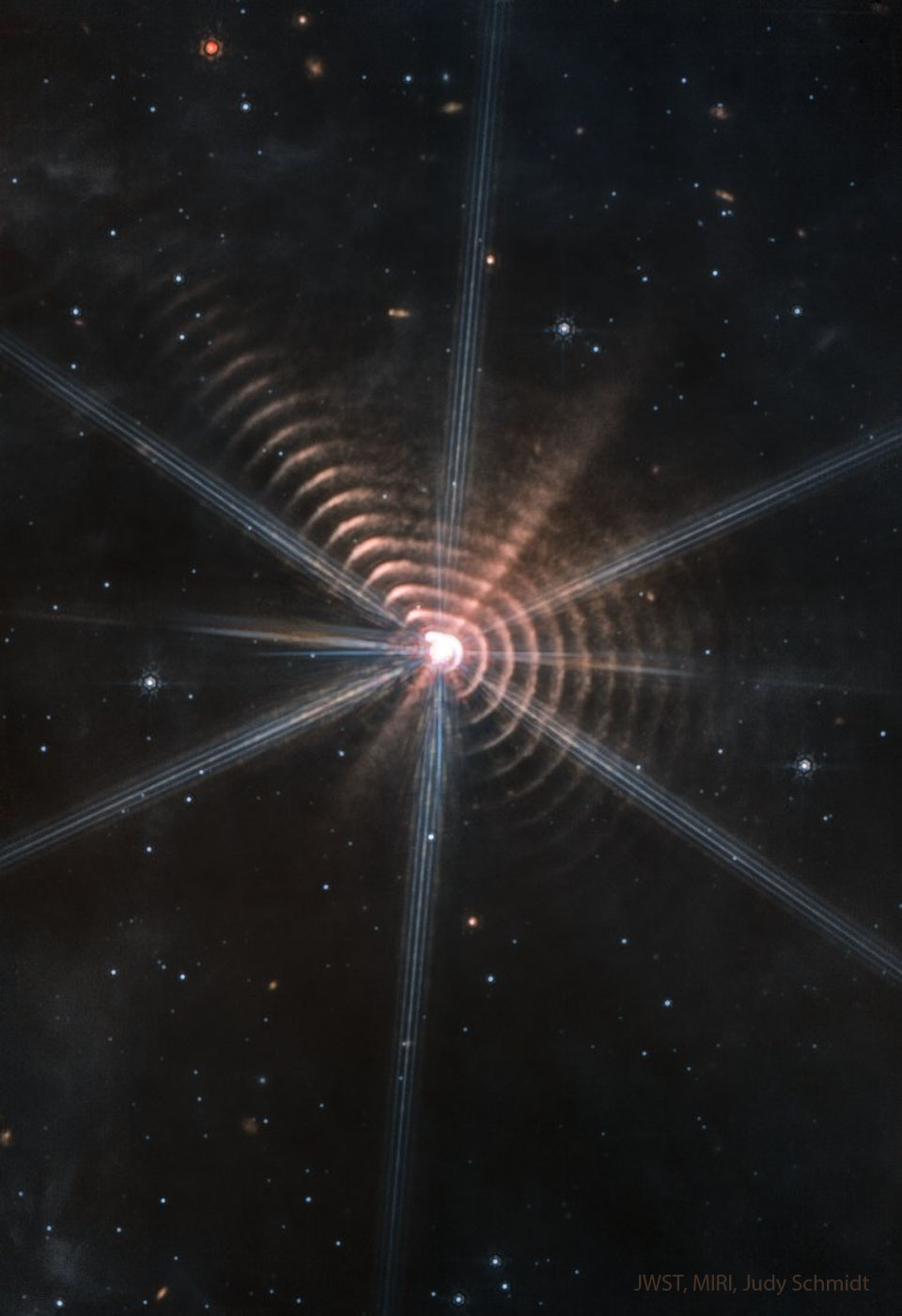
https://www.abc.net.au/news/science/2022-10-13/james-webb-space-telescope-image-wr140-dust-shells/101511786?fbclid=IwAR0AV7RDl61sJNKUDFIySiU0gnuhvCHKeMxF3NOh0f9wgB3xx4RgBA14CvQ

But the JWST observations, detailed today in the journal Nature Astronomy, revealed more than 17 shells nested inside each other.

But as luck would have it, Professor Tuthill’s student Yinuo Han had just developed a 3D model of WR 140 based on 20 years of data.

WR 140 lies more than 5,000 light-years away in Cygnus, a prominent constellation in northern hemisphere skies.

At its heart is one of the cosmos’ most extreme type of stars — a Wolf-Rayet.

because its orbit isn’t circular, the Wolf-Rayet only puffs out dust every eight years when it is near the closest point to its stellar companion, the O-type star.

That means the dust shells seen in the JWST image were created in just 136 years.

Reply Quote

Date: 15/10/2022 09:22:39
From: mollwollfumble
ID: 1944416
Subject: re: webb Neptune

mollwollfumble said:


Also Webb, not Neptune.

https://www.abc.net.au/news/science/2022-10-13/james-webb-space-telescope-image-wr140-dust-shells/101511786?fbclid=IwAR0AV7RDl61sJNKUDFIySiU0gnuhvCHKeMxF3NOh0f9wgB3xx4RgBA14CvQ

But the JWST observations, detailed today in the journal Nature Astronomy, revealed more than 17 shells nested inside each other.

But as luck would have it, Professor Tuthill’s student Yinuo Han had just developed a 3D model of WR 140 based on 20 years of data.

WR 140 lies more than 5,000 light-years away in Cygnus, a prominent constellation in northern hemisphere skies.

At its heart is one of the cosmos’ most extreme type of stars — a Wolf-Rayet.

because its orbit isn’t circular, the Wolf-Rayet only puffs out dust every eight years when it is near the closest point to its stellar companion, the O-type star.

That means the dust shells seen in the JWST image were created in just 136 years.

Also seen on apod.

https://apod.nasa.gov/apod/ap221013.html

Reply Quote

Date: 15/10/2022 09:36:33
From: roughbarked
ID: 1944422
Subject: re: webb Neptune

mollwollfumble said:


mollwollfumble said:

Also Webb, not Neptune.

https://www.abc.net.au/news/science/2022-10-13/james-webb-space-telescope-image-wr140-dust-shells/101511786?fbclid=IwAR0AV7RDl61sJNKUDFIySiU0gnuhvCHKeMxF3NOh0f9wgB3xx4RgBA14CvQ

But the JWST observations, detailed today in the journal Nature Astronomy, revealed more than 17 shells nested inside each other.

But as luck would have it, Professor Tuthill’s student Yinuo Han had just developed a 3D model of WR 140 based on 20 years of data.

WR 140 lies more than 5,000 light-years away in Cygnus, a prominent constellation in northern hemisphere skies.

At its heart is one of the cosmos’ most extreme type of stars — a Wolf-Rayet.

because its orbit isn’t circular, the Wolf-Rayet only puffs out dust every eight years when it is near the closest point to its stellar companion, the O-type star.

That means the dust shells seen in the JWST image were created in just 136 years.

Also seen on apod.

https://apod.nasa.gov/apod/ap221013.html

Are you sure they aren’t spider’s webs?

Shelob is out there?

Reply Quote

Date: 15/10/2022 09:42:44
From: mollwollfumble
ID: 1944425
Subject: re: webb Neptune

roughbarked said:


mollwollfumble said:

mollwollfumble said:

Also Webb, not Neptune.

https://www.abc.net.au/news/science/2022-10-13/james-webb-space-telescope-image-wr140-dust-shells/101511786?fbclid=IwAR0AV7RDl61sJNKUDFIySiU0gnuhvCHKeMxF3NOh0f9wgB3xx4RgBA14CvQ

But the JWST observations, detailed today in the journal Nature Astronomy, revealed more than 17 shells nested inside each other.

But as luck would have it, Professor Tuthill’s student Yinuo Han had just developed a 3D model of WR 140 based on 20 years of data.

WR 140 lies more than 5,000 light-years away in Cygnus, a prominent constellation in northern hemisphere skies.

At its heart is one of the cosmos’ most extreme type of stars — a Wolf-Rayet.

because its orbit isn’t circular, the Wolf-Rayet only puffs out dust every eight years when it is near the closest point to its stellar companion, the O-type star.

That means the dust shells seen in the JWST image were created in just 136 years.

Also seen on apod.

https://apod.nasa.gov/apod/ap221013.html

Are you sure they aren’t spider’s webs?

Shelob is out there?

I’ve sort of been waiting for this. Planetary nebulas have to come from somewhere, and this looks like a great mechanism for starting off the dust cloud that becomes one of these nebulas.

Reply Quote