Date: 8/12/2022 13:21:34
From: dv
ID: 1964602
Subject: Reindeer of the sub-Antarctic

https://www.atlasobscura.com/articles/reindeer-in-the-southern-hemisphere

REINDEER AND PENGUINS ARE BOTH at home in snowy expanses, but they’re not supposed to be together. After all, reindeer live in the Northern Hemisphere, penguins in the Southern. Yet for some 100 years, a split second in their natural histories, they shared an island. Their unlikely coexistence seemed “quite peaceful,” says Carl Erik Kilander, who first saw them together in 2004. “They did not seem to pay much attention to each other.” It didn’t end quite so peacefully.

Far out in the South Atlantic Ocean, more than 1,000 miles east of Cape Horn, Argentina, the island of South Georgia is an unforgiving place. Glaciers cover much of the land, and gales pound the jagged coast. This was the place where north and south ended up together.
For decades, no one knew how many reindeer roamed on South Georgia. In 2012, when Kilander, a Norwegian naturalist with experience in reindeer management, trekked through the island’s steep terrain to find out, he and his colleagues counted around 2,000, and guessed there was another 1,000 they missed. Later, they found out that the island had harbored more than twice that number. But by then, almost all of them were dead.

(More at link)
Reply Quote

Date: 8/12/2022 13:53:31
From: sibeen
ID: 1964618
Subject: re: Reindeer of the sub-Antarctic

It has always surprised me a little that some penguins were never released into artic regions.

Reply Quote

Date: 8/12/2022 13:55:17
From: Witty Rejoinder
ID: 1964621
Subject: re: Reindeer of the sub-Antarctic

sibeen said:


It has always surprised me a little that some penguins were never released into artic regions.

Food for hungry polar bears: it’s Win-Win.

Reply Quote

Date: 8/12/2022 13:55:39
From: Peak Warming Man
ID: 1964622
Subject: re: Reindeer of the sub-Antarctic

sibeen said:


It has always surprised me a little that some penguins were never released into artic regions.

It’s one of the polar bear shop stewards ambit claims.

Reply Quote

Date: 8/12/2022 15:08:28
From: dv
ID: 1964648
Subject: re: Reindeer of the sub-Antarctic

There’s also a permanent population of sheep and deer on Kerguelen.

I wonder what the southernmost location you could reasonabky graze animals?

Reply Quote

Date: 8/12/2022 15:21:19
From: mollwollfumble
ID: 1964667
Subject: re: Reindeer of the sub-Antarctic

sibeen said:


It has always surprised me a little that some penguins were never released into arctic regions.

To replace the Great Auks that used to live there? It would make sense.
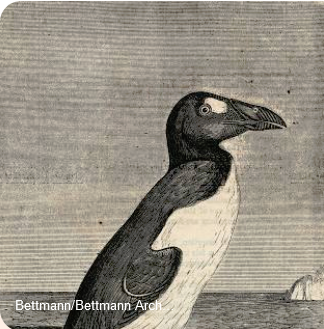
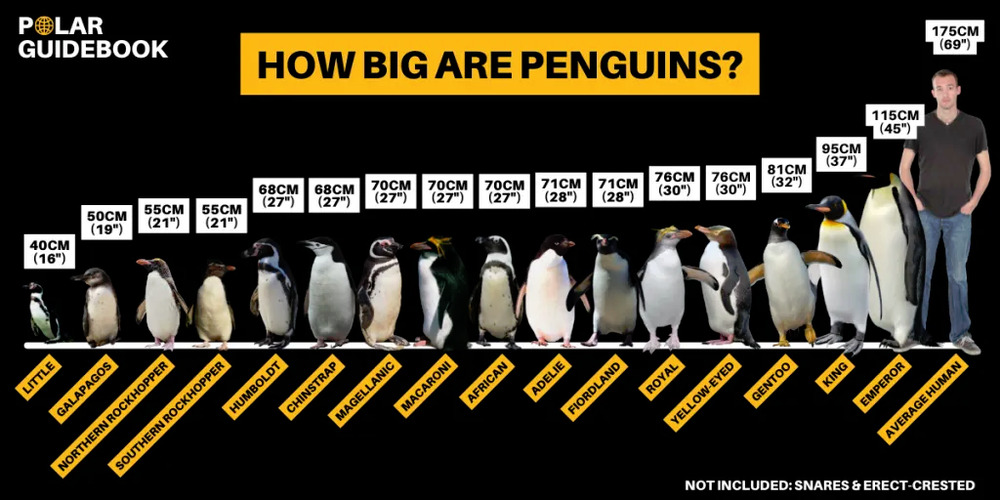
The bird was 75 to 85 centimetres (30 to 33 inches) tall and weighed about 5 kilograms. As tall as the third, fourth and fifth largest penguins.

Picture of Great Auk.

Keep in mind that every flightless bird now in existence lives in the southern hemisphere, although one straddles the equator.
Could that have something to do with human beings?

Reply Quote

Date: 8/12/2022 15:23:17
From: Cymek
ID: 1964669
Subject: re: Reindeer of the sub-Antarctic

mollwollfumble said:


sibeen said:

It has always surprised me a little that some penguins were never released into arctic regions.

To replace the Great Auks that used to live there? It would make sense.
The bird was 75 to 85 centimetres (30 to 33 inches) tall and weighed about 5 kilograms. As tall as the third, fourth and fifth largest penguins.

Picture of Great Auk.

Keep in mind that every flightless bird now in existence lives in the southern hemisphere, although one straddles the equator.
Could that have something to do with human beings?


A more unusual and rarer penguin

Reply Quote

Date: 8/12/2022 15:27:42
From: mollwollfumble
ID: 1964675
Subject: re: Reindeer of the sub-Antarctic

dv said:


https://www.atlasobscura.com/articles/reindeer-in-the-southern-hemisphere

REINDEER AND PENGUINS ARE BOTH at home in snowy expanses, but they’re not supposed to be together. After all, reindeer live in the Northern Hemisphere, penguins in the Southern. Yet for some 100 years, a split second in their natural histories, they shared an island. Their unlikely coexistence seemed “quite peaceful,” says Carl Erik Kilander, who first saw them together in 2004. “They did not seem to pay much attention to each other.” It didn’t end quite so peacefully.

Far out in the South Atlantic Ocean, more than 1,000 miles east of Cape Horn, Argentina, the island of South Georgia is an unforgiving place. Glaciers cover much of the land, and gales pound the jagged coast. This was the place where north and south ended up together.
For decades, no one knew how many reindeer roamed on South Georgia. In 2012, when Kilander, a Norwegian naturalist with experience in reindeer management, trekked through the island’s steep terrain to find out, he and his colleagues counted around 2,000, and guessed there was another 1,000 they missed. Later, they found out that the island had harbored more than twice that number. But by then, almost all of them were dead.

(More at link)
> That summer, more than 1,900 reindeer were culled in the first of the two reindeer areas. Then the marksmen moved on to the second area and removed some 1,500 more. The following summer, six Norwegian hunters came to finish the job—3,140 additional reindeer in six weeks.

:-(

Reply Quote

Date: 8/12/2022 15:27:43
From: SCIENCE
ID: 1964676
Subject: re: Reindeer of the sub-Antarctic

Cymek said:

mollwollfumble said:

sibeen said:

It has always surprised me a little that some penguins were never released into arctic regions.

To replace the Great Auks that used to live there? It would make sense.
The bird was 75 to 85 centimetres (30 to 33 inches) tall and weighed about 5 kilograms. As tall as the third, fourth and fifth largest penguins.

Picture of Great Auk.

Keep in mind that every flightless bird now in existence lives in the southern hemisphere, although one straddles the equator.
Could that have something to do with human beings?


A more unusual and rarer penguin

yet another victory for the central limit theorem

Reply Quote

Date: 9/12/2022 14:44:44
From: dv
ID: 1965001
Subject: re: Reindeer of the sub-Antarctic

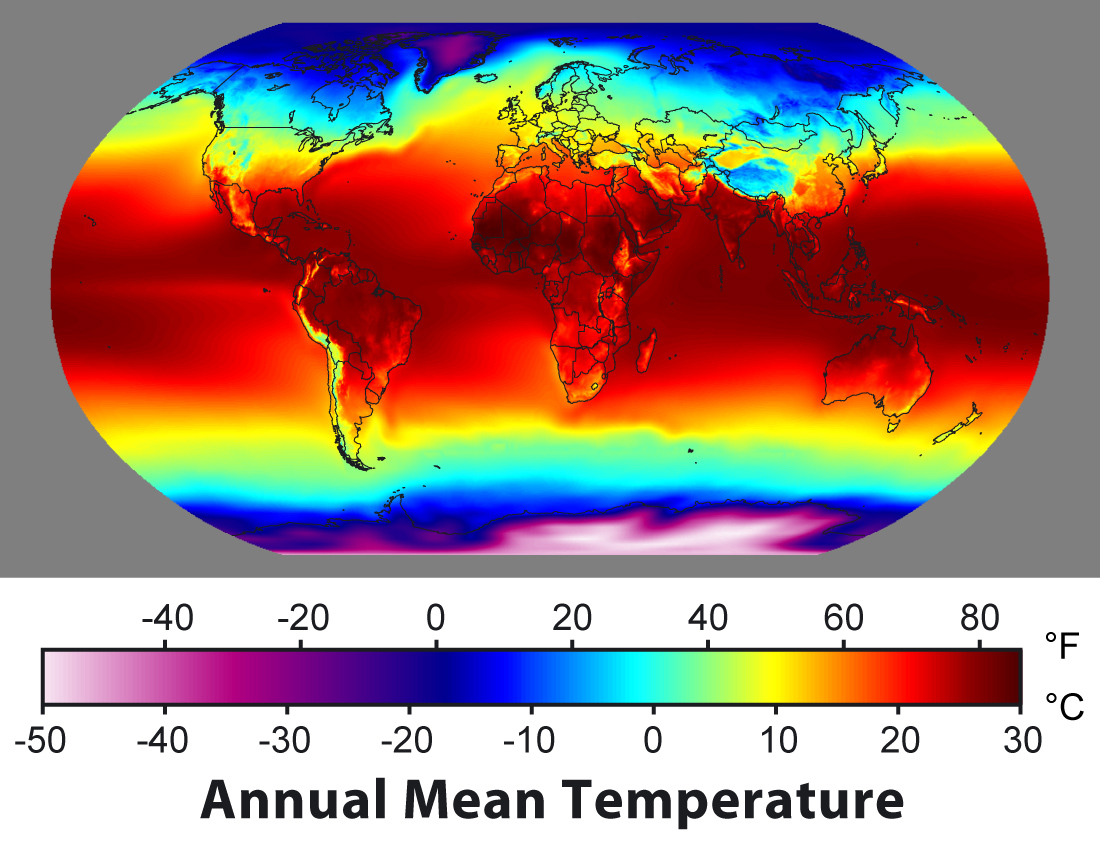
I was somewhat surprised to learn that reindeer positively thrive on the lowlands of Svalbard, which is in the way high Arctic, some 80 degrees North. I was aware that the Arctic was broadly more mild than the Antarctic but this still seemed anomalous.

A squiz at the average temperature map made things a bit plainer. Svalbard (though certainly very cold) is much warmer than most places at that latitude. Indeed the coastal temperatures appear simlar to those at say Cartwright in Labrador, Canada, at 53 degrees N: some 3000 km further south.

Reply Quote

Date: 12/12/2022 11:42:16
From: dv
ID: 1965920
Subject: re: Reindeer of the sub-Antarctic

The other grazing animal that lives basically right up to the northernmost limit of land on Earth is the musk ox. Despite the name, it is closely related to sheep and goats, rather than cattle.

Reply Quote

Date: 18/12/2022 15:01:51
From: dv
ID: 1968790
Subject: re: Reindeer of the sub-Antarctic

Speaking of invasive species in the deep south…

I just learned that annual bluegrass, Poa annua, has successfully invaded Antarctica.
It was first observed in the Antarctic maritime at Deception Island in 1953. It is now found widely on King George Island as well as in the vicinity of some mainland stations such as O’Higgins Station and Gonzales Station.

It is the only non-indigenous flowering plant to found to reproduce in Antarctica. There are two native flowering plants: Antarctic hair grass, Deschampsia antarctica, and Antarctic pearlwort, Colobanthus quitensis. (Some other introduced grasses have small clonal populations that spread by extension of the root systems etc but produce no seeds, ie do not reproduce per se.)

https://www.cambridge.org/core/journals/polar-record/article/poa-annua-l-in-the-maritime-antarctic-an-overview/A899FCB6F3FB092ECE34EAB07D878A6C
https://www.researchgate.net/figure/Biogeographic-distribution-of-Deschampsia-antarctica-Colobanthus-quitensis-and-Poa-annua_fig2_333476134

There is some plan to eradicate P. annua from King George Island.
https://link.springer.com/article/10.1007/s00300-016-2006-y

Reply Quote