Cymek asked a question about lightning and storing it, the initial response was there is no technology to do it atm and its not economically viable atm.
While I’m doing nothing I will have a think, ok, I did some looking.
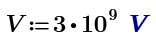
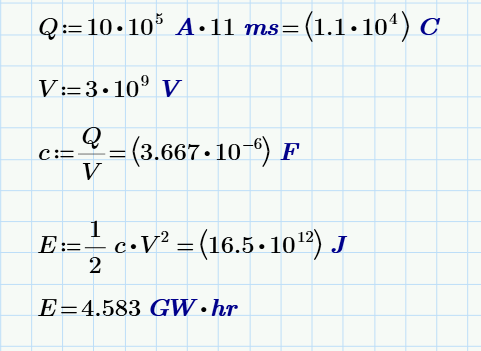
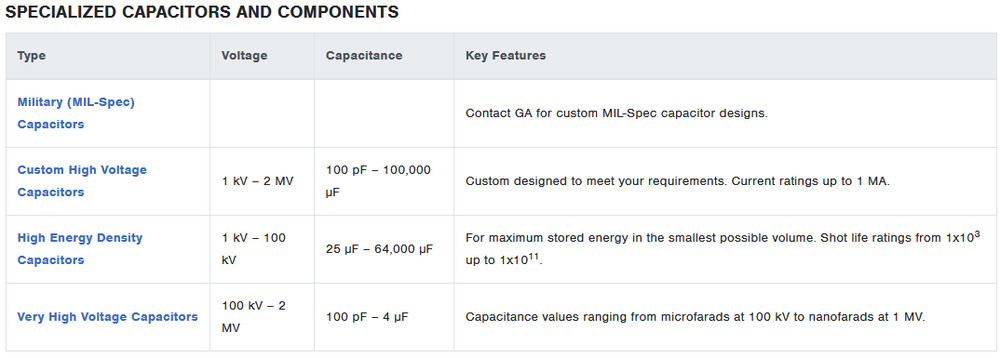
How many farads is 3 billion volts at 100,000 Amps.? That’s the kind of supercapacitors which will be needed. Could such a beast be made, what about lots of smaller ones?
ok, I think the future might hold promise, but its a big maybe, no idea on time lines.
The pathway there might be something like this…
1 Diverting the energy (This can now be done over short distances) See Sibeens article from the age
https://www.theage.com.au/world/europe/scientists-use-high-power-laser-to-divert-lightning-strikes-20230117-p5cd0n.html
Plasma tech is in its infancy, so lots of new stuff could be discovered.
2 An energy collection and distribution system (this is the current problem) I’m unaware of anything that can do this with such high energies involved.
One problem there is heat loss, consider the Vatican which gets hit a lot, thick copper pipes glow red from the heat of the lightning going to ground.
So maybe some kind of cooled superconductors which take the initial hit of the the plasma then some way of distributing and then storing large amounts of energy, maybe.
Well it will have to be distributed over a large bank of batteries which may or may not involve supercapacitors, no idea there, but the trick here is not one battery but many.
3 A large bank of super capacitors as a temporary storing of large amounts of energy. Today’s supercapacitors can now hold 10,000, 30,000 Farads, no idea of state of art.
from
https://www.quora.com/What-size-of-capacitors-would-you-use-to-collect-a-lighting-strike
What size of capacitors would you use to collect a lighting strike?
The fact that lightning will jump 1000 meters says the voltage is 3 billion volts. A typical discharge could have 100,000 Amps. It lasts only a few milliseconds.
IF you were to capture the lightning energy you will need a capacitor with a rating of 3 billion volts and a low ESR and low inductance.
Remember that the wattage dissipated will be I^2 R so if you have a 1 ohm of ESR then the wattage it needs to withstand due to ESR resistive loss will be like 10^10 watts in just a few milliseconds! Voltage loss will be 100,000 volts. and net energy loss in the stored capacitor around 6%.. You need to make ESR as small as possible.
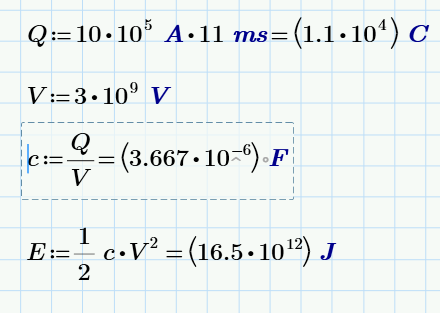
Capacitance : I = C dv/dt. If we assume I = 100,000, dV = 3,000,000,000 and dt = 11 ms then C=3.7e-6 or around 3.7 uF but rated 3 billion volts.
It will also have to have very low inductance; the voltage loss is L di/dt and as we know di/dt is huge. assuming 100,000 Amps and 1 millisecond we lose 1×10^8 volts per henry. To keep energy losses under 10% the voltage loss needs to be less than 5% (60,000,000 V) so L needs to be less than .6 Henries.
So there are several rather demanding specifications, I imagine the daunting one is the 3 billion volt rating; that by the way only applies to lightning jumping 1 km to earth; if it jumps more then you will need proportionally more voltage rating.
see more at https://www.quora.com/What-is-the-largest-capacitor-ever-made-and-what-was-its-purpose
4 A battery for long term storage (we have various batteries that can do this)
5 A suitable site, yes there are one or 2 places, but not here in Australia.
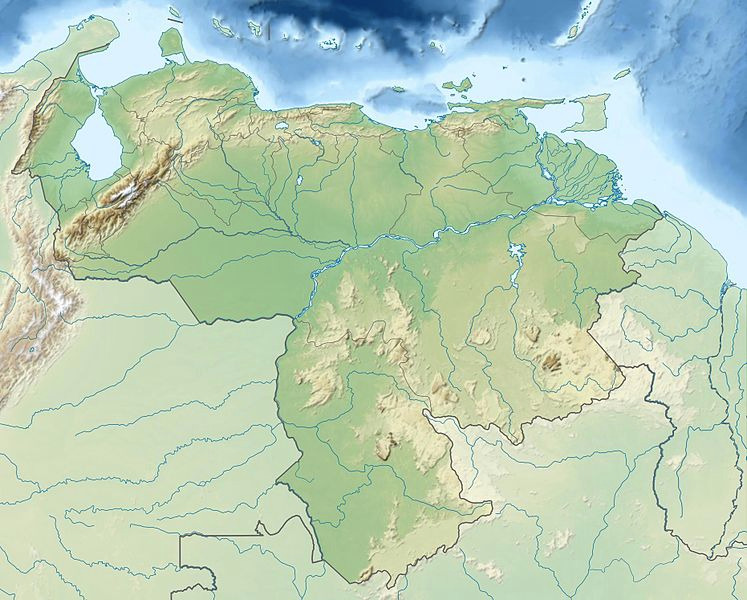
There’s only a few places in the world that receive a lot of lightning strikes, It might be viable in Venezuela and one or two other places that receive lots of strikes.
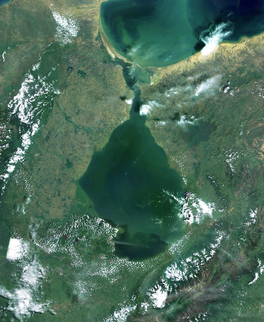
According to NASA Earth Observatory: “With an average flash rate of 389 per day, Lake Maracaibo in northern Venezuela (shown above) has the highest flash extent density in the world.15 June 2022
ok that place looks like a good place to start.
https://en.wikipedia.org/wiki/Distribution_of_lightning
The map on the right shows that lightning is not distributed evenly around the planet. About 70% of lightning occurs on land in the Tropics, where the majority of thunderstorms occur. The North and South Poles and the areas over the oceans have the fewest lightning strikes. The place where lightning occurs most often is above the Catatumbo river, which feeds Lake Maracaibo in Venezuela, where the so-called Catatumbo lightning flashes several times per minute, with lightning happening up to 300 nights a year. This gives Lake Maracaibo the highest number of lightning strikes per square kilometer in the world, at 250. The region with the second-most is the village Kifuka, in the mountains of the Democratic Republic of the Congo, where the elevation is around 1,700 metres (5,600 ft), receives 232 lightning strikes per square kilometer (409 per sq mi) a year.
Its looking very viable there at 389 strikes a day.
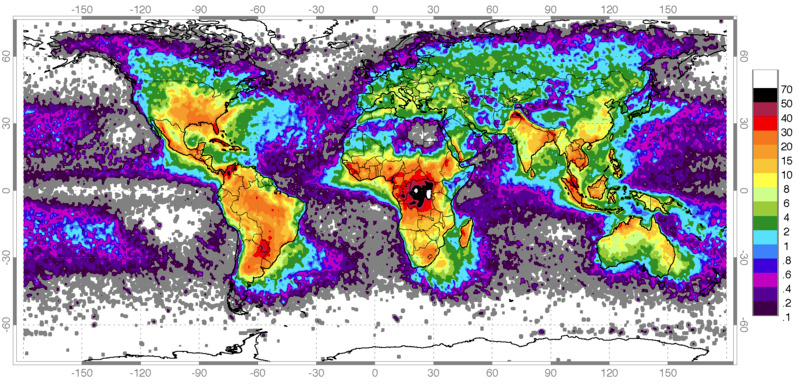
Global map of lightning frequency—strikes/km2/yr. The high lightning areas are on land located in the tropics. Areas with almost no lightning are the Arctic and Antarctic, closely followed by the oceans which have only 0.1 to 1 strikes/km2/yr.


So quite a few problems to overcome.
Found a quote on one of the tech sites
“Science can amuse and fascinate us all, but it is engineering that changes the world.”
- Isaac Asimov