An interesting read.
>>This discovery reveals a mostly unstudied but apparently universal aspect of fungal life.

Scientists found fungi are able to regulate their own body temperature in a phenomenon that appears universal across species.
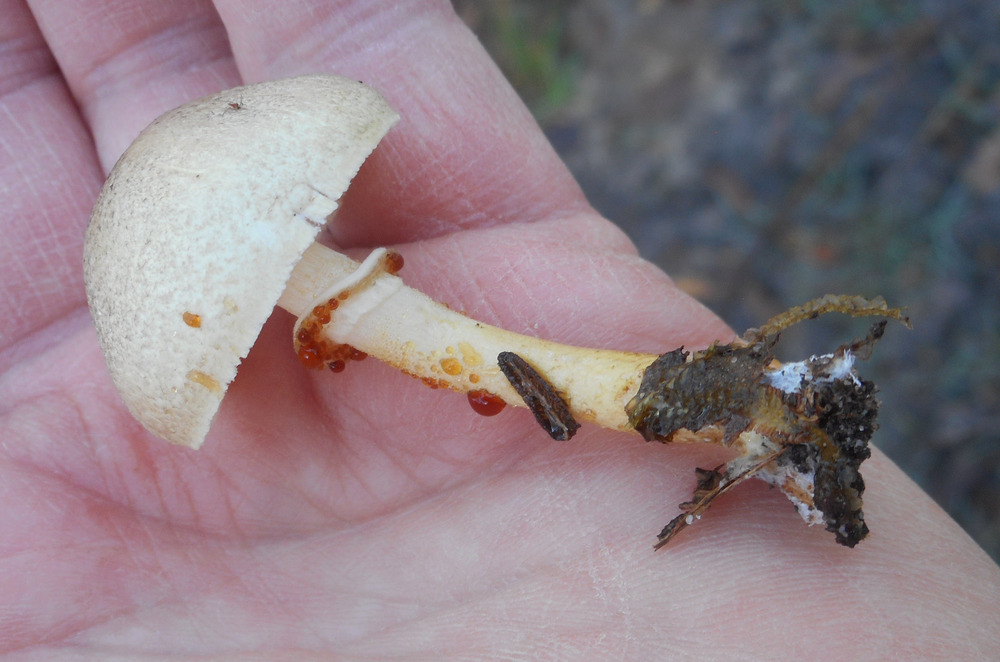
Mushrooms and possibly all fungi have the ability to cool down by “sweating” away water, a new study reveals.
It’s not yet clear why fungi might want to stay cool. However, the discovery sheds light on a potentially fundamental aspect of fungal biology and may even have implications for human health.
“It is, to me, a very interesting … unexplained phenomenon,” said Dr. Arturo Casadevall, a microbiologist at Johns Hopkins University and one of the study authors on the new paper, published last month in PNAS.
Lead author Radamés Cordero, who is also a microbiologist at Johns Hopkins, used an infrared camera to snap pictures of mushrooms in the woods. Infrared cameras can visualize the relative temperatures of each object in a photo, and Cordero noticed something odd: The mushrooms seemed to be colder than their surroundings.
Scientists had previously observed that mushrooms tend to be colder than their environments. But Casadevall said he had never heard of the phenomenon, so the team decided to find out if this cooling effect applied to all fungi.
In addition to photographing wild mushrooms, the researchers grew and photographed different types of fungi in the lab and found the same effect — the fungi were colder than their surroundings. This was even the case with their culture of Cryomyces antarcticus, a fungus that grows in Antarctica.
The fungi seem to cool down through evapotranspiration of water from their surface — meaning, essentially, they sweat. Think about coming out of the shower, Casadevall told Live Science. When you’re covered in water, you feel cold because some of the water on your skin is evaporating, taking heat with it.
Finding fungi sweat to keep cool could have implications for human health as species start to adapt to warmer global temperatures.
The team then created a sort of mushroom-powered air conditioner. They put mushrooms — Agaricus bisporus, commonly sold in supermarkets as portobello and white mushrooms, among other names — into a styrofoam box with a hole on each side. A fan was placed outside one of the holes, and they put this “MycoCooler” into a larger container and turned the fan on to circulate air over the mushrooms.
After 40 minutes, the air in the larger container had dropped from about 100 degrees Fahrenheit (37.8 degrees Celsius) down to about 82 F (27.8 C). The mushrooms had lowered the temperature through evaporative cooling, using up heat in the air to convert liquid water into gas.
The scientists are still unsure why fungi might want to keep cool.
In their paper, the authors speculate that it might have something to do with creating optimal conditions for spore formation, or it may help fungi spread their spores — by altering the temperature, they might be causing tiny winds that can blow the spores around.
It’s also possible that this phenomenon is due to something else entirely. For example, evapotranspiration also increases humidity, and when asked if it’s possible that the fungi are trying to keep humid, and the cooling is simply a by-product, Casadevall said it was conceivable.
Understanding the reason behind this cooling phenomenon in mushrooms and other fungi could help us understand how fungi interact with their environment and other organisms — ourselves included. Fungal diseases are estimated to kill more than 1.5 million people per year, many of them immunocompromised people.
At the moment, however, people also have some protection from fungal infections as we’re warm-blooded, and fungi don’t grow very well at our body temperature, Casadevall said.
But with climate change, fungi could start to adapt to warmer temperatures — potentially enabling them to more easily infect humans. If we understand why a fungus might prefer cooler temperatures, it might be able to help us inhibit fungal infections, Casadevall said.
But so far, this new discovery likely poses more questions than answers. “I think that if we could understand why — why do they want to be a bit colder than the environment?, we’re going to learn a lot.” Casadevall said.
https://www.livescience.com/planet-earth/plants/fungi-seem-to-sweat-to-stay-cool-and-scientists-dont-know-why