Date: 13/06/2023 03:17:21
From: dv
ID: 2042703
Subject: acetic acid

We had a question on the SSSF FB page from John Perrier:

I have one litre of water ph 7 (neutral). I want to make it about ph 5 by adding vinegar of ph 2. How much should I add? TIA.

After a bit of discussion it emerged that he had been advised that one ml of vinegar per litre of water should do it (one part vinegar per thousand parts water, but that didn’t seem nearly enough vinegar to John.

My advice was that was not nearly dilute enough, and that it needed to be one part per million.

So check my working.

My reasoning was that pH is a negative power of ten, and that this meant there needed to be a 1000-fold reduction in H +. Because the acetic acid is a weak acid dividing into two ions, the equation of dissociation is going to mean you have to dilute by A 2 to divide the H + ion concentration by A.

Of course eventually you get to a point where the solution is so dilute that dissociation is complete, and it tends to act like an ordinary dilution process but my gut feeling was that’s not going to happen until the solution is weaker than pH = 5.

—-

Some explanation: CH3COOH is a weak acid, meaning that when you add it to water it doesn’t all break up into H + and CH3COO -. The extent of dissociation depends on the concentration: if the acetic acid solution is very concentrated, not much is dissociated, and when it is very dilute, it is almost all dissociated.

The equation is:
Ka = /

Ka is the acid dissociation constant which is 0.00001754 for acetic acid. Square brackets is molar concentration, ie moles per litre.

If y is the total molarity of acetic acid in solution and x is the molarity of hydrogen ions, then the amount of CH3COOH remaining will be y – x and the molarity of acetate ions will also be x, so you get
Ka = x^2/(y-x)
y – x = x^2/Ka
y = x^2/Ka + x

pH = -log(x)
For JP’s purpose, volume of acetic acid per volume of water is more useful than molarity so I worked that out using molar mass of acetic acid = 60.052 and density of acetic acid = 1049 g/L and assumed that volume was conserved on mixing which is not quite correct but the discrepancy is a third order effect.

So this is what that looks like with a log scale on the x-axis. The red line is a line where the goes as the square of the volume ratio, and the green line would be where is linear with the volume ratio. The curve is kind of parallel to the red line below a pH of maybe 3.7 and then it starts to peel off and by the time you get to a pH of 5.5. it’s similar to the green line. (As we get to pH higher than 6 this analysis won’t work so well because the autoionising potential of water becomes more important and the pH starts to curve down again: obviously, no matter how dilute the acetic acid, the pH is not going to go higher than 7. So I stopped around pH = 5.7).
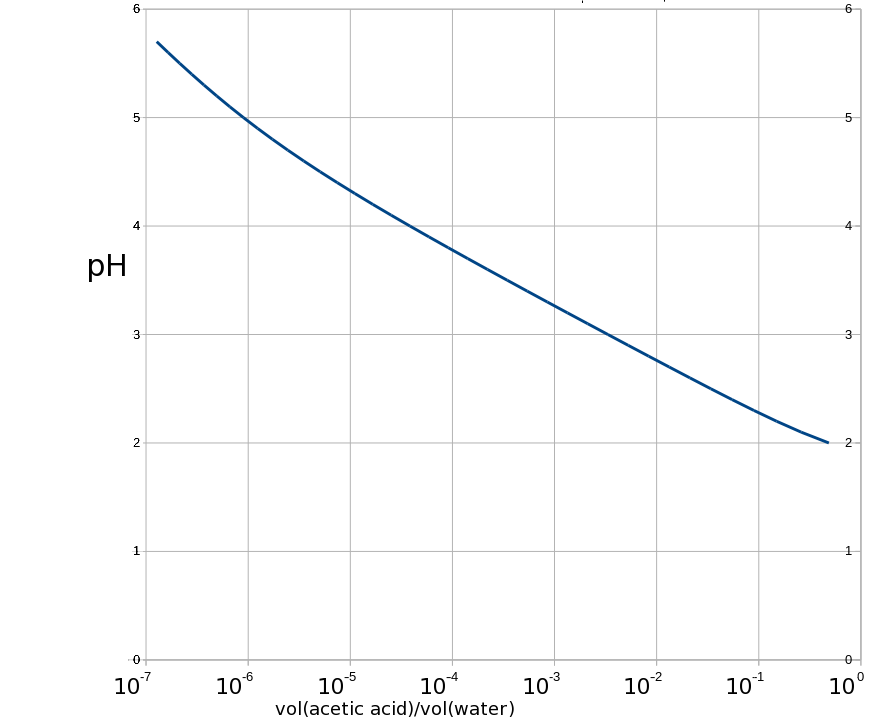
Anyway the dilution needs to be around 1 part of this pH = 2 vinegar per 540000 parts of water.

Now, ordinary household vinegar has a pH more like 2.5. I’d expect concentrated acetic acid as you might find in a lab’s reagent cabinet might be more like pH = 2. For this ordinary household vinegar the dilution is only 1 part per 38000.

Either way you’d probably need to use two steps to achieve this dilution. Like add a ml of vinegar to a litre of water, mix thoroughly, and THEN add some amount of THAT solution to a litre of water.
Reply Quote

Date: 13/06/2023 06:33:22
From: Bubblecar
ID: 2042705
Subject: re: acetic acid

Homeopathic vinegar, eh.

Reply Quote

Date: 13/06/2023 17:22:52
From: wookiemeister
ID: 2042898
Subject: re: acetic acid

Just get a pH meter a day add small amounts of vinegar of any strength to any volume of water and stop when you reach the desired pH

Reply Quote

Date: 13/06/2023 17:23:12
From: wookiemeister
ID: 2042900
Subject: re: acetic acid

wookiemeister said:


Just get a pH meter and add small amounts of vinegar of any strength to any volume of water and stop when you reach the desired pH

Reply Quote

Date: 13/06/2023 17:29:48
From: mollwollfumble
ID: 2042904
Subject: re: acetic acid

I’m used to treating the variation of pH with concentration as linear. Which is not correct but has worked well enough for me in the past.

I’d use wookie’s method, but start by getting free pool chemical test papers from a hardware store like Bunnings. You can grab a few test strips with a type of universal indicator for free. https://www.bunnings.com.au/services/in-store/pool-water-testing.

OK, I’ll have a look a dv’s calculations. Later.

Reply Quote

Date: 13/06/2023 17:30:55
From: wookiemeister
ID: 2042905
Subject: re: acetic acid

mollwollfumble said:


I’m used to treating the variation of pH with concentration as linear. Which is not correct but has worked well enough for me in the past.

I’d use wookie’s method, but start by getting free pool chemical test papers from a hardware store like Bunnings. You can grab a few test strips with a type of universal indicator for free. https://www.bunnings.com.au/services/in-store/pool-water-testing.

OK, I’ll have a look a dv’s calculations. Later.


You can buy fairly cheap electronic ph meters I think

Reply Quote

Date: 13/06/2023 17:31:49
From: wookiemeister
ID: 2042906
Subject: re: acetic acid

https://aussiebattery.com.au/product/digital-ph-meter-tester-monitor/?gad=1&gclid=CjwKCAjwp6CkBhB_EiwAlQVyxb-4Mk2QN2goBmO25qbGmbXqC0h4RrwpCj_iGDWGnwBF-1DDNj00AhoCsogQAvD_BwE

Reply Quote

Date: 13/06/2023 17:32:50
From: wookiemeister
ID: 2042908
Subject: re: acetic acid

No doubt water temperature and other variables would affect the way the vinegar reacts

Reply Quote

Date: 13/06/2023 17:36:14
From: wookiemeister
ID: 2042910
Subject: re: acetic acid

Dissolved minerals will affect the pH as well and carbonates

Reply Quote

Date: 13/06/2023 17:38:23
From: wookiemeister
ID: 2042912
Subject: re: acetic acid

Its easier to simply test the solution directly

You could use a dropper if the solution becomes too acidic just add water

Reply Quote

Date: 13/06/2023 17:42:31
From: wookiemeister
ID: 2042915
Subject: re: acetic acid

If you cook ethanol and acetic acid together you get an ester ! It’s the way they make artificial smells as we were told alcohols and organic acids. It’s the shape that makes you think it’s something else

Reply Quote

Date: 13/06/2023 17:42:37
From: mollwollfumble
ID: 2042916
Subject: re: acetic acid

dv said:


We had a question on the SSSF FB page from John Perrier:

I have one litre of water ph 7 (neutral). I want to make it about ph 5 by adding vinegar of ph 2. How much should I add? TIA.

After a bit of discussion it emerged that he had been advised that one ml of vinegar per litre of water should do it (one part vinegar per thousand parts water, but that didn’t seem nearly enough vinegar to John.

My advice was that was not nearly dilute enough, and that it needed to be one part per million.

So check my working.

My reasoning was that pH is a negative power of ten, and that this meant there needed to be a 1000-fold reduction in H +. Because the acetic acid is a weak acid dividing into two ions, the equation of dissociation is going to mean you have to dilute by A 2 to divide the H + ion concentration by A.

Of course eventually you get to a point where the solution is so dilute that dissociation is complete, and it tends to act like an ordinary dilution process but my gut feeling was that’s not going to happen until the solution is weaker than pH = 5.

—-

Some explanation: CH3COOH is a weak acid, meaning that when you add it to water it doesn’t all break up into H + and CH3COO -. The extent of dissociation depends on the concentration: if the acetic acid solution is very concentrated, not much is dissociated, and when it is very dilute, it is almost all dissociated.

The equation is:
Ka = /

Ka is the acid dissociation constant which is 0.00001754 for acetic acid. Square brackets is molar concentration, ie moles per litre.

If y is the total molarity of acetic acid in solution and x is the molarity of hydrogen ions, then the amount of CH3COOH remaining will be y – x and the molarity of acetate ions will also be x, so you get
Ka = x^2/(y-x)
y – x = x^2/Ka
y = x^2/Ka + x

pH = -log(x)
For JP’s purpose, volume of acetic acid per volume of water is more useful than molarity so I worked that out using molar mass of acetic acid = 60.052 and density of acetic acid = 1049 g/L and assumed that volume was conserved on mixing which is not quite correct but the discrepancy is a third order effect.

So this is what that looks like with a log scale on the x-axis. The red line is a line where the goes as the square of the volume ratio, and the green line would be where is linear with the volume ratio. The curve is kind of parallel to the red line below a pH of maybe 3.7 and then it starts to peel off and by the time you get to a pH of 5.5. it’s similar to the green line. (As we get to pH higher than 6 this analysis won’t work so well because the autoionising potential of water becomes more important and the pH starts to curve down again: obviously, no matter how dilute the acetic acid, the pH is not going to go higher than 7. So I stopped around pH = 5.7).

Anyway the dilution needs to be around 1 part of this pH = 2 vinegar per 540000 parts of water.

Now, ordinary household vinegar has a pH more like 2.5. I’d expect concentrated acetic acid as you might find in a lab’s reagent cabinet might be more like pH = 2. For this ordinary household vinegar the dilution is only 1 part per 38000.

Either way you’d probably need to use two steps to achieve this dilution. Like add a ml of vinegar to a litre of water, mix thoroughly, and THEN add some amount of THAT solution to a litre of water.

Hold on. What makes you think that vinegar has pH 2? Check web.

“Most vinegars have a pH of 2 to 3 and a strength of 4 to 8 percent”

Let’s try the online calculator. Half way down the following page.

https://www.chemistryscl.com/physical/calculate-pH-of-acetic-acid/index.php

mol/dm^3 pH
10 1.87
1 2.37
0.1 2.87
0.01 3.37
10^-3 3.87

Looks like their “calculator” is a cheat. It just adds a pH of 0.5 for each factor of ten.

Reply Quote

Date: 13/06/2023 17:43:06
From: wookiemeister
ID: 2042917
Subject: re: acetic acid

quote=wookiemeister]
The problem is water in theory has OH and H popping in and out of existence in perfect water which is the only time you’d get close enough to create perfect solutions created from perfect water and CH3COOH

Reply Quote

Date: 13/06/2023 17:45:41
From: wookiemeister
ID: 2042919
Subject: re: acetic acid

Presumably water would have dissolved carbon dioxide in it carbonic acid

Reply Quote

Date: 14/06/2023 11:15:14
From: mollwollfumble
ID: 2043145
Subject: re: acetic acid

wookiemeister said:


Presumably water would have dissolved carbon dioxide in it carbonic acid

Carbonic acid is a very interesting one, and is much misunderstood, by me as well as by others.

In water, there is a balance between dissolved carbon dioxide (non-dissociated) and carbonic acid (dissociated).

This balance depends critically on pH. A small change in pH not far from neutral pH will shift the balance between dissociated and non-dissociated dissolved CO2 from one extreme to the other.

And when the water is in direct contact with carbonates such as limestone, all bets are off.

Reply Quote

Date: 14/06/2023 11:19:19
From: roughbarked
ID: 2043148
Subject: re: acetic acid

mollwollfumble said:


wookiemeister said:

Presumably water would have dissolved carbon dioxide in it carbonic acid

Carbonic acid is a very interesting one, and is much misunderstood, by me as well as by others.

In water, there is a balance between dissolved carbon dioxide (non-dissociated) and carbonic acid (dissociated).

This balance depends critically on pH. A small change in pH not far from neutral pH will shift the balance between dissociated and non-dissociated dissolved CO2 from one extreme to the other.

And when the water is in direct contact with carbonates such as limestone, all bets are off.

Yeah. Well my soil is calcrete.

Reply Quote

Date: 14/06/2023 18:21:01
From: Michael V
ID: 2043327
Subject: re: acetic acid

roughbarked said:


mollwollfumble said:

wookiemeister said:

Presumably water would have dissolved carbon dioxide in it carbonic acid

Carbonic acid is a very interesting one, and is much misunderstood, by me as well as by others.

In water, there is a balance between dissolved carbon dioxide (non-dissociated) and carbonic acid (dissociated).

This balance depends critically on pH. A small change in pH not far from neutral pH will shift the balance between dissociated and non-dissociated dissolved CO2 from one extreme to the other.

And when the water is in direct contact with carbonates such as limestone, all bets are off.

Yeah. Well my soil is calcrete.

Is your calcrete nodular, or a consistent layer? At what depth is it? Are there any gold deposits in your general area?

Reply Quote

Date: 14/06/2023 19:38:35
From: roughbarked
ID: 2043345
Subject: re: acetic acid

Michael V said:


roughbarked said:

mollwollfumble said:

Carbonic acid is a very interesting one, and is much misunderstood, by me as well as by others.

In water, there is a balance between dissolved carbon dioxide (non-dissociated) and carbonic acid (dissociated).

This balance depends critically on pH. A small change in pH not far from neutral pH will shift the balance between dissociated and non-dissociated dissolved CO2 from one extreme to the other.

And when the water is in direct contact with carbonates such as limestone, all bets are off.

Yeah. Well my soil is calcrete.

Is your calcrete nodular, or a consistent layer? At what depth is it? Are there any gold deposits in your general area?

Depends how wide the area. There’s gold at Yalgogrin and around the area along with a lot of tin.
The Grong Grong Granites come across to the Binya hills..
My soil is a mix of nodular and powder It is bloody difficult to dig post holes accurate depths because all the nodules do all they can to refuse to come up out of the hole.

Reply Quote

Date: 20/06/2023 15:02:04
From: dv
ID: 2045369
Subject: re: acetic acid

So I did the experiment using distilled water and household vinegar, using 2 step dilution down to 1 part in 500000, and me pH meter says 5.29.

Eh close enough.

Reply Quote

Date: 23/04/2024 23:19:19
From: SCIENCE
ID: 2147654
Subject: re: acetic acid

Slightly related but anyway. Note also this could also be a comment about 爱 and human error.

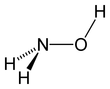
Recently, the widespread cultural awareness of many contributors here inspired us to revisit some information on hydroxylamine (NH2OH).

The structure of this molecule most immediately suggests it should be

basic (lone pairs, not shown, should be able to coordinate), but also should have acidic character (electronegative central atoms should be able to localise negative charge).

The overall feel of this molecule is that it should be more basic, which on extensive review of available evidence seems to be the case.

However, on simplistic and superficial internet search, it’s been frustrating to wade through a sludge of results that seem to be bullshit content aggregation and rookie guesswork.


Guess there’s a long way to go yet, or, guess 爱 doesn’t have far to go at all.

Reply Quote

