Article by Richard Butler, Professor of Palaeobiology, University of Birmingham.
The year 2025 saw the discovery of 44 new dinosaur species – nearly one a week.
Many new discoveries come from palaeontological hotspots, such as Argentina, China, Mongolia and the US, but dinosaur fossils are also being found in many other places, from a Serbian village to the rainswept coast of north-west Scotland. Even as a researcher, it is hard to keep track, but here is a personal view of some of the year’s highlights.
Zavacephale rinpoche
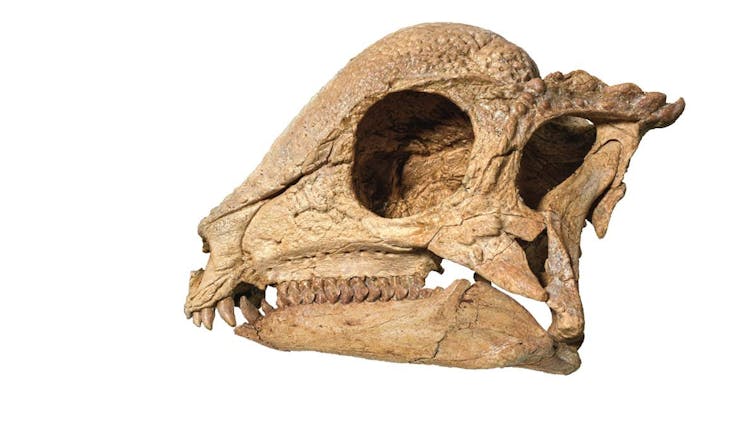
Some fossils are so exciting that when first shown at academic conferences, they draw audible gasps even from experienced palaeontologists. Zavacephale is one of these. The stunning skeleton of this one-metre-long plant-eating dinosaur was discovered in 110-million-year-old rocks in the Gobi Desert of Mongolia and described by palaeontologist Tsogtbaatar Chinzorig and colleagues.
Zavacephale is the oldest known member of the pachycephalosaurs, a group of dinosaurs famed for their domed skulls, probably used to butt heads like today’s bighorn sheep. Pachycephalosaurs have long been one of the most enigmatic dinosaur groups, and the discovery of Zavacephale is critical to understanding their early evolution.