Date: 20/01/2026 10:55:00
From: Witty Rejoinder
ID: 2351873
Subject: On the Origin of Homo Sapiens: Who were the Denisovans?

A debate is raging over the origins of an elusive cousin to modern humans

Who were the Denisovans?

Dec 17th 2025

During the Japanese invasion of northern China in 1933, a man was hired to build a bridge across the Songhua river near the city of Harbin. As he was digging, he found a large, ancient cranium embedded in the muddy riverbank, which he hid in a well. It was not until his deathbed that he told his grandchildren about the fossil. Whether apocryphal or not, that was the story the skull came with when it was donated to the Geoscience Museum of Hebei in China a few years ago.

Today the skull’s provenance is still the subject of debate, though on a much grander scale. Recent DNA evidence has linked the fossil to a mysterious group of hominins known as the Denisovans, about which scientists know precious little. The skull should have helped clarify who the group was and what role they played in human evolution. Instead it has done the opposite: its appearance suggests an evolutionary history at odds with genetic data. That could place the ancestors of Homo sapiens—modern humans—outside Africa, an idea which flips everything palaeontologists think they knew about human origins on its head.

Over the course of its history H. sapiens is known to have shared Earth with another human species: the Neanderthals, a stocky type of human that made sophisticated tools, buried its dead and even made art. In 2008 another species burst onto the scene when a fingertip from a child, between 30,000 and 60,000 years old, was discovered in Denisova cave in Siberia. A team led by Svante Paabo from the Max Planck Institute in Germany extracted DNA from the finger and found it was neither Neanderthal nor sapiens.

The team declared the presence of a new group of humans: the Denisovans. Soon genetic studies found traces of Denisovan DNA in modern people, particularly across Asia, just as Neanderthal DNA shows up in present-day populations around the world.

But who were the Denisovans? Only 12 small fragments of these humans have been found—hardly enough to put a face to the name. Then in 2021 a team led by Ni Xijun, a palaeoanthropologist at the Chinese Academy of Sciences (CAS), presented the Harbin skull to the world. More than 146,000 years old, its large brain case is reminiscent of sapiens, yet other features such as its prominent eyebrow ridges do not fit the look of modern humans. The team proposed a new species: Homo longi, “Dragon Man”.

This year brought confirmation that the skull belonged to a Denisovan. In two papers published in June and July, respectively, Fu Qiaomei, a molecular geneticist also at CAS, detailed finding ancient proteins and mitochondrial DNA in the plaque on the Harbin skull’s teeth that matched a Denisovan profile. Scientists around the world were elated: here, at last, was a face.

The result was also a vindication for the Chinese fossil record, a collection of hominin fossils found in China over the past century. Long considered of little evolutionary importance by many in the West, fossils in China were thought to consist mainly of Homo erectus, a hominin that evolved some two million years ago in Africa, before leaving the continent and dying out in south-east Asia some 110,000 years ago. In contrast, many Chinese researchers believed that these erectus fossils found in China were the ancestors of modern Chinese, despite ample evidence that modern humans stem mostly from Africa.

Christopher Bae, a palaeoanthropologist at the University of Hawai’i at Manoa, says it is only in the past two decades that the world has begun to look at the fossils with new eyes. Longi is just one of several new species recently proposed based on Chinese skulls. (In fact Dr Bae and Wu Xiujie from CAS suggested that some of these skulls belonged to a new species they called Homo juluensis (“Big-Headed People”) in 2024; they also assigned the Denisovans to that new species.)

At the same time, ancient DNA and protein research within China has advanced. Dr Fu’s dogged pursuit of DNA samples from the Harbin skull’s dental plaque, for example, showed it was possible to obtain usable samples from even the most minuscule original material. That kind of work could bring even more Chinese fossils, otherwise considered too old or poorly preserved because of the heat and humidity in some parts of the country, within reach of molecular science.

Are we related?
In the months since Dr Fu’s work was published, however, a conundrum has cropped up. Nuclear genomes extracted from Denisovans show that they and Neanderthals formed a single lineage which split from modern humans before splitting from each other (see first diagram)—a finding that was reinforced when Dr Paabo’s team, led by his colleague Janet Kelso, posted a preprint with a new high-quality genome from a Denisovan tooth on October 20th.
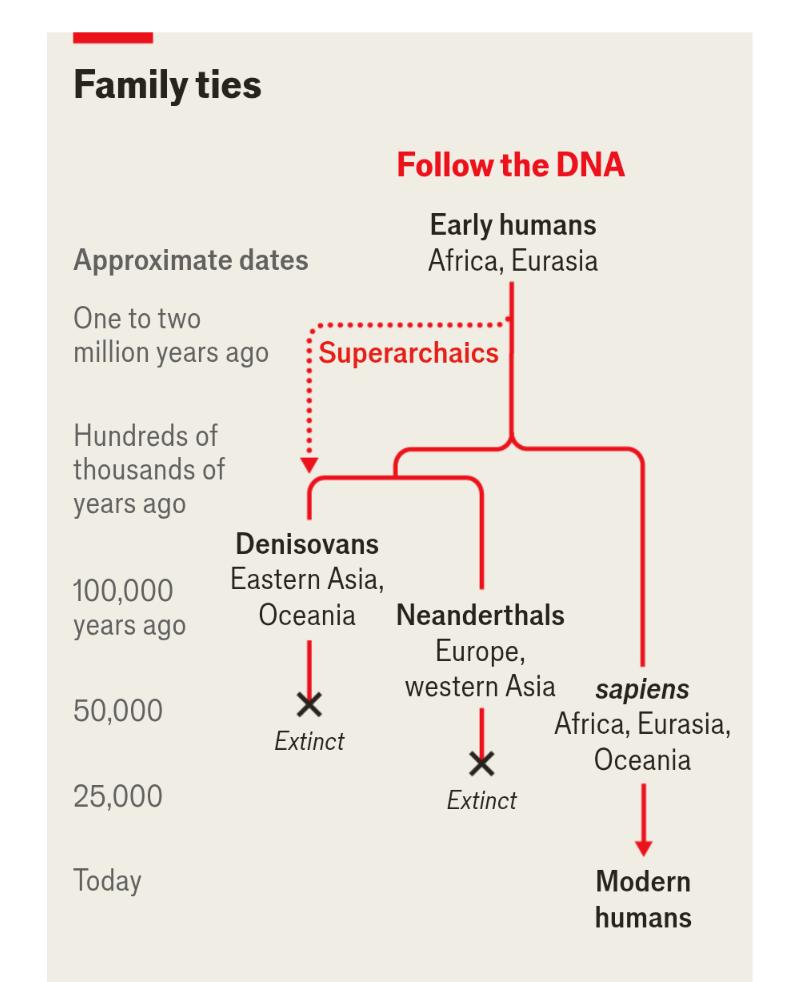
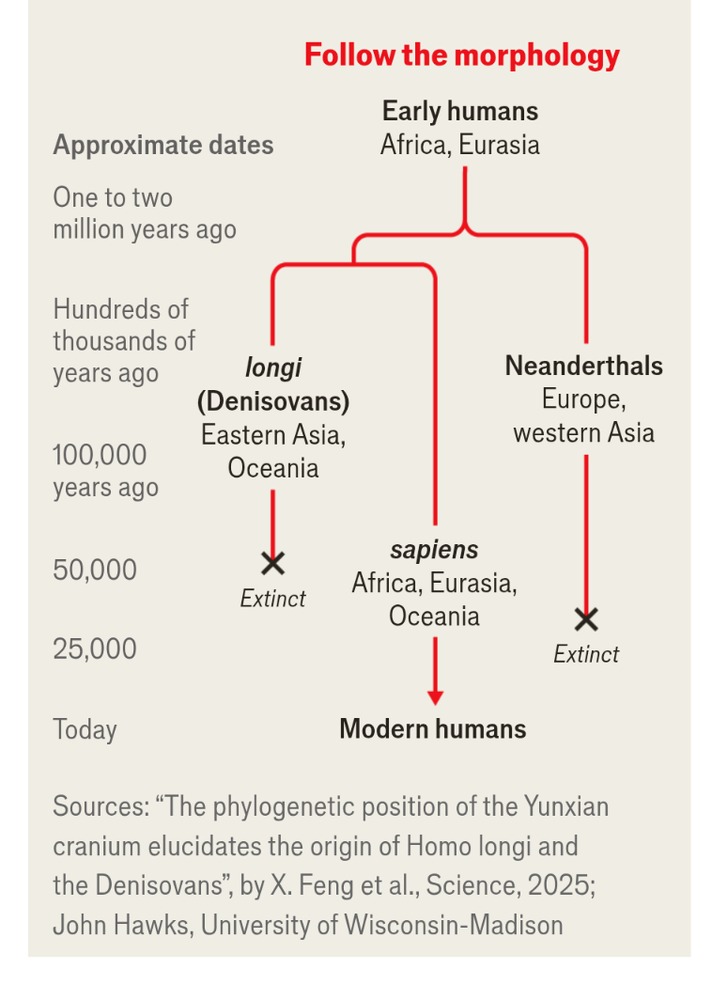
The lineage looks different when scientists study the appearance of the Harbin skull, and others that have since been designated longi, however. Dr Ni and his collaborator, Chris Stringer from the Natural History Museum in Britain, reckon that longi split from the ancestors of sapiens only after Neanderthals went their own way (see second diagram).
The discrepancy creates a mystery. Follow the DNA and the sapiens lineage seems to diverge from an ancestral group of Neanderthals and Denisovans, sometimes called the Neandersovans, between 500,000 and 800,000 years ago. This group would have spread out of Africa to Eurasia, from where the ancestors of the Neanderthals eventually moved westward into Europe and the ancestors of the Denisovans went east to Asia.

According to Dr Kelso’s new genome, at least three separate Denisovan groups then interbred with sapiens coming from Africa some 60,000 years ago. Comparing the genetics of the three Denisovan populations with that of modern populations, it suggests that groups of sapiens walked through Asia at different times and along different routes, thus differentially encountering the three Denisovan populations. The ancestors of modern Oceanians, including indigenous Australians, came first, with the ancestors of modern-day east and south Asians coming later.

Follow the morphology instead—meaning the shape of physical features such as teeth, brain cases, foreheads and eyebrows—and an entirely different story emerges. It suggests that the ancestors of sapiens and longi (including, in Dr Ni’s and Dr Stringer’s telling, the people who would become the Denisovans) remained one group and probably lived in Europe or west Asia more than a million years ago.

They base this on the Harbin skull and on a reconstruction of a one-million-year-old crushed Chinese skull called Yunxian 2, an analysis which they published in September in Science. Dr Stringer says that it is possible that the early Denisovans stayed in Asia while sapiens’s ancestors migrated back into Africa to continue most of their evolution before some of them left again 60,000 years ago. In other words, the origin of the sapiens lineage could have arisen outside Africa—an astonishing twist in the history of modern humans.

Both divergence stories cannot be true. Geneticists such as Dr Paabo maintain that genomics is the only way to determine when branches split off from one another. John Hawks, a palaeoanthropologist at the University of Wisconsin-Madison, agrees that DNA has a certain credibility that morphology does not. But, at the same time, the current DNA evidence comes from only a small set of samples, which do not reflect all populations that lived at the time. “So it can be good to keep an open mind even when the evidence seems very convincing,” he says.

Dr Hawks has a fix for the paradox. China is littered with fossils of old erectus-like people. It is possible, Dr Hawks argues, that those erectus-like humans were still around when the Denisovans arrived. If the Denisovans interbred with the Asian erectus, that could have made the resulting Denisovans look older than they actually were.

The genetics also allows for another possibility: a paper from 2020 found evidence that Denisovans interbred with a very old “superarchaic” lineage that had split from their own ancestors more than 1.2m years earlier. Alternatively, Denisovans might have retained erectus-like features while sapiens evolved differently.

Smile for the camera
The evidence is complex but scientists are optimistic that they will eventually understand the Denisovans and their history. Dr Stringer says more fossils must be out there, either of longi or their ancestors. Geneticists also feel confident that they will become better and better at extracting DNA and proteins from the fossils they already have. Both may prove crucial. After all, a single portrait is not enough to represent a whole species. A photo album will be needed, if not several of them.

https://www.economist.com/science-and-technology/2025/12/17/a-debate-is-raging-over-the-origins-of-an-elusive-cousin-to-modern-humans

Reply Quote

Date: 20/01/2026 11:06:05
From: Peak Warming Man
ID: 2351877
Subject: re: On the Origin of Homo Sapiens: Who were the Denisovans?

Witty Rejoinder said:


A debate is raging over the origins of an elusive cousin to modern humans

Who were the Denisovans?

Dec 17th 2025

During the Japanese invasion of northern China in 1933, a man was hired to build a bridge across the Songhua river near the city of Harbin. As he was digging, he found a large, ancient cranium embedded in the muddy riverbank, which he hid in a well. It was not until his deathbed that he told his grandchildren about the fossil. Whether apocryphal or not, that was the story the skull came with when it was donated to the Geoscience Museum of Hebei in China a few years ago.

Today the skull’s provenance is still the subject of debate, though on a much grander scale. Recent DNA evidence has linked the fossil to a mysterious group of hominins known as the Denisovans, about which scientists know precious little. The skull should have helped clarify who the group was and what role they played in human evolution. Instead it has done the opposite: its appearance suggests an evolutionary history at odds with genetic data. That could place the ancestors of Homo sapiens—modern humans—outside Africa, an idea which flips everything palaeontologists think they knew about human origins on its head.

Over the course of its history H. sapiens is known to have shared Earth with another human species: the Neanderthals, a stocky type of human that made sophisticated tools, buried its dead and even made art. In 2008 another species burst onto the scene when a fingertip from a child, between 30,000 and 60,000 years old, was discovered in Denisova cave in Siberia. A team led by Svante Paabo from the Max Planck Institute in Germany extracted DNA from the finger and found it was neither Neanderthal nor sapiens.

The team declared the presence of a new group of humans: the Denisovans. Soon genetic studies found traces of Denisovan DNA in modern people, particularly across Asia, just as Neanderthal DNA shows up in present-day populations around the world.

But who were the Denisovans? Only 12 small fragments of these humans have been found—hardly enough to put a face to the name. Then in 2021 a team led by Ni Xijun, a palaeoanthropologist at the Chinese Academy of Sciences (CAS), presented the Harbin skull to the world. More than 146,000 years old, its large brain case is reminiscent of sapiens, yet other features such as its prominent eyebrow ridges do not fit the look of modern humans. The team proposed a new species: Homo longi, “Dragon Man”.

This year brought confirmation that the skull belonged to a Denisovan. In two papers published in June and July, respectively, Fu Qiaomei, a molecular geneticist also at CAS, detailed finding ancient proteins and mitochondrial DNA in the plaque on the Harbin skull’s teeth that matched a Denisovan profile. Scientists around the world were elated: here, at last, was a face.

The result was also a vindication for the Chinese fossil record, a collection of hominin fossils found in China over the past century. Long considered of little evolutionary importance by many in the West, fossils in China were thought to consist mainly of Homo erectus, a hominin that evolved some two million years ago in Africa, before leaving the continent and dying out in south-east Asia some 110,000 years ago. In contrast, many Chinese researchers believed that these erectus fossils found in China were the ancestors of modern Chinese, despite ample evidence that modern humans stem mostly from Africa.

Christopher Bae, a palaeoanthropologist at the University of Hawai’i at Manoa, says it is only in the past two decades that the world has begun to look at the fossils with new eyes. Longi is just one of several new species recently proposed based on Chinese skulls. (In fact Dr Bae and Wu Xiujie from CAS suggested that some of these skulls belonged to a new species they called Homo juluensis (“Big-Headed People”) in 2024; they also assigned the Denisovans to that new species.)

At the same time, ancient DNA and protein research within China has advanced. Dr Fu’s dogged pursuit of DNA samples from the Harbin skull’s dental plaque, for example, showed it was possible to obtain usable samples from even the most minuscule original material. That kind of work could bring even more Chinese fossils, otherwise considered too old or poorly preserved because of the heat and humidity in some parts of the country, within reach of molecular science.

Are we related?
In the months since Dr Fu’s work was published, however, a conundrum has cropped up. Nuclear genomes extracted from Denisovans show that they and Neanderthals formed a single lineage which split from modern humans before splitting from each other (see first diagram)—a finding that was reinforced when Dr Paabo’s team, led by his colleague Janet Kelso, posted a preprint with a new high-quality genome from a Denisovan tooth on October 20th.

The lineage looks different when scientists study the appearance of the Harbin skull, and others that have since been designated longi, however. Dr Ni and his collaborator, Chris Stringer from the Natural History Museum in Britain, reckon that longi split from the ancestors of sapiens only after Neanderthals went their own way (see second diagram).

The discrepancy creates a mystery. Follow the DNA and the sapiens lineage seems to diverge from an ancestral group of Neanderthals and Denisovans, sometimes called the Neandersovans, between 500,000 and 800,000 years ago. This group would have spread out of Africa to Eurasia, from where the ancestors of the Neanderthals eventually moved westward into Europe and the ancestors of the Denisovans went east to Asia.

According to Dr Kelso’s new genome, at least three separate Denisovan groups then interbred with sapiens coming from Africa some 60,000 years ago. Comparing the genetics of the three Denisovan populations with that of modern populations, it suggests that groups of sapiens walked through Asia at different times and along different routes, thus differentially encountering the three Denisovan populations. The ancestors of modern Oceanians, including indigenous Australians, came first, with the ancestors of modern-day east and south Asians coming later.

Follow the morphology instead—meaning the shape of physical features such as teeth, brain cases, foreheads and eyebrows—and an entirely different story emerges. It suggests that the ancestors of sapiens and longi (including, in Dr Ni’s and Dr Stringer’s telling, the people who would become the Denisovans) remained one group and probably lived in Europe or west Asia more than a million years ago.

They base this on the Harbin skull and on a reconstruction of a one-million-year-old crushed Chinese skull called Yunxian 2, an analysis which they published in September in Science. Dr Stringer says that it is possible that the early Denisovans stayed in Asia while sapiens’s ancestors migrated back into Africa to continue most of their evolution before some of them left again 60,000 years ago. In other words, the origin of the sapiens lineage could have arisen outside Africa—an astonishing twist in the history of modern humans.

Both divergence stories cannot be true. Geneticists such as Dr Paabo maintain that genomics is the only way to determine when branches split off from one another. John Hawks, a palaeoanthropologist at the University of Wisconsin-Madison, agrees that DNA has a certain credibility that morphology does not. But, at the same time, the current DNA evidence comes from only a small set of samples, which do not reflect all populations that lived at the time. “So it can be good to keep an open mind even when the evidence seems very convincing,” he says.

Dr Hawks has a fix for the paradox. China is littered with fossils of old erectus-like people. It is possible, Dr Hawks argues, that those erectus-like humans were still around when the Denisovans arrived. If the Denisovans interbred with the Asian erectus, that could have made the resulting Denisovans look older than they actually were.

The genetics also allows for another possibility: a paper from 2020 found evidence that Denisovans interbred with a very old “superarchaic” lineage that had split from their own ancestors more than 1.2m years earlier. Alternatively, Denisovans might have retained erectus-like features while sapiens evolved differently.

Smile for the camera
The evidence is complex but scientists are optimistic that they will eventually understand the Denisovans and their history. Dr Stringer says more fossils must be out there, either of longi or their ancestors. Geneticists also feel confident that they will become better and better at extracting DNA and proteins from the fossils they already have. Both may prove crucial. After all, a single portrait is not enough to represent a whole species. A photo album will be needed, if not several of them.

https://www.economist.com/science-and-technology/2025/12/17/a-debate-is-raging-over-the-origins-of-an-elusive-cousin-to-modern-humans

Thanks.
A well written article, cuts to the chase, no peripheral dodgy theories that seem to haunt the internet.

Reply Quote

Date: 12/08/2026 11:59:04
From: Witty Rejoinder
ID: 2419448
Subject: re: On the Origin of Homo Sapiens: Who were the Denisovans?

Denisovans may have dwarfed other ancient humans
Two leg bones found on the seabed near Taiwan have been identified as Denisovans, and their size suggests these hominins stood up to 190 centimetres tall

By James Woodford
11 August 2026

Two Denisovans who lived around 45,000 years ago were among the biggest humans of their time, with one, at a height of 190 centimetres, estimated to be around 20 centimetres taller than the average man today.

The enigmatic Denisovans were a group of ancient humans who lived in Asia until around 30,000 years ago. They were first discovered in 2010, and only a few fossils have been found, giving us limited information about their biology and their lifestyles.

Read more An incredible Denisovan skull is upending the story of human evolution
Yousuke Kaifu at the University of Tokyo, Japan, and his colleagues analysed leg bones from two separate individuals, dredged by fishermen from the seafloor of Penghu Channel, west of Taiwan.

During the Pleistocene, from 2.58 million to 11,700 years ago, mainland Asia and the South-East Asian archipelago were home to multiple hominin species, including Homo sapiens, Homo erectus, Denisovans, Homo floresiensis and Homo luzonensis.

The team was able to determine which hominin species the femur and tibia fossils came from by analysing proteins preserved in the bones. Known as Penghu 2 and 3, they are some of the largest Pleistocene Homo leg bones ever found, the researchers say.

Kaifu and his colleagues, who declined to be interviewed for this story, say in their paper that Penghu 2 was probably male and would have weighed around 83 kilograms and been about 180 centimetres tall. Penghu 3, also likely a male, would have weighed 91 kilograms and been about 190 centimetres tall.

This means Penghu 3, in particular, would have towered over his H. erectus relatives by up to 30 centimetres and been of a height and weight comparable to the largest Homo specimens from Africa and Europe.

Adam Brumm at Griffith University in Brisbane, Australia, who wasn’t involved in the study, says the Taiwanese Denisovans were “big and imposing humans”.

“Penghu 3 would have been roughly similar in height and weight to Erling Haaland – though hopefully with a better haircut,” says Brumm.

In a separate study, released simultaneously, Kaifu’s team announced that the leg bones had been radiocarbon dated to between 45,000 and 43,000 years ago – later than most previously studied Denisovan fossils.

Read more Ancient humans were seafaring far earlier than we realised
Exactly when and where in the Penghu Channel the fossils were collected is unknown, but the two leg bones were part of a large collection donated in 2010 to the National Museum of Natural Science in Taiwan. In the same collection was a jawbone, also identified as Denisovan, but of a much less clear age.

Analysing the carbon and nitrogen isotopes in fossil bones can reveal hints about animals’ diet and the environment in which they lived. This suggests that Penghu 3 lived in a savannah or grassland environment and consumed a high proportion of animal protein, similar to findings from some European Neanderthals. There were no signs that this individual consumed food from either marine or freshwater environments.

While the Penghu leg bones generally resemble those of other archaic hominins, they also have some small anatomical features in common with Homo sapiens, including a prominent bony ridge, called a pilaster, on their thigh bones. This could indicate interbreeding with modern humans or an adaptation to their nomadic lifestyle, Kaifu and his colleagues suggest.
Brumm says the Denisovans would have needed large and athletic bodies to hunt big game like elephants and other megaherbivores and would have been nomadic foragers who frequently travelled long distances on foot in search of game and wild plant foods.
“If I were an early modern human moving through this part of the world and coming into conflict with their long-established hominin cousins, I think I’d much rather have come face to face with one of the tiny, so-called hobbits of Flores (H. floresiensis) than a Denisovan from Taiwan,” says Brumm.
Other Denisovan fossils found further north also suggest a large body, says Chris Stringer at the Natural History Museum in London. “What’s interesting is that we might have expected a somewhat lighter build in the warmer conditions around Taiwan, even if from a glacial period,” he says. These fossils are “up there with the largest Neanderthal estimates for both weight and height”.

Reference:
Biorxiv
DOI: 10.64898/2026.08.07.743438

Reference:
Biorxiv
DOI: 10.64898/2026.08.07.743455

https://www.newscientist.com/article/2584088-denisovans-may-have-dwarfed-other-ancient-humans/

Reply Quote

Date: 12/08/2026 12:08:25
From: Peak Warming Man
ID: 2419455
Subject: re: On the Origin of Homo Sapiens: Who were the Denisovans?

Witty Rejoinder said:


Denisovans may have dwarfed other ancient humans
Two leg bones found on the seabed near Taiwan have been identified as Denisovans, and their size suggests these hominins stood up to 190 centimetres tall

By James Woodford
11 August 2026

Two Denisovans who lived around 45,000 years ago were among the biggest humans of their time, with one, at a height of 190 centimetres, estimated to be around 20 centimetres taller than the average man today.

The enigmatic Denisovans were a group of ancient humans who lived in Asia until around 30,000 years ago. They were first discovered in 2010, and only a few fossils have been found, giving us limited information about their biology and their lifestyles.

Read more An incredible Denisovan skull is upending the story of human evolution
Yousuke Kaifu at the University of Tokyo, Japan, and his colleagues analysed leg bones from two separate individuals, dredged by fishermen from the seafloor of Penghu Channel, west of Taiwan.

During the Pleistocene, from 2.58 million to 11,700 years ago, mainland Asia and the South-East Asian archipelago were home to multiple hominin species, including Homo sapiens, Homo erectus, Denisovans, Homo floresiensis and Homo luzonensis.

The team was able to determine which hominin species the femur and tibia fossils came from by analysing proteins preserved in the bones. Known as Penghu 2 and 3, they are some of the largest Pleistocene Homo leg bones ever found, the researchers say.

Kaifu and his colleagues, who declined to be interviewed for this story, say in their paper that Penghu 2 was probably male and would have weighed around 83 kilograms and been about 180 centimetres tall. Penghu 3, also likely a male, would have weighed 91 kilograms and been about 190 centimetres tall.

This means Penghu 3, in particular, would have towered over his H. erectus relatives by up to 30 centimetres and been of a height and weight comparable to the largest Homo specimens from Africa and Europe.

Adam Brumm at Griffith University in Brisbane, Australia, who wasn’t involved in the study, says the Taiwanese Denisovans were “big and imposing humans”.

“Penghu 3 would have been roughly similar in height and weight to Erling Haaland – though hopefully with a better haircut,” says Brumm.

In a separate study, released simultaneously, Kaifu’s team announced that the leg bones had been radiocarbon dated to between 45,000 and 43,000 years ago – later than most previously studied Denisovan fossils.

Read more Ancient humans were seafaring far earlier than we realised
Exactly when and where in the Penghu Channel the fossils were collected is unknown, but the two leg bones were part of a large collection donated in 2010 to the National Museum of Natural Science in Taiwan. In the same collection was a jawbone, also identified as Denisovan, but of a much less clear age.

Analysing the carbon and nitrogen isotopes in fossil bones can reveal hints about animals’ diet and the environment in which they lived. This suggests that Penghu 3 lived in a savannah or grassland environment and consumed a high proportion of animal protein, similar to findings from some European Neanderthals. There were no signs that this individual consumed food from either marine or freshwater environments.

While the Penghu leg bones generally resemble those of other archaic hominins, they also have some small anatomical features in common with Homo sapiens, including a prominent bony ridge, called a pilaster, on their thigh bones. This could indicate interbreeding with modern humans or an adaptation to their nomadic lifestyle, Kaifu and his colleagues suggest.
Brumm says the Denisovans would have needed large and athletic bodies to hunt big game like elephants and other megaherbivores and would have been nomadic foragers who frequently travelled long distances on foot in search of game and wild plant foods.
“If I were an early modern human moving through this part of the world and coming into conflict with their long-established hominin cousins, I think I’d much rather have come face to face with one of the tiny, so-called hobbits of Flores (H. floresiensis) than a Denisovan from Taiwan,” says Brumm.
Other Denisovan fossils found further north also suggest a large body, says Chris Stringer at the Natural History Museum in London. “What’s interesting is that we might have expected a somewhat lighter build in the warmer conditions around Taiwan, even if from a glacial period,” he says. These fossils are “up there with the largest Neanderthal estimates for both weight and height”.

Reference:
Biorxiv
DOI: 10.64898/2026.08.07.743438

Reference:
Biorxiv
DOI: 10.64898/2026.08.07.743455

https://www.newscientist.com/article/2584088-denisovans-may-have-dwarfed-other-ancient-humans/

Denisovans got their name when the original bones were found in a cave that was lived in by a hermit named Denis.
Over.

Reply Quote

Date: 12/08/2026 12:12:47
From: Peak Warming Man
ID: 2419456
Subject: re: On the Origin of Homo Sapiens: Who were the Denisovans?

Peak Warming Man said:


Witty Rejoinder said:

Denisovans may have dwarfed other ancient humans
Two leg bones found on the seabed near Taiwan have been identified as Denisovans, and their size suggests these hominins stood up to 190 centimetres tall

By James Woodford
11 August 2026

Two Denisovans who lived around 45,000 years ago were among the biggest humans of their time, with one, at a height of 190 centimetres, estimated to be around 20 centimetres taller than the average man today.

The enigmatic Denisovans were a group of ancient humans who lived in Asia until around 30,000 years ago. They were first discovered in 2010, and only a few fossils have been found, giving us limited information about their biology and their lifestyles.

Read more An incredible Denisovan skull is upending the story of human evolution
Yousuke Kaifu at the University of Tokyo, Japan, and his colleagues analysed leg bones from two separate individuals, dredged by fishermen from the seafloor of Penghu Channel, west of Taiwan.

During the Pleistocene, from 2.58 million to 11,700 years ago, mainland Asia and the South-East Asian archipelago were home to multiple hominin species, including Homo sapiens, Homo erectus, Denisovans, Homo floresiensis and Homo luzonensis.

The team was able to determine which hominin species the femur and tibia fossils came from by analysing proteins preserved in the bones. Known as Penghu 2 and 3, they are some of the largest Pleistocene Homo leg bones ever found, the researchers say.

Kaifu and his colleagues, who declined to be interviewed for this story, say in their paper that Penghu 2 was probably male and would have weighed around 83 kilograms and been about 180 centimetres tall. Penghu 3, also likely a male, would have weighed 91 kilograms and been about 190 centimetres tall.

This means Penghu 3, in particular, would have towered over his H. erectus relatives by up to 30 centimetres and been of a height and weight comparable to the largest Homo specimens from Africa and Europe.

Adam Brumm at Griffith University in Brisbane, Australia, who wasn’t involved in the study, says the Taiwanese Denisovans were “big and imposing humans”.

“Penghu 3 would have been roughly similar in height and weight to Erling Haaland – though hopefully with a better haircut,” says Brumm.

In a separate study, released simultaneously, Kaifu’s team announced that the leg bones had been radiocarbon dated to between 45,000 and 43,000 years ago – later than most previously studied Denisovan fossils.

Read more Ancient humans were seafaring far earlier than we realised
Exactly when and where in the Penghu Channel the fossils were collected is unknown, but the two leg bones were part of a large collection donated in 2010 to the National Museum of Natural Science in Taiwan. In the same collection was a jawbone, also identified as Denisovan, but of a much less clear age.

Analysing the carbon and nitrogen isotopes in fossil bones can reveal hints about animals’ diet and the environment in which they lived. This suggests that Penghu 3 lived in a savannah or grassland environment and consumed a high proportion of animal protein, similar to findings from some European Neanderthals. There were no signs that this individual consumed food from either marine or freshwater environments.

While the Penghu leg bones generally resemble those of other archaic hominins, they also have some small anatomical features in common with Homo sapiens, including a prominent bony ridge, called a pilaster, on their thigh bones. This could indicate interbreeding with modern humans or an adaptation to their nomadic lifestyle, Kaifu and his colleagues suggest.
Brumm says the Denisovans would have needed large and athletic bodies to hunt big game like elephants and other megaherbivores and would have been nomadic foragers who frequently travelled long distances on foot in search of game and wild plant foods.
“If I were an early modern human moving through this part of the world and coming into conflict with their long-established hominin cousins, I think I’d much rather have come face to face with one of the tiny, so-called hobbits of Flores (H. floresiensis) than a Denisovan from Taiwan,” says Brumm.
Other Denisovan fossils found further north also suggest a large body, says Chris Stringer at the Natural History Museum in London. “What’s interesting is that we might have expected a somewhat lighter build in the warmer conditions around Taiwan, even if from a glacial period,” he says. These fossils are “up there with the largest Neanderthal estimates for both weight and height”.

Reference:
Biorxiv
DOI: 10.64898/2026.08.07.743438

Reference:
Biorxiv
DOI: 10.64898/2026.08.07.743455

https://www.newscientist.com/article/2584088-denisovans-may-have-dwarfed-other-ancient-humans/

Denisovans got their name when the original bones were found in a cave that was lived in by a hermit named Denis.
Over.

Not many people know that.

Reply Quote

Date: 12/08/2026 12:14:41
From: Michael V
ID: 2419457
Subject: re: On the Origin of Homo Sapiens: Who were the Denisovans?

Peak Warming Man said:


Peak Warming Man said:

Witty Rejoinder said:

Denisovans may have dwarfed other ancient humans
Two leg bones found on the seabed near Taiwan have been identified as Denisovans, and their size suggests these hominins stood up to 190 centimetres tall

By James Woodford
11 August 2026

Two Denisovans who lived around 45,000 years ago were among the biggest humans of their time, with one, at a height of 190 centimetres, estimated to be around 20 centimetres taller than the average man today.

The enigmatic Denisovans were a group of ancient humans who lived in Asia until around 30,000 years ago. They were first discovered in 2010, and only a few fossils have been found, giving us limited information about their biology and their lifestyles.

Read more An incredible Denisovan skull is upending the story of human evolution
Yousuke Kaifu at the University of Tokyo, Japan, and his colleagues analysed leg bones from two separate individuals, dredged by fishermen from the seafloor of Penghu Channel, west of Taiwan.

During the Pleistocene, from 2.58 million to 11,700 years ago, mainland Asia and the South-East Asian archipelago were home to multiple hominin species, including Homo sapiens, Homo erectus, Denisovans, Homo floresiensis and Homo luzonensis.

The team was able to determine which hominin species the femur and tibia fossils came from by analysing proteins preserved in the bones. Known as Penghu 2 and 3, they are some of the largest Pleistocene Homo leg bones ever found, the researchers say.

Kaifu and his colleagues, who declined to be interviewed for this story, say in their paper that Penghu 2 was probably male and would have weighed around 83 kilograms and been about 180 centimetres tall. Penghu 3, also likely a male, would have weighed 91 kilograms and been about 190 centimetres tall.

This means Penghu 3, in particular, would have towered over his H. erectus relatives by up to 30 centimetres and been of a height and weight comparable to the largest Homo specimens from Africa and Europe.

Adam Brumm at Griffith University in Brisbane, Australia, who wasn’t involved in the study, says the Taiwanese Denisovans were “big and imposing humans”.

“Penghu 3 would have been roughly similar in height and weight to Erling Haaland – though hopefully with a better haircut,” says Brumm.

In a separate study, released simultaneously, Kaifu’s team announced that the leg bones had been radiocarbon dated to between 45,000 and 43,000 years ago – later than most previously studied Denisovan fossils.

Read more Ancient humans were seafaring far earlier than we realised
Exactly when and where in the Penghu Channel the fossils were collected is unknown, but the two leg bones were part of a large collection donated in 2010 to the National Museum of Natural Science in Taiwan. In the same collection was a jawbone, also identified as Denisovan, but of a much less clear age.

Analysing the carbon and nitrogen isotopes in fossil bones can reveal hints about animals’ diet and the environment in which they lived. This suggests that Penghu 3 lived in a savannah or grassland environment and consumed a high proportion of animal protein, similar to findings from some European Neanderthals. There were no signs that this individual consumed food from either marine or freshwater environments.

While the Penghu leg bones generally resemble those of other archaic hominins, they also have some small anatomical features in common with Homo sapiens, including a prominent bony ridge, called a pilaster, on their thigh bones. This could indicate interbreeding with modern humans or an adaptation to their nomadic lifestyle, Kaifu and his colleagues suggest.
Brumm says the Denisovans would have needed large and athletic bodies to hunt big game like elephants and other megaherbivores and would have been nomadic foragers who frequently travelled long distances on foot in search of game and wild plant foods.
“If I were an early modern human moving through this part of the world and coming into conflict with their long-established hominin cousins, I think I’d much rather have come face to face with one of the tiny, so-called hobbits of Flores (H. floresiensis) than a Denisovan from Taiwan,” says Brumm.
Other Denisovan fossils found further north also suggest a large body, says Chris Stringer at the Natural History Museum in London. “What’s interesting is that we might have expected a somewhat lighter build in the warmer conditions around Taiwan, even if from a glacial period,” he says. These fossils are “up there with the largest Neanderthal estimates for both weight and height”.

Reference:
Biorxiv
DOI: 10.64898/2026.08.07.743438

Reference:
Biorxiv
DOI: 10.64898/2026.08.07.743455

https://www.newscientist.com/article/2584088-denisovans-may-have-dwarfed-other-ancient-humans/

Denisovans got their name when the original bones were found in a cave that was lived in by a hermit named Denis.
Over.

Not many people know that.

Wasn’t Denis’s wife’s surname Denisova?

Reply Quote

Date: 12/08/2026 12:25:32
From: Witty Rejoinder
ID: 2419459
Subject: re: On the Origin of Homo Sapiens: Who were the Denisovans?

Michael V said:


Peak Warming Man said:

Peak Warming Man said:

Denisovans got their name when the original bones were found in a cave that was lived in by a hermit named Denis.
Over.

Not many people know that.

Wasn’t Denis’s wife’s surname Denisova?

Hermit with a wife? I’m beginning to think PWM might be pulling out legs…

Reply Quote

Date: 12/08/2026 12:26:37
From: Bubblecar
ID: 2419460
Subject: re: On the Origin of Homo Sapiens: Who were the Denisovans?

Witty Rejoinder said:


Michael V said:

Peak Warming Man said:

Not many people know that.

Wasn’t Denis’s wife’s surname Denisova?

Hermit with a wife? I’m beginning to think PWM might be pulling out legs…

His information is sound. The hermit had no wife.

Reply Quote

Date: 12/08/2026 12:53:26
From: Witty Rejoinder
ID: 2419468
Subject: re: On the Origin of Homo Sapiens: Who were the Denisovans?

Bubblecar said:


Witty Rejoinder said:

Michael V said:

Wasn’t Denis’s wife’s surname Denisova?

Hermit with a wife? I’m beginning to think PWM might be pulling out legs…

His information is sound. The hermit had no wife.

Ha. I thought PWM was kidding and I presume so did MV. But indeed the cave is named after a hermit called Dennis

Reply Quote