Date: 15/03/2026 04:56:31
From: Tau.Neutrino
ID: 2369756
Subject: Dusty plasma

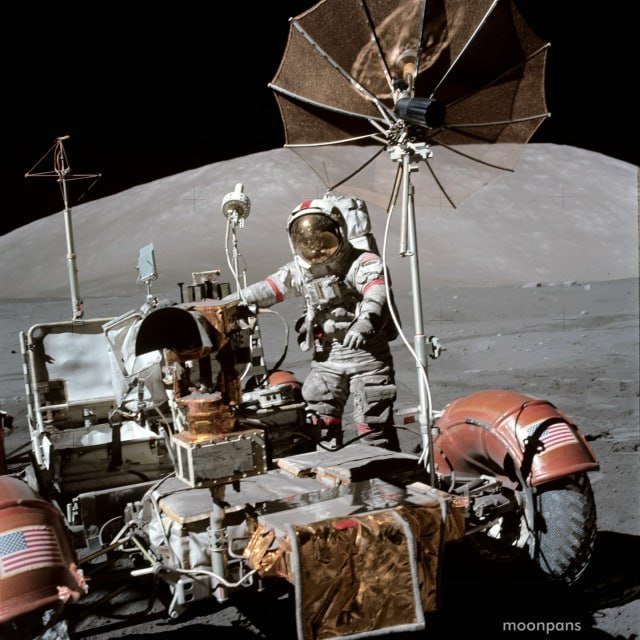
Gene Cernan standing next to the Lunar Rover, on Apollo 17.

Look at the dust on his suit.

Dusty plasma, which adds charged particles of dust to the mix of ions and electrons, is also common in space and planetary environments—from the rings of Saturn to Earth’s ionosphere.

The charged particles levitating above the surface of the moon, due to weak gravity, are an example of a dusty plasma. “That’s why when astronauts walk on the moon their suits get covered in dust,” Burton explains.

From

https://phys.org/news/2025-08-ai-reveals-unexpected-physics-dusty.html

Maybe a stronger plasma running down his suit might keep the dust off?
You could test it in a lab.
Exterior plasma’s on equipment and vehicles on the moon with stronger plasmas than the dust field’s plasma might keep dust off.
What could power it, small nuclear generator. Car engine size.

The difference on earth is dust clings to the ground and can be held there by moisture.

On the moon astronauts walk through floating dust a few mm above the ground.

Reply Quote

Date: 15/03/2026 04:59:53
From: Tau.Neutrino
ID: 2369757
Subject: re: Dusty plasma

Tau.Neutrino said:


Gene Cernan standing next to the Lunar Rover, on Apollo 17.

Look at the dust on his suit.

Dusty plasma, which adds charged particles of dust to the mix of ions and electrons, is also common in space and planetary environments—from the rings of Saturn to Earth’s ionosphere.

The charged particles levitating above the surface of the moon, due to weak gravity, are an example of a dusty plasma. “That’s why when astronauts walk on the moon their suits get covered in dust,” Burton explains.

From

https://phys.org/news/2025-08-ai-reveals-unexpected-physics-dusty.html

Maybe a stronger plasma running down his suit might keep the dust off?
You could test it in a lab.
Exterior plasma’s on equipment and vehicles on the moon with stronger plasmas than the dust field’s plasma might keep dust off.
What could power it, small nuclear generator. Car engine size.

The difference on earth is dust clings to the ground and can be held there by moisture.

On the moon astronauts walk through floating dust a few mm above the ground.

So on moons with different gravity and density, variations could occur in the height of the floating charged dust field.

Reply Quote

Date: 17/03/2026 17:57:19
From: Tau.Neutrino
ID: 2370727
Subject: re: Dusty plasma

So one way of looking at the moons charged dust field is that it is a fine shell of dust covering all of the moon.

Reply Quote

Date: 17/03/2026 18:04:21
From: Bubblecar
ID: 2370733
Subject: re: Dusty plasma

Tau.Neutrino said:


So one way of looking at the moons charged dust field is that it is a fine shell of dust covering all of the moon.

Yes, for the most part. But there’s a difference between the charges in the night and day regions.

Reply Quote

Date: 17/03/2026 19:27:39
From: Tau.Neutrino
ID: 2370762
Subject: re: Dusty plasma

Bubblecar said:


Tau.Neutrino said:

So one way of looking at the moons charged dust field is that it is a fine shell of dust covering all of the moon.

Yes, for the most part. But there’s a difference between the charges in the night and day regions.

Yes. So not a perfect shell.

Reply Quote

Date: 17/03/2026 19:30:27
From: Tau.Neutrino
ID: 2370764
Subject: re: Dusty plasma

Tau.Neutrino said:


Bubblecar said:

Tau.Neutrino said:

So one way of looking at the moons charged dust field is that it is a fine shell of dust covering all of the moon.

Yes, for the most part. But there’s a difference between the charges in the night and day regions.

Yes. So not a perfect shell.

Thank you for that correction Bubblecar.

Reply Quote