Date: 29/03/2026 18:28:34
From: Tau.Neutrino
ID: 2374585
Subject: Quantum entanglement speed is measured for the first time.

Quantum entanglement speed is measured for the first time – it’s too fast to comprehend

Unprecedented measurement reveals quantum speed beyond human understanding

Scientists Have Finally Measured How Fast Quantum Entanglement Happens

How fast is quantum entanglement? Scientists investigate it at the attosecond scale

From Google AI
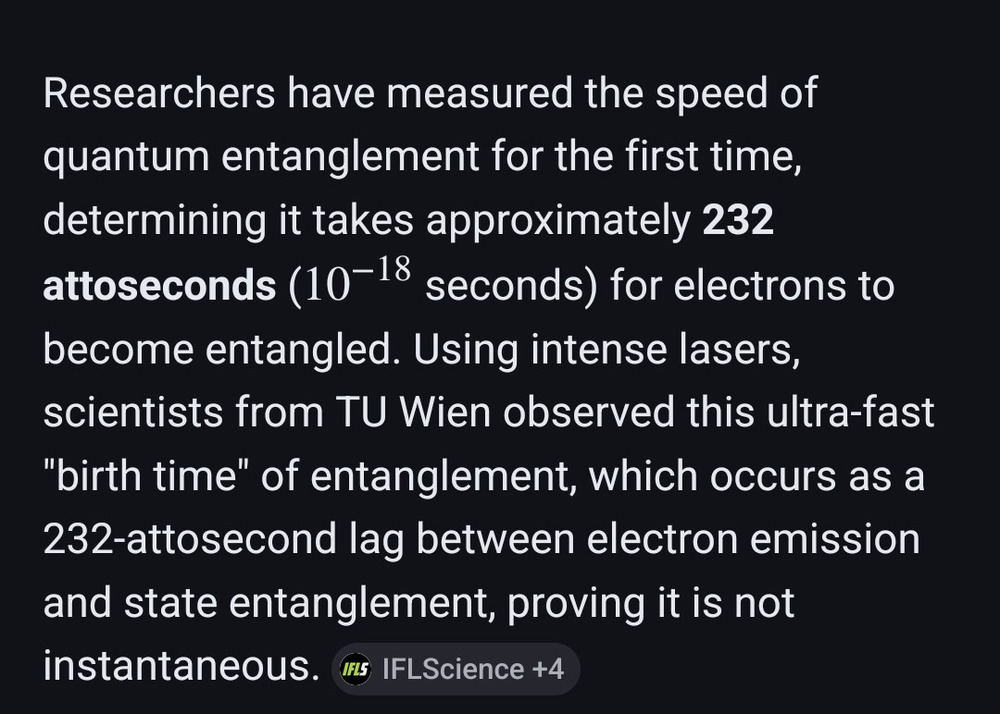
The Measurement: The study focused on an atom under a high-intensity laser pulse, causing one electron to escape while another remains in an excited state.

The Timescale: The process occurs over 232 attoseconds (billionths of a billionth of a second), making it one of the fastest physical processes ever recorded.

Significance: Conducted by researchers including Prof. Joachim Burgdörfer, this measurement provides a tangible time to a process previously thought to be immediate.

Future Impact: Understanding this speed could advance quantum computing, potentially leading to processors billions of times faster than current technologies.

This research, published in Physical Review Letters, indicates that the entanglement forms as the electron leaves the atom as a wave. This discovery opens up new avenues for controlling quantum systems at the attosecond scale.

More…

Reply Quote

Date: 30/03/2026 07:46:03
From: The Rev Dodgson
ID: 2374661
Subject: re: Quantum entanglement speed is measured for the first time.

Tau.Neutrino said:


Quantum entanglement speed is measured for the first time – it’s too fast to comprehend

Unprecedented measurement reveals quantum speed beyond human understanding

Scientists Have Finally Measured How Fast Quantum Entanglement Happens

How fast is quantum entanglement? Scientists investigate it at the attosecond scale

From Google AI

The Measurement: The study focused on an atom under a high-intensity laser pulse, causing one electron to escape while another remains in an excited state.

The Timescale: The process occurs over 232 attoseconds (billionths of a billionth of a second), making it one of the fastest physical processes ever recorded.

Significance: Conducted by researchers including Prof. Joachim Burgdörfer, this measurement provides a tangible time to a process previously thought to be immediate.

Future Impact: Understanding this speed could advance quantum computing, potentially leading to processors billions of times faster than current technologies.

This research, published in Physical Review Letters, indicates that the entanglement forms as the electron leaves the atom as a wave. This discovery opens up new avenues for controlling quantum systems at the attosecond scale.

More…

Interesting, but I’m sceptical about the “future impact” bit.

Also it raises the questions:
- How accurate is this measurement?
- Is it fixed or does it depend on the distance of separation of the entangled bodies?

Reply Quote

Date: 30/03/2026 12:49:28
From: Tau.Neutrino
ID: 2374732
Subject: re: Quantum entanglement speed is measured for the first time.

The Rev Dodgson said:


Tau.Neutrino said:

Quantum entanglement speed is measured for the first time – it’s too fast to comprehend

Interesting, but I’m sceptical about the “future impact” bit.

Also it raises the questions:
- How accurate is this measurement?
- Is it fixed or does it depend on the distance of separation of the entangled bodies?

We wait for validation.

Reply Quote

Date: 1/04/2026 10:01:15
From: Witty Rejoinder
ID: 2375263
Subject: re: Quantum entanglement speed is measured for the first time.

More quantum news:

Pairs of atoms observed existing in two places at once for the first time

By Sadie Harley, and Robert Egan

Quantum physicists at ANU have observed atoms entangled in motion. Credit: Australian National University

Quantum physicists at ANU have observed atoms entangled in motion. “It’s really weird for us to think that this is how the universe works,” says Dr. Sean Hodgman from the ANU Research School of Physics. “You can read about it in a textbook, but it’s really weird to think that a particle can be in two places at once.”

https://phys.org/news/2026-03-pairs-atoms.html#google_vignette

Reply Quote