Date: 30/03/2026 14:57:37
From: Tau.Neutrino
ID: 2374773
Subject: Solar cells just did the “impossible” with this 130% breakthrough

Solar cells just did the “impossible” with this 130% breakthrough

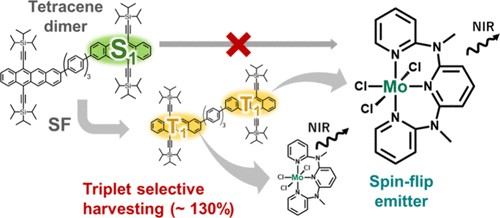
A new “spin-flip” breakthrough could let solar panels generate more energy than they receive.

A new solar breakthrough may overcome a long-standing efficiency barrier. Researchers used a “spin-flip” metal complex to capture and multiply energy from sunlight through singlet fission. The result reached about 130% efficiency, meaning more energy carriers were produced than photons absorbed. This could lead to much more powerful solar panels in the future.

More…

Take that fossil fuels.
Reply Quote

Date: 30/03/2026 14:58:00
From: SCIENCE
ID: 2374775
Subject: re: Solar cells just did the “impossible” with this 130% breakthrough

Reply Quote

Date: 30/03/2026 16:27:50
From: dv
ID: 2374809
Subject: re: Solar cells just did the “impossible” with this 130% breakthrough

SCIENCE said:


Quite.

May we see a journal article?

Reply Quote

Date: 31/03/2026 07:53:40
From: The Rev Dodgson
ID: 2374968
Subject: re: Solar cells just did the “impossible” with this 130% breakthrough

dv said:


SCIENCE said:


Quite.

May we see a journal article?

From the link:

“Under normal conditions, each photon produces only one spin-singlet exciton after excitation. With SF, this single exciton can split into two lower-energy spin-triplet excitons, which could effectively double the available energy.”

How producing twice as many excitons with half the energy each doubles the available energy, I don’t quite see.

Reply Quote

Date: 31/03/2026 08:35:37
From: JudgeMental
ID: 2374975
Subject: re: Solar cells just did the “impossible” with this 130% breakthrough

dv said:


SCIENCE said:


Quite.

May we see a journal article?

https://pubs.acs.org/doi/10.1021/jacs.5c20500

Link

Reply Quote

Date: 31/03/2026 08:41:25
From: SCIENCE
ID: 2374976
Subject: re: Solar cells just did the “impossible” with this 130% breakthrough

JudgeMental said:

dv said:

SCIENCE said:


Quite.

May we see a journal article?

https://pubs.acs.org/doi/10.1021/jacs.5c20500

Link

thanks

Reply Quote

Date: 31/03/2026 09:24:54
From: The Rev Dodgson
ID: 2374977
Subject: re: Solar cells just did the “impossible” with this 130% breakthrough

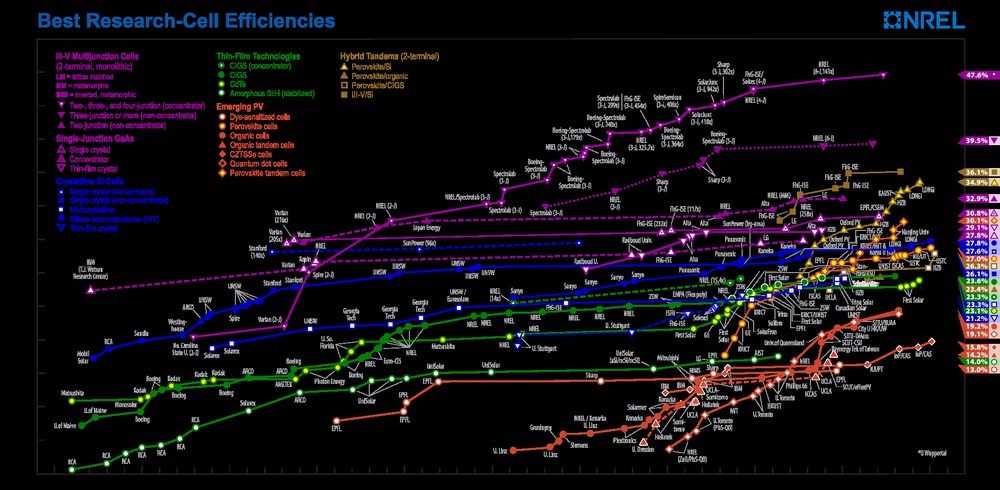
For efficiency of current solar cells TATE tells me:

but the bingbot said 27%.

Anyway, looks like this latest effort would at best increase efficiency by 30% (so 27% to 35% for instance), so still pretty good, but hardly an “impossible” breakthrough.

See https://en.wikipedia.org/wiki/Solar-cell_efficiency# for a more readable view of the graph.

Reply Quote

Date: 31/03/2026 12:13:34
From: JudgeMental
ID: 2375006
Subject: re: Solar cells just did the “impossible” with this 130% breakthrough

The Rev Dodgson said:


dv said:

SCIENCE said:


Quite.

May we see a journal article?

From the link:

“Under normal conditions, each photon produces only one spin-singlet exciton after excitation. With SF, this single exciton can split into two lower-energy spin-triplet excitons, which could effectively double the available energy.”

How producing twice as many excitons with half the energy each doubles the available energy, I don’t quite see.

does “lower energy” equate to half the energy?

Reply Quote

Date: 31/03/2026 18:55:33
From: JudgeMental
ID: 2375146
Subject: re: Solar cells just did the “impossible” with this 130% breakthrough

Bump for DV.

JudgeMental said:


dv said:

SCIENCE said:


Quite.

May we see a journal article?

https://pubs.acs.org/doi/10.1021/jacs.5c20500

Link

Reply Quote