Date: 13/04/2026 11:53:30
From: dv
ID: 2379969
Subject: Indian politics

https://www.bbc.com/news/articles/cy51qg00dezo

Political turmoil in Indian border state as nine million lose voting rights
Muhammad Daud Ali, a former Indian army technician, recently discovered that he was no longer a voter in his home state of West Bengal.

His name – and those of his three children – had been struck off the electoral rolls despite valid documents, including his passport and service records. Only his wife remained on the list.

Ali, 65, and his children are among nine million voters – about 12% of West Bengal’s 76 million electorate – who have been removed from the 2026 rolls as part of the Special Intensive Revision (SIR) exercise. Voting to elect a new state government will take place later this month in this eastern Indian state.

Of these nine million, more than six million names were struck off as absentee or deceased voters, while the fate of another 2.7 million – including families like Ali’s – remains undecided and will be determined by tribunals.

Thirteen states and federally-administered territories have undergone the SIR process so far, but West Bengal is the only one where it was followed by an additional layer of special adjudication.

These voters had submitted enumeration forms linking them to the 2002 electoral roll – widely regarded as the last “clean” list.

Yet the poll panel used a new, AI-driven process to flag what it called “logical discrepancies” in their records, treating them as doubtful voters.

Despite subsequent re-verification, people like Ali were excluded.

Reply Quote

Date: 13/04/2026 12:20:16
From: The Rev Dodgson
ID: 2379981
Subject: re: Indian politics

dv said:


https://www.bbc.com/news/articles/cy51qg00dezo

Political turmoil in Indian border state as nine million lose voting rights
Muhammad Daud Ali, a former Indian army technician, recently discovered that he was no longer a voter in his home state of West Bengal.

His name – and those of his three children – had been struck off the electoral rolls despite valid documents, including his passport and service records. Only his wife remained on the list.

Ali, 65, and his children are among nine million voters – about 12% of West Bengal’s 76 million electorate – who have been removed from the 2026 rolls as part of the Special Intensive Revision (SIR) exercise. Voting to elect a new state government will take place later this month in this eastern Indian state.

Of these nine million, more than six million names were struck off as absentee or deceased voters, while the fate of another 2.7 million – including families like Ali’s – remains undecided and will be determined by tribunals.

Thirteen states and federally-administered territories have undergone the SIR process so far, but West Bengal is the only one where it was followed by an additional layer of special adjudication.

These voters had submitted enumeration forms linking them to the 2002 electoral roll – widely regarded as the last “clean” list.

Yet the poll panel used a new, AI-driven process to flag what it called “logical discrepancies” in their records, treating them as doubtful voters.

Despite subsequent re-verification, people like Ali were excluded.

Thank goodness we live in a country where no government body would even consider using without checking computer controlled decisions that affect the rights of individuals!

Reply Quote

Date: 13/04/2026 12:22:20
From: dv
ID: 2379982
Subject: re: Indian politics

The Rev Dodgson said:


dv said:

https://www.bbc.com/news/articles/cy51qg00dezo

Political turmoil in Indian border state as nine million lose voting rights
Muhammad Daud Ali, a former Indian army technician, recently discovered that he was no longer a voter in his home state of West Bengal.

His name – and those of his three children – had been struck off the electoral rolls despite valid documents, including his passport and service records. Only his wife remained on the list.

Ali, 65, and his children are among nine million voters – about 12% of West Bengal’s 76 million electorate – who have been removed from the 2026 rolls as part of the Special Intensive Revision (SIR) exercise. Voting to elect a new state government will take place later this month in this eastern Indian state.

Of these nine million, more than six million names were struck off as absentee or deceased voters, while the fate of another 2.7 million – including families like Ali’s – remains undecided and will be determined by tribunals.

Thirteen states and federally-administered territories have undergone the SIR process so far, but West Bengal is the only one where it was followed by an additional layer of special adjudication.

These voters had submitted enumeration forms linking them to the 2002 electoral roll – widely regarded as the last “clean” list.

Yet the poll panel used a new, AI-driven process to flag what it called “logical discrepancies” in their records, treating them as doubtful voters.

Despite subsequent re-verification, people like Ali were excluded.

Thank goodness we live in a country where no government body would even consider using without checking computer controlled decisions that affect the rights of individuals!

Reply Quote

Date: 13/04/2026 12:24:38
From: Cymek
ID: 2379984
Subject: re: Indian politics

dv said:


The Rev Dodgson said:

dv said:

https://www.bbc.com/news/articles/cy51qg00dezo

Political turmoil in Indian border state as nine million lose voting rights
Muhammad Daud Ali, a former Indian army technician, recently discovered that he was no longer a voter in his home state of West Bengal.

His name – and those of his three children – had been struck off the electoral rolls despite valid documents, including his passport and service records. Only his wife remained on the list.

Ali, 65, and his children are among nine million voters – about 12% of West Bengal’s 76 million electorate – who have been removed from the 2026 rolls as part of the Special Intensive Revision (SIR) exercise. Voting to elect a new state government will take place later this month in this eastern Indian state.

Of these nine million, more than six million names were struck off as absentee or deceased voters, while the fate of another 2.7 million – including families like Ali’s – remains undecided and will be determined by tribunals.

Thirteen states and federally-administered territories have undergone the SIR process so far, but West Bengal is the only one where it was followed by an additional layer of special adjudication.

These voters had submitted enumeration forms linking them to the 2002 electoral roll – widely regarded as the last “clean” list.

Yet the poll panel used a new, AI-driven process to flag what it called “logical discrepancies” in their records, treating them as doubtful voters.

Despite subsequent re-verification, people like Ali were excluded.

Thank goodness we live in a country where no government body would even consider using without checking computer controlled decisions that affect the rights of individuals!


Robocop “Dead or alive, you’re coming with me”

Reply Quote

Date: 13/04/2026 12:32:51
From: Michael V
ID: 2379989
Subject: re: Indian politics

dv said:


https://www.bbc.com/news/articles/cy51qg00dezo

Political turmoil in Indian border state as nine million lose voting rights
Muhammad Daud Ali, a former Indian army technician, recently discovered that he was no longer a voter in his home state of West Bengal.

His name – and those of his three children – had been struck off the electoral rolls despite valid documents, including his passport and service records. Only his wife remained on the list.

Ali, 65, and his children are among nine million voters – about 12% of West Bengal’s 76 million electorate – who have been removed from the 2026 rolls as part of the Special Intensive Revision (SIR) exercise. Voting to elect a new state government will take place later this month in this eastern Indian state.

Of these nine million, more than six million names were struck off as absentee or deceased voters, while the fate of another 2.7 million – including families like Ali’s – remains undecided and will be determined by tribunals.

Thirteen states and federally-administered territories have undergone the SIR process so far, but West Bengal is the only one where it was followed by an additional layer of special adjudication.

These voters had submitted enumeration forms linking them to the 2002 electoral roll – widely regarded as the last “clean” list.

Yet the poll panel used a new, AI-driven process to flag what it called “logical discrepancies” in their records, treating them as doubtful voters.

Despite subsequent re-verification, people like Ali were excluded.

Hmmmmm.

Reply Quote

Date: 13/04/2026 12:34:29
From: Michael V
ID: 2379992
Subject: re: Indian politics

The Rev Dodgson said:


dv said:

https://www.bbc.com/news/articles/cy51qg00dezo

Political turmoil in Indian border state as nine million lose voting rights
Muhammad Daud Ali, a former Indian army technician, recently discovered that he was no longer a voter in his home state of West Bengal.

His name – and those of his three children – had been struck off the electoral rolls despite valid documents, including his passport and service records. Only his wife remained on the list.

Ali, 65, and his children are among nine million voters – about 12% of West Bengal’s 76 million electorate – who have been removed from the 2026 rolls as part of the Special Intensive Revision (SIR) exercise. Voting to elect a new state government will take place later this month in this eastern Indian state.

Of these nine million, more than six million names were struck off as absentee or deceased voters, while the fate of another 2.7 million – including families like Ali’s – remains undecided and will be determined by tribunals.

Thirteen states and federally-administered territories have undergone the SIR process so far, but West Bengal is the only one where it was followed by an additional layer of special adjudication.

These voters had submitted enumeration forms linking them to the 2002 electoral roll – widely regarded as the last “clean” list.

Yet the poll panel used a new, AI-driven process to flag what it called “logical discrepancies” in their records, treating them as doubtful voters.

Despite subsequent re-verification, people like Ali were excluded.

Thank goodness we live in a country where no government body would even consider using without checking computer controlled decisions that affect the rights of individuals!

Now remove that tongue from your cheek, please.

Reply Quote

Date: 13/04/2026 13:11:04
From: ms spock
ID: 2380012
Subject: re: Indian politics

Michael V said:


The Rev Dodgson said:

dv said:

https://www.bbc.com/news/articles/cy51qg00dezo

Political turmoil in Indian border state as nine million lose voting rights
Muhammad Daud Ali, a former Indian army technician, recently discovered that he was no longer a voter in his home state of West Bengal.

His name – and those of his three children – had been struck off the electoral rolls despite valid documents, including his passport and service records. Only his wife remained on the list.

Ali, 65, and his children are among nine million voters – about 12% of West Bengal’s 76 million electorate – who have been removed from the 2026 rolls as part of the Special Intensive Revision (SIR) exercise. Voting to elect a new state government will take place later this month in this eastern Indian state.

Of these nine million, more than six million names were struck off as absentee or deceased voters, while the fate of another 2.7 million – including families like Ali’s – remains undecided and will be determined by tribunals.

Thirteen states and federally-administered territories have undergone the SIR process so far, but West Bengal is the only one where it was followed by an additional layer of special adjudication.

These voters had submitted enumeration forms linking them to the 2002 electoral roll – widely regarded as the last “clean” list.

Yet the poll panel used a new, AI-driven process to flag what it called “logical discrepancies” in their records, treating them as doubtful voters.

Despite subsequent re-verification, people like Ali were excluded.

Thank goodness we live in a country where no government body would even consider using without checking computer controlled decisions that affect the rights of individuals!

Now remove that tongue from your cheek, please.

What Palmer did with his micotargeting of poor people he would give everyone $150 extra power week. It was a total lie. He couldn’t do it. But folks are desperate for help. They are easy to manipulate. Folks living in poverty are easy to manipulate. 65% of Queenslanders are reading and writing at a 5th Grade level. So they don’t have the critical literacy skills to decode the MSM.

Reply Quote

Date: 13/04/2026 15:01:37
From: SCIENCE
ID: 2380050
Subject: re: Indian politics

ms spock said:


Michael V said:

The Rev Dodgson said:

Thank goodness we live in a country where no government body would even consider using without checking computer controlled decisions that affect the rights of individuals!

Now remove that tongue from your cheek, please.

What Palmer did with his micotargeting of poor people he would give everyone $150 extra power week. It was a total lie. He couldn’t do it. But folks are desperate for help. They are easy to manipulate. Folks living in poverty are easy to manipulate. 65% of Queenslanders are reading and writing at a 5th Grade level. So they don’t have the critical literacy skills to decode the MSM.

democracy at work

Reply Quote

Date: 13/04/2026 15:14:43
From: Divine Angel
ID: 2380063
Subject: re: Indian politics

ms spock said:

What Palmer did with his micotargeting of poor people he would give everyone $150 extra power week. It was a total lie. He couldn’t do it. But folks are desperate for help. They are easy to manipulate. Folks living in poverty are easy to manipulate. 65% of Queenslanders are reading and writing at a 5th Grade level. So they don’t have the critical literacy skills to decode the MSM.

Education is the enemy of right wingers. Where are you getting your stats from? What I found was even lower, a mere 56% according to an ABS survey from 2011/2012.

https://www.abs.gov.au/statistics/people/education/programme-international-assessment-adult-competencies-australia/latest-release#:~:text=In%20the%20ACT%2C%2067%25%20were,followed%20by%20Queensland%20with%2046%25.

Reply Quote

Date: 13/04/2026 15:23:50
From: Cymek
ID: 2380072
Subject: re: Indian politics

Divine Angel said:

ms spock said:

What Palmer did with his micotargeting of poor people he would give everyone $150 extra power week. It was a total lie. He couldn’t do it. But folks are desperate for help. They are easy to manipulate. Folks living in poverty are easy to manipulate. 65% of Queenslanders are reading and writing at a 5th Grade level. So they don’t have the critical literacy skills to decode the MSM.

Education is the enemy of right wingers. Where are you getting your stats from? What I found was even lower, a mere 56% according to an ABS survey from 2011/2012.

https://www.abs.gov.au/statistics/people/education/programme-international-assessment-adult-competencies-australia/latest-release#:~:text=In%20the%20ACT%2C%2067%25%20were,followed%20by%20Queensland%20with%2046%25.

I’d be interested in the statistics for critical thinking amongst all adults.
Most people accept that the way our world works is acceptable and ensures the long term survival of our species.
Things like banks and business having far too much power and they way everything requires money is OK.
People in general expect far too much from our planet and it will collapse
Might is right still rules our world and the powerful can bully and do what they like
I don’t think human civilisation will last the century

Reply Quote

Date: 13/04/2026 15:37:21
From: Divine Angel
ID: 2380074
Subject: re: Indian politics

To borrow Capt spalding’s pedantry hat, literacy and critical thinking are two different things. You’ve got top scientists with PhDs who believe bullshit things like creationist geology ie the world is 4000-6000 years old. There was a post last week about someone with a PhD in English (IIRC) who couldn’t work out why the far side of the moon was illuminated. These people can read and write well enough to gather information for a PhD, but lack critical thinking skills.

Add in promises of a better future by someone whose policies are against the grain because traditional governments aren’t solving problems, and you’ve got a population of RWNJs ripe for the picking. Clive Palmer lacks the charisma Trump apparently possesses. Clive’s reregistered the United Australia Party and promises squillions of dollars spent on advertising coming up to the next election.

https://www.afr.com/politics/federal/get-ready-for-the-biggest-clive-palmer-advertising-campaign-ever-20260311-p5o9ix

Reply Quote

Date: 13/04/2026 15:42:58
From: Arts
ID: 2380078
Subject: re: Indian politics

I don’t know why having a PhD qualifies anyone for anything outside the specialist knowledge of their PhD. Or why possessing one makes everyone think you are that much smarter in general.

All it shows is that you have enough stamina and stubbornness to dedicate a period of time to learn how to write enough words in just the right way to make examiners happy.

and maybe it gets you a tenured role at a tertiary institution. shrug…

Reply Quote

Date: 13/04/2026 15:48:26
From: Divine Angel
ID: 2380081
Subject: re: Indian politics

Arts said:


I don’t know why having a PhD qualifies anyone for anything outside the specialist knowledge of their PhD. Or why possessing one makes everyone think you are that much smarter in general.

All it shows is that you have enough stamina and stubbornness to dedicate a period of time to learn how to write enough words in just the right way to make examiners happy.

and maybe it gets you a tenured role at a tertiary institution. shrug…

There are plenty of buy-your-phd “colleges” too, which sullies the qualifications somewhat. It’s almost like calling yourself an Amazon bestselling author.

Reply Quote

Date: 13/04/2026 15:49:36
From: Ian
ID: 2380084
Subject: re: Indian politics

Arts said:


I don’t know why having a PhD qualifies anyone for anything outside the specialist knowledge of their PhD. Or why possessing one makes everyone think you are that much smarter in general.

All it shows is that you have enough stamina and stubbornness to dedicate a period of time to learn how to write enough words in just the right way to make examiners happy.

and maybe it gets you a tenured role at a tertiary institution. shrug…

But why must you climb the greasy pole?

Because it is there!

Reply Quote

Date: 13/04/2026 15:50:32
From: Arts
ID: 2380085
Subject: re: Indian politics

Divine Angel said:


Arts said:

I don’t know why having a PhD qualifies anyone for anything outside the specialist knowledge of their PhD. Or why possessing one makes everyone think you are that much smarter in general.

All it shows is that you have enough stamina and stubbornness to dedicate a period of time to learn how to write enough words in just the right way to make examiners happy.

and maybe it gets you a tenured role at a tertiary institution. shrug…

There are plenty of buy-your-phd “colleges” too, which sullies the qualifications somewhat. It’s almost like calling yourself an Amazon bestselling author.

and don’t get me started on the ‘pay to have your paper published’ journals… everything is sullied and diluted these days..

Reply Quote

Date: 13/04/2026 15:52:34
From: Cymek
ID: 2380088
Subject: re: Indian politics

Arts said:


Divine Angel said:

Arts said:

I don’t know why having a PhD qualifies anyone for anything outside the specialist knowledge of their PhD. Or why possessing one makes everyone think you are that much smarter in general.

All it shows is that you have enough stamina and stubbornness to dedicate a period of time to learn how to write enough words in just the right way to make examiners happy.

and maybe it gets you a tenured role at a tertiary institution. shrug…

There are plenty of buy-your-phd “colleges” too, which sullies the qualifications somewhat. It’s almost like calling yourself an Amazon bestselling author.

and don’t get me started on the ‘pay to have your paper published’ journals… everything is sullied and diluted these days..

And you get ads and professional looking talks dressed up as scientific lectures

Reply Quote

Date: 13/04/2026 15:56:15
From: Michael V
ID: 2380092
Subject: re: Indian politics

Arts said:


I don’t know why having a PhD qualifies anyone for anything outside the specialist knowledge of their PhD. Or why possessing one makes everyone think you are that much smarter in general.

All it shows is that you have enough stamina and stubbornness to dedicate a period of time to learn how to write enough words in just the right way to make examiners happy.

and maybe it gets you a tenured role at a tertiary institution. shrug…

Thumbs up!

Reply Quote

Date: 13/04/2026 15:58:45
From: Cymek
ID: 2380093
Subject: re: Indian politics

Michael V said:


Arts said:

I don’t know why having a PhD qualifies anyone for anything outside the specialist knowledge of their PhD. Or why possessing one makes everyone think you are that much smarter in general.

All it shows is that you have enough stamina and stubbornness to dedicate a period of time to learn how to write enough words in just the right way to make examiners happy.

and maybe it gets you a tenured role at a tertiary institution. shrug…

Thumbs up!

Over specialisation breeds in weakness

Reply Quote

Date: 6/05/2026 22:02:08
From: Witty Rejoinder
ID: 2388311
Subject: re: Indian politics

Narendra Modi has extended his grip on India

India’s ruling party scores a historic victory in West Bengal—but should beware voters’ unhappiness with incumbents

Six weeks ago Narendra Modi stood on a temple-like stage in Kolkata, before a sea of saffron-clad voters. The event marked the beginning of his party’s campaign to win the populous and important state of West Bengal, one of five states that voted over the past few weeks in elections whose results were announced on May 4th.

India’s prime minister, a Hindu-nationalist strongman, was in a typically pugilistic mood. He accused party members from Mamata Banerjee’s Trinamool Congress (TMC) of taking “cut money” and conspiring in “infiltration” from neighbouring Bangladesh. “Every single one will be made to pay,” he told the cheering crowds.Bengalis will now get to see what he meant. Mr Modi’s Bharatiya Janata Party (BJP) has won a landslide in the eastern state, in one of its most important victories since it came to power nationally 12 years ago.

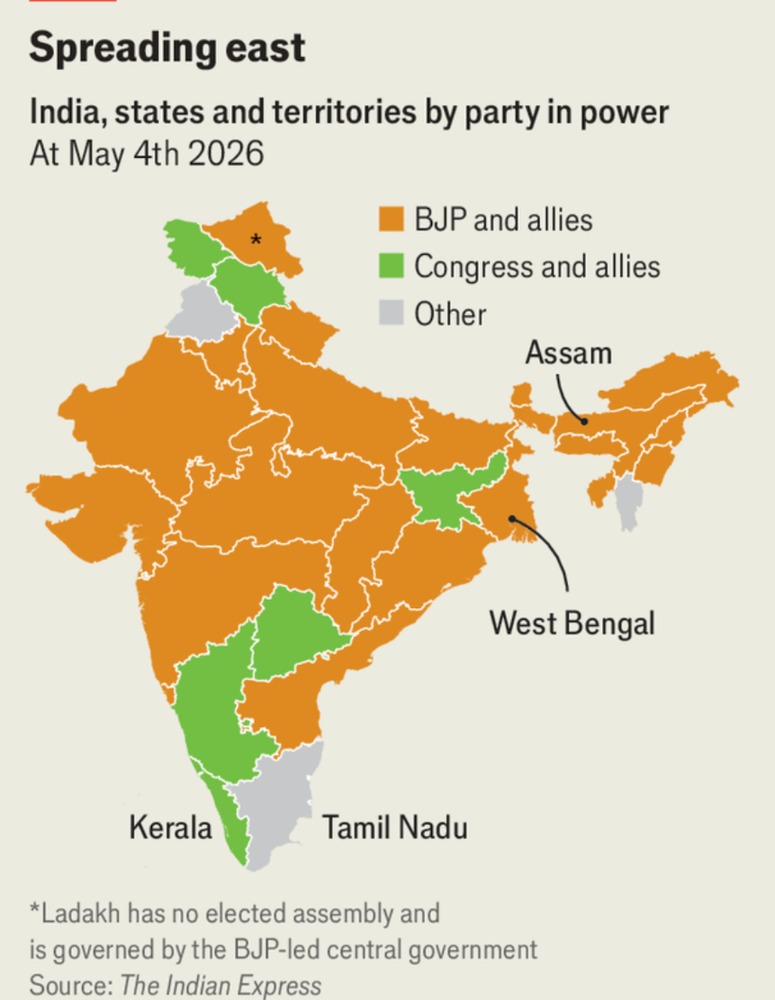
Even as incumbents elsewhere struggled, the bjp also won a third term, with 37.8% of the vote, in neighbouring Assam (see map). Nor was Ms Banerjee the only once-mighty regional-party leader booted out. In the southern state of Tamil Nadu, MK Stalin was ejected. In neighbouring Kerala, the incumbent Communists were also ejected by voters.Controversy has swirled over the way these elections were run.

Mr Modi is hardly the first Indian leader to use his power over institutions to tilt elections in his favour. But he is perhaps the most ruthless in doing so since Indira Gandhi cancelled elections altogether in the mid-1970s. His latest tool, wielded most aggressively in West Bengal, is the revision of electoral rolls that, say critics, left millions unable to vote. Yet as concerning as such methods are, they cannot explain Mr Modi’s dominance, which depends above all on his ability to unify Hindu voters.

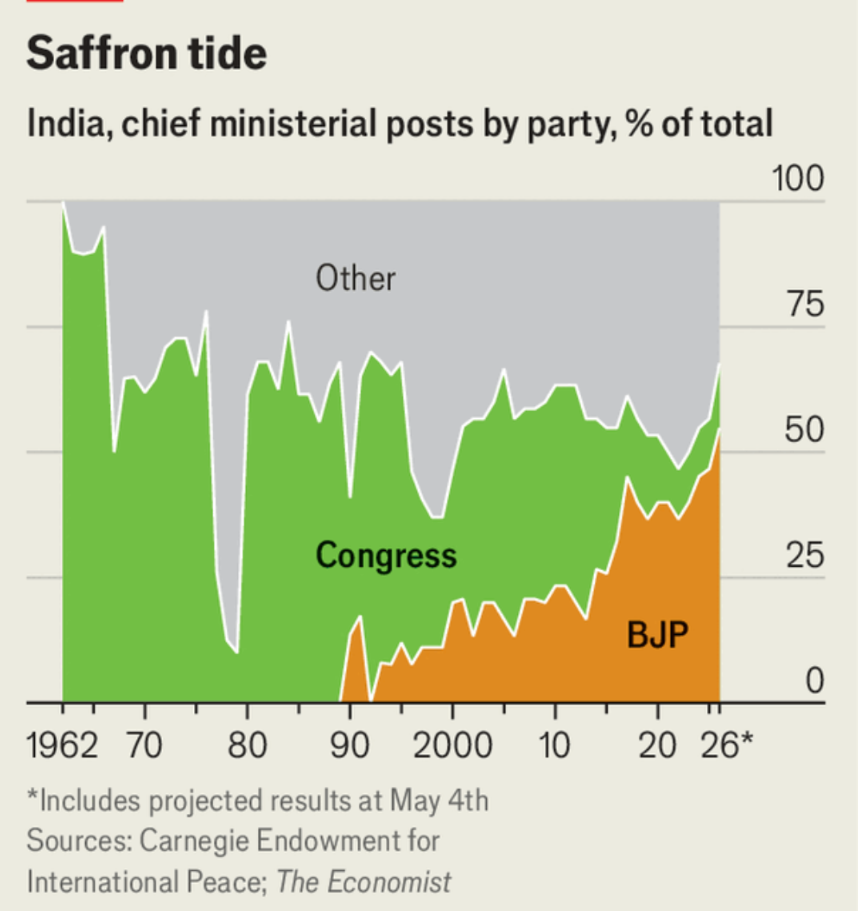
His coalition now runs 22 of India’s 31 states and territories.The BJP had already begun to march eastwards from its Hindi-speaking heartlands, winning Tripura in 2018 and Odisha in 2024. But West Bengal was the prize it had long wanted. The state has a rich history, notably as a hotbed for nationalist politics. Kolkata, its capital, is one of the great Indian cities. The state’s main attraction, however, is its size: with a population of 100m and some 42 seats in the Lok Sabha, the national parliament, it carries great electoral clout. Assuming the bjp suffers some attrition in its heartlands in the coming years, says Milan Vaishnav of the Carnegie Endowment, a think-tank, a foothold in West Bengal provides the party with some insurance.

The scale of its victory—it is on track to win almost 46% of the vote and more than two thirds of seats in the state—indicates how many Bengalis were fed up after 15 years of TMC rule. Under Ms Banerjee, industries moved out and the state’s economy fell behind that of much of the rest of the country. Voters had come to see her party as authoritarian and corrupt; the bjp focused on a teacher-recruitment scandal, while vowing to bring investment and to match Ms Banerjee’s promises of freebies. It did particularly well among urban, middle-class voters. And it appears to have won as much as 70% of the Hindu vote, which would make the electorate in West Bengal one of the most religiously polarised of any state in India

Even if the way the election was conducted did not sway the result, it remains concerning. More than 9m names, some 11% of the electorate, were removed from the electoral roll—disproportionately these were Muslims, women and Dalits (a marginalised group that was long seen as outside of the Hindu caste system) that make up the tmc’s base. The bjp argues that such an apparent bias was inevitable because Ms Banerjee had fiddled the lists. Yet the rushed process, overseen by an electoral regulator that critics say is increasingly under Mr Modi’s thumb, hardly produced confidence that all was fair. Of 3.4m voters who appealed against their exclusion, less than 2,000 appear to have been reinstated in time to vote.

The BJP-run central government also bussed in almost a quarter of a million armed police to oversee voting. There were reports of election officials intimidating tmc candidates and voters.Elsewhere in the country things were less heated, but incumbents similarly struggled with voters unhappy about rising prices and poor governance. In Kerala the ruling communist government was replaced by a Congress Party-led coalition. That was no great surprise, given that Keralites have tended to swap between two main parties at almost every election, though it does mean that India has no communist state-level government for the first time in almost 50 years. (The BJP which has until now struggled to make inroads in the state, managed to draw a decent 11.4% of the vote.)

More of a shock were the events in Tamil Nadu, with the loss of Mr Stalin to Vijay, a Tamil cinema megastar turned politician. As votes were still being counted the political novice, known by only one name, was on track to win almost half of the seats, leaving him just short of a majority.Mr Stalin had long been a leading figure in the Congress-led national opposition alliance and a chief proponent of Tamil-identity politics, in opposition to Mr Modi. He helped to make his state an industrial powerhouse, attracting the likes of Apple and Ford with pro-business reforms. Yet like Ms Banerjee, he also came to be seen by many voters as corrupt, though both of them deny the charges. Vijay’s victory was driven by young urban voters with little love for the old guard, says Rahul Verma of Shiv Nadar University in Chennai.

He is by no means the first Tamil filmstar to make the crossover, but his upstart party was only created in 2024. Analysts have been left scratching their heads about how he will govern one of India’s most dynamic states.On the face of it the elections leave Mr Modi’s ruling coalition more dominant than ever, and his opponents in disarray.

Since suffering a partial setback in the 2024 national elections (he emerged triumphant, but for the first time reliant on coalition allies), he has now won a string of state-election victories. He may well conclude that there is more mileage yet in his brand of strident, communal politics—and in pushing the limits of his powers. Yet the results contained another message: that many Indian voters are unhappy with incumbents. As a result, they may prove to be volatile. And that is before they have fully felt the pain of rising prices as a result of the energy crisis triggered by war in the Gulf. (Once voting concluded, the central government said that cooking gas prices would be lifted). If Mr Modi’s opponents can get their act together, they have just been given an opening. ■

https://www.economist.com/asia/2026/05/04/narendra-modi-has-extended-his-grip-on-india

Reply Quote

Date: 6/05/2026 22:04:23
From: Witty Rejoinder
ID: 2388312
Subject: re: Indian politics

Reply Quote

Date: 6/05/2026 22:24:43
From: Witty Rejoinder
ID: 2388313
Subject: re: Indian politics

The world’s biggest democracy is about to become a one-party state

Alex Travelli, Hari Kumar and Pragati K.B.
May 6, 2026 — 7:30pm

When Narendra Modi first campaigned to lead the country, more than a decade ago, he raised the slogan of a “Congress-free India”, plotting the elimination of his only national opposition.

Congress, the founding party of independent India, has since withered. It has hardly recovered from 2014, when its seats in the national parliament slumped from 206 to just 44 in one election. It lost its grip on state legislatures, too, and now controls only four states to the 21 held by Modi’s governing alliance.

Its decline left regional parties across India as the most important counterweight to Modi’s Bharatiya Janata Party (BJP) and its Hindu nationalist agenda. Their leaders ranged against him in the north, south, east and west. Two of the most charismatic and formidable were Mamata Banerjee, the chief minister of West Bengal since 2011, and M.K. Stalin, chief minister of Tamil Nadu since 2021.

This week, with election defeats for both Banerjee and Stalin, Modi finds himself at the helm of an India in which his opponents hold virtually no political power. Congress has held a greater number of seats in parliament, at points. But more than at any time since democracy was suspended in the 1970s Emergency, Modi has made India look like a one-leader state.

“The idea of India” formulated by Jawaharlal Nehru, its first prime minister after independence, was the ideal of a political pluralism to match the vast country’s human diversity of religion, language and culture. Nowadays, as India’s surviving smaller parties dwindle, that dream looks like a quaint loser to the BJP’s 100-year-old vision of a Hindu nation.

_‘Modi was like a wounded tiger in 2024. Now he is out to serve his revenge cold.’
Sugata Srinivasaraju, political commentator_

The BJP has always prided itself on its members’ ideological commitment. Uniting Hindus, who belong to many different caste communities but form an evenly distributed 80 per cent of the population across the country, has been the party’s strategy. In recent decades, it has picked up organisational discipline like no other national party, as well as a business-friendly reputation that made it the darling of the donor class.

Supporters say the recent string of state-level victories is the result of hard work put in by the BJP after its setback in the last national elections. When the votes were counted in June 2024, its alliance had won only 42.5 per cent of the vote, as the opposition hammered Modi over chronic unemployment and inequality. The BJP managed to stay in control, but only after Modi roped two regional parties into a coalition government.

“Modi was like a wounded tiger in 2024. Now he is out to serve his revenge cold,” said Sugata Srinivasaraju, a political commentator who has written critically about Congress and the BJP.

Modi’s march through the states brought surprise after surprise, each to the BJP’s advantage. The party won in Haryana in October 2024, though Congress had been heavily favoured. Then it went into Maharashtra, home to Mumbai, the country’s commercial capital, run by two powerful regional parties, and split each of them in two to collect the victory.

The losing parties cried foul and complained about the methods. Congress pointed out irregularities, such as a photo of a Brazilian hairdresser appearing 22 times in one state’s voter roll. The BJP dismissed the claim, and the Election Commission defended the fairness of the polls.

Last year, the BJP took hold of Delhi, the capital, for the first time in 27 years, tearing down Arvind Kejriwal, among the few politicians to have challenged Modi’s rise since 2014. Kejriwal and his lieutenants were constantly raided and arrested by federal police on charges that never resulted in conviction – evidence, they argued, that Modi was wielding the tools of government as a weapon.

On the way to winning the state of Bihar last year, the Election Commission of India, which is supposed to be independent but has a leader chosen by Modi, started an intensive housekeeping exercise to remove names that didn’t belong on voter rolls. The hectic process prevented many people from voting. Members of the state’s Muslim minority said they were targeted unfairly with deletion. In the end, as in West Bengal this week, the vote in Bihar was not even close.

The revision of the West Bengal voter lists, which struck off 9 million names and left at least 2.7 million actual people unable to cast ballots, again played a role in helping the BJP pit Muslims against Hindus. But the scale of the party’s sweep against Banerjee was so great that the thwarted voters alone cannot explain away the victory. Many Bengalis simply wanted to vote out Banerjee’s party.

Shibu Singha, 47, who sells vegetable juice in front of a British colonial monument in the centre of Kolkata, said he had voted for Banerjee in previous elections. But now, he said, Banerjee was “protecting Muslims at the cost of Hindus”, and he was worried about the economy. “No industry is coming to Bengal; youths are not getting jobs,” he said.

Down south in Tamil Nadu, which eschews the BJP and other national parties, the economy is moving at a faster pace. But Stalin, the head of the Dravida Munnetra Kazhagam (DMK) party, lost badly – and so did his main rival, from a similar party. Both were trounced by a newcomer, a media-savvy actor who goes by the name Vijay. Votes for Vijay, like votes against Banerjee, were votes for change.

Modi has been in power for 12 years and, despite persistent growth, India is facing difficult economic conditions, like high fuel prices and inflation, which matter most to most voters, along with unemployment. A study from Azim Premji University, focusing on the quarter-billion young Indians in the workforce, showed that for every 5 million who earn degrees each year, only 2.8 million find jobs.

And yet, voter dissatisfaction about the economy has not turned them against Modi – at least not enough to defeat him in the polls.

“I must give credit to the BJP’s electoral machinery,” said Arati Jerath, a political analyst in New Delhi. “They worked meticulously on the ground , mapping the constituencies and the demographics, trying to see what cracks in Mamata’s support they can widen.”

https://www.theage.com.au/world/asia/the-world-s-biggest-democracy-is-about-to-become-a-one-party-state-20260506-p5zuct.html
Reply Quote

Date: 6/05/2026 22:30:39
From: SCIENCE
ID: 2388315
Subject: re: Indian politics

team sports so good

Reply Quote