Date: 24/05/2026 23:18:29
From: Tau.Neutrino
ID: 2394676
Subject: Astronomy

Is Dust the Best Thing in the Universe? Part 1: The Apology Begins

To all the dust grains in the universe, if you’re listening, and I know you probably aren’t because a) radio waves pass through you largely unimpeded, and b) you’re just a small collection of molecules and likely not sentient: I’m sorry.

There, I said it. I feel better, don’t you?

I’ve spent years complaining about dust. There’s dust on my desk right now as I’m typing this. There’s dust floating through the sunlight in the window. And while I’m not allergic to dust at all, it feels like I am. Dust is annoying, it’s everywhere, it gets into stuff.

More…
Reply Quote

Date: 24/05/2026 23:20:18
From: Tau.Neutrino
ID: 2394677
Subject: re: Astronomy

Is Dust the Best Thing in the Universe? Part 2: The Astronomer’s Headache

And if you’re trying to do any sort of astronomy or cosmology whatsoever, dust just gets in the way. It contaminates. It RUINS.

Dust messes with light in really complicated ways. And it’s EVERYWHERE. If you go out into some random patch of interstellar space, you’re not going to have a lot of stuff around you. And about 99% of that stuff will be simple hydrogen and helium. The rest is generally categorized as “dust”, which is microscopic clumps of heavier elements like carbon, oxygen, and iron.

More…

Reply Quote

Date: 24/05/2026 23:21:44
From: Tau.Neutrino
ID: 2394679
Subject: re: Astronomy

Is Dust the Best Thing in the Universe? Part 3: Tiny Chemistry Labs

But you know what? Now that I think about it. This dust that’s so ever-present and annoying and pervasive and aggravating….it’s gotta be kinda powerful? You know, in a dusty sort of way. Not every substance gets to play a critical role in so much of observational astronomy (to the point that the entire scientific discipline could probably be called “dust mitigation strategies”).

I’m not saying dust is a GOOD thing. But…at least it’s a player on the galactic stage. We care more about dust than, I don’t know, black holes, when it comes to day-to-day astronomy. That’s pretty impressive.

More…

Reply Quote

Date: 24/05/2026 23:23:14
From: Tau.Neutrino
ID: 2394680
Subject: re: Astronomy

Is Dust the Best Thing in the Universe? Part 4: We Owe Dust Our Lives

Okay, fine. Dust does some chemistry. I’ll give it that. But surely the rest of cosmic structure, the actual stars and planets and us, has nothing to do with these annoying microscopic grains.

Reader, it has everything to do with them.

More…

Reply Quote

Date: 24/05/2026 23:26:12
From: Tau.Neutrino
ID: 2394682
Subject: re: Astronomy

The stuff that makes up Earth came from the inner solar system

Planetary scientists have shown that the material that makes up the Earth originates exclusively from the inner solar system.

Planetary scientists have long debated where the material that formed our Earth comes from. Despite its location in the inner solar system, they consider it likely that 6–40% of this material must have come from the outer solar system, i.e., beyond Jupiter.

More…

Reply Quote

Date: 24/05/2026 23:28:57
From: Bubblecar
ID: 2394684
Subject: re: Astronomy

OK OK, I’ll read it :)

Reply Quote

Date: 24/05/2026 23:29:30
From: Tau.Neutrino
ID: 2394685
Subject: re: Astronomy

Team finds rare evidence of 2 planets colliding

Astronomers have collected rare evidence of two planets colliding.

Anastasios (Andy) Tzanidakis was combing through old telescope data from 2020 when he found an otherwise boring star acting very strangely.

More…

Reply Quote

Date: 24/05/2026 23:30:11
From: Tau.Neutrino
ID: 2394687
Subject: re: Astronomy

Bubblecar said:


OK OK, I’ll read it :)

:)

Reply Quote

Date: 24/05/2026 23:33:55
From: Tau.Neutrino
ID: 2394689
Subject: re: Astronomy

YouTube video 38min – Radio Astronomy

Inside the Radio Universe – Interview with Dr. Emma Chapman

Hi Spacecats, I’m Dr Maggie Lieu and welcome to my channel, where you can find all things space, astronomy and physics! In this video I’m joined by Dr Emma Chapman, Lecturer at the University of Nottingham, Fellow of the Royal Society, Author of First Light to talk about radio astronomy, and her new book Radio Universe.

More…

Reply Quote

Date: 25/05/2026 02:40:23
From: Tau.Neutrino
ID: 2394713
Subject: re: Astronomy

Lakes formed by asteroid impacts 2.4 billion years ago helped Earth generate the oxygen needed to support complex life

About 42,000 years ago, an asteroid slammed into what is now South Korea. It carved a bowl in the ground, shattered the bedrock, and generated enough heat to melt rock and superheat groundwater for thousands of years.

Eventually, water accumulated in the crater. A lake formed, and in that lake – fed by mineral-rich hydrothermal fluids seeping up from below – life quietly took hold.

More…

Reply Quote

Date: 27/05/2026 12:22:20
From: Tau.Neutrino
ID: 2395524
Subject: re: Astronomy

Just 1.2 billion years after the Big Bang, galaxies were already shaped by where they lived

A large protocluster of galaxies that existed 12.6 billion years ago, first discovered with the Subaru Telescope, has been examined in detail using the James Webb Space Telescope (JWST). The study found that galaxies in crowded regions are more extended than similar galaxies in less dense environments. The results, published in The Astrophysical Journal Letters , show that even when the universe was only 1.2 billion years old, environment was already influencing how galaxies grow.

More…

Reply Quote

Date: 9/06/2026 06:30:56
From: Tau.Neutrino
ID: 2399478
Subject: re: Astronomy

From the smallest to the biggest objects in space

Vast arrays of planets, stars, black holes, galaxies, and more populate our Universe. Within each category, differences can be astounding.

More…

Reply Quote

Date: 9/06/2026 16:09:46
From: Tau.Neutrino
ID: 2399638
Subject: re: Astronomy

South African telescope detects record‑breaking signal from the early universe

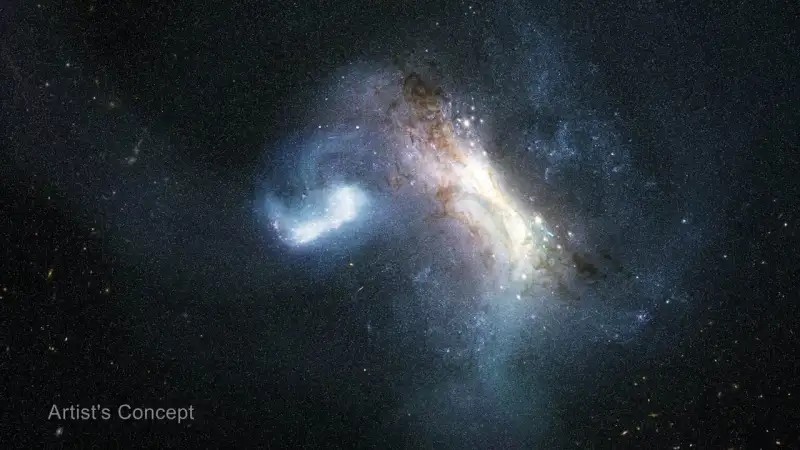
Astronomers using the MeerKAT radio telescope in South Africa have discovered the most distant hydroxyl megamaser ever detected, opening a new radio astronomy frontier. A hydroxyl megamaser is a natural space laser, and this one is located in a violently merging galaxy more than 8 billion light-years away.

More…

Reply Quote

Date: 13/06/2026 23:33:30
From: Tau.Neutrino
ID: 2400898
Subject: re: Astronomy

JWST reveals dawn-dusk atmosphere split on ultra-hot exoplanet WASP-121 b

Astronomers have revealed distinct differences in atmospheric conditions between the morning and evening transition zones of the ultra-hot gas planet WASP-121 b, which separate day from night, commonly called terminators. This achievement was only possible due to the unmatched sensitivity of the James Webb Space Telescope (JWST).

More…

Reply Quote