Was going to post this earlier:
…
Scientists have just unlocked the secrets of an ancient scroll torched by Mount Vesuvius
After a centuries-long struggle, scholars managed to read five feet of text, using machine-learning methods they hope can unlock further discoveries.
June 25, 2026 at 11:31 a.m. EDT Today at 11:31 a.m. EDT
By Miriam Waldvogel
For centuries, ancient scrolls torched nearly 2,000 years ago in the eruption of Mount Vesuvius have remained a mystery.
Once buried in hot rocks, ash and lava, the scrolls are so fragile and carbonized that they fall apart at the touch. Since their discovery in 1752, various attempts to read them — splitting them open and scraping away each slice of ancient paper with a knife, pouring mercury between the layers, soaking them in a mix of gelatin and acetic acid — have destroyed them or rendered them illegible.
Now, researchers say they have managed to completely unwrap and read the surviving portion of one scroll, about 20 columns of text, using machine learning methods that they hope can unlock further discoveries from a lost classical library.
The scrolls belong to a collection of more than 400 papyri recovered from a villa in the ancient seaside town of Herculaneum, believed to have belonged to the father-in-law of Julius Caesar. The algorithms developed by researchers at the University of Kentucky and the Vesuvius Challenge (a Silicon Valley-backed open competition), coupled with advanced imaging from a particle accelerator, have slowly unveiled various portions of the scrolls that can be analyzed by papyrologists. First, a single word in 2023, then a few phrases, and now — in the latest leap announced Thursday — at least 230 columns of text across several scrolls.
“I consider this to be a seminal moment because we’re going to, from now on, be talking more about the texts than we’re talking about the technology,” said Brent Seales, a computer scientist at the University of Kentucky who developed the first methods to digitally unroll the scrolls without touching them in the early 2000s.
The new findings released Thursday include the discovery of the existence of several new chapters of the work “On Gods” by the philosopher Philodemus of Gadara. It was previously known only as a single-chapter work, but one of the new scrolls makes a reference to it having eight chapters. In keeping with the title and Philodemus’s other writings, recovered phrases such as “providence,” “future things” and “invisible entities” point toward a discussion of Epicurean theology.
“It’s phenomenally exciting,” said Richard Janko, a classicist at the University of Michigan who was not affiliated with the new findings.
Brent Seales, left, and a colleague scan a Herculaneum scroll at Diamond Light Source. (EduceLab)
In addition to academics, the scrolls have been the focus of the Vesuvius Challenge, an open call launched by the Silicon Valley investors Nat Friedman and Daniel Gross, in collaboration with Seales. In 2023, the challenge awarded its $700,000 grand prize to a group of students who read more than 2,000 characters off of 11 scroll columns.
Since then, the Vesuvius Challenge has continued to support research efforts on the scrolls, including funding the cutting-edge scanning required to tease apart the charred papyrus layers.
“It’s a feature that is particularly hard to image because of the fact that it’s carbonized,” said Giorgio Angelotti, the challenge’s research lead.
The scanning process is a more advanced version of a typical medical CT scan. Using a specialized beam generated by a particle accelerator, the researchers stitched together two-dimensional cross-sections to create a three-dimensional image. The resulting scans are incredibly detailed — a single pixel is about two microns, thinner than spider silk, but also expensive. A single scroll can take 20 to 24 hours to scan, and a week’s time with the accelerator could cost a quarter of a million dollars, Seales estimated.
The difficulty of “unwrapping” those scans depends on a number of factors, including the artifact’s geometry. For instance, the scroll from which nearly five feet of text was read, known as PHerc. 1667, was chosen because it was cylindrical and not too compressed, said Seales.
“The diameter and in general the structure of the wrapping-up is pretty regular,” said Federica Nicolardi, who led a team of papyrologists for the challenge. “It’s kind of cute, I have to say, because it’s really, really tiny and very thin also,” she added. PHerc. 1667 is about 2 centimeters wide and 8 centimeters tall and is only a piece of a once-completed scroll.
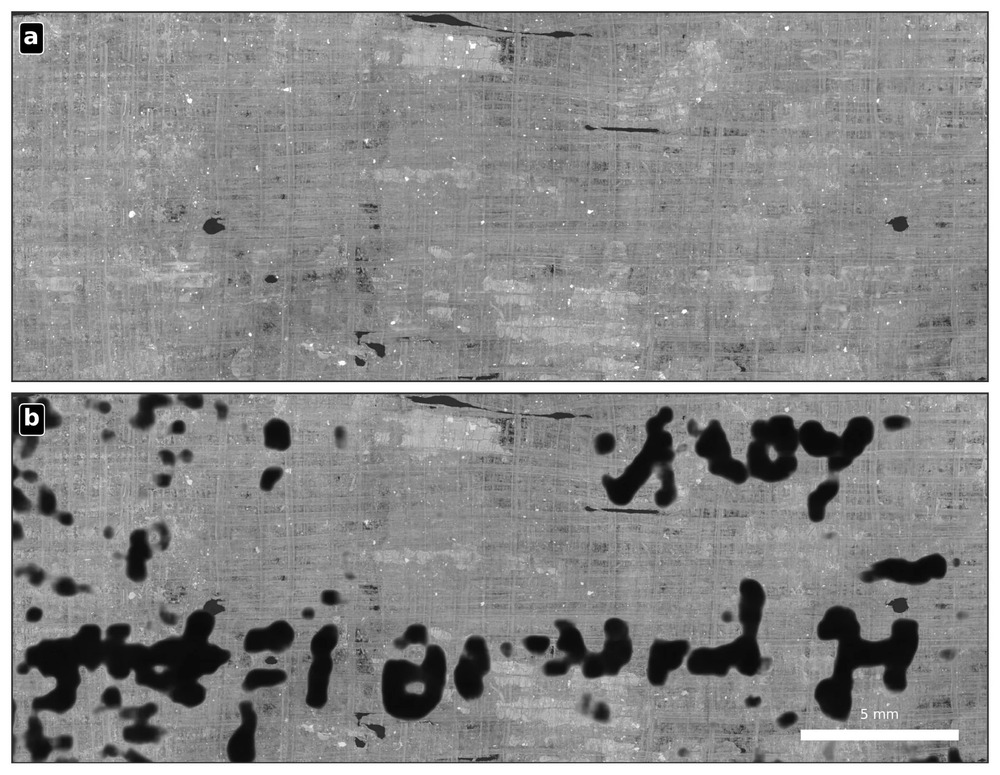
Then comes the challenge of virtually unwrapping the scroll, which involves isolating the layers of papyrus that have been compacted together over the centuries and then flattening and stitching the slices together into a composite image. Even then, the ink on the charred paper is not necessarily visible to the naked eye. So using existing scroll fragments that have been labeled by papyrologists, Seales, Angelotti and the other researchers trained algorithms to help enhance the ink, for experts like Nicolardi to analyze and translate.
“What is difficult, especially when you’re working with fragmentary material, is the fact that papyri are written in majuscule letters, with no spacing between words,” Nicolardi said. “Most of the time you don’t have punctuation or you just have very limited punctuation marks. So you need to read, understand the syntax and interpret.”
Seales and his team use lasers to scan a Herculaneum scroll at the Institut de France. (EduceLab)
And even fragmentary text can help researchers piece together certain characteristics of a text. While the authorship of PHerc. 1667 is still unclear, words such as “horme” (impulse) and “phronesis” (practical wisdom) suggest it discusses Stoicism, a philosophy of self-control and rational thinking.
Between the destructive methods used by earlier researchers and the more recent AI-powered tools, a large part of the text recovered so far has been attributed to Philodemus, who spoke Greek and was believed to have been a scholar in residence in the villa. But the villa’s library could go much further than that, said Janko, citing the presence of a history book discussing the period after the death of Alexander the Great.
The size of the surviving library is “practically unparalleled,” added Jeffrey Fish, a Philodemus scholar at Baylor University. In nearby Pompeii, the heat of the Vesuvius eruption incinerated materials like papyrus, he said. But in Herculaneum, the scrolls were carbonized — paradoxically preserving them from the usual weathering of paper over time.
For Seales, the next challenge is to scale: better imaging and better algorithms. Due to the cost, only about 10 percent of the scrolls have been scanned.
“All these parameters take a huge amount of training. We think that it does get better as we get more and more data,” he said. “If we had enough money to scan everything, then we’d have the full dataset and we could run.”
Following the latest breakthroughs, the Vesuvius Challenge is offering a new prize: $1 million to any person or team who can completely read one scroll in the next year. The challenge group is publishing its entire collection of scans, code and data online for enterprising scroll readers.
“This is an invitation to the rest of the world to join us on this venture,” said Friedman, one of the challenge’s founders, at a news conference in Naples on Thursday morning. “Most people start a little curious, and then they get sucked in, and then they find that they’ve spent months or years doing this. But I can’t think of a better way to lose six months of your life than doing this.”
https://www.washingtonpost.com/science/2026/06/25/scientists-have-just-unlocked-secrets-an-ancient-scroll-torched-by-mount-vesuvius/