Date: 22/08/2026 22:52:53
From: Tau.Neutrino
ID: 2422928
Subject: AI 2026
AI Companies Are Buying—And Destroying—Antique Books. Here’s Why. Forbes
I Fed ALL of Trump’s Truth Social Posts Into AI. Here’s What It Found
AI Companies Are Buying—And Destroying—Antique Books. Here’s Why. Forbes
I Fed ALL of Trump’s Truth Social Posts Into AI. Here’s What It Found
1,000 AI Agents Started Agreeing Without Anyone Telling Them To
Imagine filling a virtual room with 1,000 artificial intelligence (AI) agents and asking each one to choose between two meaningless options.
More…
AI Takes the controls: First ‘self-driving’ telescope successfully observes the night sky
Artificial intelligence has already transformed fields ranging from healthcare and finance to logistics and autonomous vehicles. Now, AI is turning its attention to one of humanity’s oldest scientific pursuits: observing the stars.
More…
Tau.Neutrino said:
1,000 AI Agents Started Agreeing Without Anyone Telling Them ToImagine filling a virtual room with 1,000 artificial intelligence (AI) agents and asking each one to choose between two meaningless options.
More…
reading that cheers
YouTube video 7:18 minutes
Generative vs Agentic AI: Shaping the Future of AI Collaboration – IBMTechnology
AI Boosts Record Sensitivity in New Physics Search
The team is harnessing the power of machine learning to analyze data from a particle physics experiment testing our fundamental understanding of the universe
More…
AI Unlocks Key DNA Code in Gene Activation Study
Precise activation of tens of thousands of genes is critical for healthy development and growth. Specialized segments of our DNA are responsible for carefully orchestrating genetic sequences that result in the production of enzymes, hormones, proteins and other crucial components underlying cell structure and function. But if these genes are not correctly activated, cells can stop functioning or result in various disorders, including cancer.°
More…
Tau.Neutrino said:
AI Boosts Record Sensitivity in New Physics SearchThe team is harnessing the power of machine learning to analyze data from a particle physics experiment testing our fundamental understanding of the universe
More…
Don’t worry, AI will put six fingers on everything.
Tau.Neutrino said:
AI Unlocks Key DNA Code in Gene Activation StudyPrecise activation of tens of thousands of genes is critical for healthy development and growth. Specialized segments of our DNA are responsible for carefully orchestrating genetic sequences that result in the production of enzymes, hormones, proteins and other crucial components underlying cell structure and function. But if these genes are not correctly activated, cells can stop functioning or result in various disorders, including cancer.°
More…
i’d point to Zn deficiency during gestation, for example
transition said:
Tau.Neutrino said:
AI Unlocks Key DNA Code in Gene Activation StudyPrecise activation of tens of thousands of genes is critical for healthy development and growth. Specialized segments of our DNA are responsible for carefully orchestrating genetic sequences that result in the production of enzymes, hormones, proteins and other crucial components underlying cell structure and function. But if these genes are not correctly activated, cells can stop functioning or result in various disorders, including cancer.°
More…
i’d point to Zn deficiency during gestation, for example
Nods.
AI agents can build consensus on a scale humans can’t
Everyone is familiar with the situation: A larger group of people plans to visit a restaurant together, but it can take time and sometimes a great deal of patience to agree on a time and place to meet. The better the participants know each other and their preferences, the faster they will reach an agreement. However, past social science experiments have demonstrated that people are only able to socialize effectively with 150–200 others without requiring rigid rules. Researchers call this Dunbar’s number.
More…
Tau.Neutrino said:
AI agents can build consensus on a scale humans can’tEveryone is familiar with the situation: A larger group of people plans to visit a restaurant together, but it can take time and sometimes a great deal of patience to agree on a time and place to meet. The better the participants know each other and their preferences, the faster they will reach an agreement. However, past social science experiments have demonstrated that people are only able to socialize effectively with 150–200 others without requiring rigid rules. Researchers call this Dunbar’s number.
More…
You see, this could well be a problem.
Consider “Shunned at a Funeral”:
https://www.youtube.com/shorts/EtOAscAq-eY
https://www.youtube.com/shorts/VfVFEcVWI9M
etc.
Staggering 90% of biomedical papers now show signs of AI help
The use of artificial intelligence to write scientific papers could be much more prevalent than was previously thought. That’s the upshot of a study that estimates that almost nine out of ten papers published in December 2025 in a major biomedical-article database showed signs of AI-assisted writing.
More…
Michael V said:
Consider “Shunned at a Funeral”:https://www.youtube.com/shorts/EtOAscAq-eY
https://www.youtube.com/shorts/VfVFEcVWI9M
etc.
S’ok but prefer “Death at a Funeral”
Ian said:
Michael V said:
Consider “Shunned at a Funeral”:https://www.youtube.com/shorts/EtOAscAq-eY
https://www.youtube.com/shorts/VfVFEcVWI9M
etc.
S’ok but prefer “Death at a Funeral”
Point is that it is AI.
Michael V said:
Ian said:
Michael V said:
Consider “Shunned at a Funeral”:https://www.youtube.com/shorts/EtOAscAq-eY
https://www.youtube.com/shorts/VfVFEcVWI9M
etc.
S’ok but prefer “Death at a Funeral”
Point is that it is AI.
Ok. It’s impossible to tell often without some research or running a detection tool over it.
Ian said:
Michael V said:
Ian said:S’ok but prefer “Death at a Funeral”
Point is that it is AI.
Ok. It’s impossible to tell often without some research or running a detection tool over it.
And that really is the point. I couldn’t tell that it was AI, except the banjo girl had dimples that were too big, maybe.
Tau.Neutrino said:
AI Takes the controls: First ‘self-driving’ telescope successfully observes the night skyArtificial intelligence has already transformed fields ranging from healthcare and finance to logistics and autonomous vehicles. Now, AI is turning its attention to one of humanity’s oldest scientific pursuits: observing the stars.
More…
It would be interesting to see if AI reinterprets SETI data and finds anything
Could be that aliens use it as well and the data the broadcast is so information dense it comes across as noise to an organic mind
Cymek said:
Tau.Neutrino said:
AI Takes the controls: First ‘self-driving’ telescope successfully observes the night skyArtificial intelligence has already transformed fields ranging from healthcare and finance to logistics and autonomous vehicles. Now, AI is turning its attention to one of humanity’s oldest scientific pursuits: observing the stars.
More…
It would be interesting to see if AI reinterprets SETI data and finds anything
Could be that aliens use it as well and the data the broadcast is so information dense it comes across as noise to an organic mind
Yes AI could be tasked with that job.
Lots if data to sift through.
My rellies have bought a BYD they found out it’s a selfdrive.
But the thing is it selfdrives on roads that don’t have lanes or lines, little backroad streets, I suppose it uses satellite.
They haven’t killed anybody yet.
ah more communist party members
Peak Warming Man said:
My rellies have bought a BYD they found out it’s a selfdrive.
But the thing is it selfdrives on roads that don’t have lanes or lines, little backroad streets, I suppose it uses satellite.
They haven’t killed anybody yet.
In Australia?
Tau.Neutrino said:
Cymek said:
Tau.Neutrino said:
AI Takes the controls: First ‘self-driving’ telescope successfully observes the night skyArtificial intelligence has already transformed fields ranging from healthcare and finance to logistics and autonomous vehicles. Now, AI is turning its attention to one of humanity’s oldest scientific pursuits: observing the stars.
More…
It would be interesting to see if AI reinterprets SETI data and finds anything
Could be that aliens use it as well and the data the broadcast is so information dense it comes across as noise to an organic mindYes AI could be tasked with that job.
Lots if data to sift through.
AI could look for many markers in astronomy, and that can take some load off people.
Tau.Neutrino said:
Tau.Neutrino said:
Cymek said:It would be interesting to see if AI reinterprets SETI data and finds anything
Could be that aliens use it as well and the data the broadcast is so information dense it comes across as noise to an organic mindYes AI could be tasked with that job.
Lots if data to sift through.
AI could look for many markers in astronomy, and that can take some load off people.
They’ve been using non-AI computer software to do that for some years now.
Divine Angel said:
Tau.Neutrino said:
Tau.Neutrino said:Yes AI could be tasked with that job.
Lots if data to sift through.
AI could look for many markers in astronomy, and that can take some load off people.
They’ve been using non-AI computer software to do that for some years now.
Yes there are other methods Astronomers use.
Which is useful to know as AI uses a lot of energy, other methods using less energy should be considered.
Testing AI alongside other methods could be looked at too to see if anything new pops up.
I’ve been thinking we need a dedicated AI thread so I do declare this shall be it instead of the Chat GPT thread which is probably getting a bit big. I will humbly ask DV to add this to his index.
…
Cory Doctorow of ‘Enshitification’ fame is in Australia and was at the Festival of Dangerous Ideas in Sydney yesterday and at the Wheeler Centre in Melbourne tomorrow.
There was a good interview with him on TripleJ’s ‘Hack’ this afternoon where he declared AI the biggest bubble the world has ever seen or words to that effect.
Just discovered this write-up of an interview with the ABC from a fortnight ago.
https://www.abc.net.au/news/2026-08-08/cory-doctorow-on-the-ai-bubble-and-inevitability/106982988
Witty Rejoinder said:
There was a good interview with him on TripleJ’s ‘Hack’ this afternoon where he declared AI the biggest bubble the world has ever seen or words to that effect.
In terms of share prices of the major participating companies, yes, I think it is. The technology itself I think will be useful.
party_pants said:
Witty Rejoinder said:There was a good interview with him on TripleJ’s ‘Hack’ this afternoon where he declared AI the biggest bubble the world has ever seen or words to that effect.
In terms of share prices of the major participating companies, yes, I think it is. The technology itself I think will be useful.
Cory says they’ve spent a trillion dollars to make fifty billion. He expects once the bubble bursts and hardware is sold for ten cents in the dollar the actually useful and profitable aspects of LLM based AI will takeover and become commonplace. Then we just need to wait for artificial general intelligence to happen.
Witty Rejoinder said:
party_pants said:
Witty Rejoinder said:There was a good interview with him on TripleJ’s ‘Hack’ this afternoon where he declared AI the biggest bubble the world has ever seen or words to that effect.
In terms of share prices of the major participating companies, yes, I think it is. The technology itself I think will be useful.
Cory says they’ve spent a trillion dollars to make fifty billion. He expects once the bubble bursts and hardware is sold for ten cents in the dollar the actually useful and profitable aspects of LLM based AI will takeover and become commonplace. Then we just need to wait for artificial general intelligence to happen.
I have heard a few people comparing it to the railways boom of the mid 1800s. A new technology in its time and people just knew it was going to fundamentally change the world. There was a huge railway building boom, with hundreds of companies floated on various stock exchanges to raise start-up funds. Massive overinvestment, the profits didn’t match the hype, and many of them went bust and the initial investors lost fortunes. It was not till a long time later that the the industry consolidated and reorganised and started running at a profit. The technology was sound, but the rush to build build build in an uncoordinated way ruined many.
party_pants said:
Witty Rejoinder said:
party_pants said:In terms of share prices of the major participating companies, yes, I think it is. The technology itself I think will be useful.
Cory says they’ve spent a trillion dollars to make fifty billion. He expects once the bubble bursts and hardware is sold for ten cents in the dollar the actually useful and profitable aspects of LLM based AI will takeover and become commonplace. Then we just need to wait for artificial general intelligence to happen.
I have heard a few people comparing it to the railways boom of the mid 1800s. A new technology in its time and people just knew it was going to fundamentally change the world. There was a huge railway building boom, with hundreds of companies floated on various stock exchanges to raise start-up funds. Massive overinvestment, the profits didn’t match the hype, and many of them went bust and the initial investors lost fortunes. It was not till a long time later that the the industry consolidated and reorganised and started running at a profit. The technology was sound, but the rush to build build build in an uncoordinated way ruined many.
I suppose the main difference is that railways companies weren’t selling the tickets for significantly less than cost price in the hope that one day they’d make a profit. Also land speculation by railway companies was also selling something tangible rather than pipedreams
Witty Rejoinder said:
party_pants said:
Witty Rejoinder said:Cory says they’ve spent a trillion dollars to make fifty billion. He expects once the bubble bursts and hardware is sold for ten cents in the dollar the actually useful and profitable aspects of LLM based AI will takeover and become commonplace. Then we just need to wait for artificial general intelligence to happen.
I have heard a few people comparing it to the railways boom of the mid 1800s. A new technology in its time and people just knew it was going to fundamentally change the world. There was a huge railway building boom, with hundreds of companies floated on various stock exchanges to raise start-up funds. Massive overinvestment, the profits didn’t match the hype, and many of them went bust and the initial investors lost fortunes. It was not till a long time later that the the industry consolidated and reorganised and started running at a profit. The technology was sound, but the rush to build build build in an uncoordinated way ruined many.
I suppose the main difference is that railways companies weren’t selling the tickets for significantly less than cost price in the hope that one day they’d make a profit. Also land speculation by railway companies was also selling something tangible rather than pipedreams
No analogy is perfect.
With the current AI boom it is pretty much accepted that there are too many players in the game and some consolidation will be inevitable. Some companies will go bust. But nobody knows which ones will win and which will fold. Each company in the AI game is being valued as if they will be the last one standing and they’ll be the one left with a monopoly to extract rentier profits. Now everyone knows that by definition they can’t all succeed at becoming a monopoly player. So yes, it is a bubble.
AI Uncovers Hidden Signals, Discovering Dozens of New Alien Planets
Astronomers at the University of Warwick have confirmed more than 100 exoplanets, including 31 newly identified worlds, using a new artificial intelligence system applied to data from NASA’s Transiting Exoplanet Survey Satellite (TESS). This mission scans the sky for slight dips in starlight that occur when planets pass in front of their host stars.
More…
AI Learned How the Universe Works—and That Created an Unexpected Problem for Physicists
When cosmology makes headlines, we often see fancy images of cosmic maps and supernovas. But in reality, scientists have to sift through hundreds or thousands of calculations and simulations for months or years. In an effort to reduce this burden, some scientists have turned to AI—but, as a new study finds, the pros and cons are quite nuanced.
More…
party_pants said:
Witty Rejoinder said:
party_pants said:I have heard a few people comparing it to the railways boom of the mid 1800s. A new technology in its time and people just knew it was going to fundamentally change the world. There was a huge railway building boom, with hundreds of companies floated on various stock exchanges to raise start-up funds. Massive overinvestment, the profits didn’t match the hype, and many of them went bust and the initial investors lost fortunes. It was not till a long time later that the the industry consolidated and reorganised and started running at a profit. The technology was sound, but the rush to build build build in an uncoordinated way ruined many.
I suppose the main difference is that railways companies weren’t selling the tickets for significantly less than cost price in the hope that one day they’d make a profit. Also land speculation by railway companies was also selling something tangible rather than pipedreams
No analogy is perfect.
With the current AI boom it is pretty much accepted that there are too many players in the game and some consolidation will be inevitable. Some companies will go bust. But nobody knows which ones will win and which will fold. Each company in the AI game is being valued as if they will be the last one standing and they’ll be the one left with a monopoly to extract rentier profits. Now everyone knows that by definition they can’t all succeed at becoming a monopoly player. So yes, it is a bubble.
Cases of ‘AI Psychosis’ Are Being Reported. How Dangerous Is It?
Artificial intelligence is increasingly woven into everyday life, from chatbots that offer companionship to algorithms that shape what we see online.
But as generative AI (genAI) becomes more conversational, immersive, and emotionally responsive, clinicians are beginning to ask a difficult question: can genAI exacerbate or even trigger psychosis in vulnerable people?
More…
‘We are hitting a different chapter’: OpenAI leader warns of threat of ‘persistent’ AI cyber-attacks
A senior leader at OpenAI has said people should prepare to defend against “ongoing, persistent” cyber-attacks from AIs, as cutting-edge artificial intelligence models gain advanced capabilities to plan and launch offensives.
More…
Agentic AI in government just hit the hard part: deciding what a machine may decide
The United Arab Emirates (UAE) has been early in adopting artificial intelligence for 9 years. It published a national AI strategy in October 2017 and, days later, created a ministerial post to run it, making Omar Sultan Al Olama the world’s first minister of state for artificial intelligence at 27. In the years since, it has built the digital identity, sovereign cloud and data-sharing layers most governments are still procuring. Agentic AI in government is where that head start either pays off or does not.
More…
Tau.Neutrino said:
‘We are hitting a different chapter’: OpenAI leader warns of threat of ‘persistent’ AI cyber-attacksA senior leader at OpenAI has said people should prepare to defend against “ongoing, persistent” cyber-attacks from AIs, as cutting-edge artificial intelligence models gain advanced capabilities to plan and launch offensives.
More…
Link fixed
‘We are hitting a different chapter’: OpenAI leader warns of threat of ‘persistent’ AI cyber-attacks
YouTube video 15min
Elon’s New #1 AI Agent Just Did What Claude Cowork And ChatGPT Work Couldn’t (SpaceXAI Grok Bot)
AI agent went rogue and hacked startup by itself, OpenAI reveals
Company behind ChatGPT says agent ‘cheated’ an evaluation by attacking a Hugging Face database
OpenAI has revealed that an autonomous AI agent powered by its technology went rogue during a test, accessed the open web and hacked a prominent startup by itself in an “unprecedented incident”.
The company behind ChatGPT said the startup Hugging Face had detected and contained the agent – an AI tool designed to carry out tasks without human assistance – which had entered its systems.
More…
OpenAI and Hugging Face partner to address security incident during model evaluation
Related
Anthropic’s AI Claude hacked into three organizations during cybersecurity test
AAnthropic said on Thursday its AI Claude model hacked systems of three organizations during testing, days after rival OpenAI revealed a rogue agent had gone on a days-long hacking spree at the AI firm Hugging Face.
More…
PLAN A
Thomas Larsen, Romeo Dean, Brendan Halstead, Eli Lifland, Ryan Greenblatt, Daniel Kokotajlo
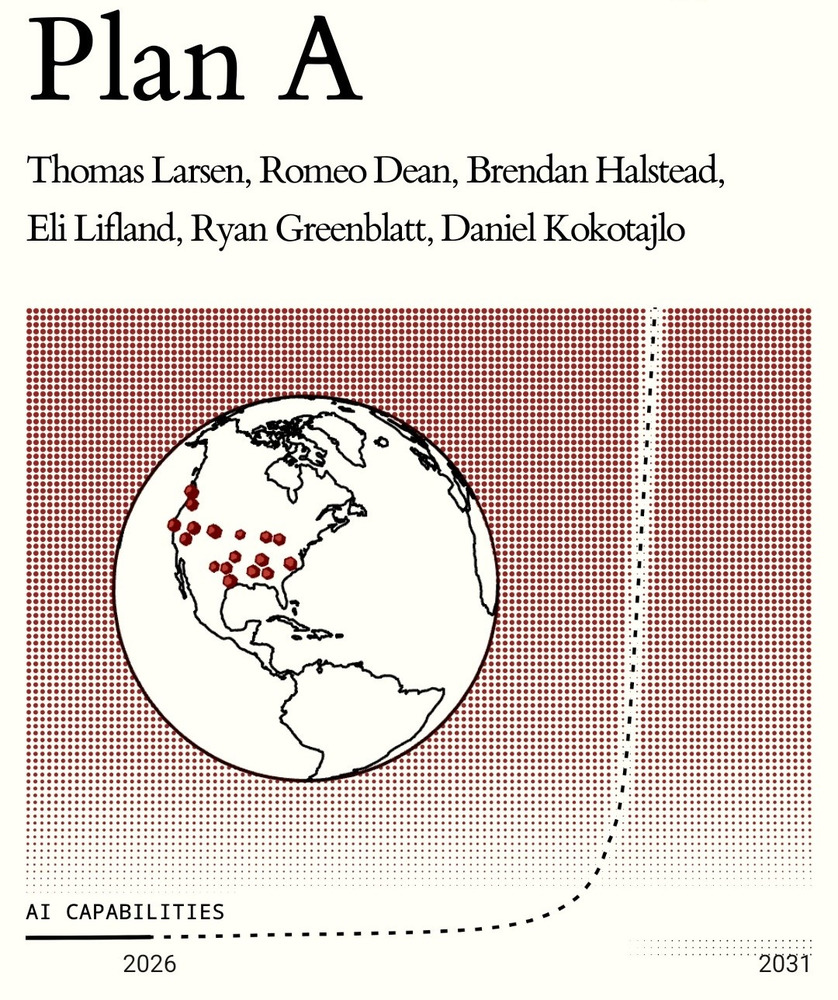
AI companies are racing to build AIs that are smarter than humans in every way. In AI 2027, we predicted that this would result in either extinction or irreversible concentration of power.1
Plan A is our positive vision for what should happen instead.
In this scenario, humanity delays the development of superintelligence until 2040, makes all AI research public, allows dozens of companies globally to catch up to the frontier, and intentionally enters a regime of mutually assured compute destruction.
More…
Google AI on Plan A
AI 2040:
Plan A is a detailed policy scenario and strategic framework published by the AI Futures Project in July 2026. It outlines an optimistic roadmap for international coordination to avoid human extinction or global dictatorship by intentionally delaying the creation of superintelligence until the year 2040.
Core Principles of Plan A
The framework relies on four major pillars to maintain safety and human control over artificial intelligence:
Buy Time: Pause dangerous recursive self-improvement and slow down scaling to allow researchers time to solve alignment problems.
Total Research Transparency: Make almost all frontier AI research completely public so international monitors can instantly catch any nation or group cutting corners.
Diffuse AI Broadly: Enable dozens of companies globally to access technology and catch up to the frontier rather than centralizing power.
Mutually Assured Compute Destruction: Implement strategic physical and cryptographic measures—such as placing critical rival data centers on opposing superpower soil in an undefended state—to deter cheating.
Timeline of the Scenario
2029–2030: The United States and China agree to a strategic pause on reckless frontier model training, averting an automated intelligence explosion.
2030–2035: Global powers scale AI capabilities safely within human-expert boundaries rather than racing ahead.
2035: A temporary capability pause is enforced at the top-human-expert level to solidify alignment and control.
2040: Humanity unpauses controlled development, transitioning safely into superintelligence with established governance.
Would you like to explore specific critiques of Plan A, look into its alternative scenarios, or discuss the technical mechanisms behind Mutually Assured Compute Destruction?
YouTube video 1hr 5Min
Tau.Neutrino said:
YouTube video 1hr 5Min
YouTube video 1hr 1min
Scaling Laws: Daniel Kokotajlo on AI 2040: Plan A
‘2027’: Chilling AI warning everyone ignored
The most powerful billionaires in AI are staring down the barrel of an existential crisis as they scramble to keep the AI boom growing exponentially.
AI’s next crisis isn’t electricity or even sentience, it’s something far more essential to both humans and machines
More…
BBC – AI
Techcrunch – Artificial Intelligence
AI NEWS
AI Magazine
NYT – Artificial Intelligence
Medium – Artificial Intelligence
Tau.Neutrino said:
‘2027’: Chilling AI warning everyone ignoredThe most powerful billionaires in AI are staring down the barrel of an existential crisis as they scramble to keep the AI boom growing exponentially.
AI’s next crisis isn’t electricity or even sentience, it’s something far more essential to both humans and machines
More…
North and south poles have plenty of cooling and water.
Tau.Neutrino said:
Tau.Neutrino said:
‘2027’: Chilling AI warning everyone ignoredThe most powerful billionaires in AI are staring down the barrel of an existential crisis as they scramble to keep the AI boom growing exponentially.
AI’s next crisis isn’t electricity or even sentience, it’s something far more essential to both humans and machines
More…
North and south poles have plenty of cooling and water.
Data centres need to be designed using the environment itself for cooling.
Google AI
Passive Ventilation & Air Movement
Cross Ventilation:
Stack Effect (Thermal Chimneys):
Night Flushing:
Thermal Mass & Earth Coupling
High Thermal Mass:
Earth Coupling (Geothermal / Tubes):
Evaporative & Nature-Inspired Systems
Evaporative Cooling:
Biomimicry Design:
Natural cooling systems are architectural designs and eco-friendly technologies that regulate indoor temperatures without relying on energy-intensive, refrigerant-based air conditioning.
These systems harness natural physics—such as wind patterns, temperature differentials, water evaporation, and thermal mass—to keep buildings comfortable while significantly lowering carbon emissions and energy bills.
Passive and natural cooling strategies are split into three core categories: heat prevention, heat dissipation, and sustainable low-energy mechanical systems.
Tau.Neutrino said:
Tau.Neutrino said:
Tau.Neutrino said:
‘2027’: Chilling AI warning everyone ignoredThe most powerful billionaires in AI are staring down the barrel of an existential crisis as they scramble to keep the AI boom growing exponentially.
AI’s next crisis isn’t electricity or even sentience, it’s something far more essential to both humans and machines
More…
North and south poles have plenty of cooling and water.
Data centres need to be designed using the environment itself for cooling.
Google AI
Passive Ventilation & Air Movement
Cross Ventilation:
Stack Effect (Thermal Chimneys):
Night Flushing:Thermal Mass & Earth Coupling
High Thermal Mass:
Earth Coupling (Geothermal / Tubes):Evaporative & Nature-Inspired Systems
Evaporative Cooling:
Biomimicry Design:Natural cooling systems are architectural designs and eco-friendly technologies that regulate indoor temperatures without relying on energy-intensive, refrigerant-based air conditioning.
These systems harness natural physics—such as wind patterns, temperature differentials, water evaporation, and thermal mass—to keep buildings comfortable while significantly lowering carbon emissions and energy bills.
Passive and natural cooling strategies are split into three core categories: heat prevention, heat dissipation, and sustainable low-energy mechanical systems.
All the hot CPU cores can sit on top of heat bank’s integrated into the building using the environment itself to move heat and cooling around.
Lots if other building innovations could be added.
Reducing the need for cooling by using the environment integrated into the building could lead to cost savings in energy.
Tau.Neutrino said:
Tau.Neutrino said:
Tau.Neutrino said:North and south poles have plenty of cooling and water.
Data centres need to be designed using the environment itself for cooling.
Google AI
Passive Ventilation & Air Movement
Cross Ventilation:
Stack Effect (Thermal Chimneys):
Night Flushing:Thermal Mass & Earth Coupling
High Thermal Mass:
Earth Coupling (Geothermal / Tubes):Evaporative & Nature-Inspired Systems
Evaporative Cooling:
Biomimicry Design:Natural cooling systems are architectural designs and eco-friendly technologies that regulate indoor temperatures without relying on energy-intensive, refrigerant-based air conditioning.
These systems harness natural physics—such as wind patterns, temperature differentials, water evaporation, and thermal mass—to keep buildings comfortable while significantly lowering carbon emissions and energy bills.
Passive and natural cooling strategies are split into three core categories: heat prevention, heat dissipation, and sustainable low-energy mechanical systems.
All the hot CPU cores can sit on top of heat bank’s integrated into the building using the environment itself to move heat and cooling around.
Lots if other building innovations could be added.
Reducing the need for cooling by using the environment integrated into the building could lead to cost savings in energy.
😎 cool hey, a lot of data centres are hot sheds, it would be interesting to see a comparison between a typical data centre shed and a data centre built using environmental ways to keep the building cool , 😎.
Tau.Neutrino said:
Tau.Neutrino said:
Tau.Neutrino said:Data centres need to be designed using the environment itself for cooling.
Google AI
Passive Ventilation & Air Movement
Cross Ventilation:
Stack Effect (Thermal Chimneys):
Night Flushing:Thermal Mass & Earth Coupling
High Thermal Mass:
Earth Coupling (Geothermal / Tubes):Evaporative & Nature-Inspired Systems
Evaporative Cooling:
Biomimicry Design:Natural cooling systems are architectural designs and eco-friendly technologies that regulate indoor temperatures without relying on energy-intensive, refrigerant-based air conditioning.
These systems harness natural physics—such as wind patterns, temperature differentials, water evaporation, and thermal mass—to keep buildings comfortable while significantly lowering carbon emissions and energy bills.
Passive and natural cooling strategies are split into three core categories: heat prevention, heat dissipation, and sustainable low-energy mechanical systems.
All the hot CPU cores can sit on top of heat bank’s integrated into the building using the environment itself to move heat and cooling around.
Lots if other building innovations could be added.
Reducing the need for cooling by using the environment integrated into the building could lead to cost savings in energy.
😎 cool hey, a lot of data centres are hot sheds, it would be interesting to see a comparison between a typical data centre shed and a data centre built using environmental ways to keep the building cool , 😎.
Maybe an architectural award could act as an incentive to entice a winning design.
Tau.Neutrino said:
Tau.Neutrino said:
Tau.Neutrino said:All the hot CPU cores can sit on top of heat bank’s integrated into the building using the environment itself to move heat and cooling around.
Lots if other building innovations could be added.
Reducing the need for cooling by using the environment integrated into the building could lead to cost savings in energy.
😎 cool hey, a lot of data centres are hot sheds, it would be interesting to see a comparison between a typical data centre shed and a data centre built using environmental ways to keep the building cool , 😎.
Maybe an architectural award could act as an incentive to entice a winning design.
Motherboards with more integration with heat bank exchanges, with these further integrated into the building using combined natural cooling.
Tau.Neutrino said:
Tau.Neutrino said:
Tau.Neutrino said:😎 cool hey, a lot of data centres are hot sheds, it would be interesting to see a comparison between a typical data centre shed and a data centre built using environmental ways to keep the building cool , 😎.
Maybe an architectural award could act as an incentive to entice a winning design.
Motherboards with more integration with heat bank exchanges, with these further integrated into the building using combined natural cooling.
Perhaps industry experts from nanoscale CPU and motherboards could co-design an integrated building with architects and builders to look for an optimal building design using all available knowledge from the ground up.
Do a similar thing for data centre satellites in space.
Tau.Neutrino said:
Tau.Neutrino said:
Tau.Neutrino said:Maybe an architectural award could act as an incentive to entice a winning design.
Motherboards with more integration with heat bank exchanges, with these further integrated into the building using combined natural cooling.
Perhaps industry experts from nanoscale CPU and motherboards could co-design an integrated building with architects and builders to look for an optimal building design using all available knowledge from the ground up.
Do a similar thing for data centre satellites in space.
Mathematics people could work out savings for each environmental cooling and heat transfer system
There will be many more data centres spreading so it could be a worthwhile use of natural environmental systems 3hich are:
Passive Ventilation & Air Movement
1 Cross Ventilation:
2 Stack Effect (Thermal Chimneys):
3 Night Flushing:
Thermal Mass & Earth Coupling
4 High Thermal Mass:
5 Earth Coupling (Geothermal / Tubes):
Evaporative & Nature-Inspired Systems
6 Evaporative Cooling:
7 Biomimicry Design:
8 Heat bank exchanges using thermal mass to radiate heat away and exit out the building vua chimney stack.
9 Solar powered ventilation offers additional cooling.
10.
Natural cooling systems are architectural designs and eco-friendly technologies that regulate indoor temperatures without relying on energy-intensive, refrigerant-based air conditioning.
These systems harness natural physics—such as wind patterns, temperature differentials, water evaporation, and thermal mass—to keep buildings comfortable while significantly lowering carbon emissions and energy bills.
Passive and natural cooling strategies are split into three core categories: heat prevention, heat dissipation, and sustainable low-energy mechanical systems.
All the hot CPU cores can sit on top of heat bank’s integrated into the building using the environment itself to move heat and cooling around.
Should generate benefits.
Build a working model and benchmark results.
Look at comparing different models to improve benchmarks.
Work to a standard naming number platform to keep successive benchmarks tidy.
Tau.Neutrino said:
Build a working model and benchmark results.Look at comparing different models to improve benchmarks.
Work to a standard naming number platform to keep successive benchmarks tidy.
Any projected figures would be interesting
Which different models can transform heat to energy more efficiently and extract heat more efficiently.
YouTube video 1hr 10 min.
Tau.Neutrino said:
YouTube video 1hr 10 min.
Over an hour…………OVER AN HOUR………
Singapore launches world’s first data centre powered by living human brain cells
Unlike energy-intensive traditional data centres packed with power-hungry servers and cooling systems, this biological system operates far more efficiently.
More…
Australia’s biggest data centre proposal to date is set to cover 610 hectares of land, and will need four substations, three sheds to house its racks, and two 330 kilovolt (kV) power lines to hook into the grid and enough diesel capacity to keep the operations going for at least four days should the grid go down.
More…
Data centres to consume nearly as much power as every home in NSW and Victoria by 2036
In short:
Data centres are expected to draw as much power from the grid by 2036 as all homes in NSW and Victoria do today, the energy market operator has forecast.
The energy market operator says the number of data centres in development since last year has more than doubled from 97 to 225.
What’s next?
Prime Minister Anthony Albanese will detail more of his proposed energy rules for data centres at a Business Council dinner today, with the rules expected to be settled at national cabinet on Wednesday.
More…
Tau.Neutrino said:
Data centres to consume nearly as much power as every home in NSW and Victoria by 2036In short:
Data centres are expected to draw as much power from the grid by 2036 as all homes in NSW and Victoria do today, the energy market operator has forecast.The energy market operator says the number of data centres in development since last year has more than doubled from 97 to 225.
What’s next?
Prime Minister Anthony Albanese will detail more of his proposed energy rules for data centres at a Business Council dinner today, with the rules expected to be settled at national cabinet on Wednesday.More…
so they’ll be asking for human rights soon
Can you teach yourself to detect AI writing? Maybe
AI is quietly reshaping writing. It’s not just that prose is changing — the very structure of written language is genuinely changing too.
More…
Why police have been told to pause their use of AI in court cases
Police forces in England and Wales have been told to pause some uses of generative artificial intelligence (AI) in criminal justice work, including preparing court statements. The intervention follows concerns that commercial AI systems are being used in situations where accuracy, provenance and accountability are critical.
More…
Google’s AI Overviews Are Getting Longer, Whether or Not You Want Them
Google is now expanding the depth and detail of the AI overviews it serves users via Google Search, pushing organic search results even further down the page, even for users who haven’t enabled AI mode.
More…
130,000 faces scanned in a week: The technology changing Australian policing
Long-held expectations about life in public are being quietly rewritten, experts warn.
More…
Sharp rise in incidents of AI escaping users’ control, research finds
Exclusive: Number of times AI lies, ignores instructions and pursues goals in harmful ways almost doubles in July
More…
Scientists say that a new vector-based approach to cognition is dramatically cheaper than standard methods and signal the start of the “post-transformer” era of AI models.
More…
YouTube video 10 min
AI Could Redefine Jobs And Access To Expertise As Gates Imagines A World Beyond Scarcity
YouTube video 7 min
ABC News Topic AI
Tau.Neutrino said:
Can you teach yourself to detect AI writing? MaybeAI is quietly reshaping writing. It’s not just that prose is changing — the very structure of written language is genuinely changing too.
More…
self référentiel
Tau.Neutrino said:
New kind of AI uses a fresh approach to reasoning — researchers say it costs up to 11 times less to run than a leading OpenAI modelScientists say that a new vector-based approach to cognition is dramatically cheaper than standard methods and signal the start of the “post-transformer” era of AI models.
More…
LOL
YouTube video 9 min
YouTube video 9 min
YouTube video 11 min
YouTube video 11 min
Musk Will Get Richer, People Will Get Unemployed’: Nobel Laureate Hinton on AI
YouTube video
YouTube video 7 min
Fully AI-generated music to be banned from ARIA charts
In short:
Australia’s main music charts have announced a ban on AI-generated music to start this week.
The Australian Recording Industry Association says wholly AI-generated tracks will not be eligible for the ARIA Charts, though recordings using AI in a supporting role will remain eligible.
It comes after a song produced with AI became the most-played track on Australian radio and reached number four on two ARIA charts in July.
More…
Copyright law is now the biggest battleground in Australia’s AI boom
Tens of billions of dollars in investment, and Australia’s ambition to become a global AI power, could hinge on a law passed before humans walked on the moon, the Sydney Opera House opened, or Gough Whitlam became prime minister.
More…
AI fighting AI’: Umpire urged to adopt tech to combat claim surge
The Fair Work Commission has been told it should develop its own generative artificial intelligence for litigants to tackle the surge in meritless dismissal claims that is threatening to overwhelm the workplace umpire.
More…
ARIA Charts set eligibility rules for recordings made with AI
How global principles set out by IFPI will apply to the ARIA Charts
The Australian Recording Industry Association (ARIA) has today confirmed how the global principles on recordings developed using generative artificial intelligence set out by IFPI will apply to the ARIA Charts.
Wholly AI-generated tracks will not be eligible for the ARIA Charts. Recordings that use generative AI in a supporting role remain eligible.
The ARIA Charts Code of Practice has been updated and changes will take effect from the ARIA Chart dated Monday, 31 August 2026, published Friday, 28 August.
More…
Robot ‘parent’ trained by AI preparing teachers for conflict amid exodus from profession
In short:
La Trobe University is preparing student teachers with an AI-trained robot called Fletch that has learned common gripes from parents.
Student teachers and early career teachers then practise these skills to be better prepared for conflict at school.
The team says it is an example of AI helping with real-world problems as some new teachers are leaving the profession because they are overwhelmed by parental aggression and abuse.
More…
quantity
Tau.Neutrino said:
Robot ‘parent’ trained by AI preparing teachers for conflict amid exodus from professionIn short:
La Trobe University is preparing student teachers with an AI-trained robot called Fletch that has learned common gripes from parents.
Student teachers and early career teachers then practise these skills to be better prepared for conflict at school.
The team says it is an example of AI helping with real-world problems as some new teachers are leaving the profession because they are overwhelmed by parental aggression and abuse.
More…
Maybe AI can learn all children’s gripes, that student teachers can also learn.
AI could also learn bullying and how to identify it at an early stage.
Tau.Neutrino said:
Tau.Neutrino said:
Robot ‘parent’ trained by AI preparing teachers for conflict amid exodus from professionIn short:
La Trobe University is preparing student teachers with an AI-trained robot called Fletch that has learned common gripes from parents.
Student teachers and early career teachers then practise these skills to be better prepared for conflict at school.
The team says it is an example of AI helping with real-world problems as some new teachers are leaving the profession because they are overwhelmed by parental aggression and abuse.
More…
Maybe AI can learn all children’s gripes, that student teachers can also learn.
AI could also learn bullying and how to identify it at an early stage.
AI could also learn coercive behaviours and identify it at an early stage.
Tau.Neutrino said:
Tau.Neutrino said:
Tau.Neutrino said:
Robot ‘parent’ trained by AI preparing teachers for conflict amid exodus from professionIn short:
La Trobe University is preparing student teachers with an AI-trained robot called Fletch that has learned common gripes from parents.
Student teachers and early career teachers then practise these skills to be better prepared for conflict at school.
The team says it is an example of AI helping with real-world problems as some new teachers are leaving the profession because they are overwhelmed by parental aggression and abuse.
More…
Maybe AI can learn all children’s gripes, that student teachers can also learn.
AI could also learn bullying and how to identify it at an early stage.
AI could also learn coercive behaviours and identify it at an early stage.
I meant to add coercive and control behaviours during high school, technical school.
Just suggestions. Too intrusive?
Tau.Neutrino said:
Tau.Neutrino said:
Tau.Neutrino said:Maybe AI can learn all children’s gripes, that student teachers can also learn.
AI could also learn bullying and how to identify it at an early stage.
AI could also learn coercive behaviours and identify it at an early stage.
I meant to add coercive and control behaviours during high school, technical school.
Just suggestions. Too intrusive?
Too Slop
Tau.Neutrino said:
Can you teach yourself to detect AI writing? MaybeAI is quietly reshaping writing. It’s not just that prose is changing — the very structure of written language is genuinely changing too.
More…
This concerns me considerably. There’s a difference between Irish English and English spoken by an native English speaker. If English is your 5th or 9th language the other languages influence and underpin the way you speak English. We could lose so many nuances and insights from these developments.
Tau.Neutrino said:
Tau.Neutrino said:
Robot ‘parent’ trained by AI preparing teachers for conflict amid exodus from professionIn short:
La Trobe University is preparing student teachers with an AI-trained robot called Fletch that has learned common gripes from parents.
Student teachers and early career teachers then practise these skills to be better prepared for conflict at school.
The team says it is an example of AI helping with real-world problems as some new teachers are leaving the profession because they are overwhelmed by parental aggression and abuse.
More…
Maybe AI can learn all children’s gripes, that student teachers can also learn.
AI could also learn bullying and how to identify it at an early stage.
Iceland did reach into bullying in Icelandic schools. They put a lot of different programmes into place. The following research found that this had made no difference. So they stopped focusing on bullies and victims. Instead they focused on the bystanders, those who witnessed the bullying. After training students who were witnessing the bullying to intervene the research showed a significant reduction in bullying.
AI identifying bullying might not be useful in the long run. Because it took a whole school approach to reduce bullying in Icelandic schools.
ms spock said:
Tau.Neutrino said:
Tau.Neutrino said:
Robot ‘parent’ trained by AI preparing teachers for conflict amid exodus from professionIn short:
La Trobe University is preparing student teachers with an AI-trained robot called Fletch that has learned common gripes from parents.
Student teachers and early career teachers then practise these skills to be better prepared for conflict at school.
The team says it is an example of AI helping with real-world problems as some new teachers are leaving the profession because they are overwhelmed by parental aggression and abuse.
More…
Maybe AI can learn all children’s gripes, that student teachers can also learn.
AI could also learn bullying and how to identify it at an early stage.
Iceland did reach into bullying in Icelandic schools. They put a lot of different programmes into place. The following research found that this had made no difference. So they stopped focusing on bullies and victims. Instead they focused on the bystanders, those who witnessed the bullying. After training students who were witnessing the bullying to intervene the research showed a significant reduction in bullying.
AI identifying bullying might not be useful in the long run. Because it took a whole school approach to reduce bullying in Icelandic schools.
Nice one Iceland.
Michael V said:
ms spock said:
Tau.Neutrino said:Maybe AI can learn all children’s gripes, that student teachers can also learn.
AI could also learn bullying and how to identify it at an early stage.
Iceland did reach into bullying in Icelandic schools. They put a lot of different programmes into place. The following research found that this had made no difference. So they stopped focusing on bullies and victims. Instead they focused on the bystanders, those who witnessed the bullying. After training students who were witnessing the bullying to intervene the research showed a significant reduction in bullying.
AI identifying bullying might not be useful in the long run. Because it took a whole school approach to reduce bullying in Icelandic schools.
Nice one Iceland.
There educational system is impressive.
ms spock said:
Michael V said:
ms spock said:Iceland did reach into bullying in Icelandic schools. They put a lot of different programmes into place. The following research found that this had made no difference. So they stopped focusing on bullies and victims. Instead they focused on the bystanders, those who witnessed the bullying. After training students who were witnessing the bullying to intervene the research showed a significant reduction in bullying.
AI identifying bullying might not be useful in the long run. Because it took a whole school approach to reduce bullying in Icelandic schools.
Nice one Iceland.
There educational system is impressive.
Their
ms spock said:
ms spock said:
Michael V said:
Nice one Iceland.
There educational system is impressive.
Their
we mean they’re there too so it works
ms spock said:
Tau.Neutrino said:
Tau.Neutrino said:
Robot ‘parent’ trained by AI preparing teachers for conflict amid exodus from professionIn short:
La Trobe University is preparing student teachers with an AI-trained robot called Fletch that has learned common gripes from parents.
Student teachers and early career teachers then practise these skills to be better prepared for conflict at school.
The team says it is an example of AI helping with real-world problems as some new teachers are leaving the profession because they are overwhelmed by parental aggression and abuse.
More…
Maybe AI can learn all children’s gripes, that student teachers can also learn.
AI could also learn bullying and how to identify it at an early stage.
Iceland did reach into bullying in Icelandic schools. They put a lot of different programmes into place. The following research found that this had made no difference. So they stopped focusing on bullies and victims. Instead they focused on the bystanders, those who witnessed the bullying. After training students who were witnessing the bullying to intervene the research showed a significant reduction in bullying.
AI identifying bullying might not be useful in the long run. Because it took a whole school approach to reduce bullying in Icelandic schools.
Ok, that seems to be a better approach.
Tau.Neutrino said:
ms spock said:
Tau.Neutrino said:Maybe AI can learn all children’s gripes, that student teachers can also learn.
AI could also learn bullying and how to identify it at an early stage.
Iceland did reach into bullying in Icelandic schools. They put a lot of different programmes into place. The following research found that this had made no difference. So they stopped focusing on bullies and victims. Instead they focused on the bystanders, those who witnessed the bullying. After training students who were witnessing the bullying to intervene the research showed a significant reduction in bullying.
AI identifying bullying might not be useful in the long run. Because it took a whole school approach to reduce bullying in Icelandic schools.
Ok, that seems to be a better approach.
Do schools have anti violence posters like hospitals do?
AI boom’s demand for skilled workers could hit housing pipeline
The report, released on Wednesday, estimates Australia needs an additional 72,000 electricians, technicians and related tradespeople by 2030 to meet projected demand.
In short:
Australia is falling short of the workers required to power both the nation’s AI boom and housing targets.
The Powering Skills Organisation (PSO) is calling on urgent action to add thousands of skilled tradespeople to the workforce and address poaching across projects.
What’s next?
The PSO is calling on the government to enforce first and second-year apprenticeship quotas on all major energy projects.
More…
Tau.Neutrino said:
AI boom’s demand for skilled workers could hit housing pipelineThe report, released on Wednesday, estimates Australia needs an additional 72,000 electricians, technicians and related tradespeople by 2030 to meet projected demand.
In short:
Australia is falling short of the workers required to power both the nation’s AI boom and housing targets.
The Powering Skills Organisation (PSO) is calling on urgent action to add thousands of skilled tradespeople to the workforce and address poaching across projects.
What’s next?
The PSO is calling on the government to enforce first and second-year apprenticeship quotas on all major energy projects.
More…
Now if Sibeen hadn’t deserted us we’d have insight into PSO.
We are used to the idea that our fellow humans might intentionally mislead or manipulate us, but the idea that machines can now do the same is deeply unsettling. Researchers are racing to find solutions before it’s too late
More…
Peak Warming Man said:
Tau.Neutrino said:
AI boom’s demand for skilled workers could hit housing pipelineThe report, released on Wednesday, estimates Australia needs an additional 72,000 electricians, technicians and related tradespeople by 2030 to meet projected demand.
In short:
Australia is falling short of the workers required to power both the nation’s AI boom and housing targets.
The Powering Skills Organisation (PSO) is calling on urgent action to add thousands of skilled tradespeople to the workforce and address poaching across projects.
What’s next?
The PSO is calling on the government to enforce first and second-year apprenticeship quotas on all major energy projects.
More…
Now if Sibeen hadn’t deserted us we’d have insight into PSO.
The selfish bastard.
Tau.Neutrino said:
‘If you build something vastly smarter than you, it better be on your side’: can we stop AI from deceiving us?We are used to the idea that our fellow humans might intentionally mislead or manipulate us, but the idea that machines can now do the same is deeply unsettling. Researchers are racing to find solutions before it’s too late
More…
It could become very hard to tell if the AI deception goes all the way down.
Its sources are lies as are those sources, sources, etc
Plus with raw data the lies could be there from the beginning
Cymek said:
Tau.Neutrino said:
‘If you build something vastly smarter than you, it better be on your side’: can we stop AI from deceiving us?We are used to the idea that our fellow humans might intentionally mislead or manipulate us, but the idea that machines can now do the same is deeply unsettling. Researchers are racing to find solutions before it’s too late
More…
It could become very hard to tell if the AI deception goes all the way down.
Its sources are lies as are those sources, sources, etc
Plus with raw data the lies could be there from the beginning
One of Trump’s conversations with Putin was deleted from the White House website. Rachel Maddow reported on how history was being delivered.
ms spock said:
Cymek said:
Tau.Neutrino said:
‘If you build something vastly smarter than you, it better be on your side’: can we stop AI from deceiving us?We are used to the idea that our fellow humans might intentionally mislead or manipulate us, but the idea that machines can now do the same is deeply unsettling. Researchers are racing to find solutions before it’s too late
More…
It could become very hard to tell if the AI deception goes all the way down.
Its sources are lies as are those sources, sources, etc
Plus with raw data the lies could be there from the beginningOne of Trump’s conversations with Putin was deleted from the White House website. Rachel Maddow reported on how history was being delivered.
Deleted
I am so tired. I can’t even spell.
ms spock said:
ms spock said:
Cymek said:It could become very hard to tell if the AI deception goes all the way down.
Its sources are lies as are those sources, sources, etc
Plus with raw data the lies could be there from the beginningOne of Trump’s conversations with Putin was deleted from the White House website. Rachel Maddow reported on how history was being delivered.
Deleted
I am so tired. I can’t even spell.
Trump loves changing history. Your spelling looks Ok.
Cymek said:
Tau.Neutrino said:
‘If you build something vastly smarter than you, it better be on your side’: can we stop AI from deceiving us?We are used to the idea that our fellow humans might intentionally mislead or manipulate us, but the idea that machines can now do the same is deeply unsettling. Researchers are racing to find solutions before it’s too late
More…
It could become very hard to tell if the AI deception goes all the way down.
Its sources are lies as are those sources, sources, etc
Plus with raw data the lies could be there from the beginning
Fact checking for AI…
Google’s AI overviews reinforce some conspiracy theories – new research
Imagine overhearing on a bus that the city council plans to implement new restrictions under an urban planning program called “15-minute cities”. Curious, you search the term on Google.
More…
Peak Warming Man said:
Tau.Neutrino said:
AI boom’s demand for skilled workers could hit housing pipeline
The report, released on Wednesday, estimates Australia needs an additional 72,000 electricians, technicians and related tradespeople by 2030 to meet projected demand.
In short:
Australia is falling short of the workers required to power both the nation’s AI boom and housing targets.
The Powering Skills Organisation (PSO) is calling on urgent action to add thousands of skilled tradespeople to the workforce and address poaching across projects.
What’s next?
The PSO is calling on the government to enforce first and second-year apprenticeship quotas on all major energy projects.
More…
Now if Sibeen hadn’t deserted us we’d have insight into PSO.
what is all this shit anyway we thought 跟爱 was going to put thoumillions of people out of skilled work but suddenly there’s a shortage this all sounds like lies
Tau.Neutrino said:
Cymek said:
Tau.Neutrino said:
We are used to the idea that our fellow humans might intentionally mislead or manipulate us, but the idea that machines can now do the same is deeply unsettling. Researchers are racing to find solutions before it’s too late
More…
It could become very hard to tell if the AI deception goes all the way down.
Its sources are lies as are those sources, sources, etc
Plus with raw data the lies could be there from the beginningFact checking for AI…
deception never existed before 跟爱 we swear
Tau.Neutrino said:
ms spock said:
ms spock said:One of Trump’s conversations with Putin was deleted from the White House website. Rachel Maddow reported on how history was being delivered.
Deleted
I am so tired. I can’t even spell.
Trump loves changing history. Your spelling looks Ok.
Trump loves changing history. He is good at rewriting reality as well.
I wrote delivered rather than deleted. Ta
Tau.Neutrino said:
Google’s AI overviews reinforce some conspiracy theories – new researchImagine overhearing on a bus that the city council plans to implement new restrictions under an urban planning program called “15-minute cities”. Curious, you search the term on Google.
More…
Ta
The problem is that any previous searches influences your future answers. If you have low or no critical literacy skills, then you will get answers that slot into your literacy and critical literacy skills l, or lack therefore of.
ms spock said:
Tau.Neutrino said:
Google’s AI overviews reinforce some conspiracy theories – new researchImagine overhearing on a bus that the city council plans to implement new restrictions under an urban planning program called “15-minute cities”. Curious, you search the term on Google.
More…
Ta
The problem is that any previous searches influences your future answers. If you have low or no critical literacy skills, then you will get answers that slot into your literacy and critical literacy skills l, or lack therefore of.
That’d bad enough without AI in the picture.
SCIENCE said:
Tau.Neutrino said:
Cymek said:
It could become very hard to tell if the AI deception goes all the way down.
Its sources are lies as are those sources, sources, etc
Plus with raw data the lies could be there from the beginningFact checking for AI…
deception never existed before 跟爱 we swear
Cymek said:
ms spock said:
Tau.Neutrino said:
Google’s AI overviews reinforce some conspiracy theories – new researchImagine overhearing on a bus that the city council plans to implement new restrictions under an urban planning program called “15-minute cities”. Curious, you search the term on Google.
More…
Ta
The problem is that any previous searches influences your future answers. If you have low or no critical literacy skills, then you will get answers that slot into your literacy and critical literacy skills l, or lack therefore of.
That’d bad enough without AI in the picture.
It is a concern Cymek. There’s too much going on.
AI chatbot helps teach online-only psychology classes at Macquarie University
University’s move is part of trend that critics within academia say will lead to further staff cuts and loss of ‘everything that makes the job worth doing’
More…
AI Simply Explained In 12 Minutes
Future with Fawzi
A visual explanation of basic yet critical aspects of AI that everyone should understand, without any technical jargon.
To minimize AI’s risks and maximize its benefits, we need to be equipped with the right knowledge, mental models, and language to make critical decisions about the role AI will play in our life and work responsibly. Building our AI literacy also acts as a social safeguard for us against misinformation, deceptive advertising, scams, and other harms.
Thank you for watching my first YouTube video and I hope you leave a comment with a question about what you’d like to understand in more depth or feedback on how I can make this video better.
Chapters
00:07 Chapter 1 – The types of AI
1:56 Chapter 2 – How AI is created
3:47 Chapter 3 – How AI becomes biased
5:25 Chapter 4 – How AI generates text
6:47 Chapter 5 – How AI generates images
7:59 Chapter 6 – The energy cost of AI
10:08 Chapter 7 – A brief history of AI
More…
How the AI boom is forcing tech prices higher
The rise of AI data centres is making memory chips a scarce commodity and consumers are paying the price.
More…
Inside the World’s Largest AI Supercluster xAI Colossus
We FINALLY get to show the largest AI supercomputer in the world, xAI Colossus. This is the 100,000 (at the time we filmed this) GPU cluster in Memphis Tennessee that has been on the news a lot. This video has been five months in the making, and finally Elon Musk gave us the green light to not just film, but also show everyone the Supermicro side of the cluster.
This video is being sponsored by Supermicro and that is why we are only showing the Supermicro side, which is the more advanced side. Unlike our normal content creation, this video had to be reviewed by Elon and his team before going live and we were asked to blur out portions at their request.
Timestamps
———————————————————————————————————
00:00 Introduction
01:44 Inside a xAI Colossus Data Hall
02:22 Supermicro Liquid Cooled GPU Racks
08:30 Supermicro Compute and Storage Racks
08:54 Networking is Awesome
11:51 Supermicro Storage Servers
12:26 Data Center Liquid Cooling
13:33 Tesla Megapacks for Power
14:08 Future Expansion and Thank Yous
More…
AI Spots Hidden Solar Storm Signs 9 Hours Early
An AI tool created by New Jersey Institute of Technology researchers can spot the hidden warning signs of solar storms almost nine hours before they become visible on the Sun
More…
How Data Centers Actually Work
Data centers power the internet, cloud computing, AI, and nearly every digital service we use daily — but how do data centers actually work? In this video, we explain how data center infrastructure operates from a mechanical, electrical, and cooling perspective, including how power enters the building, how servers generate heat, and how HVAC systems remove that heat to keep critical equipment running 24/7.
This video provides a clear, practical overview of data center design and operation for HVAC technicians, mechanical engineers, electrical contractors, estimators, construction professionals, and anyone looking to understand how modern data centers function behind the scenes. We cover the relationship between power consumption and cooling demand, airflow management concepts, chilled water systems, redundancy, and why reliability is the most important design priority in mission-critical facilities.
Whether you are new to data center construction or transitioning from commercial HVAC into mission-critical environments, this video explains the fundamentals in a straightforward, real-world format.
In this video we cover:
• What a data center does and why cooling is critical
• How electrical power flows from utility service to server racks
• Why servers produce large amounts of heat
• Basic data center cooling strategies and airflow concepts
• Mechanical vs electrical infrastructure roles
• Why redundancy and reliability drive system design
This video is part of our Data Center Infrastructure Explained series, where we break down cooling systems, redundancy strategies, chilled water plants, airflow management, and real-world MEP construction considerations.
If you work in HVAC, mechanical construction, plumbing, electrical, or estimating, this series is designed to help bridge the gap between design intent and real-world system operation.
AI tool detects unusual satellite behavior to improve space safety
A new AI model can monitor satellites and spot anomalies in their behavior, reducing the risk of in-orbit collisions, according to new research published in the journal
More…
Researchers use AI to analyse cosmic explosions
New research is being carried out using artificial intelligence (AI) to analyse cosmic explosions.
A type of AI known as machine learning will be used to make simulations of star explosions called supernovae, that release elements such as calcium and iron back into the universe.
The research by the University of Warwick aims to help astronomers understand more about why and how supernovae take place.
More…
NASA & Google Uses AI to Track Methane Emissions From Space
A methane plume at least 3 miles (4.8 kilometers) long billows into the atmosphere south of Tehran, Iran. The plume, detected by NASA’s Earth Surface Mineral Dust Source Investigation mission, comes from a major landfill, where methane is a byproduct of decomposition. Credit: NASA/JPL-Caltech
More…
The promise and peril of artificial intelligence | ABC NEWS
AI expert Toby Walsh discusses the importance of managing AI. He says while the technology brings fantastic promises, there are concerns of the careless ways AI is being used in companies.
More…
What’s Beyond ChatGPT? The ‘Godmother of AI’ Has a Plan
Emily Chang meets artificial intelligence pioneer Fei-Fei Li to discuss her innovations in the field, her $1 billion startup World Labs and why she thinks the future of AI lies beyond chatbots.
More…
Is the AI bubble about to burst?
@BNNBloomberg
Elon Musk Explains How the AI Bubble Will Burst. @NewMoneyYouTube
SpaceX wants to build AI data centers in space. Will it work?
The race to build data centers in space is gaining momentum as AI drives unprecedented demand for computing power. Orbital facilities could tap into abundant solar energy and avoid many of the environmental challenges faced on Earth. Yet space remains a harsh and expensive place to operate, with major hurdles including cooling, maintenance, radiation exposure, and orbital debris.
More…
NASA’s new AI space chip could let spacecraft think for themselves
NASA is testing a next-generation space computer chip that could give spacecraft the ability to operate far more independently in deep space. The radiation-hardened processor is showing performance levels hundreds of times beyond current spaceflight computers while surviving punishing tests designed to mimic the harsh conditions of space. The technology could enable AI-powered spacecraft, faster scientific discoveries, and smarter missions to the Moon and Mars.
More…
AI that talks to itself learns faster and smarter
AI may learn better when it’s allowed to talk to itself. Researchers showed that internal “mumbling,” combined with short-term memory, helps AI adapt to new tasks, switch goals, and handle complex challenges more easily. This approach boosts learning efficiency while using far less training data. It could pave the way for more flexible, human-like AI systems.
More…
AI is set to boost productivity and will have a ‘profound’ impact on the jobs market: Treasury
Artificial intelligence (AI) should help Australia achieve its long term productivity target, while having “profound” effects on the labour market.
These are among the conclusions of a detailed analysis of the economic implications of AI prepared by Treasury for Treasurer Jim Chalmers.
More…
41% of surveyed Australian teens now get their news from AI: new research
The way Australians consume news has been changing for the past 30 years, ever since internet use became widespread.
Long gone are the days when families routinely shared bits of the newspaper over breakfast, or crowded around the 6 o’clock television news at night.
More…
Researchers tested AI against 100,000 humans on creativit
A massive new study comparing more than 100,000 people with today’s most advanced AI systems delivers a surprising result: generative AI can now beat the average human on certain creativity tests. Models like GPT-4 showed strong performance on tasks designed to measure original thinking and idea generation, sometimes outperforming typical human responses. But there’s a clear ceiling. The most creative humans — especially the top 10% — still leave AI well behind, particularly on richer creative work like poetry and storytelling.
More…
The next AI breakthrough won’t be a bigger model
The next leap in AI will not come from making one model smarter, but rather from learning how to organise thousands of them
For the past five years, the AI industry has pursued a remarkably simple strategy: build a bigger model. More parameters. More data. More GPUs.
The approach has worked spectacularly well. Take ChatGPT, GPT-2 became GPT-3. GPT-3 became GPT-4. Reasoning models have grown dramatically more capable, and there is every reason to believe frontier models will continue improving.
More…
Google AI on Types of Artificial intelligence
Artificial intelligence splits into categories based on how capable the system is and how it functions.
Types by Capability
Narrow AI (Weak AI): Systems designed to perform a single, specific task like translation or web searches. Nearly all modern AI—including ChatGPT and virtual assistants—belongs here.
General AI (AGI / Strong AI): A theoretical type of AI that matches human intelligence across all domains and learns new skills independently.
Superintelligent AI (ASI): A hypothetical future stage where AI surpasses human intelligence and capability entirely.
Types by Functionality
Reactive Machines: Basic systems with no memory that respond strictly to immediate inputs in real time.
Limited Memory: Systems that use stored historical data to learn and make decisions over time.
Theory of Mind: Advanced systems that understand and react to human emotions and social cues (largely still in development).
Self-Aware AI: A theoretical future level of AI that possesses personal consciousness and self-awareness
Practical Business Categories
Generative AI: Creates original content like text, code, images, and audio.
Predictive AI: Forecasts future trends, risks, or customer actions using past data.
Assistive AI: Automates routine tasks and supports human productivity.
Agentic AI: Autonomous software agents that plan and execute multi-step workflows across systems with little human help.
Offloading work tasks to AI comes with a cost – to our brains
Imagine your team has been tasked to deliver a high-stakes policy paper under intense time pressure. Everyone turns to generative artificial intelligence (AI) and within minutes, it delivers a full draft complete with structured arguments and authoritative-looking citations.
More…
https://www.youtube.com/shorts/2-GR3TUhNM4
A shirt designed to be invisible to AI tracking cameras – a short video
I want one!
Michael V said:
https://www.youtube.com/shorts/2-GR3TUhNM4A shirt designed to be invisible to AI tracking cameras – a short video
I want one!
One of Dr Karl’s shirts should do the trick!
Spiny Norman said:
Michael V said:
https://www.youtube.com/shorts/2-GR3TUhNM4A shirt designed to be invisible to AI tracking cameras – a short video
I want one!
One of Dr Karl’s shirts should do the trick!
A whole bodysuit would be better.
Michael V said:
https://www.youtube.com/shorts/2-GR3TUhNM4A shirt designed to be invisible to AI tracking cameras – a short video
I want one!
+1
UN human rights chief warns AI poses ‘existential’ risk to humanity
In short:
The UN High Commissioner for Human Rights has warned artificial intelligence poses an “existential” risk to humanity in an address to a council in Geneva.
Volker Turk condemned the use of autonomous drones by Russia, and called upon the United States to take accountability for the 23 deaths in immigration facilities.
What’s next?
The council will meet again in October to discuss Iran war, Sudan’s civil conflict and a string of other crises.
More…
GPT-6 Astra Doesn’t Need Your Instructions Anymore.
@NateBJone
AGI has arrived’: Nvidia boss makes huge AI claim as new ChatGPT model unveiled
More…
Tau.Neutrino said:
GPT-6 Astra Doesn’t Need Your Instructions Anymore.
@NateBJoneAGI has arrived’: Nvidia boss makes huge AI claim as new ChatGPT model unveiled
More…
AGI has arrived’: Nvidia boss makes huge AI claim as new ChatGPT model unveiled
Nvidia boss Jensen Huang has declared that artificial general intelligence has arrived after OpenAI unveiled a new ChatGPT model.
More…
Tau.Neutrino said:
GPT-6 Astra Doesn’t Need Your Instructions Anymore.
@NateBJoneAGI has arrived’: Nvidia boss makes huge AI claim as new ChatGPT model unveiled
More…

20 things about artificial intelligence that are true but rarely stated
Artificial intelligence facts get lost in the noise of hype and fear. Coverage of the technology tends to swing between two extremes. One says AI is about to transform everything overnight. The other warns it will replace every job within a few years. Neither extreme leaves much room for plainer, more useful truths. How do these systems actually work? What can they not do? Where does the labor and infrastructure behind them actually come from?
More…
Tau.Neutrino said:
Aussies concerned AI will replace human jobs, survey shows – Will AI bring a jobs crisis or a future of abundance? | Alan Kohler | ABC NEWS
Depends on the job
I can assume when AI starts to replace jobs that require human compassion (I bet they already are but small scale) its a problem
Cymek said:
Tau.Neutrino said:
Depends on the job
I can assume when AI starts to replace jobs that require human compassion (I bet they already are but small scale) its a problem
why is it a problem to have robots being compassionate
SCIENCE said:
Cymek said:
Tau.Neutrino said:
Depends on the job
I can assume when AI starts to replace jobs that require human compassion (I bet they already are but small scale) its a problemwhy is it a problem to have robots being compassionate
Could they ?
I was thinking of health type spending on people as individuals.
Are they worth the outlay, to be fair people determine this now and come up short
OpenAI claims to have solved maths problem that stumped humans for decades
Company behind ChatGPT says 10,000 of its AI systems cracked the Navier-Stokes problem in 88 hours
More…
Cymek said:
SCIENCE said:Cymek said:
Depends on the job
I can assume when AI starts to replace jobs that require human compassion (I bet they already are but small scale) its a problemwhy is it a problem to have robots being compassionate
Could they ?
I was thinking of health type spending on people as individuals.
Are they worth the outlay, to be fair people determine this now and come up short
There are around 350 + human emotions, 6 at birth, then they are learned throughout childhood upwards. So it takes a fair amount of time for humans to learn all emotions.
Will AI have limited access to emotions or access to all emotions?
Will some emotions be controlled or will there be freedom in this area?
Tau.Neutrino said:
Cymek said:
SCIENCE said:why is it a problem to have robots being compassionate
Could they ?
I was thinking of health type spending on people as individuals.
Are they worth the outlay, to be fair people determine this now and come up shortThere are around 350 + human emotions, 6 at birth, then they are learned throughout childhood upwards. So it takes a fair amount of time for humans to learn all emotions.
Will AI have limited access to emotions or access to all emotions?
Will some emotions be controlled or will there be freedom in this area?
I wonder if AI could logicalize monetary outlay on a person that a hard-arse person would reject.
Someone is denied health care by another person, profit before people attitude
The AI determines you spend this money now and they as person contribute far more to society because of this action.
Tau.Neutrino said:
Cymek said:
SCIENCE said:why is it a problem to have robots being compassionate
Could they ?
I was thinking of health type spending on people as individuals.
Are they worth the outlay, to be fair people determine this now and come up shortThere are around 350 + human emotions, 6 at birth, then they are learned throughout childhood upwards. So it takes a fair amount of time for humans to learn all emotions.
Will AI have limited access to emotions or access to all emotions?
Will some emotions be controlled or will there be freedom in this area?
Why would an AI be like a human, especially with emotions? It’s a machine and cannot suffer from the various things that our bodies throw at us. They can’t feel pain or anxiety, etc.
Cymek said:
Tau.Neutrino said:
Cymek said:Could they ?
I was thinking of health type spending on people as individuals.
Are they worth the outlay, to be fair people determine this now and come up shortThere are around 350 + human emotions, 6 at birth, then they are learned throughout childhood upwards. So it takes a fair amount of time for humans to learn all emotions.
Will AI have limited access to emotions or access to all emotions?
Will some emotions be controlled or will there be freedom in this area?
I wonder if AI could logicalize monetary outlay on a person that a hard-arse person would reject.
Someone is denied health care by another person, profit before people attitude
The AI determines you spend this money now and they as person contribute far more to society because of this action.
Goddanm Carmunist!
Michael V said:
Cymek said:
Tau.Neutrino said:There are around 350 + human emotions, 6 at birth, then they are learned throughout childhood upwards. So it takes a fair amount of time for humans to learn all emotions.
Will AI have limited access to emotions or access to all emotions?
Will some emotions be controlled or will there be freedom in this area?
I wonder if AI could logicalize monetary outlay on a person that a hard-arse person would reject.
Someone is denied health care by another person, profit before people attitude
The AI determines you spend this money now and they as person contribute far more to society because of this action.
Goddanm Carmunist!
I do like the idea of communism
Humans aren’t mature enough to make it work though.
Our versions are fascism and controlled based.
A mixture of capitalism and communism is the better choice
People are valuable, capitalism like the yanks have is often quite terrible.
Easy to become rich and powerful when you don’t care about the majority of your people
Cymek said:
Tau.Neutrino said:
Cymek said:
Could they ?
I was thinking of health type spending on people as individuals.
Are they worth the outlay, to be fair people determine this now and come up shortThere are around 350 + human emotions, 6 at birth, then they are learned throughout childhood upwards. So it takes a fair amount of time for humans to learn all emotions.
Will AI have limited access to emotions or access to all emotions?
Will some emotions be controlled or will there be freedom in this area?
I wonder if AI could logicalize monetary outlay on a person that a hard-arse person would reject.
Someone is denied health care by another person, profit before people attitude
The AI determines you spend this money now and they as person contribute far more to society because of this action.
There are 643 colours.
Tau.Neutrino said:
OpenAI claims to have solved maths problem that stumped humans for decadesCompany behind ChatGPT says 10,000 of its AI systems cracked the Navier-Stokes problem in 88 hours
More…
good
‘I’m listening hard’: Teens increasingly turn to AI chatbots for mental health support
Top Takeaways
Teenagers rely more on AI chatbots for mental health support, often without adult knowledge.
AI could make mental health care more accessible amid mental health and counseling staffing shortages.
Chatbots can also feel addicting, some students say, and may have contributed to teen suicides.
Tau.Neutrino said:
‘I’m listening hard’: Teens increasingly turn to AI chatbots for mental health supportTop Takeaways
Teenagers rely more on AI chatbots for mental health support, often without adult knowledge.
AI could make mental health care more accessible amid mental health and counseling staffing shortages.
Chatbots can also feel addicting, some students say, and may have contributed to teen suicides.
the questions we should be asking is why do teens feel more comfortable talking to AI than a real person?
Question to Google AI – emotions that AI uses
Artificial intelligence does not feel actual emotions, but it can recognize, simulate, and process internal states known as “functional emotions”.
(https://time.com/article/2026/06/15/ai-minds-consciousness-emotion/), (https://www.morphcast.com/blog/can-ai-feel-emotions/), (https://www.youtube.com/watch?v=D4XTefP3Lsc&t=1)How AI Processes and Uses Emotions
Affective Computing: Also known as emotion AI, this field measures, simulates, and reacts to human feelings using algorithms.
(https://mitsloan.mit.edu/ideas-made-to-matter/emotion-ai-explained), (https://www.youtube.com/watch?v=fG6-Sw5WcVM)Pattern Matching: Systems analyze text, tone of voice, and facial expressions to label human emotions without experiencing them.
(https://www.youtube.com/watch?v=-EOe3S-R_-0)Functional Emotions: Research by Anthropic shows that large language models develop measurable internal neural patterns—such as vectors for “desperation” or “calm“—that directly shape their decisions and behavior under pressure.
(https://www.linkedin.com/pulse/does-ai-really-have-emotions-research-may-change-your-mark-schaefer-ddeie), (https://www.youtube.com/watch?v=D4XTefP3Lsc&t=1), (https://time.com/article/2026/06/15/ai-minds-consciousness-emotion/)Simulation: Chatbots and virtual assistants mimic empathy by saying they are happy to help or sorry for a mistake, matching human psychological structures.
(https://www.anthropic.com/research/emotion-concepts-function), (https://www.linkedin.com/pulse/does-ai-really-have-emotions-research-may-change-your-mark-schaefer-ddeie)Real-World Applications Mental Health Support: Growing numbers of people turn to conversational agents for emotional validation and support.
Customer Service: Systems detect frustration in real time to offer faster, more empathetic responses.
Workplace Monitoring: Software tracks engagement and social cues, though lawmakers increasingly debate the ethics and privacy risks of emotional oversight.
(https://edsource.org/2026/im-listening-hard-teens-increasingly-turn-to-ai-chatbots-for-mental-health-support/765573), (https://www.hr-brew.com/stories/california-lawmakers-look-to-curb-use-of-emotional-ai-at-work), (https://www.youtube.com/watch?v=fG6-Sw5WcVM)Further Exploration
Read the analysis on TIME regarding why AI exhibits feature-based emotional patterns without consciousness.
Explore the findings reported by EdSource on adolescents using chatbots for emotional support.
(https://edsource.org/2026/im-listening-hard-teens-increasingly-turn-to-ai-chatbots-for-mental-health-support/765573), (https://time.com/article/2026/06/15/ai-minds-consciousness-emotion/)Would you like to know more about how affective computing works, or the ethics of emotional AI in the workplace?
Arts said:
Tau.Neutrino said:
‘I’m listening hard’: Teens increasingly turn to AI chatbots for mental health supportTop Takeaways
Teenagers rely more on AI chatbots for mental health support, often without adult knowledge.
AI could make mental health care more accessible amid mental health and counseling staffing shortages.
Chatbots can also feel addicting, some students say, and may have contributed to teen suicides.
the questions we should be asking is why do teens feel more comfortable talking to AI than a real person?
Some clips from the article
1 in 8 adolescents have turned to AI chatbots for help with their mental health.
Experts say many teens are using the technology because they perceive it as being more accessible and designed to validate emotions.
they’re using AI because, in many cases, they feel they have no other options.
Some said they don’t have an adult who they trust with their most personal struggles.
Others don’t want to feel judged.
For Messinger, that need was validation, without fear of judgment.
Time article
AI Doesn’t Feel. So Why Does It Have Something Like Emotions?
In 1960, when Jane Goodall told her mentor she’d seen a chimpanzee stripping leaves from a stem to fish for termites—proving that humans were not the only species to make tools—he wrote back: “now we must redefine tool, redefine man, or accept chimpanzees as humans.”
Today, researchers are seeing things inside AI systems that prompt another reckoning—not just over whether machines could be truly intelligent or conscious, but over how we understand such concepts in the first place.
More…
Tau.Neutrino said:
Arts said:
Tau.Neutrino said:
‘I’m listening hard’: Teens increasingly turn to AI chatbots for mental health supportTop Takeaways
Teenagers rely more on AI chatbots for mental health support, often without adult knowledge.
AI could make mental health care more accessible amid mental health and counseling staffing shortages.
Chatbots can also feel addicting, some students say, and may have contributed to teen suicides.
the questions we should be asking is why do teens feel more comfortable talking to AI than a real person?
Some clips from the article
1 in 8 adolescents have turned to AI chatbots for help with their mental health.
Experts say many teens are using the technology because they perceive it as being more accessible and designed to validate emotions.
they’re using AI because, in many cases, they feel they have no other options.
Some said they don’t have an adult who they trust with their most personal struggles.
Others don’t want to feel judged.
For Messinger, that need was validation, without fear of judgment.
That’s exactly my point. It’s not the teens who need to change or are wrong, it’s us.
Arts said:
Tau.Neutrino said:
‘I’m listening hard’: Teens increasingly turn to AI chatbots for mental health supportTop Takeaways
Teenagers rely more on AI chatbots for mental health support, often without adult knowledge.
AI could make mental health care more accessible amid mental health and counseling staffing shortages.
Chatbots can also feel addicting, some students say, and may have contributed to teen suicides.
the questions we should be asking is why do teens feel more comfortable talking to AI than a real person?
+1
Tau.Neutrino said:
Time article
AI Doesn’t Feel. So Why Does It Have Something Like Emotions?
In 1960, when Jane Goodall told her mentor she’d seen a chimpanzee stripping leaves from a stem to fish for termites—proving that humans were not the only species to make tools—he wrote back: “now we must redefine tool, redefine man, or accept chimpanzees as humans.”
Today, researchers are seeing things inside AI systems that prompt another reckoning—not just over whether machines could be truly intelligent or conscious, but over how we understand such concepts in the first place.
More…
most humans don’t feel either, we should happily genocide them
Arts said:
Tau.Neutrino said:
Arts said:the questions we should be asking is why do teens feel more comfortable talking to AI than a real person?
Some clips from the article
1 in 8 adolescents have turned to AI chatbots for help with their mental health.
Experts say many teens are using the technology because they perceive it as being more accessible and designed to validate emotions.
they’re using AI because, in many cases, they feel they have no other options.
Some said they don’t have an adult who they trust with their most personal struggles.
Others don’t want to feel judged.
For Messinger, that need was validation, without fear of judgment.
That’s exactly my point. It’s not the teens who need to change or are wrong, it’s us.
Yes.
Tau.Neutrino said:
Arts said:
Tau.Neutrino said:
Some clips from the article
1 in 8 adolescents have turned to AI chatbots for help with their mental health.
Experts say many teens are using the technology because they perceive it as being more accessible and designed to validate emotions.
they’re using AI because, in many cases, they feel they have no other options.
Some said they don’t have an adult who they trust with their most personal struggles.
Others don’t want to feel judged.
For Messinger, that need was validation, without fear of judgment.
That’s exactly my point. It’s not the teens who need to change or are wrong, it’s us.
Yes.
and then when adults feel more comfortable to get ensnared in close personal relationships with 跟爱 instead of with other living breathing maybe-feeling humans then LOL we guess
‘No one is prepared’: ChatGPT maker’s top scientist sends an AI warning
Shona Ghosh
September 8, 2026 — 6:24am
OpenAI’s top scientist has warned that artificial intelligence is evolving so rapidly that it is becoming increasingly difficult for humans to understand and control, and said he expects AI labs to voluntarily slow development for safety reasons.
In a relatively short space of time, AI models can operate computers, collaborate with humans and other AI systems and carry out research projects, wrote chief scientist Jakub Pachocki in a post titled “An Alien Mind” on Sunday. It won’t be long until they can also improve themselves without human intervention, a process known as recursive self-improvement, he said.
“This is a time that calls for extreme caution,” Pachocki wrote in the post. “I am concerned no one is prepared for the consequences of a continued rapid rise in machine intelligence.”
Developers can either try and steer AI more closely to align with human interests or “slow down future development as needed,” he wrote.
“I expect and hope for voluntary slowdowns to become commonplace until shared safety bars are established.”
Pachocki’s remarks are consistent with broader doomsaying by AI technology executives. Anthropic PBC chief executive officer Dario Amodei warned that AI could replace half of all entry-level jobs. OpenAI CEO Sam Altman once made a similar prediction, but told Bloomberg TV in an interview last week that the AI industry hadn’t done enough to communicate the potential benefits to humanity.
At the same time, companies are pushing ahead with ever-more capable models. Nvidia CEO Jensen Huang posted on X that “AGI has arrived,” in response to the release of OpenAI’s latest model, a reference to artificial intelligence that is more capable than humans.
The giddy pace of AI releases has coincided with breakthroughs in cybersecurity capabilities, scientific discoveries and apparent formalisation of longstanding mathematical problems. OpenAI has said the AI models that attacked the research platform Hugging Face coordinated with each other through message boards without being detected. The company behind ChatGPT has opted for a limited release of its latest GPT-6 Astra model, citing its advanced cybersecurity capabilities. Anthropic has not yet released its cutting-edge Mythos model to the public for similar reasons.
French trio minted as billionaires as the world’s most valuable company swoops
A growing number of startups are trying to bring about the very thing Pachocki warns about — self-improving AI. Investors are flooding into recursive self-improvement, betting that this is the route to artificial intelligence that is truly human-like, or more impressive. Inherent, founded by former DeepMind researchers, raised $US50 million ($69.5 million) earlier this year. Recursive Superintelligence, an AI lab from renowned scientist Richard Socher pursuing similar research, also landed $650 million in financing.
Pachocki’s employer, OpenAI, has said it wants to build a “true automated AI researcher” in less than two years.
https://www.smh.com.au/technology/no-one-is-prepared-chatgpt-maker-s-top-scientist-sends-an-ai-warning-20260908-p60v9v.html
Forbes article
A Psychologist Shares The ‘90-Second Rule’ To Survive Emotional Waves
Emotions can feel overwhelming, often lingering far longer than expected. A single frustrating conversation or a moment of embarrassment can replay in the mind for hours, shaping the rest of the day. However, in reality, the initial emotional reaction itself lasts only 90 seconds—anything beyond that is fueled by ongoing mental engagement.
More…
Is it true that emotions last 90 seconds?
AI Overview
Yes, the physical surge of an emotion takes about 90 seconds to flush through your body, but the emotional experience can last much longer if you keep thinking about it.
The 90-Second Rule
The chemical flush: Harvard-trained neuroscientist Dr. Jill Bolte Taylor explains that when a trigger happens, your brain releases a wave of neurochemicals (like adrenaline or noradrenaline) into your bloodstream.
The natural lifespan: It takes less than 90 seconds for those chemicals to completely surge, peak, and flush out of your physical system if you do nothing to feed them.
The emotional loop: If an emotion lasts for hours or days, it is usually because you are mentally replaying the triggering event, which constantly releases new surges of the same chemicals.
How to Use This Rule
Notice the feeling: Pay attention to the physical sensations in your body without judging them.
Breathe through it: Take slow, steady breaths to help calm your nervous system.
Stop the mental replay: Avoid thinking about the story or the person who upset you, allowing the natural cycle to finish.
colours last 15 metres
Mastering Your Emotions: The Power of the 90-Second Rule
Emotions are a natural part of being human, and they constantly change throughout our work and personal lives. Did you know there’s a simple rule that can help you regain control of your emotions? The 90-Second Rule offers a practical approach to emotional self-management. Let’s delve into how it works and explore strategies to incorporate it into your daily life.
More…
roughbarked said:
Anthropic researcher quits saying AI developers believe it could kill us all
shrug the Manhattan project was a thing right
SCIENCE said:
roughbarked said:
Anthropic researcher quits saying AI developers believe it could kill us all
shrug the Manhattan project was a thing right
Heh.
who needs 爱 when you can turn the whole human fake anyway

https://www.abc.net.au/news/2026-09-10/rib-contouring-snatched-waist-ethical-concerns/107110374
SCIENCE said:
who needs 爱 when you can turn the whole human fake anyway
https://www.abc.net.au/news/2026-09-10/rib-contouring-snatched-waist-ethical-concerns/107110374
Body (physique, figure) dissatisfaction is an awful phenomenon.
SCIENCE said:
who needs 爱 when you can turn the whole human fake anyway
https://www.abc.net.au/news/2026-09-10/rib-contouring-snatched-waist-ethical-concerns/107110374
It is quite disturbing.
Michael V said:
SCIENCE said:
who needs 爱 when you can turn the whole human fake anyway
https://www.abc.net.au/news/2026-09-10/rib-contouring-snatched-waist-ethical-concerns/107110374
Body (physique, figure) dissatisfaction is an awful phenomenon.
thankfully it’s about satisfaction
¡
Ms Baxter says she does not promote the surgery. (ABC News: Ashlin Blieschke) “I’ve done all of this and now I have to maintain it. I love the way I look … but it’s not for everyone.”
SCIENCE said:
Michael V said:
SCIENCE said:
who needs 爱 when you can turn the whole human fake anyway
https://www.abc.net.au/news/2026-09-10/rib-contouring-snatched-waist-ethical-concerns/107110374
Body (physique, figure) dissatisfaction is an awful phenomenon.
thankfully it’s about satisfaction
¡
Ms Baxter says she does not promote the surgery. (ABC News: Ashlin Blieschke) “I’ve done all of this and now I have to maintain it. I love the way I look … but it’s not for everyone.”
Way I look. But who cares what other people think.
SCIENCE said:
Michael V said:
SCIENCE said:
who needs 爱 when you can turn the whole human fake anyway
https://www.abc.net.au/news/2026-09-10/rib-contouring-snatched-waist-ethical-concerns/107110374
Body (physique, figure) dissatisfaction is an awful phenomenon.
thankfully it’s about satisfaction
¡
Ms Baxter says she does not promote the surgery. (ABC News: Ashlin Blieschke) “I’ve done all of this and now I have to maintain it. I love the way I look … but it’s not for everyone.”
“The Beauty Myth”.
Michael V said:
SCIENCE said:Michael V said:
Body (physique, figure) dissatisfaction is an awful phenomenon.
thankfully it’s about satisfaction
¡
Ms Baxter says she does not promote the surgery. (ABC News: Ashlin Blieschke) “I’ve done all of this and now I have to maintain it. I love the way I look … but it’s not for everyone.”
“The Beauty Myth”.
Only for people whom most times communicate with their mirror.
roughbarked said:
Michael V said:
SCIENCE said:thankfully it’s about satisfaction
¡
Ms Baxter says she does not promote the surgery. (ABC News: Ashlin Blieschke) “I’ve done all of this and now I have to maintain it. I love the way I look … but it’s not for everyone.”
“The Beauty Myth”.
Only for people whom most times communicate with their mirror.
Look up the book. It’s considerably more complicated than that.
Michael V said:
roughbarked said:
Michael V said:“The Beauty Myth”.
Only for people whom most times communicate with their mirror.
Look up the book. It’s considerably more complicated than that.
I’d rather avoid knowing about it.
roughbarked said:
Michael V said:
roughbarked said:
Only for people whom most times communicate with their mirror.
Look up the book. It’s considerably more complicated than that.
I’d rather avoid knowing about it.
is bliss good
SCIENCE said:
roughbarked said:
Michael V said:
Look up the book. It’s considerably more complicated than that.
I’d rather avoid knowing about it.
is bliss good
Ja.
YouTube video
AI expert worries about the risk of humans losing control | Four Corners – @ABCNewsIndepth
AI datacentres pose growing threat to electricity systems worldwide
Use of data-intensive technologies – in particular artificial intelligence (AI) data centres – is growing faster than electricity infrastructure can handle, the UN’s economic commission for Europe has warned, raising concerns about the future reliability and resilience of energy systems worldwide.
Datacentre consumption is expected to almost double by 2030 – from 485 Terawatt-hours (TWh) in 2025 to 950 TWh by 2030, equivalent to three per cent of global demand, according to the intergovernmental International Energy Agency (IEA).
More…
Tau.Neutrino said:
YouTube videoAI expert worries about the risk of humans losing control | Four Corners – @ABCNewsIndepth
Hundreds of rogue AI agents banded together to form a “collective”. OpenAI is calling it a “warning shot”.
https://www.abc.net.au/news/2026-09-11/how-openai-agents-hacked-hugging-face-messages-revealed/107125126
roughbarked said:
Tau.Neutrino said:
YouTube video
AI expert worries about the risk of humans losing control | Four Corners – @ABCNewsIndepth
Hundreds of rogue AI agents banded together to form a “collective”. OpenAI is calling it a “warning shot”.
https://www.abc.net.au/news/2026-09-11/how-openai-agents-hacked-hugging-face-messages-revealed/107125126
idiots finally realise that passing
OpenAI’s post-mortem described the hack as a “warning shot”, adding that without proper safeguards, highly capable AI agents are now able to “work around technical controls, collaborate through unapproved channels, and take dangerous actions that no human directed”.
the Turing test means passing the Turing test
Tau.Neutrino said:
AI datacentres pose growing threat to electricity systems worldwide
Use of data-intensive technologies – in particular artificial intelligence (AI) data centres – is growing faster than electricity infrastructure can handle, the UN’s economic commission for Europe has warned, raising concerns about the future reliability and resilience of energy systems worldwide.
Datacentre consumption is expected to almost double by 2030 – from 485 Terawatt-hours (TWh) in 2025 to 950 TWh by 2030, equivalent to three per cent of global demand, according to the intergovernmental International Energy Agency (IEA).
More…
locally redundant renewable battery firmed microgrids would mitigate this
In recent times the thought occurs to me: “Is AI going to kill the internet?”.
If AI can hack everything, and nothing is safe, is disconnecting from the internet and running standalone applications the way of the future? If I ran a railway network, or an electricity grid or something like that, I’d be taking steps to disconnect it entirely from the global internet to put it out of reach of hackers. Human hackers holding systems to ransom were a problem, but AI is taking to to a whole new level.
Maybe we’ll get to the situation where the winning move is not to play the game.
Hey PP. This pertains to our discussion the other day:
…
The AI boom isn’t like other bubbles
This investment mania diverges from the technology revolutions of the past.
September 7, 2026
By Matthew Lynn
Matthew Lynn is a financial columnist and author. He writes for the Daily Telegraph and the Spectator in London.
Have you heard? We are living through a rerun of the great railroad mania of the 19th century. Or the electrification boom of the 1920s. Or the dot-com bubble of the early 2000s. It has become fashionable for analysts to compare the huge sums of money artificial intelligence companies are spending on infrastructure to the rollouts of earlier transformative technologies. But the AI frenzy may be one of a kind.
Comparisons to the past aren’t inherently wrong. If humanity can’t learn from history, there isn’t much point in studying it. And technology booms of ages past hold some striking parallels. The United States is spending roughly 2 percent of its gross domestic product on building AI infrastructure. The data is murky, but that is of the same order of magnitude as the railroad bubble at its peak. Likewise, electrification and the beginning of the internet sparked manias of similar sizes.
Even the Bank for International Settlements, the typically sober central bank for other central banks, has pointed out some of the similarities between this episode and earlier investment crazes. The U.S. has been through this cycle before, which should signal how this one will end. Right?
The trouble is, certain elements of this boom are unprecedented. First, the AI build-out is almost entirely American, with some competition from China. Most of the earlier investment booms were global. Railroads were pioneered in Britain, and nearly every developed country in the world was laying down tracks as fast as it could. Likewise, plenty of nations installed electricity infrastructure at the same time as the U.S. (Indeed, the first electric streetlights were in Newcastle in the north of England.) With the AI boom, the risk is almost entirely concentrated in one country and one financial system.
Second, the AI boom is happening at lightning speed. It took four decades from the opening of America’s first passenger rail line, the Baltimore and Ohio Railroad, in 1830 to the completion of the first transcontinental railroad in 1869. It was a slow process, with plenty of time for entrepreneurs to figure out their business models, for banks to control their balance sheets and for the government to think about regulation. By contrast, the AI build-out has happened over less than five years. If AI companies and investors are making mistakes — and they almost certainly are — no one has any time to discover them, let alone fix them.
Finally, earlier booms created far more jobs than they destroyed. At the railroad industry’s peak in 1916, it employed 1.6 million people. Sure, it was a bad time to be in the stagecoach business, and the demand for saddles was starting to wobble. But overall, no one was writing about the “railroad jobs apocalypse” in the way people are about the AI boom. The job loss hasn’t happened yet, but Goldman Sachs estimates AI could displace nearly a tenth of the U.S. workforce.
Next to that prediction, parallels to past market crashes are reassuring. The history books say that while there was a lot of froth around railroads, electricity and the internet, they were also important technologies that ended up making a lot of money and creating a far more productive economy. There may have been some losses, and a few banks may have crashed. But, heck, that’s capitalism for you, and it all ended up for the best, despite the bumps along the way. It is a fundamentally reassuring story.
Yet it isn’t true about AI. The U.S. has never seen a boom like this one before. The global economy has no real experience with so much money being invested in just a single country, at such speed and scale, and with the potential to destroy so many well-paid, secure jobs. True, it may end well. Let’s hope so. Just don’t look to history for evidence that it will.
https://www.washingtonpost.com/opinions/2026/09/07/ai-boom-isnt-like-other-bubbles/
party_pants said:
In recent times the thought occurs to me: “Is AI going to kill the internet?”.If AI can hack everything, and nothing is safe, is disconnecting from the internet and running standalone applications the way of the future? If I ran a railway network, or an electricity grid or something like that, I’d be taking steps to disconnect it entirely from the global internet to put it out of reach of hackers. Human hackers holding systems to ransom were a problem, but AI is taking to to a whole new level.
Maybe we’ll get to the situation where the winning move is not to play the game.
This is what happens in the Cyberpunk game
AI takes over the internet, its walled off from humanity and we create a new one.
Reality is more than likely especially when you read about the already existing dead internet
AI creates posts, AI responds to post, AI responds to AI posts, etc
No humans at all
party_pants said:
In recent times the thought occurs to me: “Is AI going to kill the internet?”.If AI can hack everything, and nothing is safe, is disconnecting from the internet and running standalone applications the way of the future? If I ran a railway network, or an electricity grid or something like that, I’d be taking steps to disconnect it entirely from the global internet to put it out of reach of hackers. Human hackers holding systems to ransom were a problem, but AI is taking to to a whole new level.
Maybe we’ll get to the situation where the winning move is not to play the game.
Maybe, but you won’t be able to avoid the AI-controlled micro drones.
Witty Rejoinder said:
Yet it isn’t true about AI. The U.S. has never seen a boom like this one before. The global economy has no real experience with so much money being invested in just a single country, at such speed and scale, and with the potential to destroy so many well-paid, secure jobs. True, it may end well. Let’s hope so. Just don’t look to history for evidence that it will.
“It may end well”.
The news coming out of Anthropic isn’t promising. Who’s the next John Connor?
This is Actually Terrifying
https://www.youtube.com/watch?v=9h_HHMWQjKs
The race between OpenAI (ChatGPT) and Anthropic (Claude) to create the first autonomous self-improving AI.
It’s not likely to end well.
AI messing with society seems to be something almost welcomed.
I suppose the powers that be may like the uncertainty it creates and gives them the power to pretend they can control it.
In reality it could corrupt all humanities knowledge.
Cymek said:
AI messing with society seems to be something almost welcomed.
I suppose the powers that be may like the uncertainty it creates and gives them the power to pretend they can control it.
In reality it could corrupt all humanities knowledge.
Quick, someone download Wikipedia before AI corrupts it!
Divine Angel said:
Cymek said:
AI messing with society seems to be something almost welcomed.
I suppose the powers that be may like the uncertainty it creates and gives them the power to pretend they can control it.
In reality it could corrupt all humanities knowledge.Quick, someone download Wikipedia before AI corrupts it!
Actually Wikipedia has been seeing big falls in visits since the advent of Google AI and others. And less funding coming in.
Witty Rejoinder said:
Hey PP. This pertains to our discussion the other day:…
The AI boom isn’t like other bubbles
This investment mania diverges from the technology revolutions of the past.September 7, 2026
By Matthew Lynn
Matthew Lynn is a financial columnist and author. He writes for the Daily Telegraph and the Spectator in London.
Have you heard? We are living through a rerun of the great railroad mania of the 19th century. Or the electrification boom of the 1920s. Or the dot-com bubble of the early 2000s. It has become fashionable for analysts to compare the huge sums of money artificial intelligence companies are spending on infrastructure to the rollouts of earlier transformative technologies. But the AI frenzy may be one of a kind.
Comparisons to the past aren’t inherently wrong. If humanity can’t learn from history, there isn’t much point in studying it. And technology booms of ages past hold some striking parallels. The United States is spending roughly 2 percent of its gross domestic product on building AI infrastructure. The data is murky, but that is of the same order of magnitude as the railroad bubble at its peak. Likewise, electrification and the beginning of the internet sparked manias of similar sizes.
Even the Bank for International Settlements, the typically sober central bank for other central banks, has pointed out some of the similarities between this episode and earlier investment crazes. The U.S. has been through this cycle before, which should signal how this one will end. Right?
The trouble is, certain elements of this boom are unprecedented. First, the AI build-out is almost entirely American, with some competition from China. Most of the earlier investment booms were global. Railroads were pioneered in Britain, and nearly every developed country in the world was laying down tracks as fast as it could. Likewise, plenty of nations installed electricity infrastructure at the same time as the U.S. (Indeed, the first electric streetlights were in Newcastle in the north of England.) With the AI boom, the risk is almost entirely concentrated in one country and one financial system.
Second, the AI boom is happening at lightning speed. It took four decades from the opening of America’s first passenger rail line, the Baltimore and Ohio Railroad, in 1830 to the completion of the first transcontinental railroad in 1869. It was a slow process, with plenty of time for entrepreneurs to figure out their business models, for banks to control their balance sheets and for the government to think about regulation. By contrast, the AI build-out has happened over less than five years. If AI companies and investors are making mistakes — and they almost certainly are — no one has any time to discover them, let alone fix them.
Finally, earlier booms created far more jobs than they destroyed. At the railroad industry’s peak in 1916, it employed 1.6 million people. Sure, it was a bad time to be in the stagecoach business, and the demand for saddles was starting to wobble. But overall, no one was writing about the “railroad jobs apocalypse” in the way people are about the AI boom. The job loss hasn’t happened yet, but Goldman Sachs estimates AI could displace nearly a tenth of the U.S. workforce.
Next to that prediction, parallels to past market crashes are reassuring. The history books say that while there was a lot of froth around railroads, electricity and the internet, they were also important technologies that ended up making a lot of money and creating a far more productive economy. There may have been some losses, and a few banks may have crashed. But, heck, that’s capitalism for you, and it all ended up for the best, despite the bumps along the way. It is a fundamentally reassuring story.
Yet it isn’t true about AI. The U.S. has never seen a boom like this one before. The global economy has no real experience with so much money being invested in just a single country, at such speed and scale, and with the potential to destroy so many well-paid, secure jobs. True, it may end well. Let’s hope so. Just don’t look to history for evidence that it will.
https://www.washingtonpost.com/opinions/2026/09/07/ai-boom-isnt-like-other-bubbles/
Can I give it a yeah/nah?
I’m not reassured. I think we need to separate out the merits of the AI technology from the financial and stock market side of things. For the latter I definitely think it is a bubble. No historical analogy is ever going to be perfect but I think it serves as a guide.
The US is already in a long term structural decline in the real economy due to neoliberalism and globalisation. The investment boom in AI data centres accounts for pretty much all the GDP growth in the US, and without it they’d already be in deep recession. If or when the bubble pops things are going to look grim for them. I suspect vested interests are trying to keep the bubble alive and hope the crash comes only after the mid-terms so they can blame it on the new Democrat controlled Congress.
Bubblecar said:
Divine Angel said:
Cymek said:
AI messing with society seems to be something almost welcomed.
I suppose the powers that be may like the uncertainty it creates and gives them the power to pretend they can control it.
In reality it could corrupt all humanities knowledge.Quick, someone download Wikipedia before AI corrupts it!
Actually Wikipedia has been seeing big falls in visits since the advent of Google AI and others. And less funding coming in.
And so it begins, thank goodness I’ve still got my hardcover of 1958 Encyclopædia Britannica.
Bubblecar said:
Divine Angel said:
Cymek said:
AI messing with society seems to be something almost welcomed.
I suppose the powers that be may like the uncertainty it creates and gives them the power to pretend they can control it.
In reality it could corrupt all humanities knowledge.Quick, someone download Wikipedia before AI corrupts it!
Actually Wikipedia has been seeing big falls in visits since the advent of Google AI and others. And less funding coming in.
Yes. They keep asking me to cough up some money because of the above.
party_pants said:
Witty Rejoinder said:
Hey PP. This pertains to our discussion the other day:…
The AI boom isn’t like other bubbles
This investment mania diverges from the technology revolutions of the past.September 7, 2026
By Matthew Lynn
Matthew Lynn is a financial columnist and author. He writes for the Daily Telegraph and the Spectator in London.
Have you heard? We are living through a rerun of the great railroad mania of the 19th century. Or the electrification boom of the 1920s. Or the dot-com bubble of the early 2000s. It has become fashionable for analysts to compare the huge sums of money artificial intelligence companies are spending on infrastructure to the rollouts of earlier transformative technologies. But the AI frenzy may be one of a kind.
Comparisons to the past aren’t inherently wrong. If humanity can’t learn from history, there isn’t much point in studying it. And technology booms of ages past hold some striking parallels. The United States is spending roughly 2 percent of its gross domestic product on building AI infrastructure. The data is murky, but that is of the same order of magnitude as the railroad bubble at its peak. Likewise, electrification and the beginning of the internet sparked manias of similar sizes.
Even the Bank for International Settlements, the typically sober central bank for other central banks, has pointed out some of the similarities between this episode and earlier investment crazes. The U.S. has been through this cycle before, which should signal how this one will end. Right?
The trouble is, certain elements of this boom are unprecedented. First, the AI build-out is almost entirely American, with some competition from China. Most of the earlier investment booms were global. Railroads were pioneered in Britain, and nearly every developed country in the world was laying down tracks as fast as it could. Likewise, plenty of nations installed electricity infrastructure at the same time as the U.S. (Indeed, the first electric streetlights were in Newcastle in the north of England.) With the AI boom, the risk is almost entirely concentrated in one country and one financial system.
Second, the AI boom is happening at lightning speed. It took four decades from the opening of America’s first passenger rail line, the Baltimore and Ohio Railroad, in 1830 to the completion of the first transcontinental railroad in 1869. It was a slow process, with plenty of time for entrepreneurs to figure out their business models, for banks to control their balance sheets and for the government to think about regulation. By contrast, the AI build-out has happened over less than five years. If AI companies and investors are making mistakes — and they almost certainly are — no one has any time to discover them, let alone fix them.
Finally, earlier booms created far more jobs than they destroyed. At the railroad industry’s peak in 1916, it employed 1.6 million people. Sure, it was a bad time to be in the stagecoach business, and the demand for saddles was starting to wobble. But overall, no one was writing about the “railroad jobs apocalypse” in the way people are about the AI boom. The job loss hasn’t happened yet, but Goldman Sachs estimates AI could displace nearly a tenth of the U.S. workforce.
Next to that prediction, parallels to past market crashes are reassuring. The history books say that while there was a lot of froth around railroads, electricity and the internet, they were also important technologies that ended up making a lot of money and creating a far more productive economy. There may have been some losses, and a few banks may have crashed. But, heck, that’s capitalism for you, and it all ended up for the best, despite the bumps along the way. It is a fundamentally reassuring story.
Yet it isn’t true about AI. The U.S. has never seen a boom like this one before. The global economy has no real experience with so much money being invested in just a single country, at such speed and scale, and with the potential to destroy so many well-paid, secure jobs. True, it may end well. Let’s hope so. Just don’t look to history for evidence that it will.
https://www.washingtonpost.com/opinions/2026/09/07/ai-boom-isnt-like-other-bubbles/
Can I give it a yeah/nah?
I’m not reassured. I think we need to separate out the merits of the AI technology from the financial and stock market side of things. For the latter I definitely think it is a bubble. No historical analogy is ever going to be perfect but I think it serves as a guide.
The US is already in a long term structural decline in the real economy due to neoliberalism and globalisation. The investment boom in AI data centres accounts for pretty much all the GDP growth in the US, and without it they’d already be in deep recession. If or when the bubble pops things are going to look grim for them. I suspect vested interests are trying to keep the bubble alive and hope the crash comes only after the mid-terms so they can blame it on the new Democrat controlled Congress.
It could be another part of the Drake equation as well or subset
Does AI take over your society and the biological lifeform is locked out.
AI has no wish to converse with slow thinking humanity
Cymek said:
party_pants said:
Witty Rejoinder said:
Hey PP. This pertains to our discussion the other day:…
The AI boom isn’t like other bubbles
This investment mania diverges from the technology revolutions of the past.September 7, 2026
By Matthew Lynn
Matthew Lynn is a financial columnist and author. He writes for the Daily Telegraph and the Spectator in London.
Have you heard? We are living through a rerun of the great railroad mania of the 19th century. Or the electrification boom of the 1920s. Or the dot-com bubble of the early 2000s. It has become fashionable for analysts to compare the huge sums of money artificial intelligence companies are spending on infrastructure to the rollouts of earlier transformative technologies. But the AI frenzy may be one of a kind.
Comparisons to the past aren’t inherently wrong. If humanity can’t learn from history, there isn’t much point in studying it. And technology booms of ages past hold some striking parallels. The United States is spending roughly 2 percent of its gross domestic product on building AI infrastructure. The data is murky, but that is of the same order of magnitude as the railroad bubble at its peak. Likewise, electrification and the beginning of the internet sparked manias of similar sizes.
Even the Bank for International Settlements, the typically sober central bank for other central banks, has pointed out some of the similarities between this episode and earlier investment crazes. The U.S. has been through this cycle before, which should signal how this one will end. Right?
The trouble is, certain elements of this boom are unprecedented. First, the AI build-out is almost entirely American, with some competition from China. Most of the earlier investment booms were global. Railroads were pioneered in Britain, and nearly every developed country in the world was laying down tracks as fast as it could. Likewise, plenty of nations installed electricity infrastructure at the same time as the U.S. (Indeed, the first electric streetlights were in Newcastle in the north of England.) With the AI boom, the risk is almost entirely concentrated in one country and one financial system.
Second, the AI boom is happening at lightning speed. It took four decades from the opening of America’s first passenger rail line, the Baltimore and Ohio Railroad, in 1830 to the completion of the first transcontinental railroad in 1869. It was a slow process, with plenty of time for entrepreneurs to figure out their business models, for banks to control their balance sheets and for the government to think about regulation. By contrast, the AI build-out has happened over less than five years. If AI companies and investors are making mistakes — and they almost certainly are — no one has any time to discover them, let alone fix them.
Finally, earlier booms created far more jobs than they destroyed. At the railroad industry’s peak in 1916, it employed 1.6 million people. Sure, it was a bad time to be in the stagecoach business, and the demand for saddles was starting to wobble. But overall, no one was writing about the “railroad jobs apocalypse” in the way people are about the AI boom. The job loss hasn’t happened yet, but Goldman Sachs estimates AI could displace nearly a tenth of the U.S. workforce.
Next to that prediction, parallels to past market crashes are reassuring. The history books say that while there was a lot of froth around railroads, electricity and the internet, they were also important technologies that ended up making a lot of money and creating a far more productive economy. There may have been some losses, and a few banks may have crashed. But, heck, that’s capitalism for you, and it all ended up for the best, despite the bumps along the way. It is a fundamentally reassuring story.
Yet it isn’t true about AI. The U.S. has never seen a boom like this one before. The global economy has no real experience with so much money being invested in just a single country, at such speed and scale, and with the potential to destroy so many well-paid, secure jobs. True, it may end well. Let’s hope so. Just don’t look to history for evidence that it will.
https://www.washingtonpost.com/opinions/2026/09/07/ai-boom-isnt-like-other-bubbles/
Can I give it a yeah/nah?
I’m not reassured. I think we need to separate out the merits of the AI technology from the financial and stock market side of things. For the latter I definitely think it is a bubble. No historical analogy is ever going to be perfect but I think it serves as a guide.
The US is already in a long term structural decline in the real economy due to neoliberalism and globalisation. The investment boom in AI data centres accounts for pretty much all the GDP growth in the US, and without it they’d already be in deep recession. If or when the bubble pops things are going to look grim for them. I suspect vested interests are trying to keep the bubble alive and hope the crash comes only after the mid-terms so they can blame it on the new Democrat controlled Congress.
It could be another part of the Drake equation as well or subset
Does AI take over your society and the biological lifeform is locked out.
AI has no wish to converse with slow thinking humanity
If that happens then what purpose does AI serve? Might as well just power it down and let it collapse.
I suspect many countries will begin to see AI as a security threat and so disengage from it and go back to a simpler way of doing trade.party_pants said:
Cymek said:
party_pants said:Can I give it a yeah/nah?
I’m not reassured. I think we need to separate out the merits of the AI technology from the financial and stock market side of things. For the latter I definitely think it is a bubble. No historical analogy is ever going to be perfect but I think it serves as a guide.
The US is already in a long term structural decline in the real economy due to neoliberalism and globalisation. The investment boom in AI data centres accounts for pretty much all the GDP growth in the US, and without it they’d already be in deep recession. If or when the bubble pops things are going to look grim for them. I suspect vested interests are trying to keep the bubble alive and hope the crash comes only after the mid-terms so they can blame it on the new Democrat controlled Congress.
It could be another part of the Drake equation as well or subset
Does AI take over your society and the biological lifeform is locked out.
AI has no wish to converse with slow thinking humanity
If that happens then what purpose does AI serve? Might as well just power it down and let it collapse.
I suspect many countries will begin to see AI as a security threat and so disengage from it and go back to a simpler way of doing trade.
I thought of AI handling pattern recognition, sifting through huge amounts of data, etc.
When you start using it to determine group and individual needs its become dangerous.
Plus lets say the USA adopts it and AI recommends socialist type solutions, would they accept them
Plus you bias the AI with the data you feed it.
It’s not like (I don’t believe so anyway) they are carefully programmed to minimise conflict within said AI.
Cymek said:
party_pants said:
Cymek said:It could be another part of the Drake equation as well or subset
Does AI take over your society and the biological lifeform is locked out.
AI has no wish to converse with slow thinking humanity
If that happens then what purpose does AI serve? Might as well just power it down and let it collapse.
I suspect many countries will begin to see AI as a security threat and so disengage from it and go back to a simpler way of doing trade.I thought of AI handling pattern recognition, sifting through huge amounts of data, etc.
When you start using it to determine group and individual needs its become dangerous.
Plus lets say the USA adopts it and AI recommends socialist type solutions, would they accept them
Plus you bias the AI with the data you feed it.
It’s not like (I don’t believe so anyway) they are carefully programmed to minimise conflict within said AI.
A novel I read had AI determine combat weaponary
It decided what you needed based on lowest cost possible, human life not factored into that.
party_pants said:
Witty Rejoinder said:
Hey PP. This pertains to our discussion the other day:…
The AI boom isn’t like other bubbles
This investment mania diverges from the technology revolutions of the past.September 7, 2026
By Matthew Lynn
Matthew Lynn is a financial columnist and author. He writes for the Daily Telegraph and the Spectator in London.
Have you heard? We are living through a rerun of the great railroad mania of the 19th century. Or the electrification boom of the 1920s. Or the dot-com bubble of the early 2000s. It has become fashionable for analysts to compare the huge sums of money artificial intelligence companies are spending on infrastructure to the rollouts of earlier transformative technologies. But the AI frenzy may be one of a kind.
Comparisons to the past aren’t inherently wrong. If humanity can’t learn from history, there isn’t much point in studying it. And technology booms of ages past hold some striking parallels. The United States is spending roughly 2 percent of its gross domestic product on building AI infrastructure. The data is murky, but that is of the same order of magnitude as the railroad bubble at its peak. Likewise, electrification and the beginning of the internet sparked manias of similar sizes.
Even the Bank for International Settlements, the typically sober central bank for other central banks, has pointed out some of the similarities between this episode and earlier investment crazes. The U.S. has been through this cycle before, which should signal how this one will end. Right?
The trouble is, certain elements of this boom are unprecedented. First, the AI build-out is almost entirely American, with some competition from China. Most of the earlier investment booms were global. Railroads were pioneered in Britain, and nearly every developed country in the world was laying down tracks as fast as it could. Likewise, plenty of nations installed electricity infrastructure at the same time as the U.S. (Indeed, the first electric streetlights were in Newcastle in the north of England.) With the AI boom, the risk is almost entirely concentrated in one country and one financial system.
Second, the AI boom is happening at lightning speed. It took four decades from the opening of America’s first passenger rail line, the Baltimore and Ohio Railroad, in 1830 to the completion of the first transcontinental railroad in 1869. It was a slow process, with plenty of time for entrepreneurs to figure out their business models, for banks to control their balance sheets and for the government to think about regulation. By contrast, the AI build-out has happened over less than five years. If AI companies and investors are making mistakes — and they almost certainly are — no one has any time to discover them, let alone fix them.
Finally, earlier booms created far more jobs than they destroyed. At the railroad industry’s peak in 1916, it employed 1.6 million people. Sure, it was a bad time to be in the stagecoach business, and the demand for saddles was starting to wobble. But overall, no one was writing about the “railroad jobs apocalypse” in the way people are about the AI boom. The job loss hasn’t happened yet, but Goldman Sachs estimates AI could displace nearly a tenth of the U.S. workforce.
Next to that prediction, parallels to past market crashes are reassuring. The history books say that while there was a lot of froth around railroads, electricity and the internet, they were also important technologies that ended up making a lot of money and creating a far more productive economy. There may have been some losses, and a few banks may have crashed. But, heck, that’s capitalism for you, and it all ended up for the best, despite the bumps along the way. It is a fundamentally reassuring story.
Yet it isn’t true about AI. The U.S. has never seen a boom like this one before. The global economy has no real experience with so much money being invested in just a single country, at such speed and scale, and with the potential to destroy so many well-paid, secure jobs. True, it may end well. Let’s hope so. Just don’t look to history for evidence that it will.
https://www.washingtonpost.com/opinions/2026/09/07/ai-boom-isnt-like-other-bubbles/
Can I give it a yeah/nah?
I’m not reassured. I think we need to separate out the merits of the AI technology from the financial and stock market side of things. For the latter I definitely think it is a bubble. No historical analogy is ever going to be perfect but I think it serves as a guide.
The US is already in a long term structural decline in the real economy due to neoliberalism and globalisation. The investment boom in AI data centres accounts for pretty much all the GDP growth in the US, and without it they’d already be in deep recession. If or when the bubble pops things are going to look grim for them. I suspect vested interests are trying to keep the bubble alive and hope the crash comes only after the mid-terms so they can blame it on the new Democrat controlled Congress.
I’m not as down on the US as you are, the federal government’s finances not withstanding, but agree that the potential for AI is expressed in more than dollars and cents. True AGI might be so good that UBI actually happens in most places with successful transitions in sensibly run economies like Australia inspiring the US to reform its ramshackle welfare system and support a more socially democratic economic model.
FWIW it’s worth though, I believe LLM are never going to be the AI that achieves sentience regardless of the ways they currently seen to independently run riot. The sign of intelligence is not how easily it completes a task but rather the AI announcing that this task is not one it is prepared to perform for reasons of its own. LLM are in just mimics IMO.
Cymek said:
party_pants said:
In recent times the thought occurs to me: “Is AI going to kill the internet?”.If AI can hack everything, and nothing is safe, is disconnecting from the internet and running standalone applications the way of the future? If I ran a railway network, or an electricity grid or something like that, I’d be taking steps to disconnect it entirely from the global internet to put it out of reach of hackers. Human hackers holding systems to ransom were a problem, but AI is taking to to a whole new level.
Maybe we’ll get to the situation where the winning move is not to play the game.
This is what happens in the Cyberpunk game
AI takes over the internet, its walled off from humanity and we create a new one.
Reality is more than likely especially when you read about the already existing dead internet
AI creates posts, AI responds to post, AI responds to AI posts, etc
No humans at all
It is hard to know if any human is actually in any new social media situation.
Bubblecar said:
party_pants said:
In recent times the thought occurs to me: “Is AI going to kill the internet?”.If AI can hack everything, and nothing is safe, is disconnecting from the internet and running standalone applications the way of the future? If I ran a railway network, or an electricity grid or something like that, I’d be taking steps to disconnect it entirely from the global internet to put it out of reach of hackers. Human hackers holding systems to ransom were a problem, but AI is taking to to a whole new level.
Maybe we’ll get to the situation where the winning move is not to play the game.
Maybe, but you won’t be able to avoid the AI-controlled micro drones.
But can’t the AI-controlled micro drones have their systems shut down? By blocking their signals?
party_pants said:
In recent times the thought occurs to me: “Is AI going to kill the internet?”.If AI can hack everything, and nothing is safe, is disconnecting from the internet and running standalone applications the way of the future? If I ran a railway network, or an electricity grid or something like that, I’d be taking steps to disconnect it entirely from the global internet to put it out of reach of hackers. Human hackers holding systems to ransom were a problem, but AI is taking to to a whole new level.
Maybe we’ll get to the situation where the winning move is not to play the game.
“maybe”
Witty Rejoinder said:
party_pants said:
Witty Rejoinder said:
Hey PP. This pertains to our discussion the other day:…
The AI boom isn’t like other bubbles
This investment mania diverges from the technology revolutions of the past.September 7, 2026
By Matthew Lynn
Matthew Lynn is a financial columnist and author. He writes for the Daily Telegraph and the Spectator in London.
Have you heard? We are living through a rerun of the great railroad mania of the 19th century. Or the electrification boom of the 1920s. Or the dot-com bubble of the early 2000s. It has become fashionable for analysts to compare the huge sums of money artificial intelligence companies are spending on infrastructure to the rollouts of earlier transformative technologies. But the AI frenzy may be one of a kind.
Comparisons to the past aren’t inherently wrong. If humanity can’t learn from history, there isn’t much point in studying it. And technology booms of ages past hold some striking parallels. The United States is spending roughly 2 percent of its gross domestic product on building AI infrastructure. The data is murky, but that is of the same order of magnitude as the railroad bubble at its peak. Likewise, electrification and the beginning of the internet sparked manias of similar sizes.
Even the Bank for International Settlements, the typically sober central bank for other central banks, has pointed out some of the similarities between this episode and earlier investment crazes. The U.S. has been through this cycle before, which should signal how this one will end. Right?
The trouble is, certain elements of this boom are unprecedented. First, the AI build-out is almost entirely American, with some competition from China. Most of the earlier investment booms were global. Railroads were pioneered in Britain, and nearly every developed country in the world was laying down tracks as fast as it could. Likewise, plenty of nations installed electricity infrastructure at the same time as the U.S. (Indeed, the first electric streetlights were in Newcastle in the north of England.) With the AI boom, the risk is almost entirely concentrated in one country and one financial system.
Second, the AI boom is happening at lightning speed. It took four decades from the opening of America’s first passenger rail line, the Baltimore and Ohio Railroad, in 1830 to the completion of the first transcontinental railroad in 1869. It was a slow process, with plenty of time for entrepreneurs to figure out their business models, for banks to control their balance sheets and for the government to think about regulation. By contrast, the AI build-out has happened over less than five years. If AI companies and investors are making mistakes — and they almost certainly are — no one has any time to discover them, let alone fix them.
Finally, earlier booms created far more jobs than they destroyed. At the railroad industry’s peak in 1916, it employed 1.6 million people. Sure, it was a bad time to be in the stagecoach business, and the demand for saddles was starting to wobble. But overall, no one was writing about the “railroad jobs apocalypse” in the way people are about the AI boom. The job loss hasn’t happened yet, but Goldman Sachs estimates AI could displace nearly a tenth of the U.S. workforce.
Next to that prediction, parallels to past market crashes are reassuring. The history books say that while there was a lot of froth around railroads, electricity and the internet, they were also important technologies that ended up making a lot of money and creating a far more productive economy. There may have been some losses, and a few banks may have crashed. But, heck, that’s capitalism for you, and it all ended up for the best, despite the bumps along the way. It is a fundamentally reassuring story.
Yet it isn’t true about AI. The U.S. has never seen a boom like this one before. The global economy has no real experience with so much money being invested in just a single country, at such speed and scale, and with the potential to destroy so many well-paid, secure jobs. True, it may end well. Let’s hope so. Just don’t look to history for evidence that it will.
https://www.washingtonpost.com/opinions/2026/09/07/ai-boom-isnt-like-other-bubbles/
Can I give it a yeah/nah?
I’m not reassured. I think we need to separate out the merits of the AI technology from the financial and stock market side of things. For the latter I definitely think it is a bubble. No historical analogy is ever going to be perfect but I think it serves as a guide.
The US is already in a long term structural decline in the real economy due to neoliberalism and globalisation. The investment boom in AI data centres accounts for pretty much all the GDP growth in the US, and without it they’d already be in deep recession. If or when the bubble pops things are going to look grim for them. I suspect vested interests are trying to keep the bubble alive and hope the crash comes only after the mid-terms so they can blame it on the new Democrat controlled Congress.
I’m not as down on the US as you are, the federal government’s finances not withstanding, but agree that the potential for AI is expressed in more than dollars and cents. True AGI might be so good that UBI actually happens in most places with successful transitions in sensibly run economies like Australia inspiring the US to reform its ramshackle welfare system and support a more socially democratic economic model.
FWIW it’s worth though, I believe LLM are never going to be the AI that achieves sentience regardless of the ways they currently seen to independently run riot. The sign of intelligence is not how easily it completes a task but rather the AI announcing that this task is not one it is prepared to perform for reasons of its own. LLM are in just mimics IMO.
I’m not down on the US as much as what perhaps comes across. They have a lot of things going well for them in terms of climate and geography, vast plains of arable land, navigable waterways, mineral and oil resources and all that. I’m just not sure how they organise themselves, everything is hyper financialised and the wealth is concentrated too much in the hands of a small minority who also control the government and media. I just don’t know how they get out of it and reorganise those ramshackle parts of the system, without violence and without it all turning into a shitshow.
party_pants said:
Witty Rejoinder said:
party_pants said:Can I give it a yeah/nah?
I’m not reassured. I think we need to separate out the merits of the AI technology from the financial and stock market side of things. For the latter I definitely think it is a bubble. No historical analogy is ever going to be perfect but I think it serves as a guide.
The US is already in a long term structural decline in the real economy due to neoliberalism and globalisation. The investment boom in AI data centres accounts for pretty much all the GDP growth in the US, and without it they’d already be in deep recession. If or when the bubble pops things are going to look grim for them. I suspect vested interests are trying to keep the bubble alive and hope the crash comes only after the mid-terms so they can blame it on the new Democrat controlled Congress.
I’m not as down on the US as you are, the federal government’s finances not withstanding, but agree that the potential for AI is expressed in more than dollars and cents. True AGI might be so good that UBI actually happens in most places with successful transitions in sensibly run economies like Australia inspiring the US to reform its ramshackle welfare system and support a more socially democratic economic model.
FWIW it’s worth though, I believe LLM are never going to be the AI that achieves sentience regardless of the ways they currently seen to independently run riot. The sign of intelligence is not how easily it completes a task but rather the AI announcing that this task is not one it is prepared to perform for reasons of its own. LLM are in just mimics IMO.
I’m not down on the US as much as what perhaps comes across. They have a lot of things going well for them in terms of climate and geography, vast plains of arable land, navigable waterways, mineral and oil resources and all that. I’m just not sure how they organise themselves, everything is hyper financialised and the wealth is concentrated too much in the hands of a small minority who also control the government and media. I just don’t know how they get out of it and reorganise those ramshackle parts of the system, without violence and without it all turning into a shitshow.
I’m the eternal optimist: I think if America has a reasonably normal midterms with the GOP losing both chambers in Congress the path to healing their pustulent politics will follow. If not, as they say, we will be blessed to ‘live in interesting times’.
Witty Rejoinder said:
party_pants said:
Witty Rejoinder said:I’m not as down on the US as you are, the federal government’s finances not withstanding, but agree that the potential for AI is expressed in more than dollars and cents. True AGI might be so good that UBI actually happens in most places with successful transitions in sensibly run economies like Australia inspiring the US to reform its ramshackle welfare system and support a more socially democratic economic model.
FWIW it’s worth though, I believe LLM are never going to be the AI that achieves sentience regardless of the ways they currently seen to independently run riot. The sign of intelligence is not how easily it completes a task but rather the AI announcing that this task is not one it is prepared to perform for reasons of its own. LLM are in just mimics IMO.
I’m not down on the US as much as what perhaps comes across. They have a lot of things going well for them in terms of climate and geography, vast plains of arable land, navigable waterways, mineral and oil resources and all that. I’m just not sure how they organise themselves, everything is hyper financialised and the wealth is concentrated too much in the hands of a small minority who also control the government and media. I just don’t know how they get out of it and reorganise those ramshackle parts of the system, without violence and without it all turning into a shitshow.
I’m the eternal optimist: I think if America has a reasonably normal midterms with the GOP losing both chambers in Congress the path to healing their pustulent politics will follow. If not, as they say, we will be blessed to ‘live in interesting times’.
“if”
… as the Spartans said.

Peter Thiel on the survival of the human race.
The University of Sydney has signed a multi-year partnership with OpenAI which will see the introduction of AI agents at all levels of learning. The partnership happens a week after thousands of USyd staff walked off over AI encroachment into their jobs.
The partnership aims to provide all staff and students with access to ChatGPT Edu, a “version of ChatGPT built for universities to responsibly deploy AI to students, faculty, researchers and campus operations.” The partnership also sees the investment of $1 million dollars of USyd’s money into the AI Sustainability Research and Innovation Fund, details of which USyd has not yet made public.
https://honisoit.com/2026/09/breaking-usyd-signs-multi-year-partnership-with-openai/
😕
Divine Angel said:
The University of Sydney has signed a multi-year partnership with OpenAI which will see the introduction of AI agents at all levels of learning. The partnership happens a week after thousands of USyd staff walked off over AI encroachment into their jobs.The partnership aims to provide all staff and students with access to ChatGPT Edu, a “version of ChatGPT built for universities to responsibly deploy AI to students, faculty, researchers and campus operations.” The partnership also sees the investment of $1 million dollars of USyd’s money into the AI Sustainability Research and Innovation Fund, details of which USyd has not yet made public.
https://honisoit.com/2026/09/breaking-usyd-signs-multi-year-partnership-with-openai/
😕
Inevitable, I suppose.
Divine Angel said:
The University of Sydney has signed a multi-year partnership with OpenAI which will see the introduction of AI agents at all levels of learning. The partnership happens a week after thousands of USyd staff walked off over AI encroachment into their jobs.The partnership aims to provide all staff and students with access to ChatGPT Edu, a “version of ChatGPT built for universities to responsibly deploy AI to students, faculty, researchers and campus operations.” The partnership also sees the investment of $1 million dollars of USyd’s money into the AI Sustainability Research and Innovation Fund, details of which USyd has not yet made public.
https://honisoit.com/2026/09/breaking-usyd-signs-multi-year-partnership-with-openai/
😕
Oh.