Date: 25/08/2026 02:38:16
From: Tau.Neutrino
ID: 2423518
Subject: Using thunderquakes to X‑ray Earth – urban seismology
Using thunderquakes to X‑ray Earth – a new study shows urban seismology in action
When lightning strikes, it superheats the air around it and creates a shock wave that we hear as thunder. But thunder doesn’t just travel through the atmosphere to our ears.
When that energy reaches the ground, some of it is converted into seismic waves that ripple through the soil and rock beneath. The resulting vibrations are known as “thunderquakes.”
More…
Date: 25/08/2026 02:41:18
From: Tau.Neutrino
ID: 2423519
Subject: re: Using thunderquakes to X‑ray Earth – urban seismology
Related article
Thunderquakes turn storms into a new tool for imaging underground hazards
Penn State researchers used seismic signals from thunder to map weak rock and karst features as deep as 100 meters beneath campus.
More…
Date: 25/08/2026 02:44:06
From: Tau.Neutrino
ID: 2423520
Subject: re: Using thunderquakes to X‑ray Earth – urban seismology
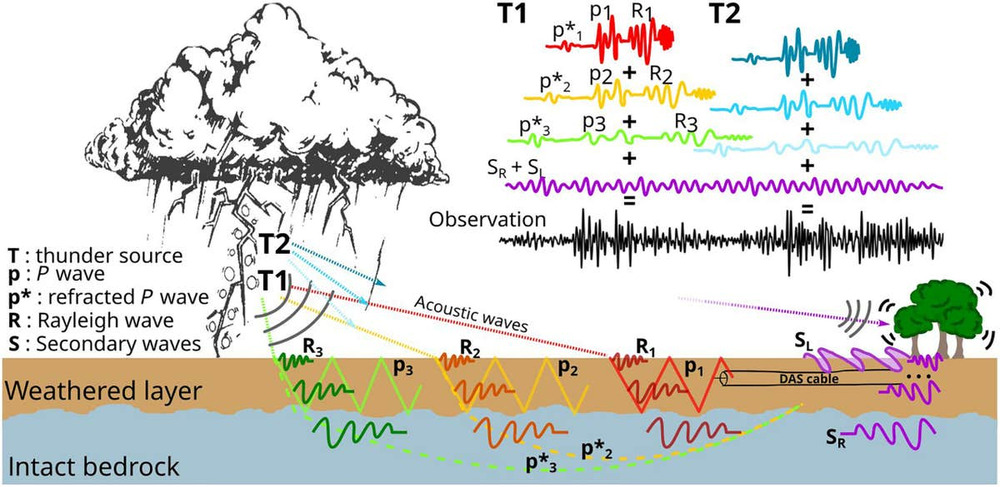
Thunderquake raypath diagram. Raypath schematic of thunderquake generation. Direct acoustic waves from along the thunderbolt (T1 and T2) couple into the ground and environment, creating propagating waves and surface waves. The summation of all these waves constitutes the thunderquake wavefield observed by DAS. (CREDIT: Tieyuan Zhu et al, Science Advances)
Date: 25/08/2026 06:12:36
From: Bubblecar
ID: 2423537
Subject: re: Using thunderquakes to X‑ray Earth – urban seismology
Very interesting, ta Tau. I hadn’t heard of thunderquakes before.