Date: 28/09/2026 00:25:06
From: Bubblecar
ID: 2434238
Subject: NASA’s Hubble Tracks New Decagon Encircling Saturn’s South Pole

Recent observations with NASA’s Hubble Space Telescope have revealed a giant, evolving, 10-sided atmospheric wave encircling Saturn’s south pole. This discovery marks the first time a large, regular-sided jet pattern has been observed in the planet’s southern hemisphere. The feature appears remarkably similar to Saturn’s famous hexagon at its northern pole, but is also distinctly different, suggesting scientists may be witnessing a new atmospheric phenomenon develop on the iconic gas giant.
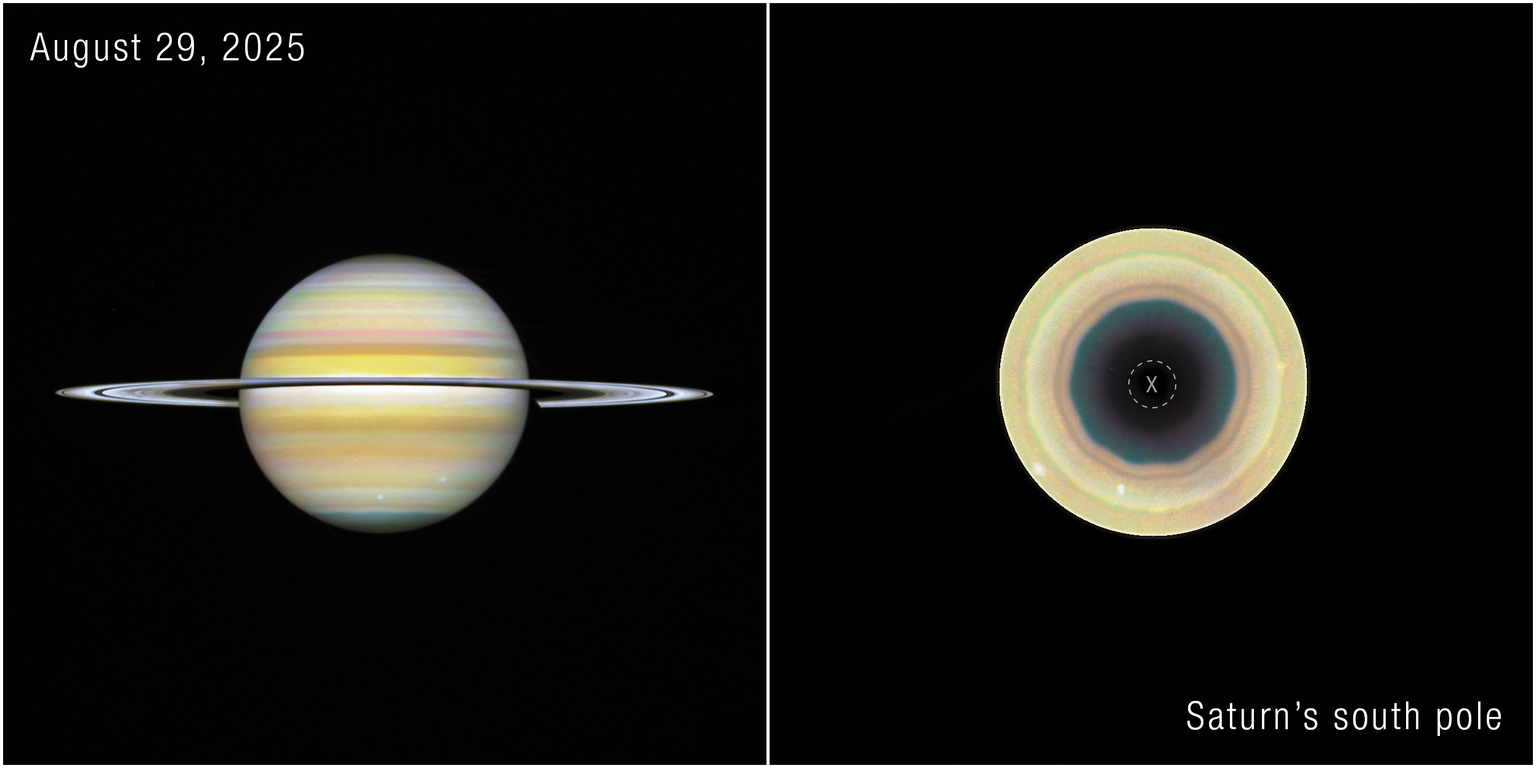
The results published Wednesday in the journal Science Advances.

By piecing together several years of Hubble observations dating back to 2023, researchers found subtle hints of the structure beginning to emerge before it became a clearly defined pattern. Those observations were taken as part of Hubble’s Outer Planet Atmospheres Legacy (OPAL) program, which has photographed the outer planets annually for more than a decade.

“We’ve never seen anything quite like this in Saturn’s southern hemisphere,” said Amy Simon, study co-author and OPAL principal investigator, NASA’s Goddard Space Flight Center in Greenbelt, Maryland. “The northern hexagon has been there every time we’ve looked for more than 40 years. This feature is different — it appears to be strengthening, giving us the rare opportunity to watch a giant atmospheric pattern develop.”

The discovery was possible because Saturn’s changing seasons gradually brought the planet’s south pole back into view from Earth, where astronomers who collectively analyze images of Saturn from ground-based observatories first identified it.
Full Report

Reply Quote

Date: 28/09/2026 01:08:03
From: dv
ID: 2434239
Subject: re: NASA’s Hubble Tracks New Decagon Encircling Saturn’s South Pole

Always up to something.

But I am very curious about why conditions would lead to different polygons at the poles.

Reply Quote

Date: 28/09/2026 04:45:49
From: SCIENCE
ID: 2434242
Subject: re: NASA’s Hubble Tracks New Decagon Encircling Saturn’s South Pole

yousr abc were already gushing about this like a couple of minutes ago

https://www.abc.net.au/news/2026-09-07/outback-amateur-astronomer-part-of-saturn-decagon-wave-discovery/107112590

Reply Quote

Date: 28/09/2026 13:43:33
From: Tau.Neutrino
ID: 2434348
Subject: re: NASA’s Hubble Tracks New Decagon Encircling Saturn’s South Pole

dv said:


Always up to something.

But I am very curious about why conditions would lead to different polygons at the poles.

Wookie is there, trying to make a Roman dodecahedron.

Reply Quote

Date: 30/09/2026 02:21:44
From: Tau.Neutrino
ID: 2434800
Subject: re: NASA’s Hubble Tracks New Decagon Encircling Saturn’s South Pole

It could be sending a signal.

Reply Quote

Date: 30/09/2026 02:27:49
From: Tau.Neutrino
ID: 2434801
Subject: re: NASA’s Hubble Tracks New Decagon Encircling Saturn’s South Pole

Tau.Neutrino said:


It could be sending a signal.

Decagon Kaleidoscope signals.

Reply Quote

Date: 30/09/2026 02:46:45
From: Tau.Neutrino
ID: 2434802
Subject: re: NASA’s Hubble Tracks New Decagon Encircling Saturn’s South Pole

Tau.Neutrino said:


Tau.Neutrino said:

It could be sending a signal.

Decagon Kaleidoscope signals.


Reply Quote

Date: 30/09/2026 02:51:03
From: Tau.Neutrino
ID: 2434803
Subject: re: NASA’s Hubble Tracks New Decagon Encircling Saturn’s South Pole

I see a Dr Who episode.

Other planets start doing the same pattern.

Dr Who becomes curious.

Reply Quote

Date: 30/09/2026 03:02:18
From: Tau.Neutrino
ID: 2434804
Subject: re: NASA’s Hubble Tracks New Decagon Encircling Saturn’s South Pole

Tau.Neutrino said:


I see a Dr Who episode.

Other planets start doing the same pattern.

Dr Who becomes curious.

Dr Who and the Decagons.

Reply Quote

Date: 30/09/2026 03:05:22
From: Tau.Neutrino
ID: 2434805
Subject: re: NASA’s Hubble Tracks New Decagon Encircling Saturn’s South Pole

dv said:


Always up to something.

But I am very curious about why conditions would lead to different polygons at the poles.

Could it be different gases behaving at different temperatures densities altitudes?

Reply Quote

Date: 30/09/2026 03:07:01
From: Tau.Neutrino
ID: 2434806
Subject: re: NASA’s Hubble Tracks New Decagon Encircling Saturn’s South Pole

Tau.Neutrino said:


dv said:

Always up to something.

But I am very curious about why conditions would lead to different polygons at the poles.

Could it be different gases behaving at different temperatures densities altitudes?

Influenced by the magagnetic field.

Reply Quote

Date: 30/09/2026 03:22:44
From: Tau.Neutrino
ID: 2434807
Subject: re: NASA’s Hubble Tracks New Decagon Encircling Saturn’s South Pole

Patterns in planetary magnetic fields.

Google

Planetary magnetic fields follow distinct structural and generation patterns across the solar system, generally categorized by whether they are dominated by a simple dipole (like a bar magnet) or complex multipoles, and whether they are powered by internal dynamos or solar wind interactions.

Dipole vs. Multipole Structures

• Dipole-Dominated Fields: Mercury, Earth, Jupiter, Saturn, and the moon Ganymede feature magnetic fields primarily shaped like a classic dipole, closely aligned with or near their rotation axes.

• Extreme Axisymmetry: Saturn’s magnetic field exhibits near-perfect alignment with its rotation axis, a rare pattern in the solar system. Earth and Jupiter also show strong axisymmetry.

• Multipole-Dominated Fields: Uranus and Neptune lack simple dipole structures. Their fields are dominated by higher-order multipoles, meaning they are far more complex, irregular, and heavily tilted or offset from their rotation centers.

Core Generation Classes (The Planetary Dynamo)

To generate an active internal magnetic field via the dynamo effect, a planet needs three main ingredients: rapid rotation, an energy supply, and a large volume of electrically conducting fluid.

• Molten Iron Cores: Terrestrial worlds like Earth and Mercury, alongside the moon Ganymede, generate fields via convection currents in liquid iron outer cores.

• Metallic Hydrogen Layers: Gas giants like Jupiter and Saturn house deep layers of compressed, liquid metallic hydrogen under extreme pressure, producing immense magnetic field strengths.

• Ionic Water-Ice Mantles: Ice giants Uranus and Neptune rely on fluid, conductive water-ammonia ice mantles rather than metallic interiors to drive their unusual dynamos.

Induced Fields and Crustal Remanence

• Induced Magnetospheres: Venus and Mars lack active internal dynamos. Instead, solar wind interacts directly with their upper atmospheres and ionospheres, creating weak, induced magnetic structures and draped magnetic tails.

• Fossil Magnetism: Ancient crustal remanence (frozen paleomagnetism) appears in rocks on Mars, the Earth’s Moon, and Mercury. This proves these bodies hosted early core dynamos billions of years ago before their internal heat died out

Further Exploration

• Explore comprehensive planetary magnetism mechanics through ScienceDirect Topics.

• Read the overview on space physics and dynamics via the NASA Technical Reports Server.

Reply Quote

Date: 1/10/2026 21:10:55
From: Tau.Neutrino
ID: 2435307
Subject: re: NASA’s Hubble Tracks New Decagon Encircling Saturn’s South Pole

I think the Decagon is caused by Saturn’s magnetic field lines interacting with the layers of gas and liquid metal hydrogen around the pole.

It would be interesting if a satellite was there that could observe the magnetic field lines.

Reply Quote

Date: 1/10/2026 21:32:31
From: Kingy
ID: 2435310
Subject: re: NASA’s Hubble Tracks New Decagon Encircling Saturn’s South Pole

If you were to draw a wave pattern, with round troughs and a pointy peak, then wrap them around a sphere/circle, you would get a hexagon/decagon/etc. It depends on the wavelength.

If you were to take this decagon and draw it in a straight line on a flat sheet with the center of the decagon at the bottom of the sheet, you would get a wave pattern.

Reply Quote

Date: 2/10/2026 17:15:51
From: Tau.Neutrino
ID: 2435557
Subject: re: NASA’s Hubble Tracks New Decagon Encircling Saturn’s South Pole

More on Saturn’s magnetic field.

Saturn’s magnetic field is stronger closer to its core and decreases in strength as you move farther away into space.

How Saturn’s Magnetic Field Works

• Core generation: Saturn’s magnetic field is generated deep inside the planet by a dynamo effect created by the churning motion of liquid metallic hydrogen surrounding its core.

• Field strength drop-off: Like a dipole magnet, the magnetic field intensity is highest near the region where it is generated close to the interior/core and weakens with an increasing distance (radius) out into the magnetosphere.

• Surface vs. Core: At Saturn’s cloud tops (equator), the magnetic field strength is about 0.2 gauss (21 microteslas), but it gets progressively more intense as you probe deeper toward the metallic hydrogen layer near the center.

Reply Quote

Date: 2/10/2026 17:17:57
From: Tau.Neutrino
ID: 2435559
Subject: re: NASA’s Hubble Tracks New Decagon Encircling Saturn’s South Pole

Saturn’s magnetic field is curiously warped, and one of its moons may be to blame

“A better understanding of Saturn’s environment is especially urgent now as plans for our return to Saturn and its moon Enceladus start to be developed.”

More…

Reply Quote

Date: 2/10/2026 17:21:29
From: Tau.Neutrino
ID: 2435560
Subject: re: NASA’s Hubble Tracks New Decagon Encircling Saturn’s South Pole

NASA article – Saturn’s Magnetosphere

Earth’s magnetic field creates a ‘bubble’ around Earth that helps protect our planet from some of the more harmful effects of energetic particles streaming out from the sun in the solar wind.

More…

Reply Quote