Date: 5/11/2013 22:38:56
From: mollwollfumble
ID: 426072
Subject: Calculus of variations?

It’s rocket science. I need to find a curve of thrust vs height that minimizes rocket fuel usage in the Earth’s atmosphere where the density decreases with height. This problem reduces to a minimization that ought to be solvable by the method of calculus of variations .

I learnt calculus of variations in 1977 and haven’t needed to use it since. When I try to solve this minimization using calculus of variations I get a nonsensical result, a curve that cannot be fitted to the value of y at either limit.

Where can I ask for help?

Reply Quote

Date: 5/11/2013 22:56:43
From: wookiemeister
ID: 426077
Subject: re: Calculus of variations?

you’d need a motor that had variable thrust as well I guess

Reply Quote

Date: 5/11/2013 23:52:45
From: sibeen
ID: 426092
Subject: re: Calculus of variations?

I had a look at that wiki page. As I’ve always with a wiki page on maths, the people who write these things should never be teachers :) Well above my pay grade. If I ever touched CoV, and I can’t remember ever doing so, it has been well scrubbed from my brane.

You can’t solve numerically, moll?

Reply Quote

Date: 6/11/2013 00:03:38
From: Stealth
ID: 426097
Subject: re: Calculus of variations?

sibeen said:


I had a look at that wiki page. As I’ve always with a wiki page on maths, the people who write these things should never be teachers :) Well above my pay grade. If I ever touched CoV, and I can’t remember ever doing so, it has been well scrubbed from my brane.

You can’t solve numerically, moll?


Solve it emperically. It is much more fun driving rockets around, than playing with pencil and paper.

Reply Quote

Date: 6/11/2013 00:17:42
From: PM 2Ring
ID: 426104
Subject: re: Calculus of variations?

sibeen said:


You can’t solve numerically, moll?

What he said. Maybe start with a simplified model, then adjust it using something like simulated annealing .

Also, are you sure that your equation contains all relevant terms? I assume that you’re trying to resolve this issue:
From http://en.wikipedia.org/wiki/Rocket_engine#Net_thrust

For optimal performance the pressure of the gas at the end of the nozzle should just equal the ambient pressure: if the exhaust’s pressure is lower than the ambient pressure, then the vehicle will be slowed by the difference in pressure between the top of the engine and the exit; on the other hand, if the exhaust’s pressure is higher, then exhaust pressure that could have been converted into thrust is not converted, and energy is wasted.

To maintain this ideal of equality between the exhaust’s exit pressure and the ambient pressure, the diameter of the nozzle would need to increase with altitude, giving the pressure a longer nozzle to act on (and reducing the exit pressure and temperature). This increase is difficult to arrange in a lightweight fashion, although is routinely done with other forms of jet engines. In rocketry a lightweight compromise nozzle is generally used and some reduction in atmospheric performance occurs when used at other than the ‘design altitude’ or when throttled.

[…]

Maximum thrust for a rocket engine is achieved by maximizing the momentum contribution of the equation without incurring penalties from over expanding the exhaust. This occurs when pe = pamb. Since ambient pressure changes with altitude, most rocket engines spend very little time operating at peak efficiency.

As Wookie said, perhaps an ideal solution would be impractical to implement.

Reply Quote

Date: 6/11/2013 03:38:46
From: mollwollfumble
ID: 426139
Subject: re: Calculus of variations?

> you’d need a motor that had variable thrust as well I guess

Yes, for a liquid-fueled motor or hybrid motor with fuel pump that’s relatively easy. For a solid-fueled motor it has to be done by multi-staging with four or more stages.

> You can’t solve numerically, moll? start with a simplified model, then adjust it using something like simulated annealing

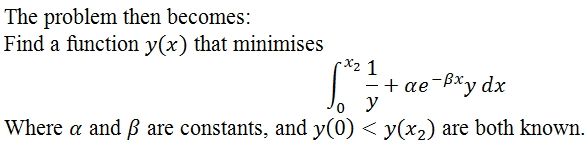
This is before the numerical solution. Currently y(0), x_2, y(x_2) (and possibly alpha) are unknowns. Searching through 3 or 4-D space numerically isn’t difficult – but with an unknown FUNCTION of x it becomes infinite dimensional, which would be a trifle more difficult. PS, I really loathe simulated annealing though you’re right in that it could be used effectively here. Simulated annealing is extremely slow so I would prefer a shooting method for this (nice terminology here, shooting a rocket into the air).

> Solve it emperically. It is much more fun driving rockets around, than playing with pencil and paper.

Am doing that too, in parallel. Pencil and paper costs a lot less than trial and error, and tends to be much faster.

> are you sure that your equation contains all relevant terms?

No. I’m feeling more and more as if I’m missing something extremely important. I know I’m simplifying reality in several ways (such as assuming constant drag coefficient, when data says that it decreases with speed) but I feel as if I’m missing something more important.

> I assume that you’re trying to resolve this issue:
From http://en.wikipedia.org/wiki/Rocket_engine#Net_thrust
… Since ambient pressure changes with altitude, most rocket engines spend very little time operating at peak efficiency.

That’s exactly the problem I’m trying to crack, adjusting thrust to get as close as possible to peak efficiency over the whole range of air pressures.
Reply Quote

Date: 6/11/2013 07:29:00
From: Spiny Norman
ID: 426146
Subject: re: Calculus of variations?

mollwollfumble said:


… Since ambient pressure changes with altitude, most rocket engines spend very little time operating at peak efficiency.

That’s exactly the problem I’m trying to crack, adjusting thrust to get as close as possible to peak efficiency over the whole range of air pressures.

Use an aerospike type nozzle, they are self-adjusting and so have a far better plateau of high efficiency.

Reply Quote

Date: 6/11/2013 07:29:55
From: Spiny Norman
ID: 426147
Subject: re: Calculus of variations?

Spiny Norman said:

Use an aerospike type nozzle, they are self-adjusting and so have a far better plateau of high efficiency.

Edit – at least up to about 40 km, then the air pressure varies very little after that and a conventional rocket bell is fine.

Reply Quote

Date: 6/11/2013 09:26:48
From: mollwollfumble
ID: 426166
Subject: re: Calculus of variations?

> Use an aerospike type nozzle, they are self-adjusting and so have a far better plateau of high efficiency – at least up to about 40 km, then the air pressure varies very little after that and a conventional rocket bell is fine.

That’s very interesting, I hadn’t seen a nozzle like that (other than on Star Wars) before and I’ve seen quite a few.

On the topic of calculus of variations. There are two possibilities.

1. The calculus of variations gives optimal speed is inversely proportional to the square root of air density. This doesn’t match boundary conditions on speed, but if I adjust the boundary conditions to match the optimal speed then the whole analysis becomes very very easy. There are no free parameters that need optimization.

2. The second possibility is based on the assumption that the rocket propulsion goes through three phases: a rapid thrust boost to bring it up to optimal speed, an optimal speed phase, and a final coast to maximum altitude. Each phase is individually optimized (in possibility 1) but it could be that transitions between the phases are very far from optimal so two or three phases need to be analysed together in the one integral.

I don’t know which of the above is correct, so I’m looking for some toy mathematics that may illustrate the need for the second possibility. eg. minimise the integral from 0 to 1 of |dy/dx| + y + 1/y given boundary conditions y(0) = y(1) = 0 using calculus of variations. I’m not at all sure that that one even has a solution, but it mimics several features of the one I’m trying to solve.

Reply Quote

Date: 6/11/2013 12:58:15
From: Stealth
ID: 426244
Subject: re: Calculus of variations?

Are allowances made for the changing weight of the rocket (which can be huge)?

Reply Quote

Date: 6/11/2013 14:28:07
From: Spiny Norman
ID: 426280
Subject: re: Calculus of variations?

mollwollfumble said:


> Use an aerospike type nozzle, they are self-adjusting and so have a far better plateau of high efficiency – at least up to about 40 km, then the air pressure varies very little after that and a conventional rocket bell is fine.

That’s very interesting, I hadn’t seen a nozzle like that (other than on Star Wars) before and I’ve seen quite a few.

I’m The Rocket Man.

Here’s some of my minor tests …

http://www.youtube.com/watch?v=4KiPl5JATsE

Reply Quote

Date: 7/11/2013 18:15:46
From: mollwollfumble
ID: 427105
Subject: re: Calculus of variations?

> Are allowances made for the changing weight of the rocket (which can be huge)

Sure are.

> I’m The Rocket Man. Here’s some of my minor tests … http://www.youtube.com/watch?v=4KiPl5JATsE

That is superb.

Reply Quote