Date: 21/12/2013 08:26:47
From: mollwollfumble
ID: 454509
Subject: Electronic maths question?
This is a straightforward maths question, for solving an electronic problem.
The time delay of a timer is given as 1.1*R*C where the time is in seconds, resistance R in ohms and capacitance C in farads. eg. a 100 kOhm resistor with a 10 microFarad capacitor gives a time delay of 1.1 seconds.
I want to get a time delay between 3.95 and 4 seconds.
I have 6 capacitors with sizes (in microFarads) 4.7, 10, 22, 33, 47, 100
Resistors (in kOhms) come in sizes 39, 47, 56, 68, 82, 100,120, 150, 180, 220, 270, 330, 390, 470, 560, 750, 1000
How many of the 6 capacitors can be used to get that time delay with one resistor?
For each of the 6 capacitors what pair of resistors in parallel (if possible) will give the correct time delay?
eg. the resistance of a 100 & 150 kOhm resistor in parallel is 1/(1/100+1/150) = 60 kOhm.
———————
Note, this is a practical problem, I need to get 5 time delays in that range.
Date: 21/12/2013 08:31:56
From: transition
ID: 454511
Subject: re: Electronic maths question?
generally with higher value C and R the leakage of the capacitors becomes an R component you don’t want (and changes with temp and age), so instead you clock a smaller RC arrangement and use the steps.
Date: 21/12/2013 10:23:41
From: transition
ID: 454607
Subject: re: Electronic maths question?
>I want to get a time delay between 3.95 and 4 seconds.
Not sure what your chances are of getting +/- .025 seconds accurancy and reliable adjustment/changes with capacitors, even if the RC were stable over whatever temp range (and age and component spread etc), then there are trigger threshold variations (if you are triggering at some upper and lower voltages).
If you are hoping the plonk within that +/- .025 for single time delay you’d have to trim it, and it may wander outside that anyway.
Date: 21/12/2013 11:23:14
From: wookiemeister
ID: 454678
Subject: re: Electronic maths question?
resistors and capacitors won’t have the accuracy you need
Date: 21/12/2013 11:25:07
From: Riff-in-Thyme
ID: 454680
Subject: re: Electronic maths question?
wookiemeister said:
resistors and capacitors won’t have the accuracy you need
need something with more lamella feedback characteristics?
Date: 21/12/2013 11:25:23
From: roughbarked
ID: 454681
Subject: re: Electronic maths question?
>I want to get a time delay between 3.95 and 4 seconds.
for this you need a chronometer.
Date: 21/12/2013 11:26:53
From: wookiemeister
ID: 454683
Subject: re: Electronic maths question?
I would use a 555 timer in conjunction with capacitors and resistors to create a timed pulse
Date: 21/12/2013 11:27:38
From: fsm
ID: 454685
Subject: re: Electronic maths question?
You should use something like this…
http://www.jaycar.com.au/productView.asp?ID=ZL3555
Date: 21/12/2013 11:27:43
From: wookiemeister
ID: 454686
Subject: re: Electronic maths question?
another approach could be straight forward clockwork, the hand goes around and strikes contacts as it travels around
Date: 21/12/2013 11:28:40
From: roughbarked
ID: 454687
Subject: re: Electronic maths question?
wookiemeister said:
another approach could be straight forward clockwork, the hand goes around and strikes contacts as it travels around
eg: the average digital is way less accurate than an analog chronometer.
Date: 21/12/2013 11:29:22
From: roughbarked
ID: 454689
Subject: re: Electronic maths question?
wookiemeister said:
another approach could be straight forward clockwork, the hand goes around and strikes contacts as it travels around
The problem though is maintaning power, over the humps.
Date: 21/12/2013 11:34:27
From: wookiemeister
ID: 454692
Subject: re: Electronic maths question?
fsm said:
You should use something like this…
http://www.jaycar.com.au/productView.asp?ID=ZL3555
yeah the 555 timer is a good way to go for a simple way to create timed pulses
you could have the timed output of one 555 timer linked to another 555 timer, as the first timer pulses whatever it also pulses a voltage on the trigger input of another 555 timer
its a good way of creating timed pulses
if you need other stuff with that timing you’d be better off with a microcontroller
Date: 21/12/2013 11:35:13
From: roughbarked
ID: 454694
Subject: re: Electronic maths question?
wookiemeister said:
fsm said:
You should use something like this…
http://www.jaycar.com.au/productView.asp?ID=ZL3555
yeah the 555 timer is a good way to go for a simple way to create timed pulses
you could have the timed output of one 555 timer linked to another 555 timer, as the first timer pulses whatever it also pulses a voltage on the trigger input of another 555 timer
its a good way of creating timed pulses
if you need other stuff with that timing you’d be better off with a microcontroller
ie: a chronometer.
Date: 21/12/2013 11:35:59
From: wookiemeister
ID: 454695
Subject: re: Electronic maths question?
roughbarked said:
wookiemeister said:
another approach could be straight forward clockwork, the hand goes around and strikes contacts as it travels around
The problem though is maintaning power, over the humps.
you use a geared electric motor with a reliable powersource
by varying the voltage you make the strikes slower or faster
Date: 21/12/2013 11:36:42
From: roughbarked
ID: 454697
Subject: re: Electronic maths question?
wookiemeister said:
roughbarked said:
wookiemeister said:
another approach could be straight forward clockwork, the hand goes around and strikes contacts as it travels around
The problem though is maintaning power, over the humps.
you use a geared electric motor with a reliable powersource
by varying the voltage you make the strikes slower or faster
whusedhewasdum?
Date: 21/12/2013 11:37:01
From: wookiemeister
ID: 454698
Subject: re: Electronic maths question?
roughbarked said:
wookiemeister said:
fsm said:
You should use something like this…
http://www.jaycar.com.au/productView.asp?ID=ZL3555
yeah the 555 timer is a good way to go for a simple way to create timed pulses
you could have the timed output of one 555 timer linked to another 555 timer, as the first timer pulses whatever it also pulses a voltage on the trigger input of another 555 timer
its a good way of creating timed pulses
if you need other stuff with that timing you’d be better off with a microcontroller
ie: a chronometer.
I was being specific
any clock is a chronometer
Date: 21/12/2013 11:38:52
From: roughbarked
ID: 454700
Subject: re: Electronic maths question?
wookiemeister said:
roughbarked said:
wookiemeister said:
yeah the 555 timer is a good way to go for a simple way to create timed pulses
you could have the timed output of one 555 timer linked to another 555 timer, as the first timer pulses whatever it also pulses a voltage on the trigger input of another 555 timer
its a good way of creating timed pulses
if you need other stuff with that timing you’d be better off with a microcontroller
ie: a chronometer.
I was being specific
well you need to be more so.
wookiemeister said:any clock is a chronometer
no
Date: 21/12/2013 11:39:23
From: wookiemeister
ID: 454701
Subject: re: Electronic maths question?
roughbarked said:
wookiemeister said:
roughbarked said:
The problem though is maintaning power, over the humps.
you use a geared electric motor with a reliable powersource
by varying the voltage you make the strikes slower or faster
whusedhewasdum?
the
IRA used clockwork time pieces in their bombs on a regular basis – in fact it was a hallmark of their devices, a clockwork time piece driven by a motor or spring with striking contacts. the times of strike could be visually confirmed rather than by calculation and prayer that electronics would do what they should.
Date: 21/12/2013 11:39:51
From: wookiemeister
ID: 454703
Subject: re: Electronic maths question?
Date: 21/12/2013 11:41:21
From: macx
ID: 454704
Subject: re: Electronic maths question?
Enter two of the required values and Hit the third button to calculate the required value. You may also choose the suitable units.
http://www.referencedesigner.com/rfcal/cal_05.php
HTH
<><><><><><><>
macx
Date: 21/12/2013 11:42:48
From: roughbarked
ID: 454705
Subject: re: Electronic maths question?
wookiemeister said:
roughbarked said:
wookiemeister said:
you use a geared electric motor with a reliable powersource
by varying the voltage you make the strikes slower or faster
whusedhewasdum?
the IRA used clockwork time pieces in their bombs on a regular basis – in fact it was a hallmark of their devices, a clockwork time piece driven by a motor or spring with striking contacts. the times of strike could be visually confirmed rather than by calculation and prayer that electronics would do what they should.
Mechanics in the way of clockwork can be timed via several methods. Yes the same can be done with electronics but the methodology was learned form making clocks. This tech is thousands of years old. The thing I mentioned is, that if one takes planned obsolescence into account, then digital timers aren’t worth thinking about.
Date: 21/12/2013 11:43:58
From: roughbarked
ID: 454707
Subject: re: Electronic maths question?
macx said:
Enter two of the required values and Hit the third button to calculate the required value. You may also choose the suitable units.
http://www.referencedesigner.com/rfcal/cal_05.php
HTH
<><><><><><><>
macx
:) hi ya. :)
Date: 21/12/2013 11:47:21
From: roughbarked
ID: 454708
Subject: re: Electronic maths question?
As regards digital watch or clock circuits. less than 20% of those manufactured reach chronograph capability.
Date: 21/12/2013 11:48:07
From: macx
ID: 454709
Subject: re: Electronic maths question?
>>>:) hi ya. :)
and you also….
Just popping in for a while over the festive season.
I see things have not changed a great deal.
:)
macx
Date: 21/12/2013 11:48:58
From: roughbarked
ID: 454710
Subject: re: Electronic maths question?
macx said:
>>>:) hi ya. :)
and you also….
Just popping in for a while over the festive season.
I see things have not changed a great deal.
:)
macx
indeed they have but hey..
change is the only constant?
Date: 21/12/2013 11:50:44
From: wookiemeister
ID: 454711
Subject: re: Electronic maths question?
actually just looking
http://www.miniinthebox.com/pro-mini-microcontroller-circuit-board-for-arduino-5v-16mhz_p764222.html?currency=AUD&litb_from=paid_adwords_shopping&pla_adwid=9286587055_138818343_9138179223_60166996743&gclid=CLSilfyLwLsCFcXFpAodIDoAAw
$12.18
this arduino can deliver many output signals , can be programmed easily, doesn’t need extra components
a 555 approach using separate ICs with resistors and capacitors will require more time to put together than the timers
this is why microcontrollers rule the roost
Date: 21/12/2013 11:50:45
From: roughbarked
ID: 454712
Subject: re: Electronic maths question?
roughbarked said:
macx said:
>>>:) hi ya. :)
and you also….
Just popping in for a while over the festive season.
I see things have not changed a great deal.
:)
macx
indeed they have but hey..
change is the only constant?
if that sounded screwed.. think about it for a bit.
Date: 21/12/2013 11:52:27
From: roughbarked
ID: 454713
Subject: re: Electronic maths question?
wookiemeister said:
actually just looking
http://www.miniinthebox.com/pro-mini-microcontroller-circuit-board-for-arduino-5v-16mhz_p764222.html?currency=AUD&litb_from=paid_adwords_shopping&pla_adwid=9286587055_138818343_9138179223_60166996743&gclid=CLSilfyLwLsCFcXFpAodIDoAAw
$12.18
this arduino can deliver many output signals , can be programmed easily, doesn’t need extra components
a 555 approach using separate ICs with resistors and capacitors will require more time to put together than the timers
this is why microcontrollers rule the roost
as long as it is accurate.. it will
after that, it needs a tech to know which part to replace or poise.
Date: 21/12/2013 11:54:53
From: macx
ID: 454714
Subject: re: Electronic maths question?
“A chronometer is a high-precision watch capable of displaying the seconds and housing a movement that has been tested over several days, in different positions and at different temperatures, by an official neutral body (COSC).
Each chronometer is unique, identified by a number engraved on its movement and a certification number given by the COSC.
Each movement is individually tested for several consecutive days, in 5 positions and at 3 temperatures.
Each movement is individually measured. Any watch with the denomination “chronometer” is provided with a certified movement.”
><><><><><>
from here:
http://www.cosc.ch/chronometre.php?lang=en
macx
Date: 21/12/2013 11:57:44
From: roughbarked
ID: 454715
Subject: re: Electronic maths question?
macx said:
“A chronometer is a high-precision watch capable of displaying the seconds and housing a movement that has been tested over several days, in different positions and at different temperatures, by an official neutral body (COSC).
Each chronometer is unique, identified by a number engraved on its movement and a certification number given by the COSC.
Each movement is individually tested for several consecutive days, in 5 positions and at 3 temperatures.
Each movement is individually measured. Any watch with the denomination “chronometer” is provided with a certified movement.”
><><><><><>
from here:
http://www.cosc.ch/chronometre.php?lang=en
macx
Blame the carpenter turned clockmaker, John Harrison for his attendance to perfection of the capacity for accuracy.
Date: 21/12/2013 11:59:32
From: macx
ID: 454716
Subject: re: Electronic maths question?
>>>…this is why microcontrollers rule the roost
The system timing will only be as good (accurate and stable) as the system “clock, usually an el cheapo’ crystal osc with little or no regard to temperature compensation and they invariably use a small equally el cheapo’ capacitor in the osc circuitry.
Digital is not a synonym for accurate!!
:)
macx
Date: 21/12/2013 12:02:35
From: macx
ID: 454717
Subject: re: Electronic maths question?
>>Blame the carpenter turned clockmaker, John Harrison for his attendance to perfection of the capacity for accuracy.
Indeed.
There is a documentary on Harrison and his clocks (and his fight with the Admiralty) which shows on TV every now and again.
I am a great admirer of Harrison.
macx
Date: 21/12/2013 12:02:46
From: roughbarked
ID: 454718
Subject: re: Electronic maths question?
macx said:
>>>…this is why microcontrollers rule the roost
Digital is not a synonym for accurate!!
:)
macx
This is what I’ve been trying to get across.
OK so we think and generally do believe that why digital clocks overran the mechanical ones, was simply because they were more accurate.. this is erroneous. the reason was because they were cheap to make.
Date: 21/12/2013 12:04:42
From: roughbarked
ID: 454719
Subject: re: Electronic maths question?
macx said:
>>Blame the carpenter turned clockmaker, John Harrison for his attendance to perfection of the capacity for accuracy.
Indeed.
There is a documentary on Harrison and his clocks (and his fight with the Admiralty) which shows on TV every now and again.
I am a great admirer of Harrison.
macx
Myself as well
they say that Jesus was a carpenter.. then if so he would know the meaning of FN.
Date: 21/12/2013 12:06:43
From: Riff-in-Thyme
ID: 454720
Subject: re: Electronic maths question?
roughbarked said:
macx said:
>>Blame the carpenter turned clockmaker, John Harrison for his attendance to perfection of the capacity for accuracy.
Indeed.
There is a documentary on Harrison and his clocks (and his fight with the Admiralty) which shows on TV every now and again.
I am a great admirer of Harrison.
macx
Myself as well
they say that Jesus was a carpenter.. then if so he would know the meaning of FN.
the revised opinion based upon substantial evidence was that the term ‘carpenter’ passed for the term ‘engineer’ before industrialisation. They believe his father was an engineer of the age……
Date: 21/12/2013 12:08:09
From: roughbarked
ID: 454721
Subject: re: Electronic maths question?
Riff-in-Thyme said:
roughbarked said:
macx said:
>>Blame the carpenter turned clockmaker, John Harrison for his attendance to perfection of the capacity for accuracy.
Indeed.
There is a documentary on Harrison and his clocks (and his fight with the Admiralty) which shows on TV every now and again.
I am a great admirer of Harrison.
macx
Myself as well
they say that Jesus was a carpenter.. then if so he would know the meaning of FN.
the revised opinion based upon substantial evidence was that the term ‘carpenter’ passed for the term ‘engineer’ before industrialisation. They believe his father was an engineer of the age……
This is all cuckoo.
turn the page to cuckoo clocks.
Date: 21/12/2013 12:09:42
From: macx
ID: 454722
Subject: re: Electronic maths question?
A Brief History of Atomic Clocks at NIST
http://tf.nist.gov/cesium/atomichistory.htm
“1999 — NIST-F1 begins operation with an uncertainty of 1.7 × 10⁻¹⁵, or accuracy to about one second in 20 million years, making it one of the most accurate clocks ever made (a distinction shared with similar standards in France and Germany).”
…and there are today even more accurate clocks, but they have not (yet) been adopted as “standards” because they do not have the “history” of the Caesium beam clocks. eg hydrogen maser, quantum dot technology etc.
macx
Date: 21/12/2013 12:10:33
From: roughbarked
ID: 454723
Subject: re: Electronic maths question?
roughbarked said:
Riff-in-Thyme said:
roughbarked said:
Myself as well
they say that Jesus was a carpenter.. then if so he would know the meaning of FN.
the revised opinion based upon substantial evidence was that the term ‘carpenter’ passed for the term ‘engineer’ before industrialisation. They believe his father was an engineer of the age……
This is all cuckoo.
turn the page to cuckoo clocks.
Just look at it this way.. before we could calculate time
science would be hearsay..
the greater the accuracy..
well, need In say more?
Date: 21/12/2013 12:11:16
From: roughbarked
ID: 454724
Subject: re: Electronic maths question?
macx said:
A Brief History of Atomic Clocks at NIST
http://tf.nist.gov/cesium/atomichistory.htm
“1999 — NIST-F1 begins operation with an uncertainty of 1.7 × 10⁻¹⁵, or accuracy to about one second in 20 million years, making it one of the most accurate clocks ever made (a distinction shared with similar standards in France and Germany).”
…and there are today even more accurate clocks, but they have not (yet) been adopted as “standards” because they do not have the “history” of the Caesium beam clocks. eg hydrogen maser, quantum dot technology etc.
macx
They are indeed an impost to wear on the wrist.
Date: 21/12/2013 12:14:53
From: Riff-in-Thyme
ID: 454725
Subject: re: Electronic maths question?
roughbarked said:
roughbarked said:
Riff-in-Thyme said:
the revised opinion based upon substantial evidence was that the term ‘carpenter’ passed for the term ‘engineer’ before industrialisation. They believe his father was an engineer of the age……
This is all cuckoo.
turn the page to cuckoo clocks.
Just look at it this way.. before we could calculate time
science would be hearsay..
the greater the accuracy..
well, need In say more?
the wheel wasn’t the bit we needed huh? bloody pendulums(excuse the battle muck)
Date: 21/12/2013 12:15:45
From: macx
ID: 454726
Subject: re: Electronic maths question?
A magnificent article from NIST re “clocks”
http://tf.nist.gov/general/pdf/2039.pdf
…and lots of piccy’s.
macx
Date: 21/12/2013 12:17:15
From: Riff-in-Thyme
ID: 454728
Subject: re: Electronic maths question?
macx said:
A magnificent article from NIST re “clocks”
http://tf.nist.gov/general/pdf/2039.pdf
…and lots of piccy’s.
macx
measurement uncertainty evaluations. awesome phrase
Date: 21/12/2013 12:17:34
From: roughbarked
ID: 454729
Subject: re: Electronic maths question?
Riff-in-Thyme said:
roughbarked said:
roughbarked said:
This is all cuckoo.
turn the page to cuckoo clocks.
Just look at it this way.. before we could calculate time
science would be hearsay..
the greater the accuracy..
well, need In say more?
the wheel wasn’t the bit we needed huh? bloody pendulums(excuse the battle muck)
I take your point but the wheel was long in use before the adaptation.
Date: 21/12/2013 12:18:10
From: roughbarked
ID: 454730
Subject: re: Electronic maths question?
Riff-in-Thyme said:
macx said:
A magnificent article from NIST re “clocks”
http://tf.nist.gov/general/pdf/2039.pdf
…and lots of piccy’s.
macx
measurement uncertainty evaluations. awesome phrase
deep.
Date: 21/12/2013 12:18:53
From: Riff-in-Thyme
ID: 454731
Subject: re: Electronic maths question?
roughbarked said:
Riff-in-Thyme said:
roughbarked said:
Just look at it this way.. before we could calculate time
science would be hearsay..
the greater the accuracy..
well, need In say more?
the wheel wasn’t the bit we needed huh? bloody pendulums(excuse the battle muck)
I take your point but the wheel was long in use before the adaptation.
it’s the work horse but we got a bit hypnotised with travelling on them everywhere
Date: 21/12/2013 12:19:28
From: roughbarked
ID: 454732
Subject: re: Electronic maths question?
Riff-in-Thyme said:
roughbarked said:
Riff-in-Thyme said:
the wheel wasn’t the bit we needed huh? bloody pendulums(excuse the battle muck)
I take your point but the wheel was long in use before the adaptation.
it’s the work horse but we got a bit hypnotised with travelling on them everywhere
wouldn’t you?
Date: 21/12/2013 12:19:34
From: macx
ID: 454733
Subject: re: Electronic maths question?
>>>measurement uncertainty evaluations. awesome phrase
It is, and especially when one knows what it means!
macx
Date: 21/12/2013 12:21:36
From: Riff-in-Thyme
ID: 454735
Subject: re: Electronic maths question?
roughbarked said:
Riff-in-Thyme said:
roughbarked said:
I take your point but the wheel was long in use before the adaptation.
it’s the work horse but we got a bit hypnotised with travelling on them everywhere
wouldn’t you?
you mean “didn’t I bloody ever!!” Bit over tearing it up from one place to another these days though……..
Date: 21/12/2013 12:22:40
From: Riff-in-Thyme
ID: 454736
Subject: re: Electronic maths question?
macx said:
>>>measurement uncertainty evaluations. awesome phrase
It is, and especially when one knows what it means!
macx
and applies it as ones most fundamental self analysis tool……..
Date: 21/12/2013 12:24:10
From: roughbarked
ID: 454739
Subject: re: Electronic maths question?
Riff-in-Thyme said:
roughbarked said:
Riff-in-Thyme said:
it’s the work horse but we got a bit hypnotised with travelling on them everywhere
wouldn’t you?
you mean “didn’t I bloody ever!!” Bit over tearing it up from one place to another these days though……..
take a beer, cool off between each phase.. one beer is usually enough.
Date: 21/12/2013 12:25:13
From: roughbarked
ID: 454741
Subject: re: Electronic maths question?
Riff-in-Thyme said:
macx said:
>>>measurement uncertainty evaluations. awesome phrase
It is, and especially when one knows what it means!
macx
and applies it as ones most fundamental self analysis tool……..
and people think I talk crap.
try applying this to my posts, in evaluation.
Date: 21/12/2013 12:25:19
From: macx
ID: 454742
Subject: re: Electronic maths question?
Recloaks and re-enters sub space.
BBL
macx
Date: 21/12/2013 12:26:01
From: Riff-in-Thyme
ID: 454743
Subject: re: Electronic maths question?
roughbarked said:
Riff-in-Thyme said:
roughbarked said:
wouldn’t you?
you mean “didn’t I bloody ever!!” Bit over tearing it up from one place to another these days though……..
take a beer, cool off between each phase.. one beer is usually enough.
if it is coopers celebration ale I can’t really stop till I’ve guzzled six. they are bastard arse enablers I say!!!!!
Date: 21/12/2013 12:27:05
From: roughbarked
ID: 454748
Subject: re: Electronic maths question?
macx said:
Recloaks and re-enters sub space.
BBL
macx
was good seeing you. :)
Date: 21/12/2013 12:28:08
From: Riff-in-Thyme
ID: 454750
Subject: re: Electronic maths question?
macx said:
Recloaks and re-enters sub space.
BBL
macx
hate it when he does that. always wonder what his missus must look like if he takes that much trouble to hide her whereabouts……
Date: 21/12/2013 12:29:07
From: roughbarked
ID: 454752
Subject: re: Electronic maths question?
Riff-in-Thyme said:
macx said:
Recloaks and re-enters sub space.
BBL
macx
hate it when he does that. always wonder what his missus must look like if he takes that much trouble to hide her whereabouts……
I’d try not to elaborate, if I was you.
Date: 21/12/2013 12:30:24
From: Riff-in-Thyme
ID: 454756
Subject: re: Electronic maths question?
roughbarked said:
Riff-in-Thyme said:
macx said:
Recloaks and re-enters sub space.
BBL
macx
hate it when he does that. always wonder what his missus must look like if he takes that much trouble to hide her whereabouts……
I’d try not to elaborate, if I was you.
He’s probably just doing it for the kids……
Date: 21/12/2013 16:02:14
From: mollwollfumble
ID: 454808
Subject: re: Electronic maths question?
> You should use something like this… http://www.jaycar.com.au/productView.asp?ID=ZL3555
> you could have the timed output of one 555 timer linked to another 555 timer, as the first timer pulses whatever it also pulses a voltage on the trigger input of another 555 timer
Both of those are exactly what I am using. The time delay for a 555 timer is ln(3)*R*C. Hence the problem.
This link might help.
http://www.sengpielaudio.com/calculator-parallel.htm
Date: 21/12/2013 16:15:29
From: Carmen_Sandiego
ID: 454819
Subject: re: Electronic maths question?
Molly, what is the output driving?
I have one or two of these things kicking around I can drop in the mail for you:
http://www.unitronics.com/plc-hmi/micro-oplc/m90-m91-
http://www.unitronics.com/Downloads/Support/Technical%20Library/M90M91%20Hardware/M90%20-%20Specifications/M90-T.pdf
You should be able to get them to operate an output to whatever time you want to 10ms accuracy.
Date: 21/12/2013 16:22:02
From: Carmen_Sandiego
ID: 454824
Subject: re: Electronic maths question?
Hmmm… reading the question, I am not sure it will do what you want.
I do not think you could build something that accurate with the hardware you’re looking at without temperature control and trimpots.
Date: 21/12/2013 16:28:28
From: mollwollfumble
ID: 454830
Subject: re: Electronic maths question?
mollwollfumble said:
This is a straightforward maths question, for solving an electronic problem.
The time delay of a timer is given as 1.1*R*C where the time is in seconds, resistance R in ohms and capacitance C in farads. I want to get a time delay between 3.95 and 4 seconds.
I have 6 capacitors with sizes (in microFarads) 4.7, 10, 22, 33, 47, 100
Resistors (in kOhms) come in sizes 39, 47, 56, 68, 82, 100,120, 150, 180, 220, 270, 330, 390, 470, 560, 750, 1000
How many of the 6 capacitors can be used to get that time delay with one resistor? For each of the 6 capacitors what pair of resistors in parallel (if possible) will give the correct time delay?
Set it up in Excel, looks like four possibilities.
22 microFarads with 330 & 330 kOhm in parallel – 3.99 seconds
33 microFarads with 220 & 220 kOhm in parallel – 3.99 seconds
47 microFarads with 100 & 330 kOhm in parallel – 3.96 seconds
100 microFarads with 39 and 470 kOhm in parallel – 3.96 seconds
Give or take the accuracy of the resistors (eg. 1%, 5%) and capacitors.
What’s the accuracy of typical electrolytic capacitors?
PS. I am aware of Klipstein’s Law of Specification: In specifications, Murphy’s Law supersedes Ohm’s.
Date: 21/12/2013 16:31:42
From: mollwollfumble
ID: 454832
Subject: re: Electronic maths question?
Carmen_Sandiego said:
Molly, what is the output driving?
I have one or two of these things kicking around I can drop in the mail for you:
http://www.unitronics.com/plc-hmi/micro-oplc/m90-m91-
http://www.unitronics.com/Downloads/Support/Technical%20Library/M90M91%20Hardware/M90%20-%20Specifications/M90-T.pdf
You should be able to get them to operate an output to whatever time you want to 10ms accuracy.
Ooh nice. A bit heavy for me though, I need to fit this in a rocket nosecone. The timer is for setting off rocket stages.
Date: 21/12/2013 16:31:42
From: Wocky
ID: 454833
Subject: re: Electronic maths question?
mollwollfumble said:
Give or take the accuracy of the resistors (eg. 1%, 5%) and capacitors.
What’s the accuracy of typical electrolytic capacitors?
PS. I am aware of Klipstein’s Law of Specification: In specifications, Murphy’s Law supersedes Ohm’s.
Electrolytic caps are generally around +/- 20%, but should be marked on the package.
Using a 555 for long times (more than about 250ms) is a bad idea. The accuracy decreases considerably as the time increases.
Date: 21/12/2013 16:50:11
From: wookiemeister
ID: 454846
Subject: re: Electronic maths question?
The 12 dollar arduino mini will give accuracy to 1 millisecond , it can control servos after all
It’s only 12 bucks
Date: 21/12/2013 17:14:04
From: Michael V
ID: 454853
Subject: re: Electronic maths question?
Wocky said:
mollwollfumble said:
Give or take the accuracy of the resistors (eg. 1%, 5%) and capacitors.
What’s the accuracy of typical electrolytic capacitors?
PS. I am aware of Klipstein’s Law of Specification: In specifications, Murphy’s Law supersedes Ohm’s.
Electrolytic caps are generally around +/- 20%, but should be marked on the package.
Using a 555 for long times (more than about 250ms) is a bad idea. The accuracy decreases considerably as the time increases.
What about a 555 triggering addition on a calculator chip? When output number = (your time) equivalent, then trigger job.
Date: 21/12/2013 21:03:17
From: transition
ID: 455005
Subject: re: Electronic maths question?
>Ooh nice. A bit heavy for me though, I need to fit this in a rocket nosecone. The timer is for setting off rocket stages.
:) always wished had been involved in rocketry as a hobby.
Good luck!
Date: 22/12/2013 20:36:38
From: mollwollfumble
ID: 455783
Subject: re: Electronic maths question?
> Electrolytic caps are generally around +/- 20%, but should be marked on the package.
Ah, in that case Murphy’s law does supersede ohms. Unless they’re very temperature sensitive it looks like a case of try resistor combinations until I get the timing I want. Not much point in insisting on 1% resistor accuracy then.
> :) always wished had been involved in rocketry as a hobby.
There’s no time like the future. Had no interest in it earlier, would still have no interest in ground launch if I hadn’t calculated that it was possible to get into space for less than the price of a typical car. Now I’ve cut that price down to about $500. I still have to prove that the method works, though.
Date: 22/12/2013 20:38:20
From: Spiny Norman
ID: 455784
Subject: re: Electronic maths question?
mollwollfumble said:
There’s no time like the future. Had no interest in it earlier, would still have no interest in ground launch if I hadn’t calculated that it was possible to get into space for less than the price of a typical car. Now I’ve cut that price down to about $500. I still have to prove that the method works, though.
It’s been interesting watching the progress.
Date: 22/12/2013 20:39:45
From: poikilotherm
ID: 455786
Subject: re: Electronic maths question?
Spiny Norman said:
mollwollfumble said:
There’s no time like the future. Had no interest in it earlier, would still have no interest in ground launch if I hadn’t calculated that it was possible to get into space for less than the price of a typical car. Now I’ve cut that price down to about $500. I still have to prove that the method works, though.
It’s been interesting watching the progress.
Pics or it didn’t happen ;)
Date: 22/12/2013 20:40:55
From: Spiny Norman
ID: 455788
Subject: re: Electronic maths question?
poikilotherm said:
Spiny Norman said:
mollwollfumble said:
There’s no time like the future. Had no interest in it earlier, would still have no interest in ground launch if I hadn’t calculated that it was possible to get into space for less than the price of a typical car. Now I’ve cut that price down to about $500. I still have to prove that the method works, though.
It’s been interesting watching the progress.
Pics or it didn’t happen ;)

Date: 22/12/2013 20:44:33
From: poikilotherm
ID: 455790
Subject: re: Electronic maths question?
Spiny Norman said:
poikilotherm said:
Spiny Norman said:
It’s been interesting watching the progress.
Pics or it didn’t happen ;)
!http://upload.wikimedia.org/wikipedia/commons/4/44/Apollo_17_launch.jpg
That cost $500?
Date: 22/12/2013 20:45:10
From: Spiny Norman
ID: 455792
Subject: re: Electronic maths question?
poikilotherm said:
Spiny Norman said:
poikilotherm said:
Pics or it didn’t happen ;)
!http://upload.wikimedia.org/wikipedia/commons/4/44/Apollo_17_launch.jpg
That cost $500?
Yep.
Moll is a great worker.
Date: 23/12/2013 05:05:15
From: mollwollfumble
ID: 456162
Subject: re: Electronic maths question?
poikilotherm said:
mollwollfumble said:
There’s no time like the future. Had no interest in it earlier, would still have no interest in ground launch if I hadn’t calculated that it was possible to get into space for less than the price of a typical car. Now I’ve cut that price down to about $500. I still have to prove that the method works, though.
Pics or it didn’t happen ;)
Pics.
Black powder hobby rockets to 6 km altitude.
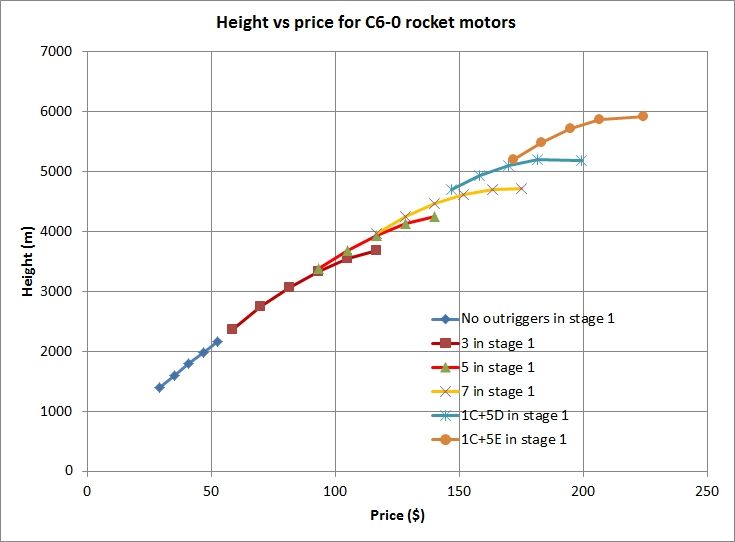
xkcd’s take on impossibility of black powder hobby rocket to 100 km altitude
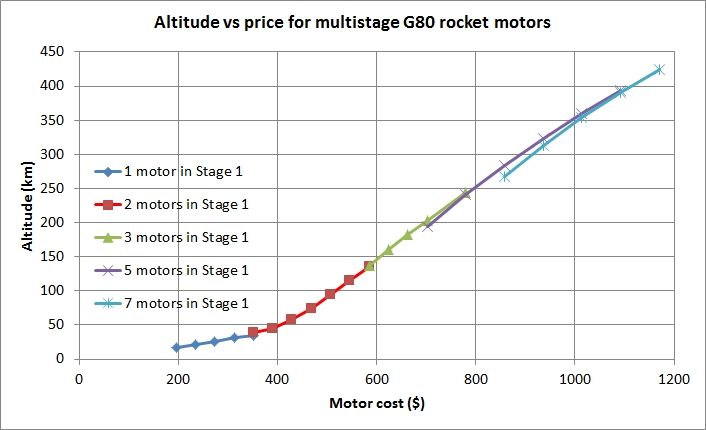
Composite hobby rockets to 400 km altitude.