Date: 27/05/2014 08:03:25
From: transition
ID: 537605
Subject: human domestication, houseplants, ornamentals, crops, livestock
Does (and has) human culture domesticated its own species, or just ‘tamed’, or are individuals a mix of both.
Does (and has) human culture domesticated its own species, or just ‘tamed’, or are individuals a mix of both.
Some background information below, maybe we could start with Mr Diamond’s proposition no. 2 as shown, the necessity to be fast growing (compared with humans) to qualify.
“2.Reasonably fast growth rate — Fast maturity rate compared to the human life span allows breeding intervention and makes the animal useful within an acceptable duration of caretaking. Some large animals require many years before they reach a useful size”
http://en.wikipedia.org/wiki/Domestication
Related
http://en.wikipedia.org/wiki/Rewilding_(anarchism)
Interesting question.
I’d go with domesticated.
The need for fast breeding cycle is removed by:
1) The very long domestication period.
2) The advent of “memes” (otherwise known as cultures).
Hadn’t heard of re-wilding related to humans.
I don’t think I’ll be adding any rewilding groups to my donations list.
>I don’t think I’ll be adding any rewilding groups to my donations list.
Popped it in there for ideological consideration, or even deconstruction, you know of enlightenment etc.
transition said:
Popped it in there for ideological consideration, or even deconstruction, you know of enlightenment etc.
Yes, it was interesting.
I wonder if there are any other species that are, in any sense, self-domesticated.
Bees perhaps?
The Rev Dodgson said:
2) The advent of “memes” (otherwise known as cultures).
Of all of the ways of thinking about ‘memes’, surely as ‘culture’ is one of the least satisfying. Culture is an emergent description of a very large number of individual behaviours and so is possibly analogous to the phenotype in biological evolution. ‘Culture’ is certainly not a unit of indidual transmission.
I don’t understand what distinction is being drawn here between ‘tame’ and ‘domesticated’.
The Rev Dodgson said:
I wonder if there are any other species that are, in any sense, self-domesticated.Bees perhaps?
Every animal that lives in social units with any kind of complex behaviour has been subject to evolutionary pressures resulting from that social environment of itself.
MartinB said:
The Rev Dodgson said:
2) The advent of “memes” (otherwise known as cultures).
Of all of the ways of thinking about ‘memes’, surely as ‘culture’ is one of the least satisfying. Culture is an emergent description of a very large number of individual behaviours and so is possibly analogous to the phenotype in biological evolution. ‘Culture’ is certainly not a unit of indidual transmission.
I’ll have a think about what I really meant then.
Since I’m sceptical of memetics as a productive way of analysing things you needn’t do it on my behalf ;-)
But certainly for your own sake if you want to think of memes as more than some ill-defined idea then you need to be able to say
1. What exactly is the heritable unit? and
2. What is the source of variation in the otherwise stable unit?
MartinB said:
Since I’m sceptical of memetics as a productive way of analysing things you needn’t do it on my behalf ;-)But certainly for your own sake if you want to think of memes as more than some ill-defined idea then you need to be able to say
1. What exactly is the heritable unit? and
2. What is the source of variation in the otherwise stable unit?
OK, leaving aside the question of how it relates to domestication for now, I’d say:
1. The question seems to be taking the analogy to genes way too far. Memes do not have a precisely defined heritable unit. Nonetheless they have some analogy to genes in that they are transferred between individuals, can remain fixed over long periods of time, and combine in complex ways to produce evolving complex entities. I think we can agree that cultures and memes are in fact different things (in spite of what I said previously).
2. The stability of memes is much lower than genes (probably), sources of variation being largely interaction with other memes (both within the same individual, and in interaction with other individuals). Again, the question seems to imply a closer match between the properties of memes and genes than is required for the meme to remain a useful concept.
The Rev Dodgson said:
1. The question seems to be taking the analogy to genes way too far. Memes do not have a precisely defined heritable unit.
On the contrary, it is a basic condition for any kind of Darwinian evolution. If ‘memes’ do not exist as stable heritable units then there can be no selection amongst competing memes and the idea of memetics explains nothing
Which, as it happens, is not far from my opinion.
MartinB said:
The Rev Dodgson said:
1. The question seems to be taking the analogy to genes way too far. Memes do not have a precisely defined heritable unit.On the contrary, it is a basic condition for any kind of Darwinian evolution. If ‘memes’ do not exist as stable heritable units then there can be no selection amongst competing memes and the idea of memetics explains nothing
Which, as it happens, is not far from my opinion.
But I didn’t say that they didn’t have stable heritable units; if they didn’t the concept would be meaningless.
I said they were not precisely defined, which is an entirely different statement.
‘r’ pet ideas “domesticated”
SCIENCE said:
‘r’ pet ideas “domesticated”
Some are.
Some run wild.
The Rev Dodgson said:
SCIENCE said:
‘r’ pet ideas “domesticated”
Some are.
Some run wild.
We change the environment.. Even what we consider are wild animals, enter the space which we have created via change and use what we have altered to suit themselves. That we make other species extinct whilst doing so is of little consequence to those which fill the voids.
Like MB, I am not getting this distinction that people are drawing between tamed and domesticated.
Would conditioned be a better word?
I think some kind of definition, perhaps even some examples, would be better.
MartinB said:
I think some kind of definition, perhaps even some examples, would be better.
How do you domesticate a human? There were near coastal Aborigines that were frightened of the Inland Aborigines and referred to them as being wild. The white man came and referred to them all as being wild, yet none of these people would consider themselves to be wild.
When these aborigines we subdued and forced to accept the white man’s food and way of life, only then were they considered domesticated. So is the distinction that the white man thinks his ways are superior, thus an attitude of mind, or the fact they lived off the land as hunter/gatherers and that we ploughed the soil made us domesticated?
I say the word domesticated is not a good word to use in these circumstances, but conditioned is probably slightly better for such a confusing question.
>I say the word domesticated is not a good word to use in these circumstances, but conditioned is probably slightly better for such a confusing question.
Fair point. Maybe take things back a way, to the social aspects of the environments of evolutionary adaptation (EoEA/ancestral environments) for some stark examples, like those born into groups of those times that tended to eat children, or were very uncooperative regards contributing to helping secure food, or had some psychopathic tendencies that made them ‘unsafe company’. And that these sorts were not amenable to models of helpful behaviour, even just minding their own business. How these may have been alienated from groups, deprived of breeding opportunities even.
There’s plenty of examples no doubt to add to that above, but the gist of it is there.
There’s the other end of the spectrum too to being a useless and/or dangerous cunt. That being useful and helpful, and reliably so.
So there’s a social dimension expressed of biologies that then influences what finds its way into the later biologies (selection).
Rev had it when he mentioned self-domesticating, which I near put in the title but wanted to broaden the subject a bit and thought that implicit anyway. Joke being are you a houseplant etc.
Anyway the thread is meant more to be about subtleties of the familial (groups inclusive)experience and more, that ‘domesticational’ it might be put.
The Q is of what is domestication really. I mean if there is something out there that happens outside the word-concept we apply, outside the conception or constructions we might apply to define it, what is it more at the level of mechanisms.
dv said:
Like MB, I am not getting this distinction that people are drawing between tamed and domesticated.
Well, the way Jared Diamond uses these terms, taming happens at the level of the individual animal, but domestication happens more at a group level, and so it really only applies to animals that are naturally gregarious. For example, with a bit of work you can tame a wild horse, but once you have a bunch of tamed horses living together and interacting nicely with humans then it becomes a whole lot easier to tame the new horses born into the group. Such a group is considered to be domesticated.
It’s possible to tame individual animals of a wide range of species, but many species are not amenable to domestication. For example, it’s possible to tame (some) zebras, but in contrast with the horse example mentioned above, nobody has (yet) succeeded in creating a group of domesticated zebras. (According to Diamond).
My personal theory is that it’s very hard to modify the herd dynamics of zebras, antelopes, giraffes, etc because they evolved in an environment where they had to cope with lions. When you’re tough enough to cope with lions you’re probably not going to be too cooperative when a bunch of pesky hominids try to domesticate you. :)
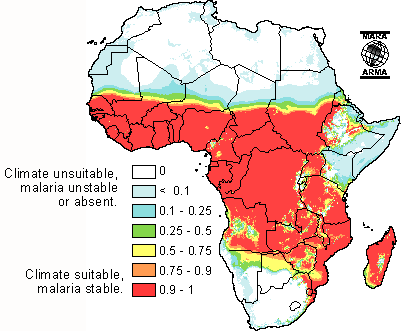
In Guns, Germs, and Steel Diamond claims that none of the African savannah animals that could potentially be beasts of burden are amenable to domestication, which severely inhibited the advancement of agriculture in much of Africa prior to the European colonization era. True, you do get cattle in northern Africa, but traditionally they were north of the malaria zone.
I’m no fan of Jared Diamond, and I am sceptical of the Environment of Evolutionary Adaptation concept so I think I’d better sit this one out.
“My personal theory is that it’s very hard to modify the herd dynamics of zebras, antelopes, giraffes, etc because they evolved in an environment where they had to cope with lions. “
Great, except that cattle and horses evolved in an environment where they had to cope with lions, which were found across Afro-Eurasia until near-historic times.
Start of thread brings back fond memories of Elapid.
dv said:
“My personal theory is that it’s very hard to modify the herd dynamics of zebras, antelopes, giraffes, etc because they evolved in an environment where they had to cope with lions. “Great, except that cattle and horses evolved in an environment where they had to cope with lions, which were found across Afro-Eurasia until near-historic times.
I admit that that does pose severe difficulties for my theory. :)
But don’t feel bad. The killing flaws in Jared Diamond’s ideas are also easy to find, and he’s a successful author, so there’s hope for you yet.
dv said:
But don’t feel bad. The killing flaws in Jared Diamond’s ideas are also easy to find, and he’s a successful author, so there’s hope for you yet.
Ta, dv. :)
FWIW, I came up with that theory while reading Guns, Germs, and Steel. I was aware of the European lions, but I figured that the European forest environment and hilly geography compared to the open flat savannah made an important difference: it’s not easy to hide on the savannah.
And in any case there was domestication of cattle in sub-Saharan Africa
And in any case the Aztecs and Incans built cities and ran farms without the aid of beasts of burden
the objections just roll on and on…
and in any case the Sahara was a lot smaller at the time when animals were first domesticated…
If we can tame lions we can probably tame what they eat.
dv said:
And in any case there was domestication of cattle in sub-Saharan Africa
True. But it’s odd that they didn’t think of using them as beasts of burden (AFAIK).
dv said:
And in any case the Aztecs and Incans built cities and ran farms without the aid of beasts of burdenthe objections just roll on and on…
Various forms of plant management have been used all over the world but permanent, monocultural farms appear to have arisen independently three times in human history. Once in Mesopotamia, once near Hangzhou bay, and once in central Mexico.
These are three very different places, in terms of climate, geography, hydrology and native fauna and flora. The people and cultures involved were also very different.
To go from collecting plants, clearing unwanted plants, and having small gardens of desired plants to having significant areas turned over to growing a small number of varieties involves a bit of organisation and imagination, but you wouldn’t have to be Einstein.
All the conditions for permanent farms existed in Europe, southern Africa, India, temperate North America, Australia. There was nothing stopping them from arising in any of those places. It just didn’t. Instead, it arose in three other places, and then spread.
Trying to find a correlation between the three small areas where permanent farms arose is probably pointless. Sometimes shit just happens.
About 15000 years ago the climate stabilised for farming to happen so I’ve read
Before that time it was too unpredictable
‘nuture’ comes to mind, which has me wondering to what extent the nuture/nature controversies of times past contributed much really.
nurture
wookiemeister said:
About 15000 years ago the climate stabilised for farming to happen so I’ve readBefore that time it was too unpredictable
I think they just ran out of land for productive hunting around 10,000 years ago (not 15,000) due to population growth. It was either war with your neighbours, starve, or think of more productive ways to produce food.
PermeateFree said:
wookiemeister said:
About 15000 years ago the climate stabilised for farming to happen so I’ve readBefore that time it was too unpredictable
I think they just ran out of land for productive hunting around 10,000 years ago (not 15,000) due to population growth. It was either war with your neighbours, starve, or think of more productive ways to produce food.
What is the reason that you think that?
dv said:
PermeateFree said:
wookiemeister said:
About 15000 years ago the climate stabilised for farming to happen so I’ve readBefore that time it was too unpredictable
I think they just ran out of land for productive hunting around 10,000 years ago (not 15,000) due to population growth. It was either war with your neighbours, starve, or think of more productive ways to produce food.
What is the reason that you think that?
Perhaps I have just read too many books on the subject.
PermeateFree said:
dv said:
PermeateFree said:I think they just ran out of land for productive hunting around 10,000 years ago (not 15,000) due to population growth. It was either war with your neighbours, starve, or think of more productive ways to produce food.
What is the reason that you think that?
Perhaps I have just read too many books on the subject.
Or perhaps you’ve just read the wrong ones.
dv said:
PermeateFree said:
dv said:What is the reason that you think that?
Perhaps I have just read too many books on the subject.
Or perhaps you’ve just read the wrong ones.
You are so pathetic, if you want to ask a question than do so without having me write a book to satisfy your casual enquiry, or more likely sh*t making.
PermeateFree said:
You are so pathetic
Good comeback.
dv said:
PermeateFree said:
You are so pathetic
Good comeback.
Have you a question or not? If not please go back under your rock.
Surely you’re not going to allow PF have the word DV? His stupidity needs to be corrected!
Witty Rejoinder said:
Surely you’re not going to allow PF have the word DV? His stupidity needs to be corrected!
Grrrr…
Surely you’re not going to allow PF to have the last word DV? His stupidity needs to be corrected!
Witty Rejoinder said:
Surely you’re not going to allow PF have the word DV? His stupidity needs to be corrected!I didn’t know you WWISed too! ERMAHGERD! Aldi has a million faces, just call me Alex the somnambulant troglobiont.
Witty Rejoinder said:
Surely you’re not going to allow PF have the word DV? His stupidity needs to be corrected!
From some old bloke in the backwoods, who prays to God for enlightenment, but can’t even get the name of the person I am posting to right, then calls me stupid is beyond belief. Go back to bed Witty, because you are a waste of time here.
Witty Rejoinder said:
Surely you’re not going to allow PF have the word DV? His stupidity needs to be corrected!
I don’t think it can be.
dv said:
Witty Rejoinder said:
Surely you’re not going to allow PF have the word DV? His stupidity needs to be corrected!I don’t think it can be.
Think you might need a heavier rock dv, you only make a fool of yourself when climb out from under your current one.
PermeateFree said:
From some old bloke in the backwoods, who prays to God for enlightenment, but can’t even get the name of the person I am posting to right, then calls me stupid is beyond belief. Go back to bed Witty, because you are a waste of time here.
I’m just along for the ride sunshine. You’re the one who doesn’t know how to engage with other people on the forum.
Let’s get back on topic. What evidence do you have for this contention:
“I think they just ran out of land for productive hunting around 10,000 years ago (not 15,000) due to population growth. It was either war with your neighbours, starve, or think of more productive ways to produce food.”
Witty Rejoinder said:
PermeateFree said:From some old bloke in the backwoods, who prays to God for enlightenment, but can’t even get the name of the person I am posting to right, then calls me stupid is beyond belief. Go back to bed Witty, because you are a waste of time here.
I’m just along for the ride sunshine. You’re the one who doesn’t know how to engage with other people on the forum.
Let’s get back on topic. What evidence do you have for this contention:
“I think they just ran out of land for productive hunting around 10,000 years ago (not 15,000) due to population growth. It was either war with your neighbours, starve, or think of more productive ways to produce food.”
Just what part of my statement interests you if any. As for my engagement with other people here, I treat them the same as they treat me, ok Shitty Rejoiner.
PermeateFree said:
“I think they just ran out of land for productive hunting around 10,000 years ago (not 15,000) due to population growth. It was either war with your neighbours, starve, or think of more productive ways to produce food.”
Just what part of my statement interests you if any. As for my engagement with other people here, I treat them the same as they treat me, ok Shitty Rejoiner.
It’s not up to me to provide references for what you say. Nevertheless I can pick apart your argument.
Firstly what evidence do you have that population growth prompted early agriculture and not the other way round?
Agriculture developed independently in three locations around 10,000 years ago. What evidence do you have that the same cause prompted the development of agriculture in all three locations?
Orthodox ideas are not always right but you ought to be aware that your ideas are unorthodox and that hence you need to provide an especially good argument. It is usually said that population grew very slowly up until the farming revolution.
https://www.youtube.com/watch?feature=player_embedded&v=lQoT9xXRXtY
clarke and dawe.
>>Firstly what evidence do you have that population growth prompted early agriculture and not the other way round?
Agriculture developed independently in three locations around 10,000 years ago. What evidence do you have that the same cause prompted the development of agriculture in all three locations?<<
Let us clarify a few facts first. Everyone was a hunter/gatherer 10,000 years ago.
Predators like us need a large land area to support the hunter/gatherer lifestyle, otherwise they either kill all the game or the game moves elsewhere and cannot be caught.
As the hunter/gatherer populations grew, smaller groups would split off into less hunted areas to catch food (this was what aborigines did), unfortunately the land available for hunting becomes less as the human population grows, so it will one day run out, or you begin to encroach on other peoples land. Therefore, unless you want to starve, you must find other ways to produce food, fight with your neighbours or control your population. A door stop size book on the history of South Africa had a very good section on this aspect concerning the behaviour or native peoples.
With the above human expansion in various parts of the world with different people, the same problem would arise. You mention three locations, but there would have been many more as different people experienced different problems at different times, so for one people, they began farming 10,000 years ago, other people 5,000 years ago and even a 1,000 years ago, To have the intelligence to grow food yourself was not a eureka moment and not limited to certain people. It was a necessity due to population growth that stimulated the development of agriculture. Once people settled and had a regular food supply, they increased their population even more, simply because they had the means to do so.
transition said:
Does (and has) human culture domesticated its own species, or just ‘tamed’, or are individuals a mix of both.
—-
In the animal world their will becomes our will because we take care of them.
In the description of humans as animals taken care for their usefullness by other humans then that is why there is politics
PF that all sounds plausible but I’m unconvinced that a growing population prompts the development of agriculture.
Witty Rejoinder said:
PF that all sounds plausible but I’m unconvinced that a growing population prompts the development of agriculture.
There are probably many things that went to the development of agriculture, however necessity is a very big driving force. To live from agriculture would take many years to develop as eating only one product year in, year out would not work. It would need the collection or trade of many food items, plus domestication of stock for a ready meat supply.
Naturally plants that produce grain often grow together in an extensive habitat. People would first begin harvesting them when they were available, but as they would have limited means to store and carry it, it would need settlement there with a form of grain store, plus other foods would be required, and they would need to travel further and further to hunt game, there seems little point of going to all that trouble.
Domestication of stock would probably have been the first serious venture in the production of food, as the animals can be herded to fresh pasture and the hunters and gatherers of the group could still gather other foods. The production of agriculture only becomes necessary if you are restricted in your movements by a natural feature or other people, then at that stage you would seriously begin to gather a selection of foods to grow, which when combined with the domestic herd would make you largely self-sustainable. To do so otherwise I suggest is very unlikely as the gains would initially not warrant the additional problems of settlement.