Date: 5/12/2014 22:12:32
From: Postpocelipse
ID: 640399
Subject: Physicists achieve superconductivity at room temperature
you could transport vast amounts of energy across the planet, you wouldn’t need to step up the voltage as much meaning less expensive equipment as well
wookiemeister said:
you could transport vast amounts of energy across the planet, you wouldn’t need to step up the voltage as much meaning less expensive equipment as well
Forget the applications – maximum allowable magnetic field strength, cost and brittleness all argue against that. Also, this new superconductor only remained superconducting for a few PICOseconds.
However, as a scientific discovery it is brilliant. According to a graph I remembered from wikipedia there has been no significant improvement in the maximum temperature of high temperature superconductors since the year 1994. The jump of 140 degrees or more in maximum operating temperature just now is fantastic. I’ve been pessimistic enough to think that the maximum had already almost been reached because most conceivable ceramic element compositions have already been tried.

And the method it has been achieved is equally fantastic. You’ll note that Yttrium-Barium-Copper-Oxide is the earliest high temperature superconductor on the above graph. It’s maximum temperature was soon exceeded.
> “The infrared pulse had not only excited the atoms to oscillate, but had also shifted their position in the crystal as well. This briefly made the copper dioxide double layers thicker – by two picometres, or one hundredth of an atomic diameter – and the layer between them became thinner by the same amount. This in turn increased the quantum coupling between the double layers to such an extent that the crystal became superconducting at room temperature for a few picoseconds.”
Trying that image again:
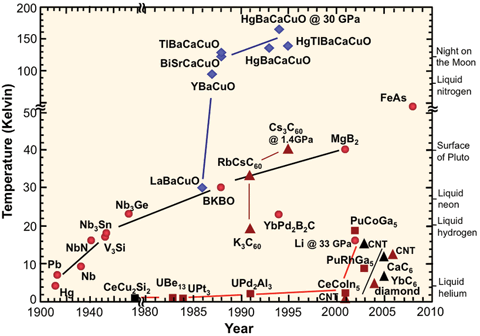
(That’s better)