Date: 11/01/2017 14:09:08
From: mollwollfumble
ID: 1008602
Subject: Those magnificent men in their flying machines
Saw this movie yesterday or the day before. It brought up three questions I hadn’t thought of before.
1) In the movie the villain nobbles competitors planes. What would the easiest way to nobble a modern passenger jet? Something like putting sugar in the fuel or shooting some delicate part of the plane with a potato gun?
2) In the movie the pond is the safest place to land. But every time a modern passenger jet tries to ditch in the open ocean there are no survivors. The skids as well as wheels on the American aircraft made me consider the following. A good safety feature would be to fit a small hydrofoil under the nose of the passenger jet, to stop it going arse over nose when forced to ditch at a mild descent angle into the ocean.
3) If I was to make my own aircraft, say a flapping wing design with feathers, where could I fly it?
Date: 11/01/2017 14:12:43
From: roughbarked
ID: 1008605
Subject: re: Those magnificent men in their flying machines
mollwollfumble said:
Saw this movie yesterday or the day before. It brought up three questions I hadn’t thought of before.
1) In the movie the villain nobbles competitors planes. What would the easiest way to nobble a modern passenger jet? Something like putting sugar in the fuel or shooting some delicate part of the plane with a potato gun?
2) In the movie the pond is the safest place to land. But every time a modern passenger jet tries to ditch in the open ocean there are no survivors. The skids as well as wheels on the American aircraft made me consider the following. A good safety feature would be to fit a small hydrofoil under the nose of the passenger jet, to stop it going arse over nose when forced to ditch at a mild descent angle into the ocean.
3) If I was to make my own aircraft, say a flapping wing design with feathers, where could I fly it?
:)
Date: 11/01/2017 14:14:59
From: dv
ID: 1008608
Subject: re: Those magnificent men in their flying machines
mollwollfumble said:
2) In the movie the pond is the safest place to land. But every time a modern passenger jet tries to ditch in the open ocean there are no survivors.
That’s not true, there have been a small number of ocean ditches with survivors.
Date: 11/01/2017 14:19:51
From: mcgoon
ID: 1008612
Subject: re: Those magnificent men in their flying machines
mollwollfumble said:
3) If I was to make my own aircraft, say a flapping wing design with feathers, where could I fly it?
Anywhere where the emergency services can make it to the crash site to clean up the mess.
Date: 11/01/2017 14:24:03
From: mollwollfumble
ID: 1008618
Subject: re: Those magnificent men in their flying machines
dv said:
mollwollfumble said:
2) In the movie the pond is the safest place to land. But every time a modern passenger jet tries to ditch in the open ocean there are no survivors.
That’s not true, there have been a small number of ocean ditches with survivors.
Two in rivers that I know of. At least one on a beach. None that I’ve heard of in the ocean. Perhaps a twin otter or something small like that.
Date: 11/01/2017 14:24:18
From: btm
ID: 1008619
Subject: re: Those magnificent men in their flying machines
dv said:
mollwollfumble said:
2) In the movie the pond is the safest place to land. But every time a modern passenger jet tries to ditch in the open ocean there are no survivors.
That’s not true, there have been a small number of ocean ditches with survivors.
Actually, in the vast majority of ocean ditchings, very few die. In many cases, some die from drowning after the event, though (in the case of Pan Am flight 526A, which ditched on 11 April 1952, many of the passengers panicked and refused to leave the sinking wreck, and so drowned. It was this event that led to the preflight safety briefing in modern RPT flights.)
Date: 11/01/2017 14:26:26
From: mcgoon
ID: 1008622
Subject: re: Those magnificent men in their flying machines
mollwollfumble said:
2) In the movie the pond is the safest place to land. But every time a modern passenger jet tries to ditch in the open ocean there are no survivors.
It’s a matter of making the best of the situation.
You have an aircraft that won’t fly. you have to put it down somewhere, and fast.
Ideally, you do it at an airfield with proper emergency facilities. But, you can’t make it to one.
Choices:
1. Find a place on land to set it down. Disadvantage: trees, buildings, road, vehicles, people, and ground is jolly unforgiving.
2. Sea surface. Advantages: none of the obstructions listed above. Water is much more likely to allow you to ‘plane’ to a stop (if you do everything just right), and isn’t going to make so many of those big friction sparks and such like. Heck, if you’re lucky, it might even float, if you can’t do it in shallow water.
Date: 11/01/2017 14:30:25
From: mcgoon
ID: 1008624
Subject: re: Those magnificent men in their flying machines
Ethiopian Airlines Flight 961, 1996.
125 dead, 50 survivors.
A lot of the dead passengers drowned because they inflated their lifejackets inside the plane, causing them to be trapped by rising water.
Date: 11/01/2017 14:31:56
From: dv
ID: 1008625
Subject: re: Those magnificent men in their flying machines
mcgoon said:
Ethiopian Airlines Flight 961, 1996.
125 dead, 50 survivors.
A lot of the dead passengers drowned because they inflated their lifejackets inside the plane, causing them to be trapped by rising water.
I was also thinking of the Lion Air ditching four years ago.
Date: 11/01/2017 14:33:24
From: mollwollfumble
ID: 1008626
Subject: re: Those magnificent men in their flying machines
btm said:
dv said:
mollwollfumble said:
2) In the movie the pond is the safest place to land. But every time a modern passenger jet tries to ditch in the open ocean there are no survivors.
That’s not true, there have been a small number of ocean ditches with survivors.
Actually, in the vast majority of ocean ditchings, very few die. In many cases, some die from drowning after the event, though (in the case of Pan Am flight 526A, which ditched on 11 April 1952, many of the passengers panicked and refused to leave the sinking wreck, and so drowned. It was this event that led to the preflight safety briefing in modern RPT flights.)
Pan Am flight 526A wasn’t a jet.
Date: 11/01/2017 14:37:15
From: mollwollfumble
ID: 1008628
Subject: re: Those magnificent men in their flying machines
mcgoon said:
mollwollfumble said:
2) In the movie the pond is the safest place to land. But every time a modern passenger jet tries to ditch in the open ocean there are no survivors.
It’s a matter of making the best of the situation.
You have an aircraft that won’t fly. you have to put it down somewhere, and fast.
Ideally, you do it at an airfield with proper emergency facilities. But, you can’t make it to one.
Choices:
1. Find a place on land to set it down. Disadvantage: trees, buildings, road, vehicles, people, and ground is jolly unforgiving.
2. Sea surface. Advantages: none of the obstructions listed above. Water is much more likely to allow you to ‘plane’ to a stop (if you do everything just right), and isn’t going to make so many of those big friction sparks and such like. Heck, if you’re lucky, it might even float, if you can’t do it in shallow water.
No! the exact opposite of that. The drag on the underside of an aircraft when ditching at sea is enormous, very much greater drag than all of the above put togther – trees make a much softer landing, roads and fields too.
Date: 11/01/2017 14:38:46
From: party_pants
ID: 1008629
Subject: re: Those magnificent men in their flying machines
mollwollfumble said:
1) In the movie the villain nobbles competitors planes. What would the easiest way to nobble a modern passenger jet? Something like putting sugar in the fuel or shooting some delicate part of the plane with a potato gun?
Foreign Object Debris.
A handfull of nut and bolts into the jet engine.
Date: 11/01/2017 14:54:06
From: mollwollfumble
ID: 1008633
Subject: re: Those magnificent men in their flying machines
mcgoon said:
Ethiopian Airlines Flight 961, 1996.
125 dead, 50 survivors.
A lot of the dead passengers drowned because they inflated their lifejackets inside the plane, causing them to be trapped by rising water.
Cripes! I’ve seen the video of the crash landing umpteen times. It hadn’t occurred to me that anyone could survive that. I thought they all died. I keep a copy as an example of how not to land a plane on water.

> Lion Air
Lion air flight 904. I hadn’t heard about this one. Was the water calm? The fuselage broke in two. I don’t want the fuselage of the plane to break in two. All survived, 46 injured.
A small hydrofoil under the nose, if properly designed, would keep the nose up until the water drag had reduced the plane speed enough to ditch safely.
Date: 11/01/2017 14:54:18
From: btm
ID: 1008634
Subject: re: Those magnificent men in their flying machines
mollwollfumble said:
btm said:
dv said:
That’s not true, there have been a small number of ocean ditches with survivors.
Actually, in the vast majority of ocean ditchings, very few die. In many cases, some die from drowning after the event, though (in the case of Pan Am flight 526A, which ditched on 11 April 1952, many of the passengers panicked and refused to leave the sinking wreck, and so drowned. It was this event that led to the preflight safety briefing in modern RPT flights.)
Pan Am flight 526A wasn’t a jet.
That’s true, but completely irrelevant. I mentioned it because it was what led to the preflight safety briefing. You want some jets? How about ALM Flight 980, (a McDonnell Douglas DC-9-33CF —a twin-engine jet airliner) that ditched on 2 May 1970; 40 survivors were rescued of 63 passengers; Ethiopian Airlines Flight 961, a Boeing 767-260ER, which ditched on 23 November 1996; the pilot couldn’t operate the flaps, so the aircraft was travelling much faster than it should have been, and the port wingtip contacted the water first, causing the craft to tumble and break up. Even so, 50 of the 175 passengers survived; Garuda Indonesia Flight 421 (a Boeing 737), which ditched on 16 January 2002: one flight attendant was killed (of 60 pob).
I could find more if you want them.
Date: 11/01/2017 14:55:01
From: mollwollfumble
ID: 1008635
Subject: re: Those magnificent men in their flying machines
party_pants said:
mollwollfumble said:
1) In the movie the villain nobbles competitors planes. What would the easiest way to nobble a modern passenger jet? Something like putting sugar in the fuel or shooting some delicate part of the plane with a potato gun?
Foreign Object Debris.
A handfull of nut and bolts into the jet engine.
That’s the way to do it.
Date: 11/01/2017 14:57:24
From: mollwollfumble
ID: 1008637
Subject: re: Those magnificent men in their flying machines
btm said:
mollwollfumble said:
btm said:
Actually, in the vast majority of ocean ditchings, very few die. In many cases, some die from drowning after the event, though (in the case of Pan Am flight 526A, which ditched on 11 April 1952, many of the passengers panicked and refused to leave the sinking wreck, and so drowned. It was this event that led to the preflight safety briefing in modern RPT flights.)
Pan Am flight 526A wasn’t a jet.
That’s true, but completely irrelevant. I mentioned it because it was what led to the preflight safety briefing. You want some jets? How about ALM Flight 980, (a McDonnell Douglas DC-9-33CF —a twin-engine jet airliner) that ditched on 2 May 1970; 40 survivors were rescued of 63 passengers; Ethiopian Airlines Flight 961, a Boeing 767-260ER, which ditched on 23 November 1996; the pilot couldn’t operate the flaps, so the aircraft was travelling much faster than it should have been, and the port wingtip contacted the water first, causing the craft to tumble and break up. Even so, 50 of the 175 passengers survived; Garuda Indonesia Flight 421 (a Boeing 737), which ditched on 16 January 2002: one flight attendant was killed (of 60 pob).
I could find more if you want them.
Yes, more please.
Date: 11/01/2017 15:08:28
From: mollwollfumble
ID: 1008641
Subject: re: Those magnificent men in their flying machines
How about this idea?
Before any aircraft model is accepted for passenger service it must successfully complete a landing on water without killing any of the crash test dummies inside.
I bring the topic up because when landing on water, the area of fuselage on which the water drag acts is enormous, about ten times as much as landing on tarmac without wheels, about a hundred times as much as landing in a pine forest.
Date: 11/01/2017 15:16:03
From: btm
ID: 1008645
Subject: re: Those magnificent men in their flying machines
mollwollfumble said:
btm said:
I could find more if you want them.
Yes, more please.
You should remember the one that ditched into the Hudson on 15 January 2009, US Airways Flight 1549 (an Airbus A320). That wasn’t into the ocean, but it was onto water; all 155 pob survived. A DAS Air Cargo DC-10-30F twin-engine jet overshot the runway at Entebbe, Uganda, on 30 April 2002; no deaths. Trans Arabian Air Transport Flight 310, a Boeing 707-351© landed in Lake Victoria in Tanzania on 3 February 2002. All pob survived (some with minor injuries.) China Airlines Flight 605, a Boeing 747-409, ditched on 4 November 1993; all 396 pob survived, though some with minor injuries. That’s enough to disprove your claim that every time a modern passenger jet tries to ditch in the open ocean there are no survivors.
Your idea of a skid under the nose wouldn’t have much effect, because aircraft are landed in a nose-up attitude, so that their main undercarriage touch down first.
Date: 11/01/2017 15:23:03
From: mollwollfumble
ID: 1008646
Subject: re: Those magnificent men in their flying machines
mollwollfumble said:
btm said:
mollwollfumble said:
Pan Am flight 526A wasn’t a jet.
That’s true, but completely irrelevant. I mentioned it because it was what led to the preflight safety briefing. You want some jets? How about ALM Flight 980, (a McDonnell Douglas DC-9-33CF —a twin-engine jet airliner) that ditched on 2 May 1970; 40 survivors were rescued of 63 passengers; Ethiopian Airlines Flight 961, a Boeing 767-260ER, which ditched on 23 November 1996; the pilot couldn’t operate the flaps, so the aircraft was travelling much faster than it should have been, and the port wingtip contacted the water first, causing the craft to tumble and break up. Even so, 50 of the 175 passengers survived; Garuda Indonesia Flight 421 (a Boeing 737), which ditched on 16 January 2002: one flight attendant was killed (of 60 pob).
I could find more if you want them.
Yes, more please.
> Garuda Indonesia Flight 421 (a Boeing 737), which ditched on 16 January 2002: one flight attendant was killed (of 60 pob).
That was a river, a shallow one.
> I was also thinking of the Lion Air ditching four years ago.
Is this the one? It doesn’t really look much like ditching in the open ocean, but perhaps I have the wrong crash.

Date: 11/01/2017 15:32:57
From: mollwollfumble
ID: 1008647
Subject: re: Those magnificent men in their flying machines
> Your idea of a skid under the nose wouldn’t have much effect, because aircraft are landed in a nose-up attitude, so that their main undercarriage touch down first.
That’s the safest landing on both tarmac and water at present. A single hydrofoil near the back of the plane would be worse than useless because it would slam the nose down.
Date: 11/01/2017 22:37:39
From: Spiny Norman
ID: 1008657
Subject: re: Those magnificent men in their flying machines
No point in changing what the current system is much, as it works quite well and making any significant changes like you mention would attract a significant financial and perhaps performance penalty.
When you consider the number of flights that have to ditch compared to the overall number of flights, it’s less than trivial. Modern airliners are extremely safe machines and very difficult to knock out of the sky. The typical modern twin-engined airliner will likely never have an engine failure in its life.
Water ditchings are tricky at the best of times, and changing the structure of fuselage to allow for a water landing would make them somewhat heavier and incur an aerodynamic drag penalty. The reason, as mentioned above, is that they will touch-down on the water tail first. Depending on the speed and size of the aircraft, it may mean that the lower-rear curved section of the fuselage will get ripped open from the suction of the water. That, and any excess vertical speed on touchdown, can cause the fuselage to break into two.
The best compromise is the current system, which is to make them very safe so they don’t have to ditch. Even if they lose an engine, they can still fly quite safely for the rest of the flight.
Date: 11/01/2017 23:11:15
From: roughbarked
ID: 1008658
Subject: re: Those magnificent men in their flying machines
Spiny Norman said:
No point in changing what the current system is much, as it works quite well and making any significant changes like you mention would attract a significant financial and perhaps performance penalty.
When you consider the number of flights that have to ditch compared to the overall number of flights, it’s less than trivial. Modern airliners are extremely safe machines and very difficult to knock out of the sky. The typical modern twin-engined airliner will likely never have an engine failure in its life.
Water ditchings are tricky at the best of times, and changing the structure of fuselage to allow for a water landing would make them somewhat heavier and incur an aerodynamic drag penalty. The reason, as mentioned above, is that they will touch-down on the water tail first. Depending on the speed and size of the aircraft, it may mean that the lower-rear curved section of the fuselage will get ripped open from the suction of the water. That, and any excess vertical speed on touchdown, can cause the fuselage to break into two.
The best compromise is the current system, which is to make them very safe so they don’t have to ditch. Even if they lose an engine, they can still fly quite safely for the rest of the flight.
Yet some still crash and unfortunately, many of them dive straight into the sa from a great height.
Date: 11/01/2017 23:15:43
From: roughbarked
ID: 1008659
Subject: re: Those magnificent men in their flying machines
mollwollfumble said:
> Your idea of a skid under the nose wouldn’t have much effect, because aircraft are landed in a nose-up attitude, so that their main undercarriage touch down first.
That’s the safest landing on both tarmac and water at present. A single hydrofoil near the back of the plane would be worse than useless because it would slam the nose down.
There is a difference in the way a seaplane is made and landed that a jet liner.
The fact is known that if the pilot is able to control the landing the plane may land and float long enough to get the passengers off. they need something like airbags to hold them up a bit longer.
Date: 12/01/2017 00:40:40
From: mollwollfumble
ID: 1008665
Subject: re: Those magnificent men in their flying machines
> No point in changing what the current system is much, as it works quite well
You’re fucking kidding. There are at least half a dozen trivial changes I can think of that together would halve the death rate.
roughbarked said:
mollwollfumble said:
> Your idea of a skid under the nose wouldn’t have much effect, because aircraft are landed in a nose-up attitude, so that their main undercarriage touch down first.
That’s the safest landing on both tarmac and water at present. A single hydrofoil near the back of the plane would be worse than useless because it would slam the nose down.
There is a difference in the way a seaplane is made and landed that a jet liner.
The fact is known that if the pilot is able to control the landing the plane may land and float long enough to get the passengers off. they need something like airbags to hold them up a bit longer.
Air bags aren’t going to stop landings like this.
Date: 12/01/2017 00:45:28
From: roughbarked
ID: 1008667
Subject: re: Those magnificent men in their flying machines
mollwollfumble said:
> No point in changing what the current system is much, as it works quite well
You’re fucking kidding. There are at least half a dozen trivial changes I can think of that together would halve the death rate.
roughbarked said:
mollwollfumble said:
> Your idea of a skid under the nose wouldn’t have much effect, because aircraft are landed in a nose-up attitude, so that their main undercarriage touch down first.
That’s the safest landing on both tarmac and water at present. A single hydrofoil near the back of the plane would be worse than useless because it would slam the nose down.
There is a difference in the way a seaplane is made and landed that a jet liner.
The fact is known that if the pilot is able to control the landing the plane may land and float long enough to get the passengers off. they need something like airbags to hold them up a bit longer.
Air bags aren’t going to stop landings like this.
Pilots can be trained to be able to land planes on water. I’d surprised if they aren’t.
Date: 12/01/2017 01:21:02
From: Spiny Norman
ID: 1008669
Subject: re: Those magnificent men in their flying machines
mollwollfumble said:
> No point in changing what the current system is much, as it works quite well
You’re fucking kidding. There are at least half a dozen trivial changes I can think of that together would halve the death rate.
Like what?
The primary cause of crashes is crew error, so better training would have the greatest impact on the accident rate. Mechanical failures are also mainly due to ground engineer error, so an improved system of maintenance would also have a bit of an impact. Pure mechanical failure is quite rare.
Date: 12/01/2017 01:23:32
From: roughbarked
ID: 1008670
Subject: re: Those magnificent men in their flying machines
Spiny Norman said:
mollwollfumble said:
> No point in changing what the current system is much, as it works quite well
You’re fucking kidding. There are at least half a dozen trivial changes I can think of that together would halve the death rate.
Like what?
The primary cause of crashes is crew error, so better training would have the greatest impact on the accident rate. Mechanical failures are also mainly due to ground engineer error, so an improved system of maintenance would also have a bit of an impact. Pure mechanical failure is quite rare.
Yes.
Date: 12/01/2017 01:29:17
From: dv
ID: 1008673
Subject: re: Those magnificent men in their flying machines
In this day and age, I wonder whether it would be possible/practical to have a system whereby a ground crew can detect that a flight is in trouble and take over the control of the plane. Seems a lot of crashes are due to the flight crew panicking and/or not misinterpreting the visual clues.
Date: 12/01/2017 01:31:53
From: roughbarked
ID: 1008675
Subject: re: Those magnificent men in their flying machines
dv said:
In this day and age, I wonder whether it would be possible/practical to have a system whereby a ground crew can detect that a flight is in trouble and take over the control of the plane. Seems a lot of crashes are due to the flight crew panicking and/or not misinterpreting the visual clues.
If security worries about hackers, then it must already be a possibility. Mental stability of cabin crew should be monitired more carefully though as they can still interrupt or block outside interference if they feel they need to for any particular reasoning.
Date: 12/01/2017 01:33:30
From: Spiny Norman
ID: 1008676
Subject: re: Those magnificent men in their flying machines
dv said:
In this day and age, I wonder whether it would be possible/practical to have a system whereby a ground crew can detect that a flight is in trouble and take over the control of the plane. Seems a lot of crashes are due to the flight crew panicking and/or not misinterpreting the visual clues.
Yes it’s possible, but I can’t really see a need for it.
On modern airliners the information that hte crew acts upon is presented on the screen, then the crew applies the appropriate checklist. If there was the ability to do that from the ground, then the ground crew would just do the same thing anyway.
Date: 12/01/2017 01:56:23
From: dv
ID: 1008684
Subject: re: Those magnificent men in their flying machines
Spiny Norman said:
dv said:
In this day and age, I wonder whether it would be possible/practical to have a system whereby a ground crew can detect that a flight is in trouble and take over the control of the plane. Seems a lot of crashes are due to the flight crew panicking and/or not misinterpreting the visual clues.
Yes it’s possible, but I can’t really see a need for it.
On modern airliners the information that hte crew acts upon is presented on the screen, then the crew applies the appropriate checklist. If there was the ability to do that from the ground, then the ground crew would just do the same thing anyway.
Yeah okay but what I was thinking was
a) it seems some pilots lose their heads because their lives are on the line, whereas a ground crew can deal with it without the looming reaper messing with their chi
b) whatever the odds are, the odds of the flight crew AND the ground crew both misreading the situation have got to be lower than the flight crew alone misreading the situation, because probability theory
c) the ground team could be arbitrarily large, could have a dozen people with formal chain of command and distribution of responsibility. An airline with 300 planes in the air might not need to use the ground team more than a few times a year: some algorithm would detect something was awry, they’d view all the data and communicate with the pilot, and at some point if it was clear the flight crew were not going to be able to handle it, the ground crew would seize control.
Date: 12/01/2017 02:02:45
From: poikilotherm
ID: 1008693
Subject: re: Those magnificent men in their flying machines
dv said:
Spiny Norman said:
dv said:
In this day and age, I wonder whether it would be possible/practical to have a system whereby a ground crew can detect that a flight is in trouble and take over the control of the plane. Seems a lot of crashes are due to the flight crew panicking and/or not misinterpreting the visual clues.
Yes it’s possible, but I can’t really see a need for it.
On modern airliners the information that hte crew acts upon is presented on the screen, then the crew applies the appropriate checklist. If there was the ability to do that from the ground, then the ground crew would just do the same thing anyway.
c) the ground team could be arbitrarily large, could have a dozen people with formal chain of command and distribution of responsibility.
Would they have a committee to deliberate on decisions before making them?
Date: 12/01/2017 02:06:34
From: Spiny Norman
ID: 1008700
Subject: re: Those magnificent men in their flying machines
dv said:
Spiny Norman said:
dv said:
In this day and age, I wonder whether it would be possible/practical to have a system whereby a ground crew can detect that a flight is in trouble and take over the control of the plane. Seems a lot of crashes are due to the flight crew panicking and/or not misinterpreting the visual clues.
Yes it’s possible, but I can’t really see a need for it.
On modern airliners the information that hte crew acts upon is presented on the screen, then the crew applies the appropriate checklist. If there was the ability to do that from the ground, then the ground crew would just do the same thing anyway.
Yeah okay but what I was thinking was
a) it seems some pilots lose their heads because their lives are on the line, whereas a ground crew can deal with it without the looming reaper messing with their chi
b) whatever the odds are, the odds of the flight crew AND the ground crew both misreading the situation have got to be lower than the flight crew alone misreading the situation, because probability theory
c) the ground team could be arbitrarily large, could have a dozen people with formal chain of command and distribution of responsibility. An airline with 300 planes in the air might not need to use the ground team more than a few times a year: some algorithm would detect something was awry, they’d view all the data and communicate with the pilot, and at some point if it was clear the flight crew were not going to be able to handle it, the ground crew would seize control.
A – Better training pretty much fixes that. It’s also common in very serious situations that the on-board crew performs better than anyone on the ground does. It’s happened quite a few times after a big one, where it’s recreated in the simulator. The real crew gets the plane back on the ground, everyone that tries it in the sim dies.
B – True, but again I can’t really see what a ground crew could add most of the time. Because the vast majority of the time most in-flight problems are dealt with, with the appropriate checklists. If something happens outside the checklist then the on-board crew is often in a better place to see what’s going on. Unusual noises, etc.
C. Airlines just aren’t going to pay for that. The cost-to-benefit ratio makes it not viable. The data feed coming back from the planes (most of the time, as best I understand) is monitored anyway and anything odd that comes up is flagged.
Date: 12/01/2017 02:07:45
From: Spiny Norman
ID: 1008703
Subject: re: Those magnificent men in their flying machines
poikilotherm said:
dv said:
Spiny Norman said:
Yes it’s possible, but I can’t really see a need for it.
On modern airliners the information that hte crew acts upon is presented on the screen, then the crew applies the appropriate checklist. If there was the ability to do that from the ground, then the ground crew would just do the same thing anyway.
c) the ground team could be arbitrarily large, could have a dozen people with formal chain of command and distribution of responsibility.
Would they have a committee to deliberate on decisions before making them?
All that stuff worked well for NASA, due to the situations and equipment they were in & using. Airliners are several levels better in safety than any spacecraft.
Date: 12/01/2017 02:18:24
From: btm
ID: 1008714
Subject: re: Those magnificent men in their flying machines
dv said:
In this day and age, I wonder whether it would be possible/practical to have a system whereby a ground crew can detect that a flight is in trouble and take over the control of the plane. Seems a lot of crashes are due to the flight crew panicking and/or not misinterpreting the visual clues.
There are so many things wrong with this idea that it’s hard to figure out where to start, but let’s try security: what’s to stop “terrorists” (ie anyone with an agenda) from seizing control of any aircraft, and doing whatever they want with it? The World Trade Center attacks could be done from the comfort of the killers’ own homes. We’ve already seen it in autonomous cars. Hackers would see it as a challenge. Then there’s the obvious fact that the crew, for all their faults, are in a position to see exactly what’s happening, and are (theoretically) able to respond to what they see, rather than what’s on a computer screen. I’ve flown physical aeroplanes (I’ve got a PPL), and flown virtual aircraft on sims; the difference is vast.
Date: 12/01/2017 03:24:09
From: dv
ID: 1008745
Subject: re: Those magnificent men in their flying machines
Spiny Norman said:
dv said:
Spiny Norman said:
Yes it’s possible, but I can’t really see a need for it.
On modern airliners the information that hte crew acts upon is presented on the screen, then the crew applies the appropriate checklist. If there was the ability to do that from the ground, then the ground crew would just do the same thing anyway.
Yeah okay but what I was thinking was
a) it seems some pilots lose their heads because their lives are on the line, whereas a ground crew can deal with it without the looming reaper messing with their chi
b) whatever the odds are, the odds of the flight crew AND the ground crew both misreading the situation have got to be lower than the flight crew alone misreading the situation, because probability theory
c) the ground team could be arbitrarily large, could have a dozen people with formal chain of command and distribution of responsibility. An airline with 300 planes in the air might not need to use the ground team more than a few times a year: some algorithm would detect something was awry, they’d view all the data and communicate with the pilot, and at some point if it was clear the flight crew were not going to be able to handle it, the ground crew would seize control.
A – Better training pretty much fixes that. It’s also common in very serious situations that the on-board crew performs better than anyone on the ground does. It’s happened quite a few times after a big one, where it’s recreated in the simulator. The real crew gets the plane back on the ground, everyone that tries it in the sim dies.
B – True, but again I can’t really see what a ground crew could add most of the time. Because the vast majority of the time most in-flight problems are dealt with, with the appropriate checklists. If something happens outside the checklist then the on-board crew is often in a better place to see what’s going on. Unusual noises, etc.
C. Airlines just aren’t going to pay for that. The cost-to-benefit ratio makes it not viable. The data feed coming back from the planes (most of the time, as best I understand) is monitored anyway and anything odd that comes up is flagged.
Fair enough.
Date: 12/01/2017 11:25:53
From: mollwollfumble
ID: 1008943
Subject: re: Those magnificent men in their flying machines
Spiny Norman said:
mollwollfumble said:
> No point in changing what the current system is much, as it works quite well
You’re fucking kidding. There are at least half a dozen trivial changes I can think of that together would halve the death rate.
Like what?
The primary cause of crashes is crew error, so better training would have the greatest impact on the accident rate. Mechanical failures are also mainly due to ground engineer error, so an improved system of maintenance would also have a bit of an impact. Pure mechanical failure is quite rare.
For starters, 50% of crashes occur because the crew doesn’t know what is going on in the rest of the plane. Typical cases are:
The crew doesn’t know that the a door has blown off
The crew doesn’t know that the ice on the wing is too thick
The crew doesn’t know that the oxygen masks have deployed in the cabin
The crew doesn’t know which engine is on fire
The crew doesn’t know which pitot tube is blocked
The crew doesn’t know if the undercarriage is down or up
The crew doesn’t know that the autopilot is disengaged
The crew doesn’t know that jet fuel is pouring out of a damaged fuel line
The crew can’t see through the damaged windscreen
etc.
All but two of those could be fixed by the installation of a few Go-Pro closed circuit cameras, total cost – negligible.
Pitot tube – easy to solve – don’t use them, or at least make them fault tolerant.
Autopilot – a big light saying “autopilot on”. Make it the third most important control after the speed indicator and the artificial horizon.
Other causes of plane crashes.
The tail. All other mechanical errors can be coped with, but if the tail is severely damaged then the plane and all the passengers are doomed. The tail is the weakest link in plane construction. In rocketry parlance, the tail ensures that the centre of pressure is behind the centre of gravity. Fix it so that a plane can fly if the tail is destroyed. I can think of several ways.
Escape the phugoid. it only requires an extra software routine to be added to the autopilot software.
OK, all the above is about avoiding crashes. Next step is about surviving them. Racing motocycles and racecars both survive high speed crashes without the people on board being injured in any way. The strategies are opposite – for motorbike racing the person is unrestrained – for car racing the person is completely restrained. Crash survival is all about: a) not hitting anything, and b) ensuring that accelerations are optimised. In jet passenger aircraft, footrests used to be deadly, caused large numbers of broken ankles. Legs hitting the floor resulted in a large number of leg fractures.
Hitting the seat in front because of a poor seat belt. “Brace position” ought never to be necessary, any more than it is in a motor car. If I understand correctly, the design of the seat belt used in all passenger jets is more than 100 years old, was superseded by the three point in 1959, by the belt-in-seat in 1970, and by seat belts that actually work (inverted Y, 5 point, 6 point, 7 point) not long after or possibly earlier.
Date: 12/01/2017 12:41:28
From: Spiny Norman
ID: 1008977
Subject: re: Those magnificent men in their flying machines
mollwollfumble said:
For starters, 50% of crashes occur because the crew doesn’t know what is going on in the rest of the plane. Typical cases are:
The crew doesn’t know that the a door has blown off
>
Cabin doors can’t blow out, they are larger than the opening. Cargo doors can, and ever so very occasionally do. It’s very obvious that a cargo door has blown off though, as all the cabin pressure disappears in a few seconds, along with a phenomenal air noise.
There are procedures to handle this situation.
The crew doesn’t know that the ice on the wing is too thick
>
On the ground they have no idea, either the ground crew has to keep an eye on it and advise the flight crew or the flight crew has to do regular inspections before take-off. There’s set procedures for waiting times after a ground de-icing in icing conditions. They are well established and reliable.
Crew training and procedures cover all that quite well.
In flight, it’s not a problem if the procedures are followed.
The crew doesn’t know that the oxygen masks have deployed in the cabin
>
Yes they do on any airliner that’s halfway modern. An advisory pops up on the instrument panel.
The crew doesn’t know which engine is on fire
>
Yes they do, a big red light lights up on the appropriate fire handle. Follow the procedures, the fire goes out and no more emergency.
The crew doesn’t know which pitot tube is blocked
>
True, but again if they follow procedures it’s a very minor problem. I’ve had it happen.
The crew doesn’t know if the undercarriage is down or up
>
There’s two independent systems that show if each gear is up or down. It’s extremely unlikely for both to fail. But yes, having a small video camera to look at such things would be very handy indeed.
The crew doesn’t know that the autopilot is disengaged
>
Yes they do. There’s a loud ‘BING’ noise and an annunciator light goes out. There’s also indications on the PFD – Primary Flight Display.
The crew doesn’t know that jet fuel is pouring out of a damaged fuel line
>
True. Again a camera either pointing back from the front or vice-versa would be quite handy.
The crew can’t see through the damaged windscreen
etc.
>
No real need to on a lot of airliners, they can do an auto-land and stop on the runway if need be.
All but two of those could be fixed by the installation of a few Go-Pro closed circuit cameras, total cost – negligible.
Pitot tube – easy to solve – don’t use them, or at least make them fault tolerant.
>
I’d also like to see something along those lines. If at least only for a back-up.
Autopilot – a big light saying “autopilot on”. Make it the third most important control after the speed indicator and the artificial horizon.
>
There is a light that says the autopilot is on. And other indications on various other displays. Crew procedures covers this as well.
Other causes of plane crashes.
The tail. All other mechanical errors can be coped with, but if the tail is severely damaged then the plane and all the passengers are doomed. The tail is the weakest link in plane construction. In rocketry parlance, the tail ensures that the centre of pressure is behind the centre of gravity. Fix it so that a plane can fly if the tail is destroyed. I can think of several ways.
>
Nope. Tail comes off, the aeroplane cannot fly, end of story. It’s roughly like pulling the steering wheel off you car on the highway at the same time as losing your brakes with the throttle jammed.
Escape the phugoid. it only requires an extra software routine to be added to the autopilot software.
>
Airbuses don’t do that at all. Boeings can, but only if the crew aren’t doing anything.
OK, all the above is about avoiding crashes. Next step is about surviving them. Racing motocycles and racecars both survive high speed crashes without the people on board being injured in any way. The strategies are opposite – for motorbike racing the person is unrestrained – for car racing the person is completely restrained. Crash survival is all about: a) not hitting anything, and b) ensuring that accelerations are optimised. In jet passenger aircraft, footrests used to be deadly, caused large numbers of broken ankles. Legs hitting the floor resulted in a large number of leg fractures.
>
Face the passengers backwards, military style. You can survive a much larger crash that way.
Hitting the seat in front because of a poor seat belt. “Brace position” ought never to be necessary, any more than it is in a motor car. If I understand correctly, the design of the seat belt used in all passenger jets is more than 100 years old, was superseded by the three point in 1959, by the belt-in-seat in 1970, and by seat belts that actually work (inverted Y, 5 point, 6 point, 7 point) not long after or possibly earlier.
>
Either simply don’t crash, or face the seats backwards.
Date: 12/01/2017 12:51:42
From: Biggles
ID: 1008980
Subject: re: Those magnificent men in their flying machines
>>The tail. All other mechanical errors can be coped with, but if the tail is severely damaged then the plane and all the passengers are doomed. The tail is the weakest link in plane construction. In rocketry parlance, the tail ensures that the centre of pressure is behind the centre of gravity. Fix it so that a plane can fly if the tail is destroyed. I can think of several ways.<<
I saw one of those air crash investigation programs which involved the co-pilot encountering heavy “tail vortex” from the preceding take-off. He apparently pumped the rudder far too aggressively which caused bolts holding the vertical stabilizer on to shear off or something like that.
Could be USAir Flight 427
Date: 12/01/2017 16:21:28
From: mollwollfumble
ID: 1009053
Subject: re: Those magnificent men in their flying machines
> The tail. All other mechanical errors can be coped with, but if the tail is severely damaged then the plane and all the passengers are doomed. The tail is the weakest link in plane construction. In rocketry parlance, the tail ensures that the centre of pressure is behind the centre of gravity. Fix it so that a plane can fly if the tail is destroyed. I can think of several ways.
>
Nope. Tail comes off, the aeroplane cannot fly, end of story. It’s roughly like pulling the steering wheel off you car on the highway at the same time as losing your brakes with the throttle jammed.
Exactly. With only a couple of minutes thought, I can think of three basic classes of solutions.
1) Make sure the tail never comes off.
2) Have either a spare tail or some other emergency stabiliser that can be deployed if the tail is lost.
3) In the event of a lost tail, shed most of the wings. Think of it in terms of the car analogy, as soon as the car loses steering wheel, brakes and throttle, it helps if you immediately discard the wheels.
Date: 12/01/2017 22:18:03
From: Spiny Norman
ID: 1009109
Subject: re: Those magnificent men in their flying machines
mollwollfumble said:
Nope. Tail comes off, the aeroplane cannot fly, end of story. It’s roughly like pulling the steering wheel off you car on the highway at the same time as losing your brakes with the throttle jammed.
Exactly. With only a couple of minutes thought, I can think of three basic classes of solutions.
1) Make sure the tail never comes off.
2) Have either a spare tail or some other emergency stabiliser that can be deployed if the tail is lost.
3) In the event of a lost tail, shed most of the wings. Think of it in terms of the car analogy, as soon as the car loses steering wheel, brakes and throttle, it helps if you immediately discard the wheels.
Looks, if the tail comes off then it’s simply not survivable. There’s no way around that. Fortunately it’s extremely rare – I can’t remember it ever happening. There’s enough authority in the tail to suffer a substantial chunk of of it coming off and still being able to fly though; for example the China Airline 747-SP that had an engine fail over the middle of the Pacific Ocean, resulting in an extremely wild ride until the crew got it back under control again. https://en.wikipedia.org/wiki/China_Airlines_Flight_006

It’s not physically & practically possible to have a ‘spare’ tail that would pop out of the rear of the fuselage. The aerodynamic surfaces require a large area with a long lever arm. You also don’t know in advance how much of the tail is going to be missing, etc. The forces are also quite large, so how to have a movable structure that’s strong enough and compact enough would be extremely difficult to fit inside the fuselage without such machinery taking up large volumes of the cabin.
What’s the plan after shedding most of the wings? I’m assuming you are thinking that large parachutes are going to pop out from somewhere? Where? The problems involved in making such a system light and reliable are massive. And in reality not practical at all sorry.
Date: 12/01/2017 22:33:44
From: btm
ID: 1009110
Subject: re: Those magnificent men in their flying machines
When you refer to the tail, moll (and Bill), are you referring to the empennage generally or the vertical or horizontal stabiliser specifically?
Date: 12/01/2017 22:59:16
From: Spiny Norman
ID: 1009111
Subject: re: Those magnificent men in their flying machines
btm said:
When you refer to the tail, moll (and Bill), are you referring to the empennage generally or the vertical or horizontal stabiliser specifically?
Moll wrote tail and not horizontal or vertical stabilisers, so I assumed he meant the whole thing. You could probably lose an entire side of the horizontal stabiliser and still be able to get back onto the ground okay, but much more than that and you’d be a world of hurt.
Because vertical stabiliser, you could also lose a reasonable chunk of it and still be flyable but if the whole thing comes off the aircraft (with swept-back wings) will not be dynamically stable (due to dutch roll) and not be flyable. A partial loss of the fin happened on the Japan Airlines 747 flight that crashed in the mountains when most of the tail was blown off due to the rear bulkhead failing. It also took out all the hydraulics and hence control surface power. The crew were able to fly the plane for a while by means of differential thrust on the engines, but eventually could not stop it from crashing. Their plan was apparently to try to get the plane out over the water and try for a semi-controlled ditching. They didn’t have enough control over the plane though – and as I mentioned a few posts ago, a lot of people have tried it in the simulator and they couldn’t do anywhere near as well as that crew did. I’ve tried it and couldn’t do it, and that was with the tail still on.
The crew of the DC-10 that crashed at Sioux City also lost all the hydraulics when the centre engine catastrophically failed, and so had no working control surfaces. They were able to do an exceptional job of controlling the plan with the two remaining engines only, to line-up with a runway at an airport. They didn’t have enough control to make a good landing, so a lot of people died but without their efforts everyone would have died. Again, everyone that tried it in the sim died.
But FWIW NASA has experimented with flying an airliner with using differential engine thrust only, and with reasonable success. https://www.nasa.gov/centers/dryden/research/IFCS/ I’d really like to have seen that incorporated into the flight control systems of airliners. As I’ve mentioned the need for it is incredible rare, but it costs nothing to carry that software so why not.
Date: 13/01/2017 04:11:43
From: mollwollfumble
ID: 1009181
Subject: re: Those magnificent men in their flying machines
Spiny Norman said:
mollwollfumble said:
Nope. Tail comes off, the aeroplane cannot fly, end of story. It’s roughly like pulling the steering wheel off you car on the highway at the same time as losing your brakes with the throttle jammed.
Exactly. With only a couple of minutes thought, I can think of three basic classes of solutions.
1) Make sure the tail never comes off.
2) Have either a spare tail or some other emergency stabiliser that can be deployed if the tail is lost.
3) In the event of a lost tail, shed most of the wings. Think of it in terms of the car analogy, as soon as the car loses steering wheel, brakes and throttle, it helps if you immediately discard the wheels.
Looks, if the tail comes off then it’s simply not survivable. There’s no way around that. Fortunately it’s extremely rare – I can’t remember it ever happening. There’s enough authority in the tail to suffer a substantial chunk of of it coming off and still being able to fly though; for example the China Airline 747-SP that had an engine fail over the middle of the Pacific Ocean, resulting in an extremely wild ride until the crew got it back under control again. https://en.wikipedia.org/wiki/China_Airlines_Flight_006
https://upload.wikimedia.org/wikipedia/commons/8/83/Damaged_empennage_of_China_Airlines_Flight_006-N4522V.JPG
It’s not physically & practically possible to have a ‘spare’ tail that would pop out of the rear of the fuselage. The aerodynamic surfaces require a large area with a long lever arm. You also don’t know in advance how much of the tail is going to be missing, etc. The forces are also quite large, so how to have a movable structure that’s strong enough and compact enough would be extremely difficult to fit inside the fuselage without such machinery taking up large volumes of the cabin.
What’s the plan after shedding most of the wings? I’m assuming you are thinking that large parachutes are going to pop out from somewhere? Where? The problems involved in making such a system light and reliable are massive. And in reality not practical at all sorry.
> Look, if the tail comes off then it’s simply not survivable.
At present, yes.
> There’s no way around that.
Engineered properly, I think there is.
> I can’t remember it ever happening
I can think of any number of examples, a midair collision that takes the tail off is the most common one. Failure of the rear bulkhead blowing the tail off from inside has happened. I’m also thinking of the accident were a rookie pilot tore off his own tail using radical rudder left and right swings. And of the case where a the bolts were taken out from the leading edge and not replaced.
> a substantial chunk of of it coming off and still being able to fly though
Yes.
> It’s not physically & practically possible to have a ‘spare’ tail that would pop out of the rear of the fuselage.
All passenger jets already come standard with a spare tail that pops out of the rear of the fuselage. Only they don’t call it a tail, they call it an emergency slide. As installed presently it’s not much use as an emergency tail, but it could be redesigned to be. It doesn’t have to be aerodynamic, it doesn’t have to have a rudder, all it has to do is shift the centre of pressure backwards.
> You also don’t know in advance how much of the tail is going to be missing
All you need to assume is that it’s “more than enough to put the plane in an unstable tumbling dive”.
> What’s the plan after shedding most of the wings?
I’ll use a really bad example to show how even a bad strategy can be good enough. A plane loses it’s tail, before it can go into an unstable dive it sheds all of one wing (surely there’s a better strategy than this, but follow it through). A plane with no tail and only one wing rapidly goes into an inverted flat spin, like this. A tumbling dive is not survivable, but an inverted flat spin can be survivable. It’s a serious crash landing, but not necessarily a 100% death rate, provided the plane is designed not to disintegrate midair.

> large parachutes are going to pop out from somewhere?
Not necessary, but could be done. The space between the rear pressure bulkhead and the end of the tail would be sufficient to stow it. Within limits, the smaller the parachute the better, I was noticing this while watching the descents of model high-power rockets. With a very large parachute, the plane would descend nose down. But with a long cord and a relatively small parachute (eg similar surface area to the pre-loss tail or even less), the descent goes into a flat spin where the aircraft’s wing area acts to slow the descent much more than the parachute could do alone, and again that’s a lot better than a tumbling dive. Put another way, with a very long parachute cord the centre of pressure is moved further backwards stabilising the flight.
Date: 13/01/2017 04:15:16
From: ChrispenEvan
ID: 1009183
Subject: re: Those magnificent men in their flying machines
maybe just make all passenger planes like the black box, they survive most crashes.
Date: 13/01/2017 04:24:58
From: dv
ID: 1009188
Subject: re: Those magnificent men in their flying machines
ChrispenEvan said:
maybe just make all passenger planes like the black box, they survive most crashes.
ha ha ha ha ha haaaaaaaaaaaaaaaaaaaaaaaaaaaaaaaaaaaaaaaaa
Date: 13/01/2017 05:09:26
From: Cymek
ID: 1009200
Subject: re: Those magnificent men in their flying machines
No matter what safety procedures are in place you will always have plane crashes due to the nature of what they do and that they are designed by imperfect beings. The idea would be to reduce crashes due to the incompetence/oversight of all parties involved with them.
Date: 13/01/2017 05:14:06
From: Tau.Neutrino
ID: 1009201
Subject: re: Those magnificent men in their flying machines
Cymek said:
No matter what safety procedures are in place you will always have plane crashes due to the nature of what they do and that they are designed by imperfect beings. The idea would be to reduce crashes due to the incompetence/oversight of all parties involved with them.
How can airline companies control suicidal pilots?
this list needs updating
https://en.wikipedia.org/wiki/Suicide_by_pilot
does not include Malaysia Airlines Flight 370 (MH370/MAS370
Date: 13/01/2017 05:15:18
From: Cymek
ID: 1009202
Subject: re: Those magnificent men in their flying machines
Tau.Neutrino said:
Cymek said:
No matter what safety procedures are in place you will always have plane crashes due to the nature of what they do and that they are designed by imperfect beings. The idea would be to reduce crashes due to the incompetence/oversight of all parties involved with them.
How can airline companies control suicidal pilots?
this list needs updating
https://en.wikipedia.org/wiki/Suicide_by_pilot
does not include Malaysia Airlines Flight 370 (MH370/MAS370
Date: 13/01/2017 05:17:19
From: Cymek
ID: 1009203
Subject: re: Those magnificent men in their flying machines
Tv has that show Aeroplane Repo or something, I’ve not watched it but the whole thing must be made up, surely you couldn’t just steal a plane and take off with it without doing anything official like filing flight plans etc, especially in the post 9/11 world in the USA>
Date: 13/01/2017 05:18:35
From: dv
ID: 1009204
Subject: re: Those magnificent men in their flying machines
I suppose one thing that needs to be emphasised is the fact that passenger jet crashes are spectacularly rare, such that the personal risk of a jet aircraft flight is 50 to 100 times safer than a comparable car journey.
To highlight this:
Last year there were some 32 million commercial passenger jet flights, involving more than 3 billion passenger-journeys.
There were three commercial passenger jet flights that suffered fatal crashes.
LaMia Flight 2933 (operational error: ran out of fuel!) 47 deaths
Flydubai Flight 981 (pilot error on landing) 62 deaths
EgyptAir Flight 804 (probable terrorism: traces of explosives found but still under investigation) 66 deaths
None of your fancy plane design is going to stop explosives going off or prevent some fuckup like not refueling the plane appropriately. And the other one was on landing, not in midair.
That’s 3 out of 32 million flights.
175 deaths out of 3 billion journeys.
NOTHING in life is that safe.
Plane crashes are big news but deaths from plane crashes are so rare as to seem inconsequential compared to deaths from, say, preventable disease or car accidents.
Date: 13/01/2017 05:31:45
From: Spiny Norman
ID: 1009209
Subject: re: Those magnificent men in their flying machines
> There’s no way around that.
Engineered properly, I think there is.
>>
I doubt that ever so very much.
> I can’t remember it ever happening
I can think of any number of examples, a midair collision that takes the tail off is the most common one. Failure of the rear bulkhead blowing the tail off from inside has happened. I’m also thinking of the accident were a rookie pilot tore off his own tail using radical rudder left and right swings. And of the case where a the bolts were taken out from the leading edge and not replaced.
>
All those are/were avoidable by using the correct procedures. No need to make anything more complex or add anything to what’s already there, just
> a substantial chunk of of it coming off and still being able to fly though
Yes.
> It’s not physically & practically possible to have a ‘spare’ tail that would pop out of the rear of the fuselage.
All passenger jets already come standard with a spare tail that pops out of the rear of the fuselage. Only they don’t call it a tail, they call it an emergency slide. As installed presently it’s not much use as an emergency tail, but it could be redesigned to be. It doesn’t have to be aerodynamic, it doesn’t have to have a rudder, all it has to do is shift the centre of pressure backwards.
>
No they don’t – Only the DC-9/717 (and a very limited number of old airliners) could ever do that, and there’s almost none of those left flying any more. Everything else (99.5%+) has the rear doors coming out sideways. The force of the air will absolutely preclude any inflatable device being able to provide any useful ability to generate either lateral or pitch stability. Not a huge amount of lateral stability is needed, if you have a long enough tail, but you absolutely need good pitch control. It’s simply not possible to positively control an aircraft without that.
An additional problem is that if the horizontal stabiliser really does fail/depart completely, then the plane will pitch down so quickly that there is a very good chance that the wings will come off before anything can be deployed from the rear of the fuselage.
FWIW A short story of mine from when I lost elevator control in a POS Metroliner many years ago.
> You also don’t know in advance how much of the tail is going to be missing
All you need to assume is that it’s “more than enough to put the plane in an unstable tumbling dive”.
>
But what if whatever is left of the tail blocks whatever is deployed and quite possibly makes the aerodynamics worse?
> What’s the plan after shedding most of the wings?
I’ll use a really bad example to show how even a bad strategy can be good enough. A plane loses it’s tail, before it can go into an unstable dive it sheds all of one wing (surely there’s a better strategy than this, but follow it through). A plane with no tail and only one wing rapidly goes into an inverted flat spin, like this. A tumbling dive is not survivable, but an inverted flat spin can be survivable. It’s a serious crash landing, but not necessarily a 100% death rate, provided the plane is designed not to disintegrate midair.
>
I can pretty much guarantee that the plane will firstly not go into an inverted spin, but briefly into vertical dive whilst increasing the spin rate …. until the plane rips itself apart. They simply aren’t built to take anything like the forces involved. The only possible up-side is that it would kill the passengers far more quickly, thus saving them from a more prolonged & terrifying death.
> large parachutes are going to pop out from somewhere?
Not necessary, but could be done. The space between the rear pressure bulkhead and the end of the tail would be sufficient to stow it. Within limits, the smaller the parachute the better, I was noticing this while watching the descents of model high-power rockets. With a very large parachute, the plane would descend nose down. But with a long cord and a relatively small parachute (eg similar surface area to the pre-loss tail or even less), the descent goes into a flat spin where the aircraft’s wing area acts to slow the descent much more than the parachute could do alone, and again that’s a lot better than a tumbling dive. Put another way, with a very long parachute cord the centre of pressure is moved further backwards stabilising the flight.
>
Again that’s just a different way to kill the punters. By doing that, it takes away all possibility of the crew solving the problem with height to spare. Old aviation saying: “The most useless things in the world are the sky above you, the runway behind you, and fuel in the bowser.
By pancaking the plane into the ground, you run a very good chance of rupturing the fuel tanks and again so toasting a bunch of people as they try to get out. If you can control the landing, you almost always have a better chance.
The main reasons none of these things you mention have been implemented is because of cost, weight, practicable engineering, but more because of the same reason car manufacturers don’t make cars that are resistant to, say, a hi-rise building falling on them. It certainly does happen every now and then, but not very often and when it does the occupants of the car don’t always die. So it’s just not practical to be worth doing anything about.
Date: 13/01/2017 05:33:22
From: Spiny Norman
ID: 1009210
Subject: re: Those magnificent men in their flying machines
Cymek said:
Tv has that show Aeroplane Repo or something, I’ve not watched it but the whole thing must be made up, surely you couldn’t just steal a plane and take off with it without doing anything official like filing flight plans etc, especially in the post 9/11 world in the USA>
Not all that difficult to do. A flight plan is needed, but that can be done from the company office just about anywhere in the world. As long as it has fuel in it (which can be paid with anyone with a credit card) you can go.
Date: 13/01/2017 05:36:44
From: Spiny Norman
ID: 1009212
Subject: re: Those magnificent men in their flying machines
dv said:
I suppose one thing that needs to be emphasised is the fact that passenger jet crashes are spectacularly rare, such that the personal risk of a jet aircraft flight is 50 to 100 times safer than a comparable car journey.
To highlight this:
Last year there were some 32 million commercial passenger jet flights, involving more than 3 billion passenger-journeys.
There were three commercial passenger jet flights that suffered fatal crashes.
LaMia Flight 2933 (operational error: ran out of fuel!) 47 deaths
Flydubai Flight 981 (pilot error on landing) 62 deaths
EgyptAir Flight 804 (probable terrorism: traces of explosives found but still under investigation) 66 deaths
None of your fancy plane design is going to stop explosives going off or prevent some fuckup like not refueling the plane appropriately. And the other one was on landing, not in midair.
That’s 3 out of 32 million flights.
175 deaths out of 3 billion journeys.
NOTHING in life is that safe.
Plane crashes are big news but deaths from plane crashes are so rare as to seem inconsequential compared to deaths from, say, preventable disease or car accidents.
I think it’s actually more like thousands of times safer than a car trip. For example a typical airline pilot will never have an engine failure in his career these days. And as you mention above, most crashes are pilot error and hence with good training are largely avoidable.
Date: 13/01/2017 05:36:58
From: Cymek
ID: 1009213
Subject: re: Those magnificent men in their flying machines
Spiny Norman said:
Cymek said:
Tv has that show Aeroplane Repo or something, I’ve not watched it but the whole thing must be made up, surely you couldn’t just steal a plane and take off with it without doing anything official like filing flight plans etc, especially in the post 9/11 world in the USA>
Not all that difficult to do. A flight plan is needed, but that can be done from the company office just about anywhere in the world. As long as it has fuel in it (which can be paid with anyone with a credit card) you can go.
So you could just repossess a plane and take off leaving the angry owner behind.
I was wondering if it was just made up as surely you could just turn up with official papers and the authorities and take the plane without the need for drama.
Date: 13/01/2017 05:37:42
From: mollwollfumble
ID: 1009214
Subject: re: Those magnificent men in their flying machines
Reading the responses to proposed improvements in aircraft safety, responses by Spiny Norman, dv and Cymek above, I am reminded of the following.
Arthur C. Clarke: “New ideas pass through three periods: 1) It can’t be done. 2) It probably can be done, but it’s not worth doing. 3) I knew it was a good idea all along.”
Read more at: https://www.brainyquote.com/quotes/quotes/a/arthurccl164506.html
Date: 13/01/2017 05:40:17
From: Spiny Norman
ID: 1009215
Subject: re: Those magnificent men in their flying machines
Cymek said:
Spiny Norman said:
Cymek said:
Tv has that show Aeroplane Repo or something, I’ve not watched it but the whole thing must be made up, surely you couldn’t just steal a plane and take off with it without doing anything official like filing flight plans etc, especially in the post 9/11 world in the USA>
Not all that difficult to do. A flight plan is needed, but that can be done from the company office just about anywhere in the world. As long as it has fuel in it (which can be paid with anyone with a credit card) you can go.
So you could just repossess a plane and take off leaving the angry owner behind.
I was wondering if it was just made up as surely you could just turn up with official papers and the authorities and take the plane without the need for drama.
The problem is that the real owners are likely in a completely different country. The airport is not likely to give a shit as to who flies the plane as long as they get their money. Indeed, they often would like to see the plane gone from their property, as the operators (not owners, as the majority of airliners are leased) are behind on payments and are taking up valuable real estate.
Date: 13/01/2017 05:42:40
From: mollwollfumble
ID: 1009216
Subject: re: Those magnificent men in their flying machines
> No they don’t – Only the DC-9/717
The A380 has eight, four on each side.

Date: 13/01/2017 05:43:28
From: Spiny Norman
ID: 1009217
Subject: re: Those magnificent men in their flying machines
mollwollfumble said:
Reading the responses to proposed improvements in aircraft safety, responses by Spiny Norman, dv and Cymek above, I am reminded of the following.
Arthur C. Clarke: “New ideas pass through three periods: 1) It can’t be done. 2) It probably can be done, but it’s not worth doing. 3) I knew it was a good idea all along.”
Read more at: https://www.brainyquote.com/quotes/quotes/a/arthurccl164506.html
Sure, but it’s past the point of diminishing returns. Airlines are bloodsucking parasites that are incredibly greedy with money. If they can save a few people for a little bit of money they will do it. If they can save a few people for a lot of money, they won’t do it.
Date: 13/01/2017 05:44:04
From: Spiny Norman
ID: 1009218
Subject: re: Those magnificent men in their flying machines
mollwollfumble said:
> No they don’t – Only the DC-9/717
The A380 has eight, four on each side.
Sure, but as I wrong none have them really coming out of the rear, where they would be needed.
Date: 13/01/2017 05:44:28
From: Cymek
ID: 1009219
Subject: re: Those magnificent men in their flying machines
mollwollfumble said:
Reading the responses to proposed improvements in aircraft safety, responses by Spiny Norman, dv and Cymek above, I am reminded of the following.
Arthur C. Clarke: “New ideas pass through three periods: 1) It can’t be done. 2) It probably can be done, but it’s not worth doing. 3) I knew it was a good idea all along.”
Read more at: https://www.brainyquote.com/quotes/quotes/a/arthurccl164506.html
Wouldn’t though at some point you get diminishing returns on safety, the plane is say a couple of percentage points safer than the previous model at the expense of range and passenger capacity. Couldn’t the plane be made too safe and actually make it un-safer as the safety features could fail causing unforseen problems.
Date: 13/01/2017 05:49:28
From: Spiny Norman
ID: 1009221
Subject: re: Those magnificent men in their flying machines
Cymek said:
mollwollfumble said:
Reading the responses to proposed improvements in aircraft safety, responses by Spiny Norman, dv and Cymek above, I am reminded of the following.
Arthur C. Clarke: “New ideas pass through three periods: 1) It can’t be done. 2) It probably can be done, but it’s not worth doing. 3) I knew it was a good idea all along.”
Read more at: https://www.brainyquote.com/quotes/quotes/a/arthurccl164506.html
Wouldn’t though at some point you get diminishing returns on safety, the plane is say a couple of percentage points safer than the previous model at the expense of range and passenger capacity. Couldn’t the plane be made too safe and actually make it un-safer as the safety features could fail causing unforseen problems.
You’d end up with something like Air Force One, that transports the US president around. It is a bit safer than the average airliner, but the running costs are vastly more. The down-time for inspections and maintenance are also a heck of a lot more than a regular airliner, etc.
Date: 13/01/2017 06:04:03
From: poikilotherm
ID: 1009225
Subject: re: Those magnificent men in their flying machines
Spiny Norman said:
mollwollfumble said:
> No they don’t – Only the DC-9/717
The A380 has eight, four on each side.
!http://aviationweek.com/site-files/aviationweek.com/files/gallery_images/2-Slide-Emergency.jpg
Sure, but as I wrong none have them really coming out of the rear, where they would be needed.
They’d look a little different at 900km/h too…
Date: 13/01/2017 06:54:15
From: mollwollfumble
ID: 1009231
Subject: re: Those magnificent men in their flying machines
You guys really don’t understand the value of good engineering. You do know the ins and outs of flying, but good engineering can make a heck of a difference. For a very reasonable cost.
For example with loss of tail, the engineering approach is to build a model (mathematical or physical) and try it out (flight simulator or drop it from a helicopter).
Try out flight performance with no tail but with rearmost evacuation slides deployed. Try out flight performance with no tail and with only one wing, with and without wing engine running. Try out a small rear parachute. How strong does a tail need to be to withstand impact by a light / military aircraft? Do the maths on other methods of moving the centre of pressure backwards.
For landing on ocean, do the engineering to reduce water drag on the plane. Find using physical or mathematical models the crash landing strategies with the highest survival rates – eg. without doing the engineering there is no way to know if for example cartwheeling the plane on crashing in the ocean increases the acceleration or decreases it. See if a nose hydrofoil works.
PS, no way to avoid the problem of suicidal pilots, unless of course you allow the autopilot to take all decisions away from the pilot.
For seatbelts, the 6 point harness with quick release was available for parachutists by 1947. The multipoint harness with quick release was available for aircraft pilots by 1954.
Closed circuit cameras, software to escape the phugoid, simplified fight instrument layout, pitot tube fixing.
All no-brainers. Put together, as I said before, could halve the death rate for passenger jets.
> Safer than motor cars.
Don’t get me started on the blatant stupidity of motor car safety. Come to think of it, don’t get me started on pre-flight safety of passengers waiting at airports.
> Airlines are bloodsucking parasites.
I completely disagree.
Date: 13/01/2017 07:26:47
From: Spiny Norman
ID: 1009239
Subject: re: Those magnificent men in their flying machines
mollwollfumble said:
You guys really don’t understand the value of good engineering. You do know the ins and outs of flying, but good engineering can make a heck of a difference. For a very reasonable cost.
For example with loss of tail, the engineering approach is to build a model (mathematical or physical) and try it out (flight simulator or drop it from a helicopter).
Try out flight performance with no tail but with rearmost evacuation slides deployed. Try out flight performance with no tail and with only one wing, with and without wing engine running. Try out a small rear parachute. How strong does a tail need to be to withstand impact by a light / military aircraft? Do the maths on other methods of moving the centre of pressure backwards.
For landing on ocean, do the engineering to reduce water drag on the plane. Find using physical or mathematical models the crash landing strategies with the highest survival rates – eg. without doing the engineering there is no way to know if for example cartwheeling the plane on crashing in the ocean increases the acceleration or decreases it. See if a nose hydrofoil works.
PS, no way to avoid the problem of suicidal pilots, unless of course you allow the autopilot to take all decisions away from the pilot.
For seatbelts, the 6 point harness with quick release was available for parachutists by 1947. The multipoint harness with quick release was available for aircraft pilots by 1954.
Closed circuit cameras, software to escape the phugoid, simplified fight instrument layout, pitot tube fixing.
All no-brainers. Put together, as I said before, could halve the death rate for passenger jets.
> Safer than motor cars.
Don’t get me started on the blatant stupidity of motor car safety. Come to think of it, don’t get me started on pre-flight safety of passengers waiting at airports.
> Airlines are bloodsucking parasites.
I completely disagree.
You seem to forget that I am actually an engineer, and that I was a 747 Captain. I was in the trade for twenty-five years.
Tell ya what – How about you go through the last ten years or so of accidents and take away the ones that were pilot error and mechanical failure due to ground crew doing something wrong. You’ll find that your statement of “could halve the death rate for passenger jets” is very much in error. The biggest factor is the flight crew, then ground crew doing some poor maintenance, then everything else.
FWIW here’s me taking a 747 into Dubai many years ago. https://youtu.be/Kkn0D1nGi2k
Date: 13/01/2017 07:28:43
From: Cymek
ID: 1009241
Subject: re: Those magnificent men in their flying machines
Spiny Norman said:
mollwollfumble said:
You guys really don’t understand the value of good engineering. You do know the ins and outs of flying, but good engineering can make a heck of a difference. For a very reasonable cost.
For example with loss of tail, the engineering approach is to build a model (mathematical or physical) and try it out (flight simulator or drop it from a helicopter).
Try out flight performance with no tail but with rearmost evacuation slides deployed. Try out flight performance with no tail and with only one wing, with and without wing engine running. Try out a small rear parachute. How strong does a tail need to be to withstand impact by a light / military aircraft? Do the maths on other methods of moving the centre of pressure backwards.
For landing on ocean, do the engineering to reduce water drag on the plane. Find using physical or mathematical models the crash landing strategies with the highest survival rates – eg. without doing the engineering there is no way to know if for example cartwheeling the plane on crashing in the ocean increases the acceleration or decreases it. See if a nose hydrofoil works.
PS, no way to avoid the problem of suicidal pilots, unless of course you allow the autopilot to take all decisions away from the pilot.
For seatbelts, the 6 point harness with quick release was available for parachutists by 1947. The multipoint harness with quick release was available for aircraft pilots by 1954.
Closed circuit cameras, software to escape the phugoid, simplified fight instrument layout, pitot tube fixing.
All no-brainers. Put together, as I said before, could halve the death rate for passenger jets.
> Safer than motor cars.
Don’t get me started on the blatant stupidity of motor car safety. Come to think of it, don’t get me started on pre-flight safety of passengers waiting at airports.
> Airlines are bloodsucking parasites.
I completely disagree.
You seem to forget that I am actually an engineer, and that I was a 747 Captain. I was in the trade for twenty-five years.
Tell ya what – How about you go through the last ten years or so of accidents and take away the ones that were pilot error and mechanical failure due to ground crew doing something wrong. You’ll find that your statement of “could halve the death rate for passenger jets” is very much in error. The biggest factor is the flight crew, then ground crew doing some poor maintenance, then everything else.
FWIW here’s me taking a 747 into Dubai many years ago. https://youtu.be/Kkn0D1nGi2k
I’ve seen your Facebook posts of the building of the first warp drive powered car
Date: 13/01/2017 14:42:33
From: mollwollfumble
ID: 1009520
Subject: re: Those magnificent men in their flying machines
> You seem to forget that I am actually an engineer, and that I was a 747 Captain.
Actually, no. I was deliberately trying to attract your attention. :-) As you’re the most knowledgeable about such matters here. Looks like I succeeded.
> Tell ya what – How about you go through the last ten years or so of accidents and take away the ones that were pilot error and mechanical failure due to ground crew doing something wrong. You’ll find that your statement of “could halve the death rate for passenger jets” is very much in error. The biggest factor is the flight crew, then ground crew doing some poor maintenance, then everything else.
What makes you think that more than 50% of flight crew errors can’t be fixed by giving the flight crew more data and better data in an easy to read format? I mean it, serious question.
As for ground crew error. I can’t do much about that. Well there is something, but that’s such a major rethink that I hesitate to mention it.
Also, I have had another thought about a foolproof way to stop a suicidal pilot from crashing the plane, but that’s even more of a radical rethink and I can’t see it being approved in the foreseeable future.
Date: 13/01/2017 15:39:57
From: Spiny Norman
ID: 1009575
Subject: re: Those magnificent men in their flying machines
mollwollfumble said:
What makes you think that more than 50% of flight crew errors can’t be fixed by giving the flight crew more data and better data in an easy to read format? I mean it, serious question.
They already have a heap of data in modern airliners. They are very sophisticated machines. As I’ve mentioned many times, better crew training will cure the vast majority of crashes. And yes I do like the idea of having external cameras on the fuselage, that’s been around for a long time but never really done. People are visual creatures, so if the crew could see what was going on outside the plane better, it would quite possibly help. A bit more difficult at night, of course.
FWIW this is the only external part of a 747 that you can see from the cockpit. Not very much at all.

Date: 13/01/2017 15:46:20
From: Tau.Neutrino
ID: 1009576
Subject: re: Those magnificent men in their flying machines
Spiny Norman said:
mollwollfumble said:
What makes you think that more than 50% of flight crew errors can’t be fixed by giving the flight crew more data and better data in an easy to read format? I mean it, serious question.
They already have a heap of data in modern airliners. They are very sophisticated machines. As I’ve mentioned many times, better crew training will cure the vast majority of crashes. And yes I do like the idea of having external cameras on the fuselage, that’s been around for a long time but never really done. People are visual creatures, so if the crew could see what was going on outside the plane better, it would quite possibly help. A bit more difficult at night, of course.
FWIW this is the only external part of a 747 that you can see from the cockpit. Not very much at all.
needs some side mirrors
Date: 13/01/2017 15:47:34
From: party_pants
ID: 1009577
Subject: re: Those magnificent men in their flying machines
not much of a view out the front window either I’m guessing?
Date: 13/01/2017 15:50:19
From: AwesomeO
ID: 1009578
Subject: re: Those magnificent men in their flying machines
One of the design criteria around the f16 was the all round visibility, makes sense, it was also influenced by a new doctrine called the boyds cycle that has got famous in business terms.
Date: 14/01/2017 00:48:50
From: mollwollfumble
ID: 1009632
Subject: re: Those magnificent men in their flying machines
> FWIW here’s me taking a 747 into Dubai many years ago. https://youtu.be/Kkn0D1nGi2k
Very very interesting. Whenever I see something like this (not often), I think that flight simulators seriously lack realism, particularly when it comes to lighting (eg. sunlight in the cabin and on windscreen dirt) and random shaking. Not that I know flight simulators.
As a side issue, I’ve never understood why anyone would want to use a dial gauge for the car speedometer. I gather they’re only put in for the “retro” look. Dial gauges are incredibly inaccurate, admittedly for aircraft there is more justification for dial gauges for any readings where you only want to know the value to an accuracy of 12% or so.
Would you be flying the plane concentrating on only five or so maximally accurate displays at any one time? Artificial horizon, airspeed, altitude(s) and two or three others whose identities change? For all else would an “OK/not OK” would suffice?
> FWIW this is the only external part of a 747 that you can see from the cockpit. Not very much at all.
That is awful. Who approved that?
> One of the design criteria around the f16 was the all round visibility, makes sense, it was also influenced by a new doctrine called the boyds cycle that has got famous in business terms.
Looking up Boyd’s cycle on the web. I don’t like it at all.
Better would be: Plan → Observe → Decide → Act
Ignoring the planning and putting a long delay between the observation and decision are both recipes for disaster.
Date: 14/01/2017 02:03:05
From: Spiny Norman
ID: 1009656
Subject: re: Those magnificent men in their flying machines
> FWIW here’s me taking a 747 into Dubai many years ago. https://youtu.be/Kkn0D1nGi2k
Very very interesting. Whenever I see something like this (not often), I think that flight simulators seriously lack realism, particularly when it comes to lighting (eg. sunlight in the cabin and on windscreen dirt) and random shaking. Not that I know flight simulators.
>
They are mainly concerned with the procedures, so sunlight & dirt aren’t really important. They can certainly shake the stuffings out of you if need be though! 3,000 psi hydraulics can generate a few G’s no problems. Everyone in the box is required to wear a seatbelt in case the computer has a fit …. and it does happen every now and then.
As a side issue, I’ve never understood why anyone would want to use a dial gauge for the car speedometer. I gather they’re only put in for the “retro” look. Dial gauges are incredibly inaccurate, admittedly for aircraft there is more justification for dial gauges for any readings where you only want to know the value to an accuracy of 12% or so.
Would you be flying the plane concentrating on only five or so maximally accurate displays at any one time? Artificial horizon, airspeed, altitude(s) and two or three others whose identities change? For all else would an “OK/not OK” would suffice?
>
The 747 in that video is an old one, not much like a modern airliner. The modern gear has a lot of LCD screens and a lot more automation. For example, the engine display on the 747-400 looks like this – They use (simulated) tape gauges but with a digital read-out above them. It’s not taught specifically as such, but you tend to use the tape part to check for large power changes and the digital for small changes and to set the engine power (if you are using the throttles manually) more accurately.
https://www.flickr.com/photos/taken_by_tom/931401890
In flight, you typically just monitor the autopilot, autothrottle, and nav systems. The majority of that is done by watching the PFD (Primary Flight Display), the map screen, and the engine screen. Quite a lot of information in those. In that photo I linked to a few lines up, on the left is the PFD (cropped), then the nav map, then in the middle is the engine display. The analogue gauges are purely for a legally required back-up. The small screen with the green lettering and large number pad below it is the Honeywell FMS, or Flight Management System. It’s the primary data entry point to tell the aircraft where to navigate, how fast, etc.
> FWIW this is the only external part of a 747 that you can see from the cockpit. Not very much at all.
That is awful. Who approved that?
>
Aerodynamics require it that way.
Date: 14/01/2017 06:32:12
From: mollwollfumble
ID: 1009867
Subject: re: Those magnificent men in their flying machines
Spiny Norman said:
>https://www.flickr.com/photos/taken_by_tom/931401890
In flight, you typically just monitor the autopilot, autothrottle, and nav systems. The majority of that is done by watching the PFD (Primary Flight Display), the map screen, and the engine screen. Quite a lot of information in those. In that photo I linked to a few lines up, on the left is the PFD (cropped), then the nav map, then in the middle is the engine display. The analogue gauges are purely for a legally required back-up. The small screen with the green lettering and large number pad below it is the Honeywell FMS, or Flight Management System. It’s the primary data entry point to tell the aircraft where to navigate, how fast.
Aerodynamics require it that way.
That’s a much easier cockpit display. I like it.
As for “aerodynamics require it”, aerodynamics doesn’t require thick pillars that obscure the view. But otherwise I suppose you’re right.
Date: 14/01/2017 09:36:21
From: Spiny Norman
ID: 1009945
Subject: re: Those magnificent men in their flying machines
mollwollfumble said:
As for “aerodynamics require it”, aerodynamics doesn’t require thick pillars that obscure the view. But otherwise I suppose you’re right.
Quite true, but the requirements for having a thick windscreen that can deflect a bird of however many kg’s is specified at 250 kts, and the structure to contain that/those windscreens does.
Date: 14/01/2017 10:14:56
From: Ian
ID: 1009952
Subject: re: Those magnificent men in their flying machines
Bill, what are switches for in the centre, roof that you reach for a lot in that video?
Date: 14/01/2017 23:38:21
From: Spiny Norman
ID: 1010207
Subject: re: Those magnificent men in their flying machines
Ian said:
Bill, what are switches for in the centre, roof that you reach for a lot in that video?
The landing lights. There’s two in each wing root, the inboard ones are aimed fairly parallel and have a small heater device in them ,so you can turn them on in-flight even when they are cold soaked and the filaments won’t blow. The outboard ones are angled inwards, so they illuminate the area around the nose better and are mainly used on the ground. They don’t have a heater and so are only used below 10,000’ where the air is warmer.
The reason I hit the landing light switch when I did (the outboards) was in response to getting a “clear to land” from the tower. It’s a procedural thing I used to do. The other thing I used to do that not many other pilots did was when replying to the ‘clear to ‘land from the tower I’d ask for a ‘wind check’. They’d read out the wind at the landing threshold and we’d compare that with the wind at our level – If there was any significant difference between the two then I’d tell the crew to expect some undershoot or overshoot wind sheer.
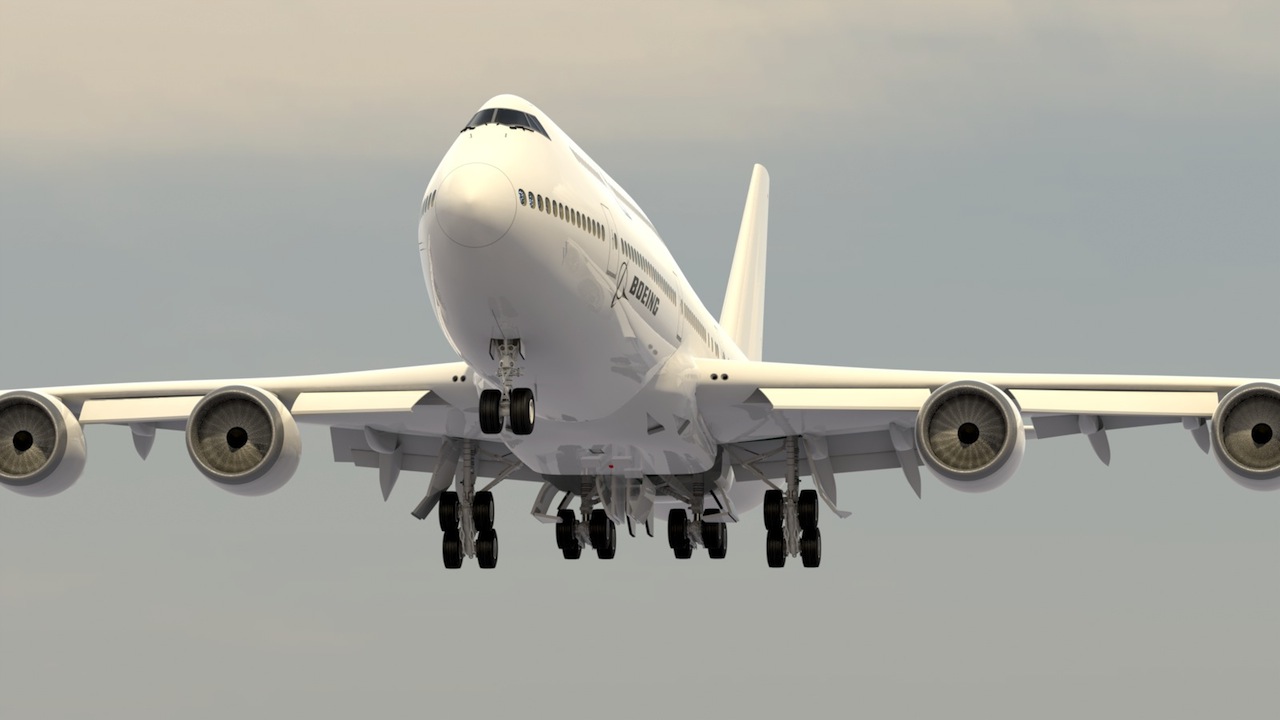
Date: 15/01/2017 06:04:26
From: Ian
ID: 1010337
Subject: re: Those magnificent men in their flying machines
Thanks for that.
Nice image of the Boeing 747-8 “Intercontinental” .
What are the main differences in the feel of flying a 747 v 707 v 737?
I notice that Boeing 747-8i is sticking with a yoke control rather than a side-stick.. makes it look like a “regular” cockpit setup to me, like a light plane. What are the pros and cons?
The extra story on the front of the 747 (to allow for front loading cargo) gives it a much more stylish profile than the Airbus cylinders. Does it create much extra drag?
Date: 16/01/2017 08:04:03
From: mollwollfumble
ID: 1010813
Subject: re: Those magnificent men in their flying machines
Spiny Norman said:
mollwollfumble said:
As for “aerodynamics require it”, aerodynamics doesn’t require thick pillars that obscure the view. But otherwise I suppose you’re right.
Quite true, but the requirements for having a thick windscreen that can deflect a bird of however many kg’s is specified at 250 kts, and the structure to contain that/those windscreens does.
I used to fire a “chicken gun” as part of my work for CSIRO. At the windows of high speed trains. The windows had to be pre-cooled for the trains much as would have been needed for aircraft. It was very interesting how what was supposed to be a trivial change in window design (an extra window tinting layer) had an enormous effect on performance.
Date: 16/01/2017 10:00:43
From: Spiny Norman
ID: 1010870
Subject: re: Those magnificent men in their flying machines
Ian said:
Thanks for that.
Nice image of the Boeing 747-8 “Intercontinental” .
What are the main differences in the feel of flying a 747 v 707 v 737?
I notice that Boeing 747-8i is sticking with a yoke control rather than a side-stick.. makes it look like a “regular” cockpit setup to me, like a light plane. What are the pros and cons?
The extra story on the front of the 747 (to allow for front loading cargo) gives it a much more stylish profile than the Airbus cylinders. Does it create much extra drag?
They all feel a little different, but you largely fly on autopilot and to a set of numbers. That being said, the smaller the aeroplane the more it feels ….. little. I much prefer a conventional control column as it makes the plane easier to control in turbulence. The downside is that it gets in the way of your legs and makes it harder to eat a meal on a tray.
Not sure about the big bump on the 747, not a lot of extra drag I think. It was originally added to get everything up well above the main deck, so when loading from the front very long loads could be rolled onto the main deck without having to go through the relatively small rear freight door.
Date: 17/01/2017 15:50:29
From: mollwollfumble
ID: 1011361
Subject: re: Those magnificent men in their flying machines
Spiny Norman said:
They all feel a little different, but you largely fly on autopilot and to a set of numbers. That being said, the smaller the aeroplane the more it feels ….. little. I much prefer a conventional control column as it makes the plane easier to control in turbulence. The downside is that it gets in the way of your legs and makes it harder to eat a meal on a tray.
Not sure about the big bump on the 747, not a lot of extra drag I think. It was originally added to get everything up well above the main deck, so when loading from the front very long loads could be rolled onto the main deck without having to go through the relatively small rear freight door.
The feel of size would depend partly on frequency of vibration. The larger the aircraft, the lower the flexural and vibration frequency.
I would love to know why a conventional control column makes it easier to control in turbulence. Many other forms of transport – trains, large ships and large earthmoving equipment – use joysticks for control. But they don’t have to cope with much turbulence.
I agree with the bump on the 747. It doesn’t help drag, but drag is not the main consideration here.
Date: 1/02/2017 02:35:58
From: mollwollfumble
ID: 1018670
Subject: re: Those magnificent men in their flying machines
Troubling air crash on “air crash investigators” last night.
On March 23, 2009, a McDonnell Douglas MD-11 operated by FedEx crashed on landing at Narita Airport in Japan.
I’m having trouble sorting out the various factors. One thing is clear, and that is that my previous suggestion of a backward facing external camera looking at the landing gear could have prevented the crash. A camera facing forwards and slightly down could perhaps also have prevented the crash.
But there are more factors at play here.
Everything looked fine, the aircraft was straight and level, until 20 ft above the ground, but already three things had gone wrong.
One was that the pilots were heavily fatigued after a gruelling week, and it was a night flight. One pilot had got a maximum of 4 1/2 hours sleep in the previous 24 hours. The other had got less, less than 3 1/2 hours in three short one-hour bursts.
A second was that the MD-11 has a small tail so needs to be landed fast, but the auto-throttle had cut power to the engines at 50 ft when it was still needed. So the plane was dropping too fast.
A third was that the pilots were 0.7 seconds late in flaring the aircraft. In the flare, the nose of the plane is raised, slowing the descent rate. They should have flared the aircraft at 30 ft, instead they flared it at 20 ft.
One of the factors involved in flaring the aircraft is that with this aircraft, putting the nose up means that you can’t see any of the runway or the horizon any more, it makes you temporarily fly blind.
As a result, the plane was dropping too fast, and bounced. If the plane bounces, you keep the nose up and reduce power. If the plane doesn’t bounce, you bring the nose down and increase power. Because the pilots were fatigued and flying blind, they didn’t necessarily know that the plane had bounced, and followed the wrong strategy.
The plane bounced three times in total, and the third was fatal. The combination of bounce asymmetry and strong headwind flipped the plane.
In a sense the landing was opposite to a normal landing. In a normal landing the power is cut at 50 ft and increased after touchdown to bring the nose down. In this landing the opposite was required, power at 50 ft because of the strong headwind and cut after touchdown because of the bounce.
So, in addition to crew fatigue, there were three mechanical factors:
1. The auto-throttle setting was inappropriate to the point of being deadly.
2. The small tail meant a fast touchdown was needed.
3. The poor visibility meant that at touchdown the pilots were flying blind.
And four, if a time difference of 0.7 seconds in pilot reaction time is all that is needed to change a safe situation into a potentially deadly one, then the aircraft is unsafe.