Mrs m wants to know.
She rescued four ants swimming in a ice cream container full of water this morning. All four ants were alive.
Sometimes ants drown.
So how long can ants survive swimming in water?
Mrs m wants to know.
She rescued four ants swimming in a ice cream container full of water this morning. All four ants were alive.
Sometimes ants drown.
So how long can ants survive swimming in water?
mollwollfumble said:
Mrs m wants to know.She rescued four ants swimming in a ice cream container full of water this morning. All four ants were alive.
Sometimes ants drown.
So how long can ants survive swimming in water?
Not very long without help. Lots of ants can float like an island by helping each other but on their own they eventually drown.
Not sure how long they can swim for, but some species of ant can survive under water for days. They close off their spiracles and put themselves into a torpor-like state in which they consume oxygen at 1/20th the rate they normally do.
“A 2011 paper by David Hu and colleagues at Georgia Tech found that when you drop a clump of fire ants on a surface of water, they will cling to each other and distribute themselves into a pancake-shaped disc.
“The ants can do this because their bodies partially repel water, or, in scientific terms, they are “hydrophobic.” When water comes in contact with a fire ant, it beads up into droplets, the same way it does on a car window treated with Rain-X.
“An advantage of being hydrophobic is the ability of ants and semiaquatic insects to trap a plastron layer of air around their bodies, without which they would sink,” Hu and his colleagues write. In other words if you try to sink an ant, its hydrophobic body will trap an air bubble with it as it submerges.”
Ants can use the air trapped against their body to survive whilst in the torpor-like state.
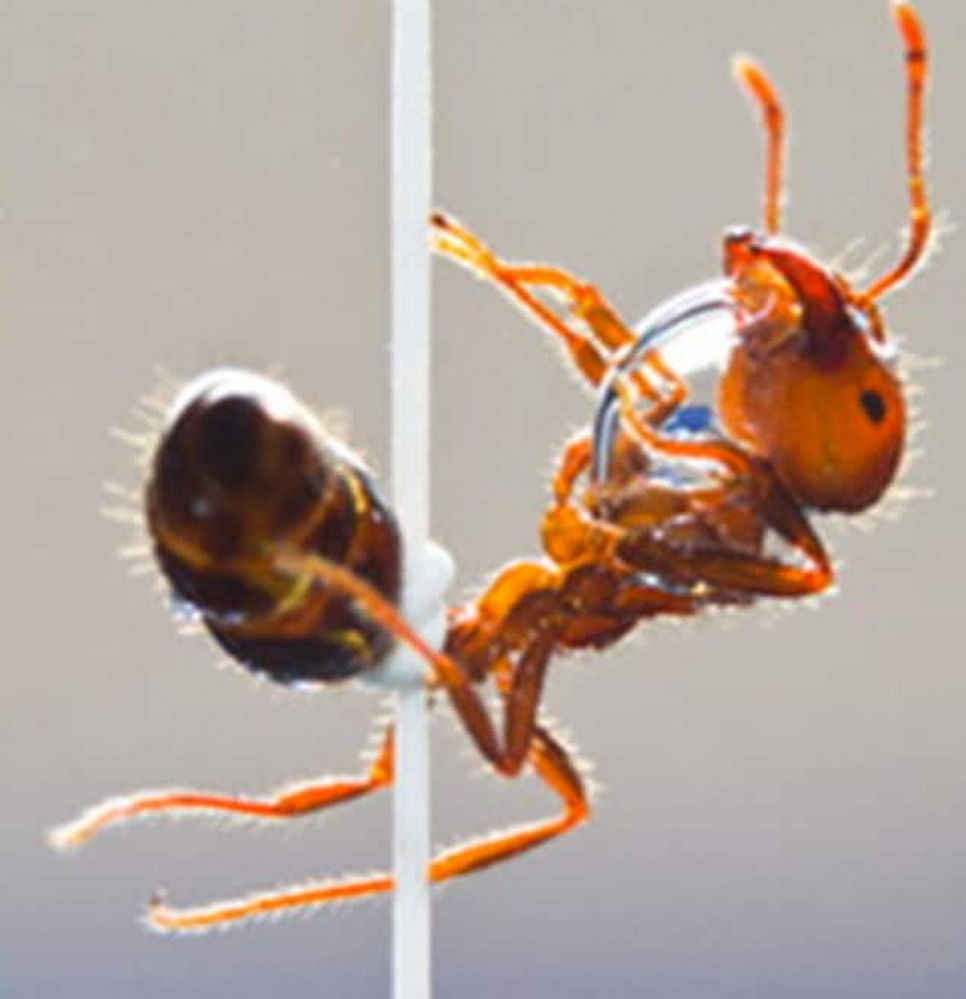
Here is a picture of a fire ant, held under water by a thread, with invisible SCUBA gear attached to its thorax.
https://www.washingtonpost.com/news/wonk/wp/2017/08/30/the-terrifying-science-behind-floating-fire-ant-colonies-and-how-to-destroy-them/?utm_term=.255dbce41692
esselte said:
Not sure how long they can swim for, but some species of ant can survive under water for days. They close off their spiracles and put themselves into a torpor-like state in which they consume oxygen at 1/20th the rate they normally do.“A 2011 paper by David Hu and colleagues at Georgia Tech found that when you drop a clump of fire ants on a surface of water, they will cling to each other and distribute themselves into a pancake-shaped disc.
“The ants can do this because their bodies partially repel water, or, in scientific terms, they are “hydrophobic.” When water comes in contact with a fire ant, it beads up into droplets, the same way it does on a car window treated with Rain-X.
“An advantage of being hydrophobic is the ability of ants and semiaquatic insects to trap a plastron layer of air around their bodies, without which they would sink,” Hu and his colleagues write. In other words if you try to sink an ant, its hydrophobic body will trap an air bubble with it as it submerges.”
Ants can use the air trapped against their body to survive whilst in the torpor-like state.
Here is a picture of a fire ant, held under water by a thread, with invisible SCUBA gear attached to its thorax.
https://www.washingtonpost.com/news/wonk/wp/2017/08/30/the-terrifying-science-behind-floating-fire-ant-colonies-and-how-to-destroy-them/?utm_term=.255dbce41692
The same thing happens to some beetles too. There are a number of Darkling Beetles here and sometimes one will fall into one of the small low water dishes, all I do is fish them out and place them upright on the ground where they all seem to recover. Just the other day one had been in the water for at lest 10 hours and I thought it was beyond recovery, but it did if a little slowly. Interestingly as it was recovering 3 other Darkling Beetles come over and made contact with it, so they may be social too.
Drowning ant = girl ant
Floating ant = buoyant…
Thanks esselte and permeatefree